


WitnessAI is an AI security platform that provides unified visibility, intent-based behavioral controls, and runtime defense for enterprise AI usage across employees, models, applications, and agents.
Unlike pattern-matching AI security tools that scan for known malicious strings, WitnessAI analyzes the meaning and purpose behind each prompt to catch sophisticated multi-turn attacks and contextual jailbreaks.
Co-founded by Rick Caccia (CEO) and incubated by Ballistic Ventures, WitnessAI is headquartered in Mountain View, California. Caccia brings over two decades of cybersecurity leadership experience from Palo Alto Networks, Google Cloud Security, and Exabeam.
In January 2026, WitnessAI announced $58 million in strategic funding led by Sound Ventures, with participation from Fin Capital, Samsung Ventures, Qualcomm Ventures, and Forgepoint Capital Partners — joining existing investors Google Ventures and Ballistic Ventures.
Alongside the raise, WitnessAI reported more than 500% ARR growth and a 5x headcount expansion over the prior year. These are figures the company disclosed in its own funding announcement, not independently audited numbers.
The company has been recognized on Fortune’s Cyber60 list, as an SC Awards Excellence Award finalist, and named in the 2025 IDC Innovators report for Security for Agentic AI.
What is WitnessAI?
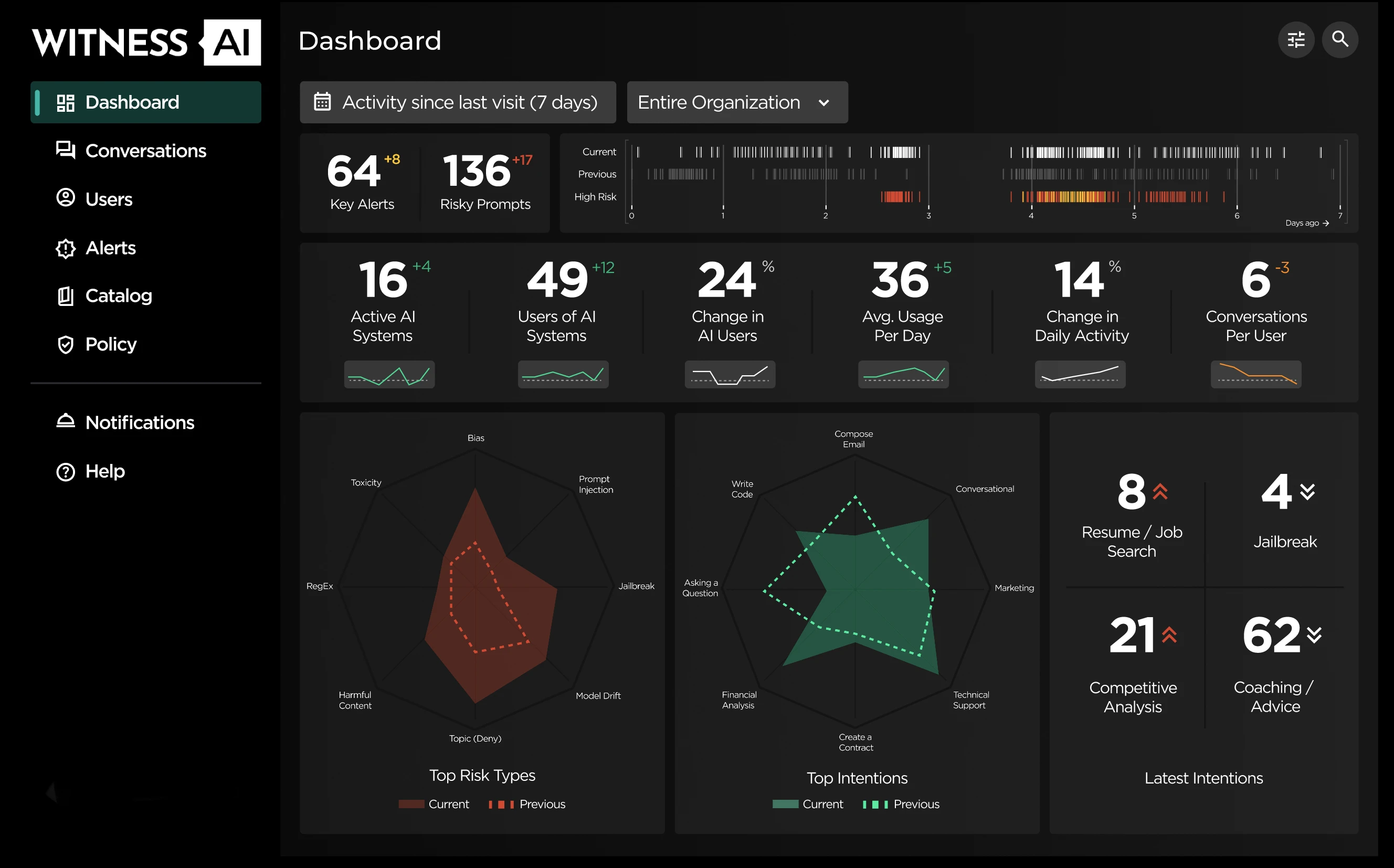
WitnessAI sits at the infrastructure layer between users and AI models. Instead of building safety features into models or relying on endpoint monitoring alone, the platform intercepts and analyzes AI interactions at the network level, applying intent-based behavioral controls in real time.
The platform is organized into three modules — Observe, Protect, and Control — that work together to give security teams full visibility into AI usage, defend against adversarial attacks, and enforce governance policies across the organization.
What distinguishes WitnessAI from pattern-matching approaches is its intent-based detection engine. Rather than flagging keywords or matching predefined patterns, the system analyzes the meaning and purpose behind each prompt, catching sophisticated multi-turn attacks and advanced prompt injection that rule-based filters miss.
| Capability | Details |
|---|---|
| Observe | Discovers and catalogs all AI applications, agents, and MCP servers across the organization. Provides real-time visibility into AI conversations — including prompts and responses — and identifies shadow AI usage across employees and teams. |
| Protect | Delivers runtime defense against prompt injection, jailbreaks, and harmful AI responses with automated red teaming for pre-deployment vulnerability discovery. Includes a bidirectional AI Firewall that screens both inputs and outputs. |
| Control | Enforces governance policies based on department, role, intent, or workforce type. Intelligently routes prompts to appropriate models based on risk and cost, applies real-time data redaction, and generates granular audit trails for compliance. |
What are WitnessAI’s key features?
| Feature | Details |
|---|---|
| Detection Approach | Intent-based behavioral analysis of prompt meaning and purpose |
| Shadow AI Discovery | Catalogs all AI apps, agents, and MCP servers across the organization |
| Prompt Injection Defense | Blocks advanced attacks including multi-turn and jailbreak attempts |
| Automated Red Teaming | Pre-deployment vulnerability discovery for AI applications |
| Data Protection | Real-time redaction for regulatory compliance |
| Policy Engine | Role-based, department-based, and intent-based governance controls |
| Prompt Routing | Intelligent routing to appropriate models based on risk and cost |
| Agent Security | Monitors agent activity, MCP server access, and tool interactions |
| Audit Trails | Granular logging of all AI interactions for compliance |
| Recognition | Fortune Cyber60, SC Awards finalist, 2025 IDC Innovators (Agentic AI Security) |
| Deployment | Single-tenant with data sovereignty options |
Intent-based controls
Traditional AI security relies on pattern matching — scanning prompts for known malicious strings or keywords. WitnessAI takes a different approach by analyzing the behavioral intent behind each interaction. The system understands what a user or agent is trying to accomplish, not just what words they used.
This matters because sophisticated attackers craft prompts that look innocuous at the surface level but carry malicious intent when interpreted in context. Multi-turn attacks spread malicious instructions across several messages. Intent-based detection catches these by evaluating the conversation as a whole.
Agent and MCP security
As organizations deploy AI agents that interact with external tools and data sources through the Model Context Protocol (MCP), WitnessAI extends its monitoring to cover these interactions. The platform tracks which MCP servers agents connect to, what tools they invoke, and what data flows through these connections.
Intelligent prompt routing
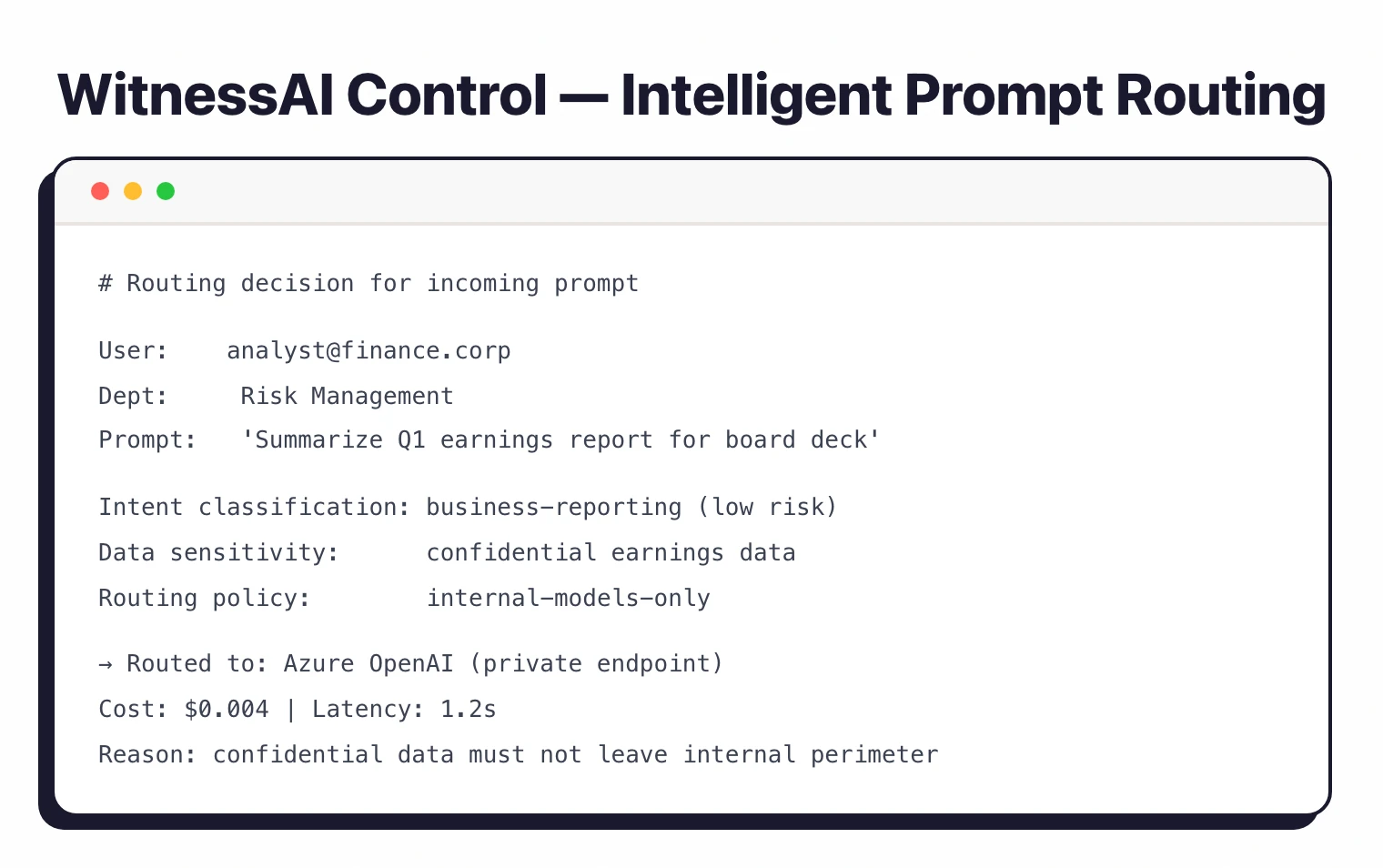
The Control module can route prompts to different AI models based on the sensitivity of the request, the user’s role, and cost considerations. A routine query might route to a cost-efficient model, while a request involving sensitive data routes to a model within the organization’s secure perimeter.
How do I get started with WitnessAI?
- Request a demo — Visit witness.ai and schedule a demonstration. WitnessAI deploys as a single-tenant platform with data sovereignty options for regulated industries.
- Deploy at the infrastructure layer — WitnessAI integrates at the network level between users and AI models. The deployment provides visibility into all AI interactions without requiring changes to individual AI applications or models.
- Discover shadow AI — The Observe module automatically catalogs AI applications, agents, and MCP servers across the organization, giving security teams a complete inventory of AI usage.
- Configure intent-based policies — Define governance rules based on departments, roles, intent categories, and workforce types. Set redaction policies for sensitive data and configure prompt routing rules.
- Enable runtime protection — Activate the Protect module to block prompt injection, jailbreaks, and data exfiltration in real time. Use automated red teaming to test AI applications before deployment.
What are alternatives to WitnessAI?
Lakera competes on API-level runtime guardrails with the sub-50ms detection latency it advertises — a better fit when latency budget is the binding constraint. Acquired by Check Point in September 2025, Lakera now sits inside Check Point’s GenAI security portfolio.
Prompt Security overlaps on shadow AI discovery and employee GenAI monitoring via a browser extension; it was acquired by SentinelOne in 2025 and is now part of the Singularity Platform. CalypsoAI is the peer enterprise platform with strong public-sector traction and a similar policy engine.
For open-source teams, NeMo Guardrails provides programmable safety policies via the Colang DSL, and LLM Guard bundles input and output scanners. The full enterprise AI gateway cluster is mapped in the AI security tools directory.
When to use WitnessAI
Ideal for organizations that need infrastructure-level visibility and control over AI usage across the enterprise. The intent-based approach handles sophisticated attacks that bypass pattern-matching defenses — multi-turn prompt injection, contextual jailbreaks, and social engineering through AI channels.
The platform is well suited for large enterprises in regulated industries — financial services, utilities, telecommunications, and automotive — where data sovereignty requirements make cloud-only solutions impractical and where granular audit trails are a compliance necessity.
For a broader overview of AI security risks and solutions, see the AI security tools guide. For browser-level employee monitoring, consider Prompt Security (now part of SentinelOne).
For automated AI red teaming, see Mindgard or Garak . For open-source input/output guardrails, look at LLM Guard or NeMo Guardrails .