HTTP response headers can constrain how browsers load, frame, and share a site's content. Correct settings can reduce risks such as cross-site scripting (XSS), clickjacking, protocol downgrade, and cross-origin data exposure, but headers are only one part of application security.
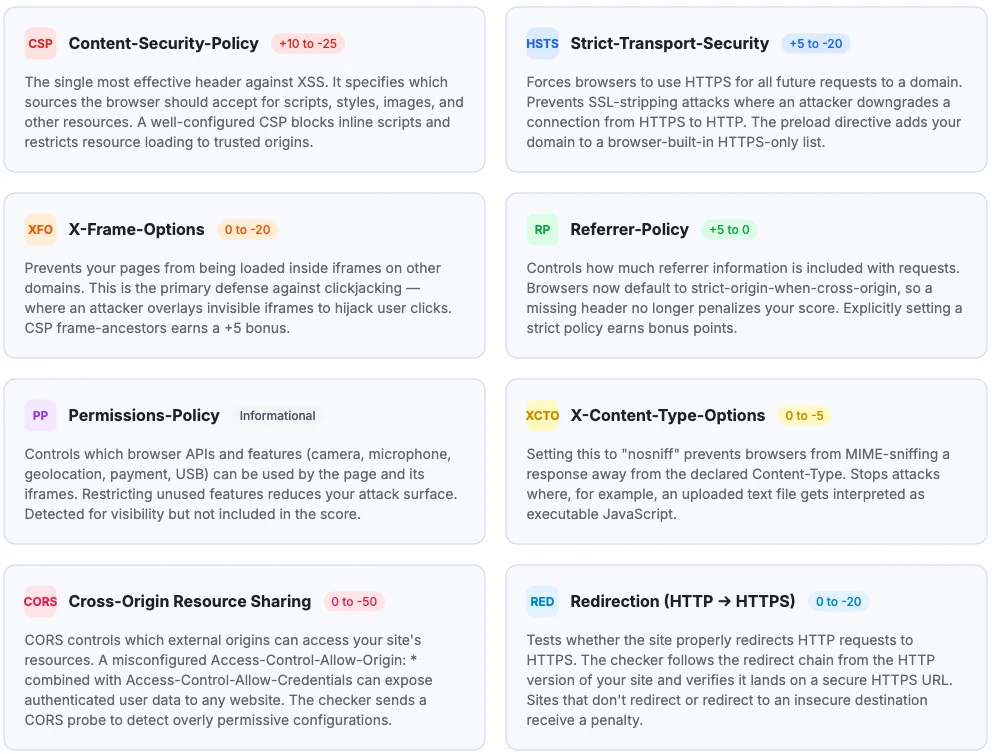
CSP
Content-Security-Policy
+10 to -25CSP specifies which sources the browser may use for scripts, styles, images, and other resources. A policy tailored to the application can restrict inline script execution and untrusted resource loading, which helps mitigate some XSS paths.
HSTS
Strict-Transport-Security
+5 to -20Forces browsers to use HTTPS for all future requests to a domain. Prevents SSL-stripping attacks where an attacker downgrades a connection from HTTPS to HTTP. The preload directive adds your domain to a browser-built-in HTTPS-only list.
XFO
X-Frame-Options
0 to -20X-Frame-Options can deny framing or limit it to the same origin, helping mitigate clickjacking. CSP frame-ancestors offers more flexible framing control and earns a +5 bonus in this checker.
RP
Referrer-Policy
+5 to 0Controls how much referrer information is included with requests. Modern browsers use strict-origin-when-cross-origin as the default when no policy is specified, so this checker treats a missing header as neutral and awards a bonus for selected explicit policies.
PP
Permissions-Policy
InformationalControls which browser APIs and features, such as camera, microphone, geolocation, payment, and USB, may be used by the page and its iframes. Restricting unused features can reduce exposure. This checker reports the header but does not score it.
XCTO
X-Content-Type-Options
0 to -5Setting this to nosniff tells browsers not to reinterpret a response away from its declared MIME type. This helps prevent certain script and style responses from being handled as an unintended content type.
CORS
Cross-Origin Resource Sharing
0 to -50CORS controls which origins may read cross-origin responses in a browser. The checker sends a probe with a test Origin and flags a response that reflects that origin while allowing credentials; it also reports wildcard access separately.
RED
Redirection (HTTP → HTTPS)
0 to -20Tests whether the site properly redirects HTTP requests to HTTPS. The checker follows the redirect chain from the HTTP version of your site and verifies it lands on a secure HTTPS URL. Sites that don't redirect or redirect to an insecure destination receive a penalty.
SRI
Subresource Integrity
+5 to -50SRI lets a browser verify a fetched script or stylesheet against a declared cryptographic hash. This checker inspects external script tags in the retrieved HTML; it does not currently assess stylesheet integrity.
CORP
Cross-Origin-Resource-Policy
0 to -5CORP tells browsers whether a resource may be loaded with cross-origin no-cors requests. same-origin and same-site restrict that loading boundary; cross-origin permits it.
info
Cross-Origin Isolation (COOP & COEP)
InformationalCOOP (Cross-Origin-Opener-Policy) isolates your window from cross-origin popups. COEP (Cross-Origin-Embedder-Policy) ensures all embedded resources are explicitly shared. Together they enable cross-origin isolation for advanced APIs like SharedArrayBuffer. These are analyzed for visibility but not included in the score.
Scoring Methodology
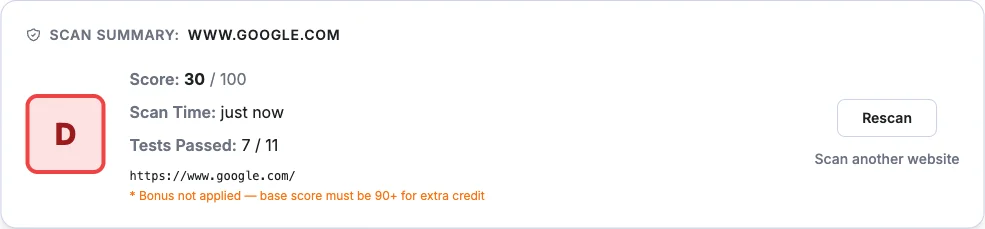
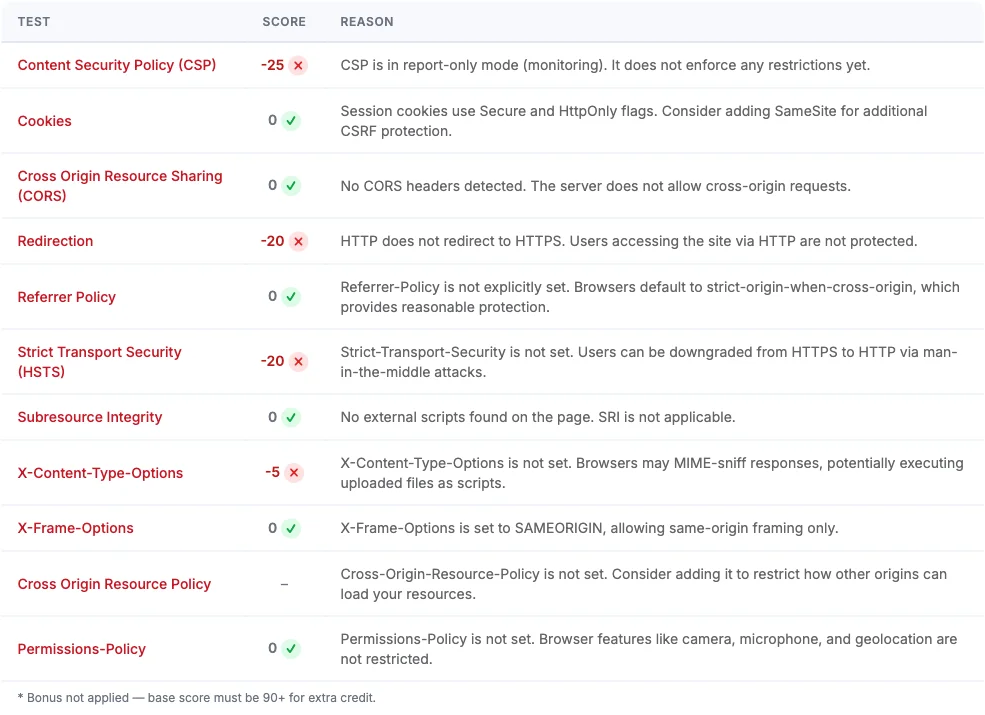
This is an AppSec Santa heuristic, not an MDN HTTP Observatory result or a security certification. It starts at 100, applies penalties from 11 checks, and adds bonuses only when the score after penalties is at least 90. The two-round structure and grade bands are adapted from the HTTP Observatory methodology; the checks and modifiers are not identical.
| Score | Grade | Interpretation |
|---|
| 100+ | A+ | Highest band in this model |
| 90–99 | A | A band in this model |
| 85–89 | A- | A-minus band |
| 80–84 | B+ | B-plus band |
| 70–79 | B | B band |
| 65–69 | B- | B-minus band |
| 60–64 | C+ | C-plus band |
| 50–59 | C | C band |
| 45–49 | C- | C-minus band |
| 40–44 | D+ | D-plus band |
| 30–39 | D | D band |
| 25–29 | D- | D-minus band |
| 0–24 | F | Lowest band in this model |