

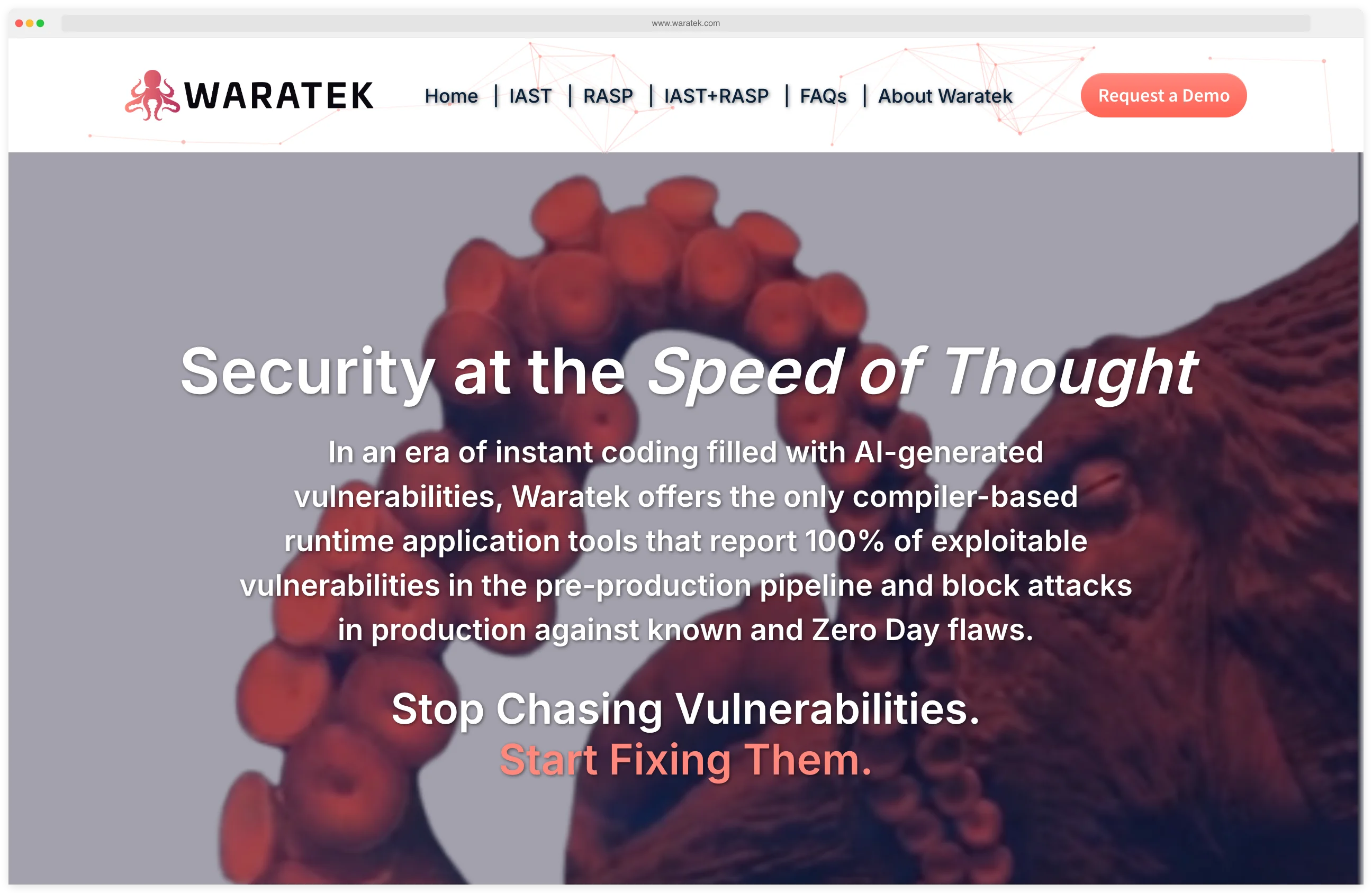
Waratek is a Java-focused RASP solution that embeds security directly into the JVM. Winner of the RSA Innovation Sandbox Award, it protects Java applications from OWASP Top 10 vulnerabilities, zero-day exploits, and known CVEs without code changes or restarts.
The platform ships as two products: Waratek Secure (automated vulnerability remediation) and Waratek Elevate (legacy app modernization with compliance). Both operate at the JVM bytecode level using a patented data tainting engine that tracks untrusted data as it flows through the application.
Waratek claims 2% performance overhead, 150ms time-to-remediate, and protection across 80,000+ applications in production. The company targets financial services, healthcare, and government organizations running business-critical Java workloads.
| Feature | Details |
|---|---|
| Language | Java (JVM-based) |
| Architecture | JVM bytecode instrumentation |
| Products | Waratek Secure, Waratek Elevate |
| Detection | Patented data tainting engine |
| Performance overhead | 2% (vendor-stated) |
| Virtual patching | CVE remediation without code changes or restarts |
| API security | RESTful API endpoint discovery |
| Frameworks | Spring, Struts, Tomcat, and other Java frameworks |
| Compliance | PCI DSS, GDPR, SOC 2, HIPAA |
| Management | Waratek Portal (SaaS or on-premises) |
What is Waratek?
Waratek instruments the JVM at the bytecode level. When untrusted data enters the application from the network, the data tainting engine tracks it through every method call, variable assignment, and framework transformation.
If that data reaches a dangerous operation — a SQL query, a deserialization call, a file system access — Waratek knows whether it has been properly sanitized.
This approach differs from pattern-matching RASP tools that look at request signatures. Waratek sees how data actually flows through code, which eliminates the false positives that come from matching attack patterns in legitimate traffic.
Virtual patching applies security fixes at the JVM bytecode level. When a CVE affects a third-party library, Waratek can neutralize the vulnerability without modifying source code, rebuilding the application, or restarting the process.
This is particularly valuable for legacy Java applications that cannot be easily patched or redeployed.
| Capability | Details |
|---|---|
| Data Tainting Engine | Tracks untrusted data from network entry through every code path. When tainted data reaches a dangerous operation without sanitization, Waratek blocks the request. Eliminates false positives from pattern matching. |
| Virtual Patching | Applies security fixes at the JVM bytecode level. Remediate CVEs in third-party libraries without code changes, rebuilds, or restarts. Patches take effect immediately when the affected code is loaded. |
What are Waratek’s key features?
Virtual Patching
Apply security fixes without modifying code or restarting applications:
- CVE Remediation — patch known vulnerabilities in application code and third-party libraries
- Zero-Day Protection — block exploit patterns before vendor patches exist
- Framework Coverage — protect Struts, Spring, Tomcat, and other Java frameworks
Attack Prevention
Block attacks at the runtime level:
- SQL Injection — context-aware detection through data tainting
- Cross-Site Scripting (XSS) — block malicious script injection
- Deserialization Attacks — prevent gadget chain exploits
- Remote Code Execution — block unauthorized command execution
- Path Traversal — stop directory traversal attempts
API Security
Discover and protect RESTful API endpoints automatically. The agent identifies exposed endpoints and delivers inventory to the Waratek Portal for hardening.
Compliance Automation
Built-in controls for PCI DSS, GDPR, SOC 2, and HIPAA requirements. Security monitoring and logging configured through the Waratek Portal.
How do I get started with Waratek?
- Set up the Waratek Portal — Choose between the SaaS portal (hosted by Waratek) or Portal Dedicated (on-premises). Configure your organization and application inventory.
- Deploy the Java Agent — Add the Waratek agent as a JVM argument to your Java application startup. The agent instruments the runtime without code changes.
- Configure security rules — Define protection rules using Waratek’s ARMR (Application Runtime Model & Rules) engine. Rules specify which vulnerabilities to block and which code paths to protect.
- Monitor and tune — Review attack detections, virtual patch status, and API inventory in the Waratek Portal. The data tainting engine produces very few false positives, but review findings before switching from monitoring to blocking mode.
Enterprises with legacy Java applications that cannot be easily patched or modernized. If you need to remediate CVEs in production without touching source code, Waratek’s virtual patching delivers that capability.
For multi-language RASP, look at Contrast Protect or Datadog ASM instead.
When to Use Waratek
Waratek fits enterprises running business-critical Java applications that need protection without code changes. The data tainting approach and virtual patching are strongest when you have legacy applications with vulnerable dependencies that cannot be easily updated.
The platform is Java-only. If you need RASP for Node.js, Python, Go, or other languages, look elsewhere — evaluate Contrast Protect / ADR (six-language coverage) or Datadog Application Security (seven-language coverage including PHP) instead.
For Java-specific runtime protection with near-zero false positives and minimal performance overhead, Waratek is a strong option.
How Waratek’s virtual patching works
Virtual patching is the single strongest editorial moat in this category, and the workflow is worth walking through carefully because no other commercial RASP I have reviewed markets it as a first-class capability.
Traditional patching of a Java CVE — say a deserialization gadget in a third-party library — runs through this sequence: vendor publishes the CVE → application team reviews exposure → developer updates the dependency in the build → CI/CD pipeline rebuilds the application → release manager schedules a maintenance window → production restarts and the patched JAR runs. That sequence routinely takes weeks for legacy applications and is the reason CVE-to-remediation cycles in enterprise Java are stubbornly long.
Waratek’s virtual patching collapses the same sequence into a policy update at the JVM layer. The vendor publishes the CVE → the security team writes (or imports from Waratek) an ARMR policy describing which method calls or data paths to block → the JVM agent applies the policy at the bytecode-instrumentation layer with no code change, no rebuild, and no restart. Waratek claims a 150ms time-to-remediate from policy push to active enforcement on the running JVM. Verify the specific number against current Waratek docs before quoting it externally; the order-of-magnitude advantage over traditional patching is the durable claim.
This works because Waratek instruments at the bytecode level rather than the source level. The patch is a runtime contract, not a code change, so the same policy file can apply across Spring, Struts, Tomcat, JBoss, WebLogic, and any other Java framework loaded into the JVM.
Waratek vs alternatives
Five realistic alternatives, ordered by how cleanly they overlap with Waratek’s positioning:
- Contrast Protect / ADR — broader language coverage (six languages including .NET, Node.js, Python, Ruby, Go), also data-flow tracing rather than pattern matching. The right pick for Java teams that may also need non-Java coverage in the same procurement; weaker on virtual patching as a first-class concept.
- Datadog Application Security — APM-coupled deployment via a single agent flag if you already pay for Datadog APM. Seven-language coverage including PHP. Less specialized on Java-specific compliance use cases than Waratek.
- Dynatrace — single-agent runtime protection bundled with the Dynatrace observability platform. Strong fit if Dynatrace is already your APM, but secondary to Datadog and Contrast on the standalone-RASP procurement.
- Imperva RASP — Java/.NET. Note: Imperva has communicated an end-of-sale path through 2025; do not start a procurement here in 2026 even though it overlaps with Waratek on Java.
- OpenRASP — open-source Java RASP from Baidu. Project inactive since January 2022; only viable if you have an in-house team to fork-and-maintain.
For a deeper RASP-vs-WAF distinction relevant to Waratek’s positioning, see RASP vs WAF . For the broader field, see the RASP tools directory .
How I evaluated Waratek
I reviewed the Waratek product site and docs , the public Waratek blog and About page including the executive bios, the Crunchbase and PitchBook profiles for company-status verification, the historical RSA Innovation Sandbox archive (Waratek won in 2015), Gartner Peer Insights and G2 review snippets for the Java-RASP category, and the Rimini Street partner page for the legacy-Java-modernization story behind Waratek Elevate. Pricing is sales-gated and not published publicly — Waratek scopes per JVM count and product (Secure vs Elevate), so this review does not include per-JVM pricing. Three vendor claims (150ms time-to-remediate, 2% performance overhead, 80,000+ applications protected) come from Waratek’s own materials and should be treated as vendor-stated until independently verified at the time of procurement.