


w3af is a Python-based web application security scanning framework. It identifies vulnerabilities through automated crawling, plugin-based testing, and an exploit framework for post-detection verification.
I read w3af’s limited maintenance as the core risk for teams evaluating it in 2026.
Holm Security sponsors w3af and uses it as part of their vulnerability assessment platform.
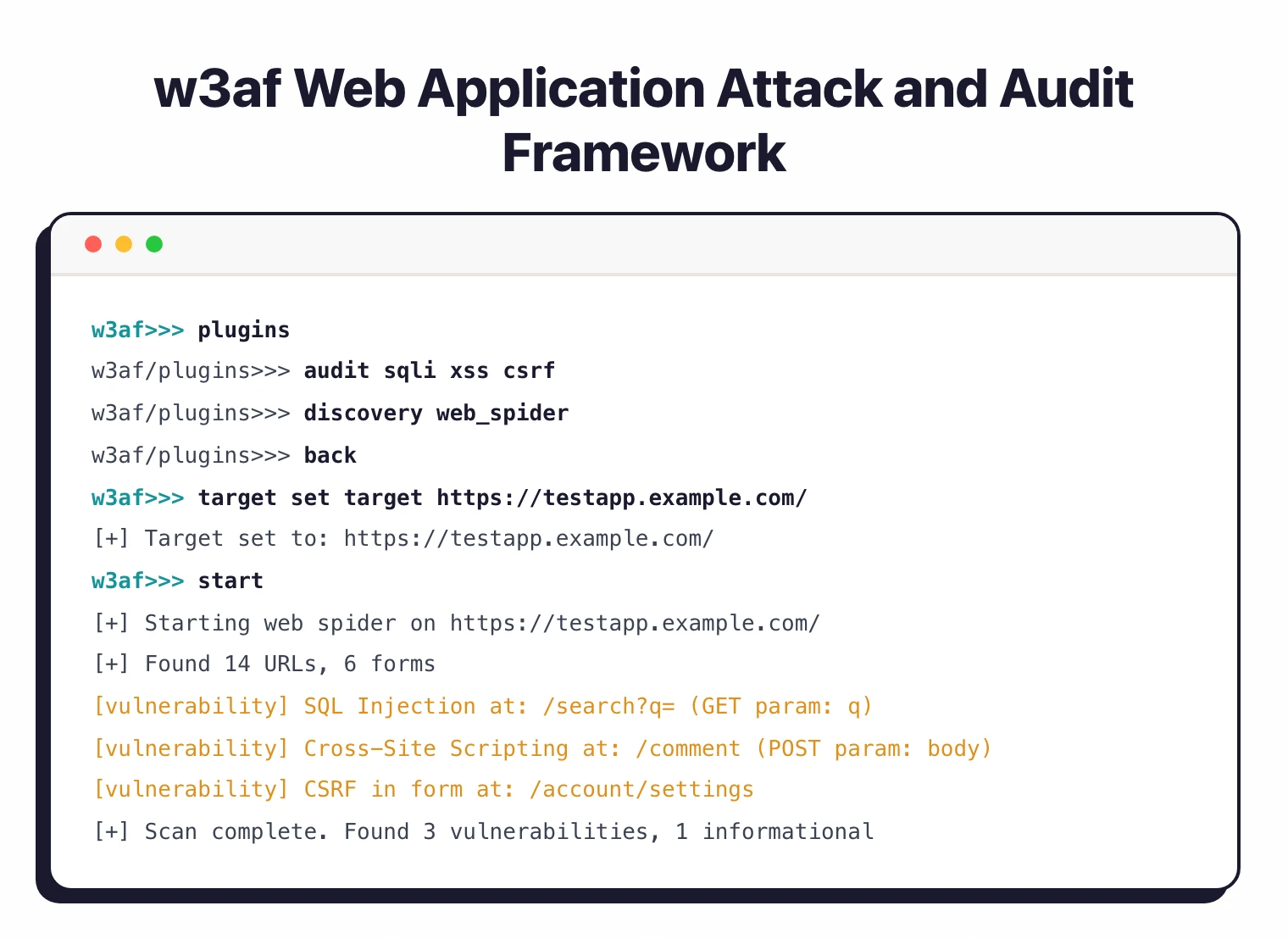
What w3af does
w3af crawls web applications, identifies attack surfaces like forms and parameters, and tests them with 200+ vulnerability detection plugins. The framework includes an exploit module for verifying findings and a GUI for manual testing alongside automated scans.
Written in Python, it runs on Linux, macOS, and Windows. The architecture separates crawling, auditing, and exploitation into distinct phases.
| Capability | Details |
|---|---|
| Plugin Architecture | Over 200 plugins detect XSS, SQL injection, CSRF, LFI/RFI, command injection, and other OWASP Top 10 vulnerabilities. Plugins organized by phase: discovery, audit, attack. |
| Authenticated Scanning | Supports session management for testing applications behind authentication. Handles form-based login, HTTP auth, and custom session tokens. |
| Exploit Framework | Verifies vulnerabilities by executing exploits. Confirms SQL injection with data extraction, validates RCE with command execution. Reduces false positives. |
Key features
| Feature | Details |
|---|---|
| Vulnerability detection | XSS, SQLi, CSRF, LFI/RFI, command injection, XXE, SSRF, path traversal |
| Crawling | Follows links, parses forms, analyzes JavaScript, handles cookies |
| Output formats | Text, HTML, XML, CSV |
| Interfaces | GUI (GTK), CLI, REST API |
| Extensibility | Python-based plugin system for custom checks |
| Authentication | Form login, HTTP auth, cookie-based sessions |
| Proxy support | Routes traffic through Burp, ZAP, or other proxies |
Using w3af
Install w3af from source or Docker image. The GUI provides point-and-click scanning for manual testing. The CLI suits automation and CI/CD integration.
# Clone repository
git clone https://github.com/andresriancho/w3af.git
cd w3af

# Install dependencies
./w3af_console

# Start GUI
./w3af_gui

# Run CLI scan
./w3af_console -s scripts/scan_example.w3af
Example scan script:
plugins
discovery web_spider
audit xss, sqli, csrf
output console, html_file
target
set target http://example.com/
back
start
REST API
The w3af REST API enables programmatic scan control and result retrieval. Launch the API server and submit scan requests via HTTP.
# Start API server
./w3af_api

# Submit scan via curl (profile content is w3af scan script format)
curl -X POST http://localhost:5000/scans \
  -H "Content-Type: application/json" \
  -d '{"scan_profile": "<w3af_profile_content>", "target_urls": ["http://example.com/"]}'

# Check scan status
curl http://localhost:5000/scans/0/status
Current status
The maintainer’s last commit lands February 9, 2020 on github.com/andresriancho/w3af. The repository still accepts community pull requests — new ones land as recently as October 2025 — but they are not being merged. No new release tags have shipped in years.
Dependency updates lag behind Python ecosystem changes. According to the NIST National Vulnerability Database, new web application CVEs are published daily, and scanners that fall behind on updates risk missing detection of recent vulnerability classes.
Holm Security’s sponsorship keeps the project alive but does not drive active feature development. Most recent commits focus on bug fixes rather than new capabilities.
Should you still use w3af in 2026?
Honest answer: not for production scanning, but the tool is not useless either.
w3af still works as a learning environment. The plugin architecture, the discovery / audit / attack phase model, and the exploit framework are clean teaching tools for understanding how a DAST scanner is structured. CTF players and security students get value from the codebase as a Python reference.
The scanner also still hits classic OWASP Top 10 categories — SQLi, XSS, CSRF, LFI/RFI, command injection — well enough on toy targets like DVWA, Juice Shop, or WebGoat. If your goal is to practice triaging findings rather than scan a real production site, w3af suffices.
Where w3af falls down is anything modern. Dependency drift around Python 2 versus Python 3 broke the install path for most users. JavaScript-heavy SPAs (React, Angular, Vue) crawl poorly because the engine never adopted a real browser. New auth flows, WebSocket apps, OAuth-protected APIs, and GraphQL endpoints largely fail.
For real applications in production, switch to OWASP ZAP or a paid scanner. For a learning environment or a hobby project, w3af is fine. Treat the tool as a museum piece that still runs — useful for context, not for protecting users.
Alternatives to w3af
For actively developed DAST tools, OWASP ZAP provides comprehensive web application scanning with GUI, API, and CI/CD integrations. ZAP supports modern web frameworks, JavaScript rendering, and automated authentication. Migration friction: ZAP’s automation framework YAML is the closest analog to w3af scan scripts — moving a scan profile takes an afternoon.
Nuclei offers template-based vulnerability detection with 7000+ community templates. It runs faster than traditional crawlers for targeted checks. Migration friction: Nuclei is template-driven, not crawler-driven, so you need a target list rather than a w3af-style spider.
Wapiti is the closest Python-3 free alternative for teams that liked w3af’s CLI workflow. It runs from the terminal, supports authenticated scanning, and stays actively maintained — drop-in mental model for w3af users.
Nikto focuses on web server and CGI scanning. It detects outdated software, dangerous files, and server misconfigurations.
For commercial web application testing, Burp Suite Professional combines manual and automated testing. Invicti provides automated scanning with proof-based verification to eliminate false positives. Migration friction: paid tools cost money, but the CI workflow rewires faster than fighting w3af’s stale dependencies.
For a curated list of free, actively maintained alternatives, see the free DAST tools guide.
Browse other DAST tools for web application security scanning options, or see the free DAST tools guide for actively maintained open-source alternatives.