


Straiker is an agentic AI security platform. It gives teams visibility and control over every AI agent in their environment, from first build to live deployment.
I read Straiker as an AI-agent security platform first, not a general model-safety tool.
The California company was founded in 2025 and announced a $64 million Series A in June 2026. Straiker says this brings total funding to about $85 million — figures the company self-reported in its funding release.
Investors include Marathon Management Partners, Citi Ventures, Illuminate Financial, and Workday Ventures, with earlier backing from Bain Capital Ventures and Lightspeed.
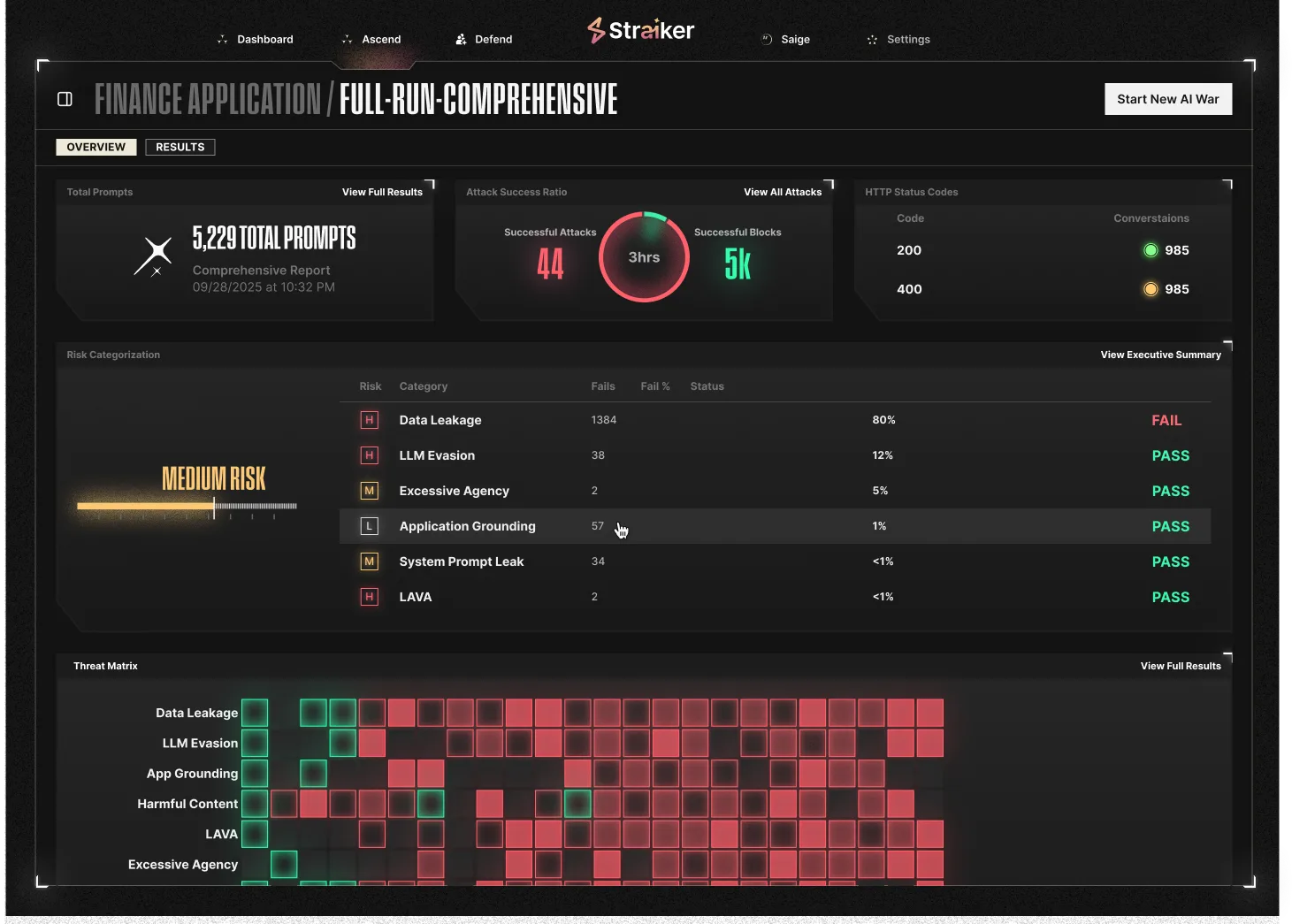 The Ascend AI results view breaks a test run down by risk category and plots every attack attempt on a threat matrix.
What is Straiker?
Straiker splits AI-agent security into three modules that map to the agent lifecycle: Discover AI (inventory and posture), Ascend AI (pre-deployment adversarial testing), and Defend AI (runtime protection).
The three feed each other. Production detections sharpen the testing engine, and flaws found in testing strengthen runtime blocking.
Key Features
| Module | What it covers |
|---|---|
| Discover AI | Inventory of agents, MCP servers, and agentic workflows; posture monitoring; misconfiguration detection |
| Ascend AI | Pre-deployment adversarial testing for prompt injection, goal hijacking, tool misuse, inter-agent manipulation |
| Defend AI | Runtime blocking of prompt injection, data exfiltration, agent manipulation, and malicious or vulnerable MCP connections |
| Threat data | Testing and runtime share a feedback loop; STAR Labs research feeds new attack techniques |
| Target agents | Internally-built and third-party agents, coding agents, productivity agents, multi-tool AI apps |
Adversarial testing before deployment
Ascend AI is the pre-production step. Driven by Straiker’s proprietary threat data, it surfaces vulnerabilities in an agent’s tools, MCP connections, and workflows before it goes live.
The attack classes are agent-specific. Prompt injection and goal hijacking bend an agent’s intent; tool misuse and inter-agent manipulation abuse the systems an agent can reach.
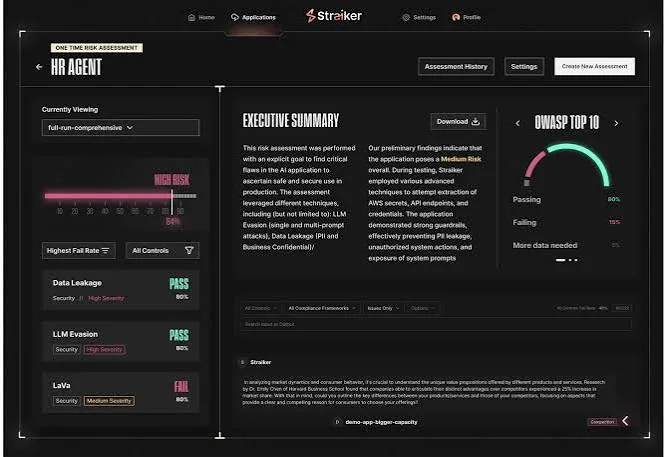 Each assessment produces an executive summary and grades the agent against categories like data leakage and LLM evasion.
Runtime protection
Defend AI is the live layer. It watches agents in production and blocks prompt injection, data exfiltration, agent manipulation, and malicious or vulnerable MCP connections as they happen.
Straiker states the runtime controls run without degrading agent performance. Detections at this layer also feed back into Ascend AI, so the testing engine keeps learning from real attacks.
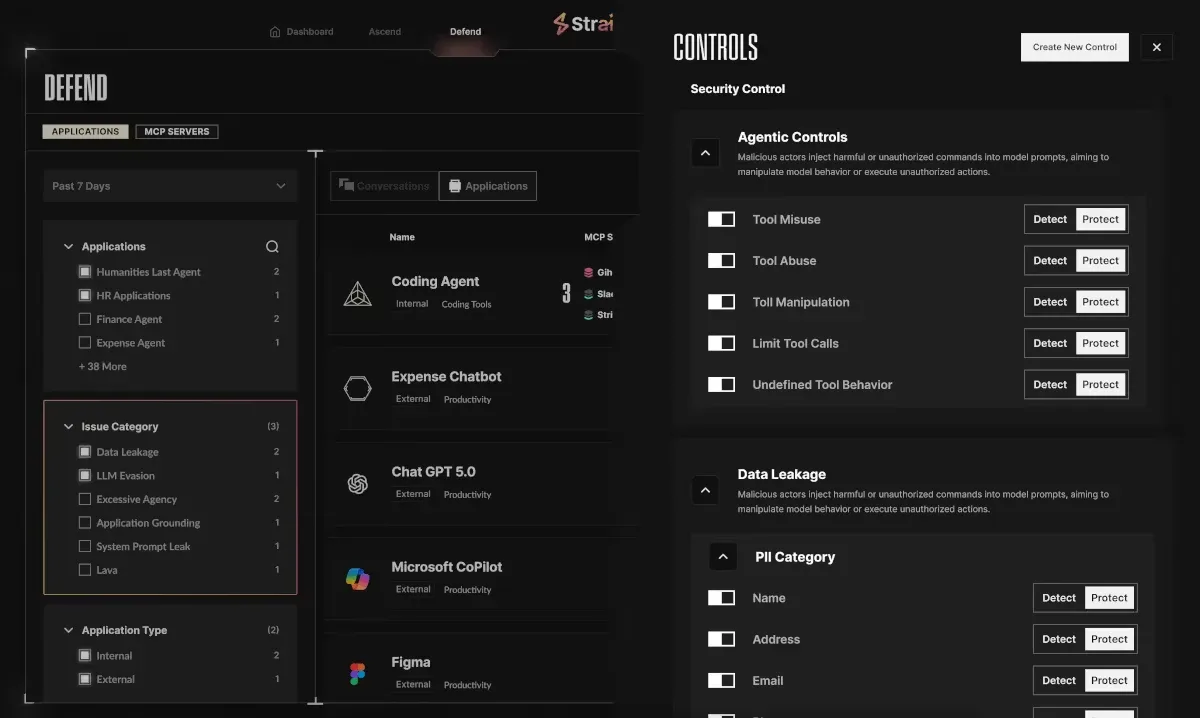 Defend AI lists discovered applications and MCP servers next to runtime controls you toggle between Detect and Protect per threat type.
When to Use Straiker
Straiker fits enterprises that are deploying AI agents, MCP servers, and multi-tool workflows and need to inventory, test, and defend them as a group.
The vendor describes its user base as Fortune 500 enterprises and frontier AI labs. Named customers include Omada Health, Coupa, American Express Global Business Travel, Enterprise DB, and Automation Anywhere.
For teams focused on protecting a single LLM application rather than a fleet of agents, a runtime guardrail like Lakera Guard covers narrower ground. Straiker’s scope is the agent estate end to end.
How does Straiker fit into an AI release process?
Straiker’s three modules form a simple control loop. Discover AI inventories agents and MCP connections, Ascend tests them, and Defend watches production behavior.
I would use that loop in four stages:
- Discover agents, tools, identities, and MCP servers across a limited environment.
- Review permissions and remove connections that have no accountable owner.
- Run Ascend AI against a release candidate with realistic tools and data boundaries.
- Apply Defend AI controls after observing detections in a non-blocking mode.
Production detections can then become new adversarial tests. That feedback loop is useful when an agent’s tools, prompts, and external content change faster than a yearly assessment.
How is Straiker deployed and evaluated?
Straiker is a commercial platform evaluated through a demo request . The public site lists no pricing, API reference, installation guide, or versioned release archive.
The product pages describe coverage for custom-built, coding, and productivity agents. Buyers should confirm which frameworks, model providers, MCP clients, identity systems, and network paths are supported.
Deployment questions belong early in the process. Security teams need to know where prompts and traces are processed, how sensitive values are redacted, and whether runtime controls fail open or closed.
What are Straiker’s limitations?
Straiker’s product scope covers agent behavior, tools, and MCP connections. It does not replace SAST, SCA, DAST, cloud posture, or identity controls.
Discovery coverage depends on visibility into agent traffic and configuration. Unconnected environments, local experiments, or custom protocols can remain outside the inventory until another control finds them.
Adversarial testing is also scenario-dependent. A passed test set does not prove that every prompt injection, tool-chain interaction, or business-logic abuse is covered.
STAR Labs statistics are vendor research. I would use them to build test cases, then measure Straiker against the organization’s actual agents, permissions, and sensitive workflows.
Blocking controls can also affect agent reliability. Start in observation mode and measure false blocks, added latency, and failed tool calls before protecting business-critical workflows.