

SpectralOps, branded as Spectral , is a developer-first code security scanner that finds hardcoded secrets, misconfigurations, and exposed credentials before they reach production. It scans source code, configuration files, and infrastructure-as-code rather than secrets alone.
Check Point Software acquired Spectral in February 2022. The product now ships as part of Check Point’s CloudGuard cloud and developer security portfolio, which places secret scanning next to Check Point’s broader infrastructure security stack.
That acquisition is the main thing buyers weigh: Spectral is no longer a standalone startup tool, but a component inside a large security vendor’s ecosystem.
What is SpectralOps?
SpectralOps is a code security platform that detects hardcoded secrets, API keys, tokens, and misconfigurations across a development environment. It scans source code, dotfiles, configuration files, and infrastructure-as-code, not just git commits.
The platform also monitors public-facing assets and SaaS surfaces for exposure, catching credentials that leak outside the repository itself. This broader scope is what separates it from single-purpose secret scanners.
Spectral positions itself as developer-first, meaning it runs early in the workflow — pre-commit and in CI — so issues surface before code merges. Check Point markets it under the CloudGuard brand alongside its wider cloud security offerings.
How does SpectralOps work?
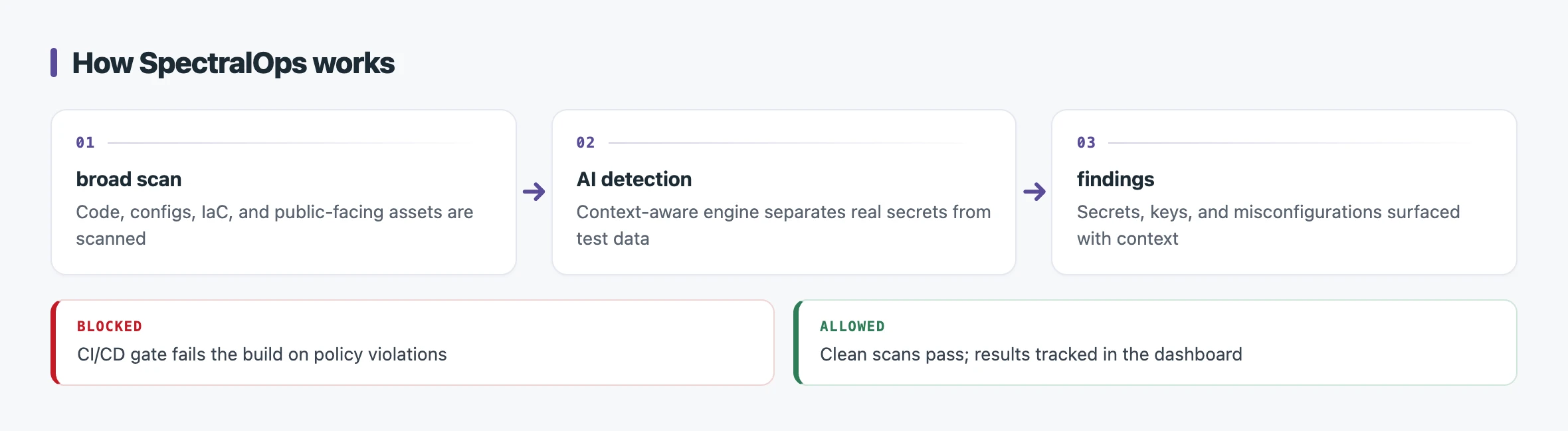
Spectral runs as a scanner that you wire into the development lifecycle through pre-commit hooks and CI/CD pipelines. It inspects code and configuration as changes move through the pipeline, so credential leaks and misconfigurations are flagged before they reach the remote repository.
The detection layer is AI-backed and context-aware rather than purely regex-driven. According to Check Point, the engine distinguishes real keys from test or example values, which is the design choice aimed at cutting false-positive noise.
Coverage extends past source code into IaC files such as Terraform, CloudFormation, and Kubernetes manifests. Spectral checks these for misconfigurations alongside the secret scan, so a single run covers both credential exposure and insecure infrastructure definitions.
Teams can extend detection with custom rules for proprietary credential formats. Beyond the codebase, Spectral monitors public-facing assets and SaaS surfaces, surfacing secrets that have leaked outside the version control system entirely.
Key features
Secret and credential detection
Spectral scans for hardcoded secrets, API keys, tokens, certificates, and passwords across code and configuration. The detection engine is AI-backed, which Check Point frames as the way it separates live credentials from test data to keep the false-positive rate down.
Infrastructure-as-code scanning
The platform checks infrastructure-as-code for misconfigurations, covering formats like Terraform, CloudFormation, and Kubernetes manifests. This brings config security into the same scan as secret detection, rather than requiring a separate IaC tool.
Configuration and asset coverage
Beyond source code, Spectral inspects dotfiles, configuration files, and public-facing assets. Monitoring SaaS and public surfaces catches credentials that leak outside the repository, which a repo-only scanner would miss.
CI/CD and pre-commit integration
Spectral plugs into CI/CD pipelines and pre-commit hooks so scanning runs early in the workflow. Catching a leaked credential at commit time prevents it from entering version control, where rotation becomes the only real fix.
Custom detection rules
Teams can define custom detectors for proprietary credential formats and internal patterns. This extends coverage beyond the built-in rule set to whatever secret shapes a specific organization uses.
When to use SpectralOps
SpectralOps fits teams that want secret scanning bundled with broader code, IaC, and configuration security rather than a single-purpose tool. The Check Point acquisition makes it most relevant to organizations already invested in, or evaluating, the CloudGuard ecosystem.
Compared with open-source scanners like Gitleaks , Spectral covers more surfaces — IaC, config files, and public asset monitoring — but is a commercial platform rather than a free CLI. The trade-off is breadth and vendor support against the simplicity and zero cost of a focused git scanner.
Against a dedicated secrets platform like GitGuardian , the comparison comes down to focus and ecosystem. GitGuardian is a specialist in secrets detection and incident workflows; Spectral folds secret scanning into Check Point’s wider cloud and infrastructure security stack.
I’d shortlist Spectral when an organization wants one vendor across cloud security and code security, and when consolidating tools under Check Point carries weight. For a narrow git-only secret-scanning need, a focused tool is usually the lighter pick.
How does SpectralOps fit into a pipeline?
Spectral’s CLI documentation
separates interactive run from pipeline-oriented scan. It also supports Git history, GitHub, GitLab, custom rules, and severity-based nonzero exits.
A practical rollout is:
- Run an interactive scan and classify existing findings before enabling a gate.
- Add
scanto CI with high or critical severity as the initial failure threshold. - Add pre-commit or pre-receive checks after developers have an ignore process.
- Route accepted findings through Jira, Slack, PagerDuty, Monday, or a webhook.
The integration guide documents those workflow destinations. Custom webhooks use HMAC-SHA256 signatures and expect an HTTP 200 response.
How is SpectralOps released and deployed?
The public changelog lists Spectral 1.10.243 as the latest release note. It adds three detectors and adjusts several false-positive cases.
The scanner is CLI-driven and connects to an account using a Spectral DSN. Issue state, teams, integrations, and centralized rules live in the service.
Centralized custom rules require scanner version 1.9.131 or later, according to the custom-rule guide . Published rules also require review and approval before becoming active.
What are SpectralOps’ limitations?
Spectral is strongest around secrets, configuration, IaC, and selected open-source checks. It does not replace source-code dataflow analysis, dynamic testing, or runtime exploit validation.
The account connection is part of the standard workflow. Teams that require a fully offline scanner should confirm whether their deployment and reporting needs can avoid service-side ingestion.
Custom detectors need governance. A broad regular expression can expose sensitive matches or create enough noise that developers bypass the gate, so rule review matters as much as rule coverage.
Finally, the public docs still carry Spectral branding inside CloudGuard documentation. Buyers should verify product ownership, support routing, roadmap, and contract boundaries with Check Point.