
SonarQube Alternatives
Top SonarQube Alternatives

Binary Analysis AppSec Platform
AI-native SAST with automatic vulnerability detection and code fix generation

Compliance-first SAST for automotive, aerospace & medical device software
Meta's Inter-Procedural Static Analyzer
- The majority of SonarQube’s built-in rules target code quality rather than security; its Community Edition lacks taint analysis for finding injection vulnerabilities.
- Semgrep scans 30+ languages in ~10 seconds with custom YAML rules writable in minutes; CodeQL offers deeper semantic analysis but takes minutes to 30+ minutes per scan.
- Aikido bundles SAST, SCA, DAST, secrets, and cloud scanning into one platform with flat per-developer pricing, the most-cited all-in-one alternative for teams leaving SonarCloud over per-line billing.
- Qodana runs JetBrains’ 3,000+ IDE inspections across 60+ languages in CI/CD, starting at $6/contributor/month with a free Community tier.
- Coverity (now under Black Duck) holds TUV SUD safety certification for automotive (ISO 26262) and industrial (IEC 61508) use, and is the default SAST in safety-critical industries.
Why Look for SonarQube Alternatives?#
SonarQube is one of the most widely deployed code analysis platforms, with over 10,200 GitHub stars and installations across thousands of organizations.
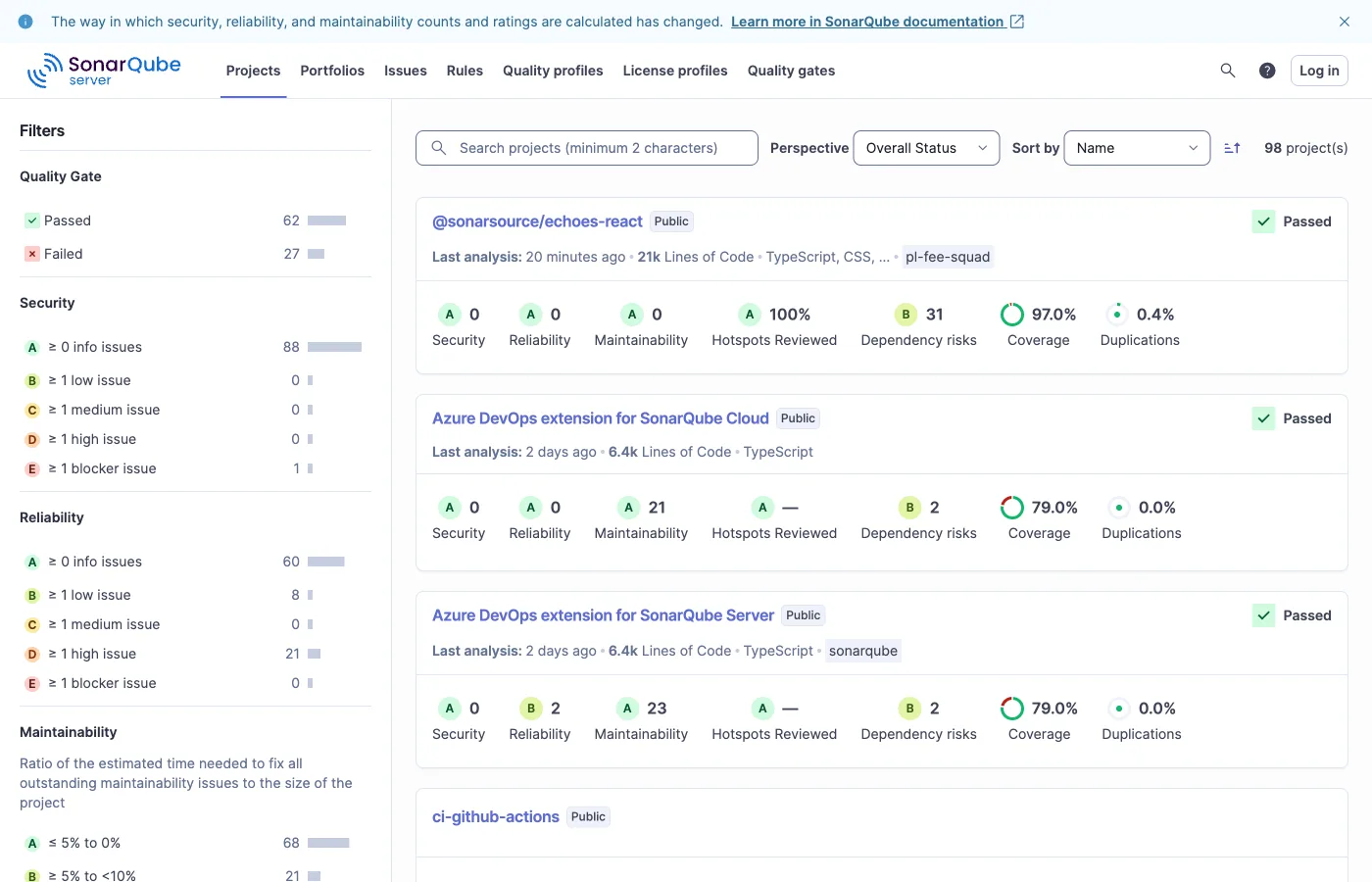
It does two things at once: code quality analysis (bugs, code smells, duplication, technical debt) and security vulnerability detection. For many teams, that combination is exactly right. For others, it is the source of frustration.
AppSec Santa is vendor-neutral. No company on this page pays to be included, ranked higher, or excluded from comparisons. Each alternative is evaluated against the same criteria applied across all tool reviews on the site: language and framework coverage, CI/CD integration depth, false-positive rate on public benchmarks, deployment model, pricing transparency, and maintenance activity. Where vendor marketing claims cannot be independently verified, I note that explicitly. Rankings reflect analysis based on publicly verifiable evidence, not vendor relationships.
The most common complaint is that SonarQube’s security coverage is secondary to its code quality focus. The majority of its built-in rules target code quality rather than security.
The Community Edition lacks taint analysis, which means it cannot trace data flow from user input through to dangerous operations — a fundamental capability for finding injection vulnerabilities.
Teams that need serious security scanning often find they still need a dedicated SAST tool alongside SonarQube.
Self-hosting is another friction point. SonarQube requires a server, a database, and ongoing maintenance.
The Community Edition limits you to single-branch analysis, so teams using feature branches or pull request workflows need to upgrade to the Developer Edition (priced per instance per year, scaled by lines of code).
For organizations running SonarQube across many projects, the infrastructure and licensing costs can grow faster than expected.
Top SonarQube Alternatives#
The best SonarQube alternative depends on what you are optimizing for:
- Developer-first security, all-in-one platform: Aikido Security or Snyk Code
- Deep, security-focused SAST: Semgrep
- Native DevSecOps on GitHub or GitLab: GitHub CodeQL or GitLab Ultimate
- AI-powered code review with autofix: DeepSource or Codacy
- Code quality plus quality gates (SonarQube’s core strength): Qodana
- Safety-critical C/C++ precision: Coverity
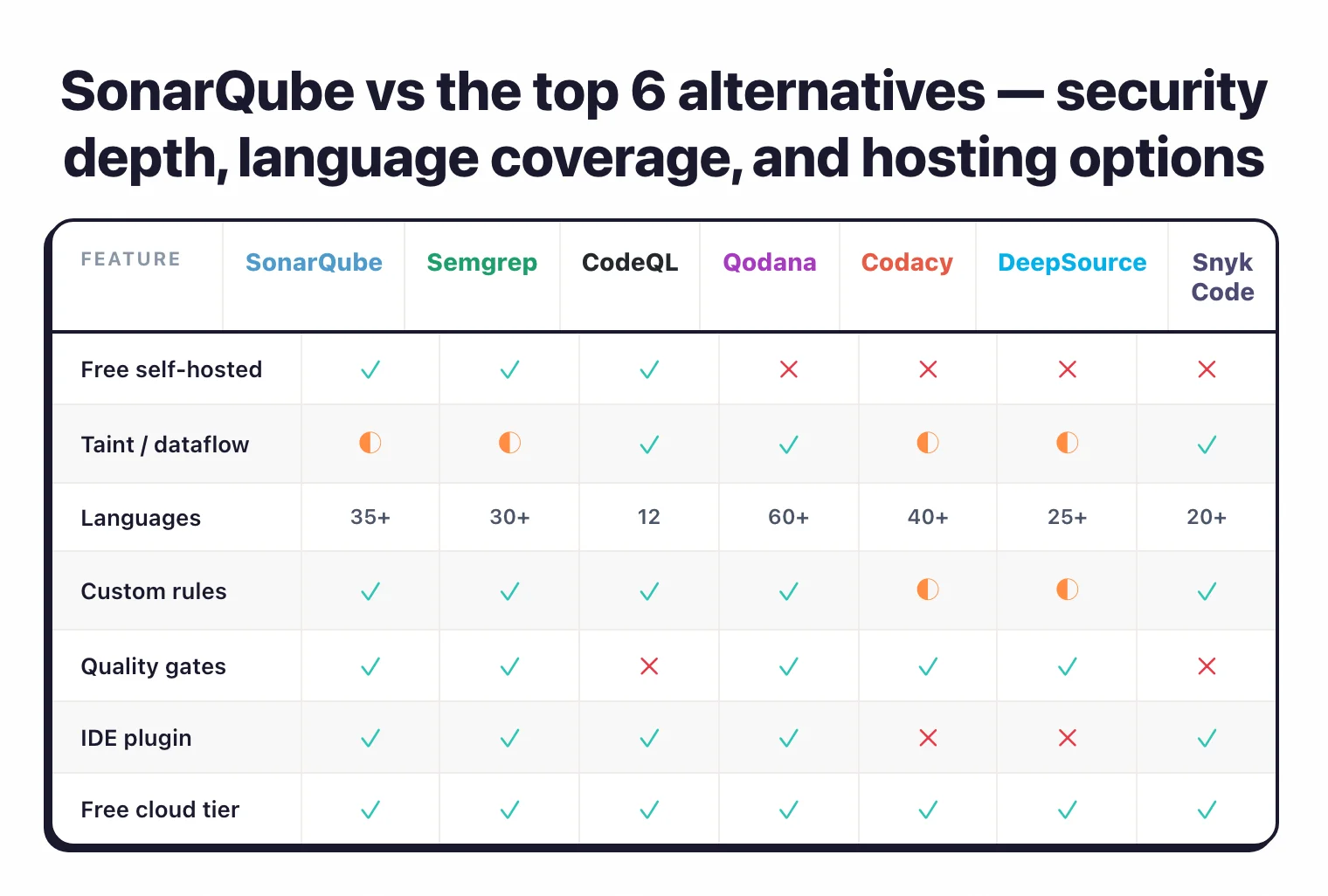
Each option is detailed below, followed by a feature comparison table.
1. Semgrep#
Semgrep is a fast, open-source static analysis tool built around pattern matching. Its rule syntax is designed to be readable and writable by developers, not just security researchers.
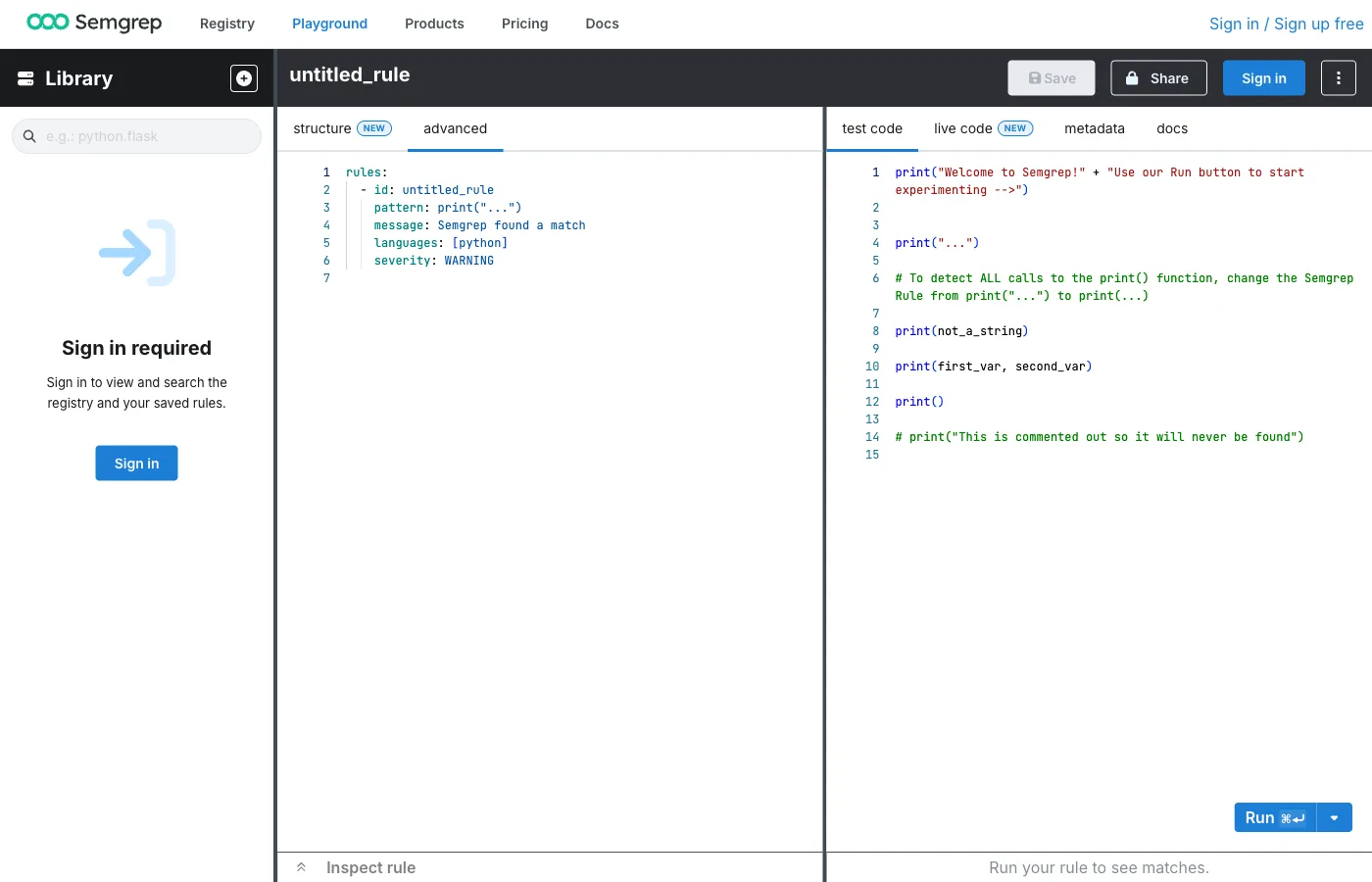
You can create a custom rule in minutes by writing a pattern that looks like the code you want to find.
Semgrep Community Edition (CE) covers 30+ languages with 2,000+ community rules . Semgrep Code adds cross-file dataflow analysis, taint tracking, and a managed rule registry (Semgrep Registry).
The Semgrep AppSec Platform also includes Semgrep Supply Chain for SCA and Semgrep Secrets for credential detection.
Best for: Security-focused teams that want fast scans, easy custom rules, and a modern CLI-first workflow. License: Open-source (LGPL-2.1) with commercial Semgrep Code tier Key difference: Security-first with dead-simple custom rule authoring. No code quality metrics, duplication detection, or quality gates.
2. Snyk Code#
Snyk Code is a developer-first SAST tool powered by DeepCode AI . It scans code in real-time inside IDEs (VS Code, JetBrains, Eclipse) and provides AI-powered fix suggestions trained on millions of real-world code fixes.
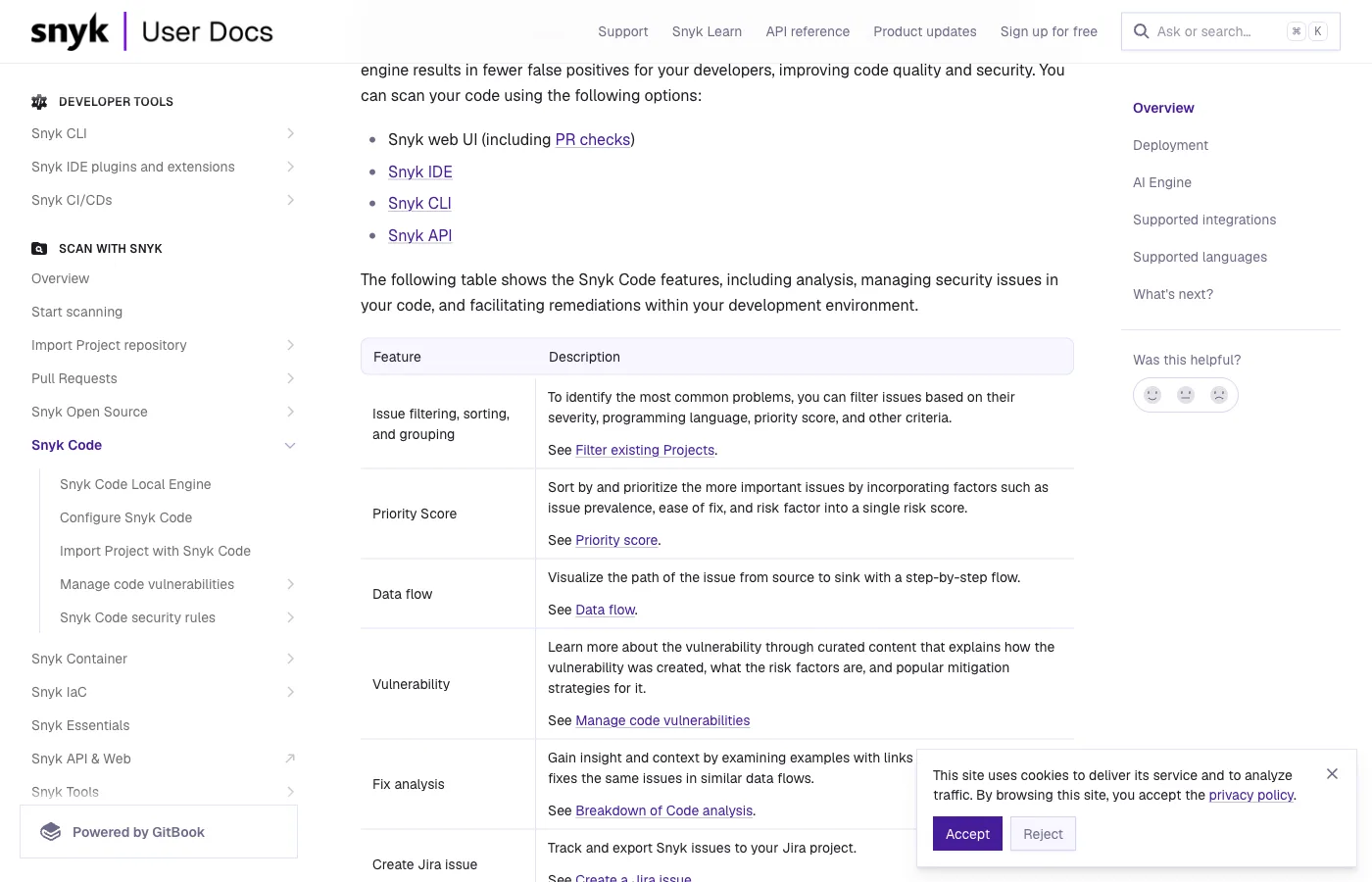
The tool supports 20+ languages and performs semantic analysis rather than simple pattern matching.
Snyk Code is part of the Snyk platform, so teams already using Snyk Open Source for SCA get unified reporting across both code and dependency vulnerabilities. Snyk has over 2.5 million developers on its platform.
Best for: Developer teams that want inline IDE feedback with AI-generated fix suggestions. License: Commercial (free tier available) Key difference: Real-time IDE scanning with AI fix suggestions. No code quality analysis — pure security focus.
3. GitHub CodeQL#
CodeQL is GitHub’s semantic code analysis engine. It treats code as data, letting you write queries that search for vulnerability patterns across your codebase.
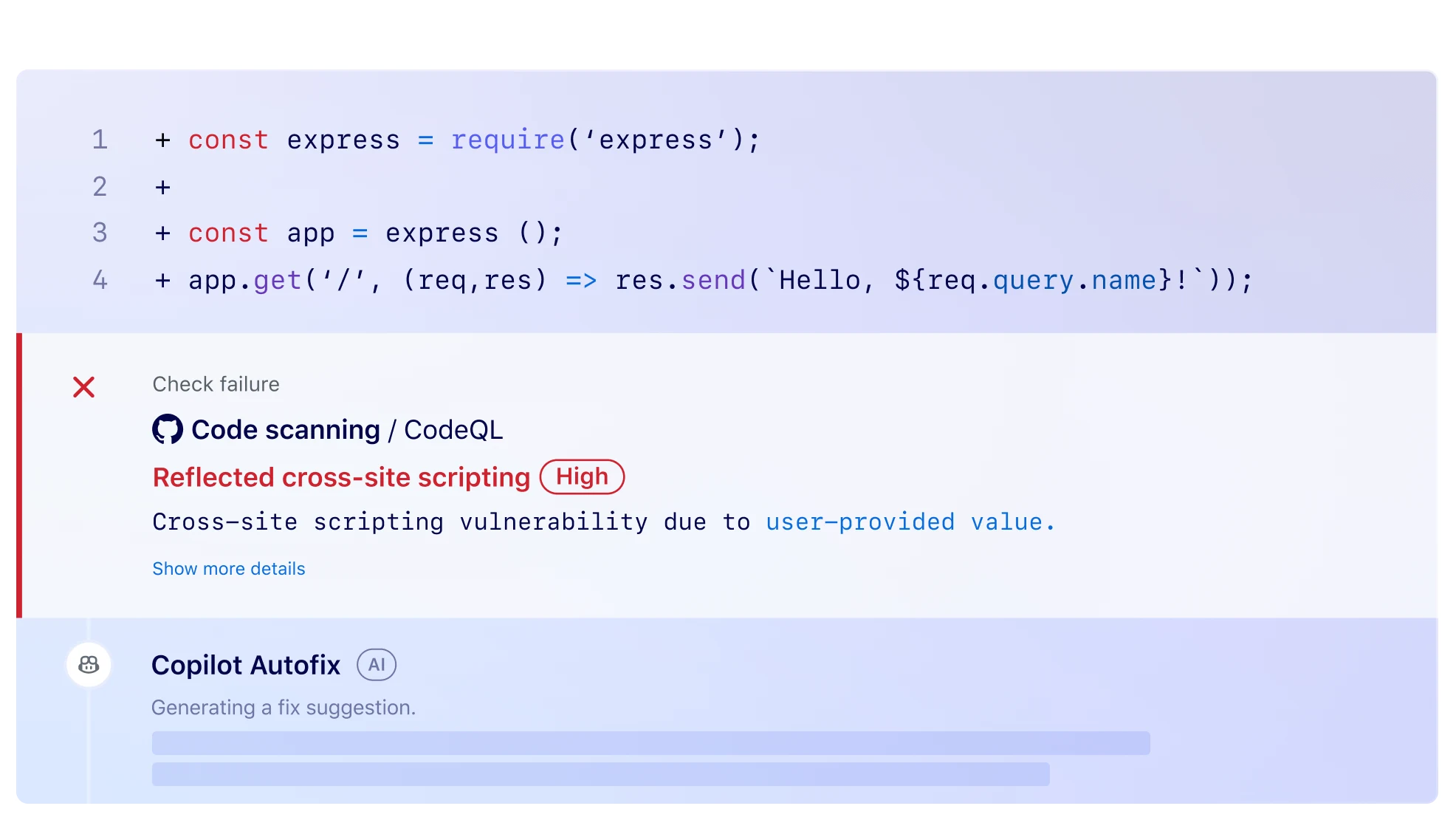
CodeQL performs deep dataflow and taint analysis across 12 languages . It is free for public repositories and included with GitHub Advanced Security for private repos.
CodeQL integrates natively with GitHub Actions and surfaces findings directly in the Security tab. The query language is powerful but has a learning curve steeper than Semgrep’s pattern syntax.
Best for: Teams on GitHub that want deep semantic analysis with native platform integration. License: Free (public repos), commercial (private repos via GitHub Advanced Security) Key difference: Semantic query language enables highly precise vulnerability patterns. GitHub-native with no self-hosting needed.
4. Checkmarx#
Checkmarx One is a commercial application security platform that unifies SAST, SCA, DAST, IaC security, container security, API security, and secrets detection. The SAST engine supports 35+ languages and 100+ frameworks.
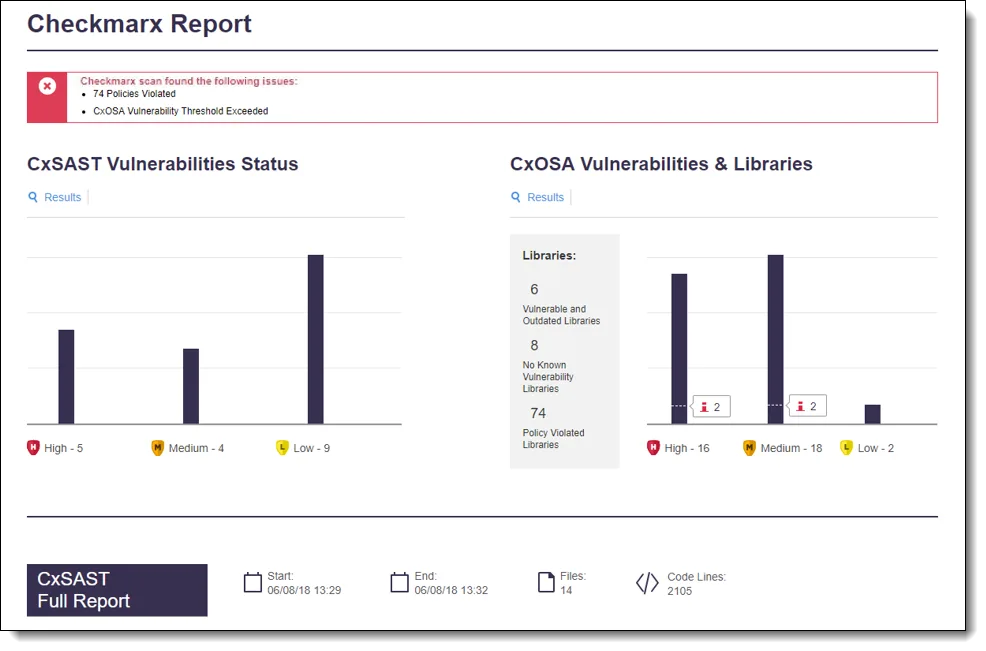
Checkmarx counts Apple, Salesforce, and Walmart among its customers and is a standard choice at large enterprises with complex governance requirements.
ASPM (Application Security Posture Management) sits on top of all scanning engines to prioritize findings based on application context rather than raw severity scores.
Best for: Enterprise teams that want a unified application security platform with centralized prioritization. License: Commercial Key difference: Full application security suite, not just SAST. Significantly higher cost than SonarQube.
5. DeepSource#
DeepSource combines static analysis with AI-powered autofix. It covers 20+ analyzers and generates pull requests with automated code fixes for detected issues.
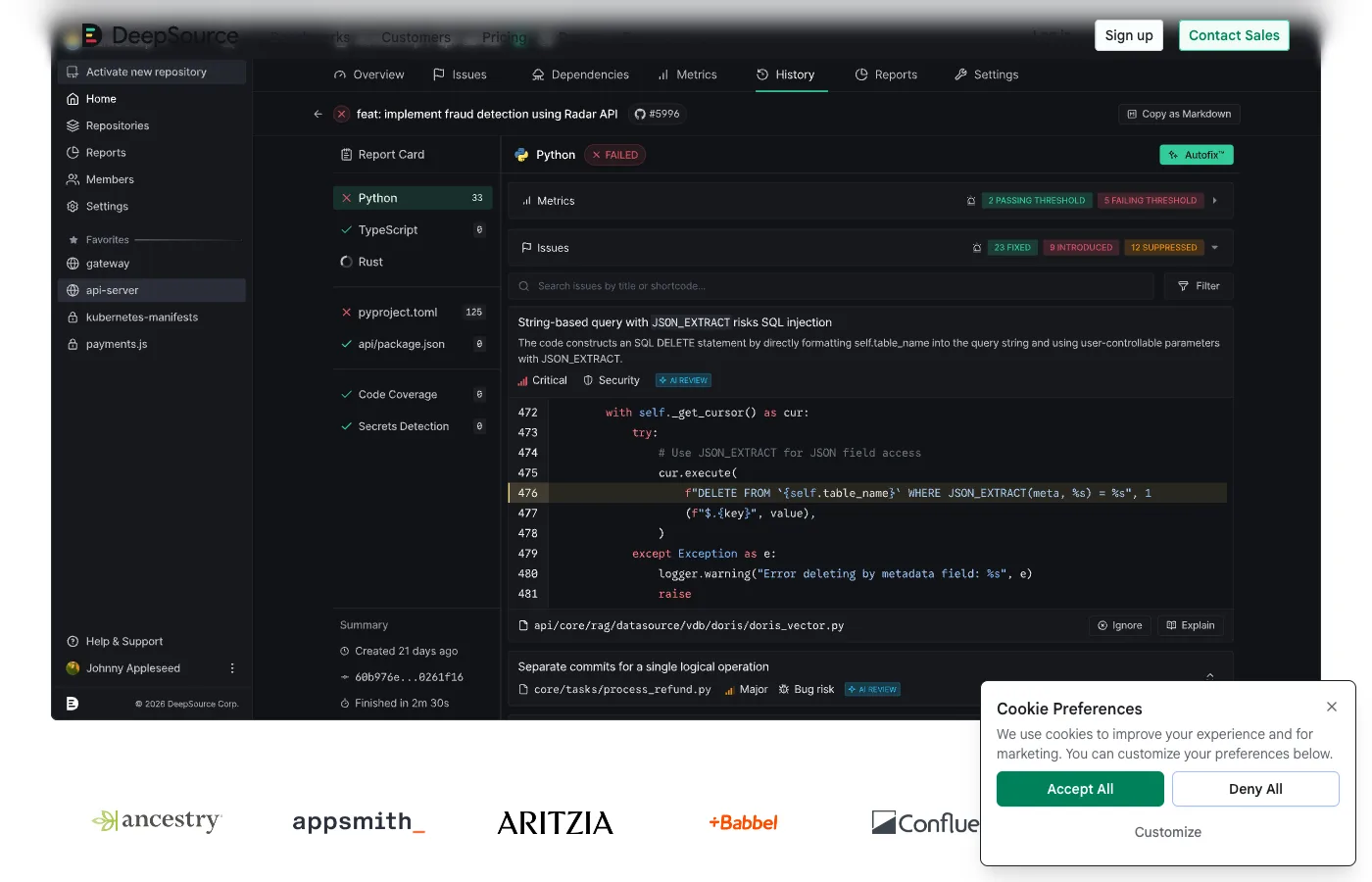
The platform tracks code quality metrics alongside security, making it a more direct SonarQube replacement than pure security tools.
DeepSource includes secrets detection, SCA with reachability analysis, and code coverage tracking. The free tier covers public repositories, and a self-hosted option is available.
Best for: Teams that want SonarQube-like code quality tracking with modern AI-powered autofix. License: Commercial (free tier available) Key difference: AI Autofix generates PRs with code fixes. Covers both code quality and security like SonarQube, but with a more modern interface.
6. Codacy#
Codacy provides automated code review across 40+ languages by aggregating 30+ underlying analysis tools. It tracks code quality, security, duplication, complexity, and coverage in a unified dashboard. Setup takes minutes through Git provider integration.
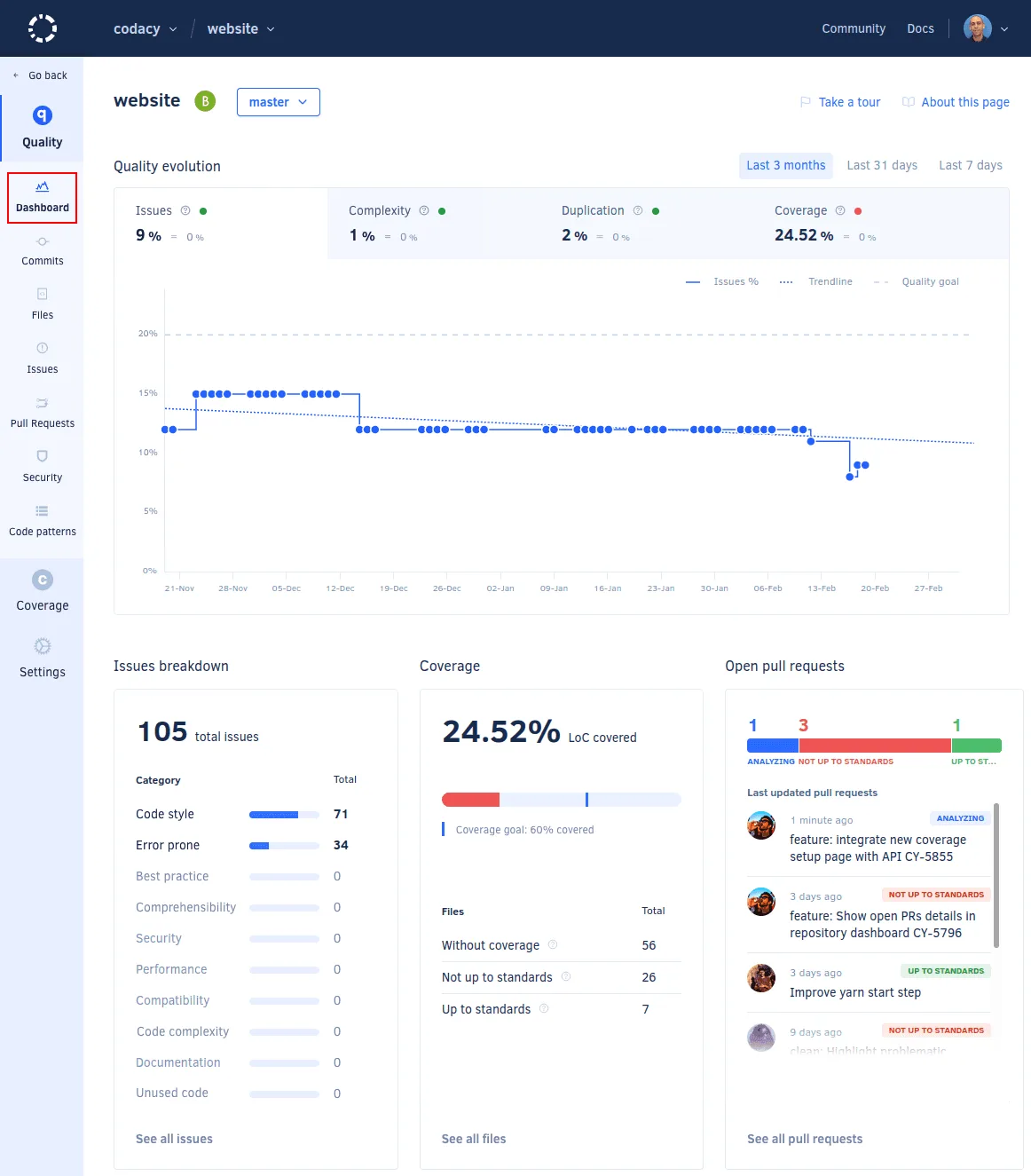
The platform includes AI guardrails for AI-generated code and a secrets detection module. Codacy is free for open-source projects and offers commercial plans for private repositories.
Best for: Teams that want broad language coverage and automated code review without configuring multiple individual tools. License: Commercial (free for open-source) Key difference: Aggregates 30+ analysis engines into one dashboard. Broad but sometimes shallow compared to specialized tools.
7. Qodana#
Qodana brings JetBrains’ IDE inspections to CI/CD pipelines. It covers 60+ languages and runs the same 3,000+ inspections you get in IntelliJ, PyCharm, or WebStorm — but as a server-side analysis. The Ultimate Plus tier adds taint analysis for security.
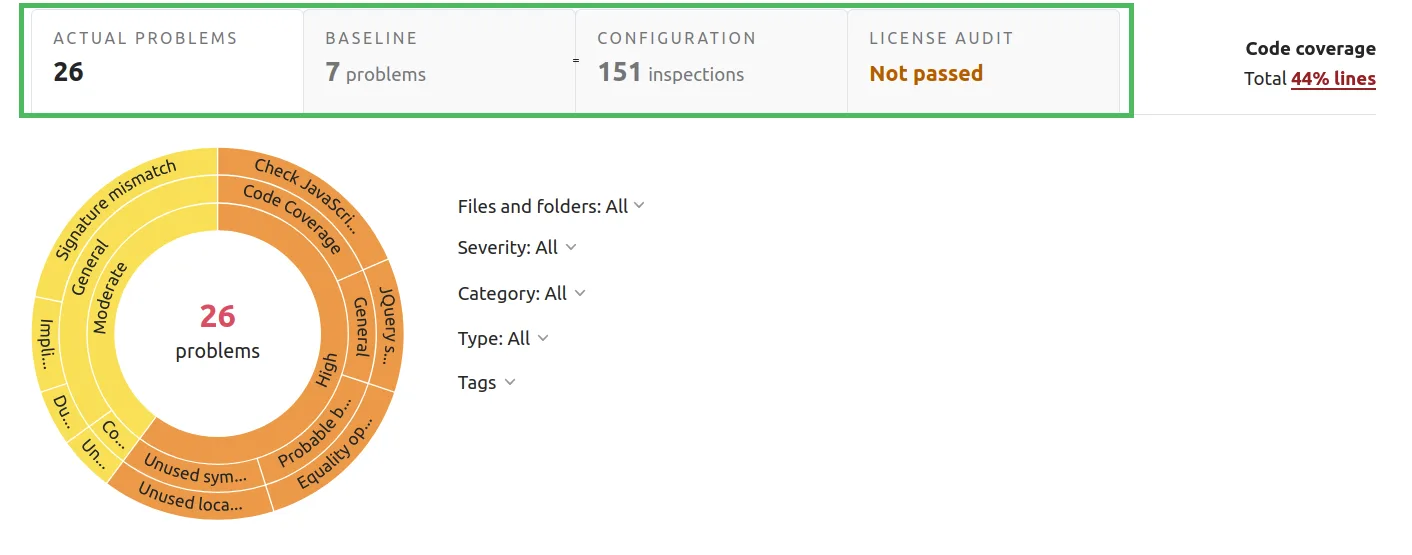
Qodana tracks technical debt, provides quality gates, and integrates with JetBrains IDEs for inline feedback. The Community tier is free, and paid plans start at $6 per contributor per month.
Best for: Teams using JetBrains IDEs that want the same inspection rules running in CI/CD. License: Commercial (free Community tier) Key difference: Same inspections as JetBrains IDEs. Deep JetBrains ecosystem integration that no other tool matches.
8. Coverity#
Coverity is an enterprise SAST tool from Black Duck (formerly Synopsys Software Integrity Group). It performs deep interprocedural dataflow and path-sensitive analysis across 22 languages and 200+ frameworks.
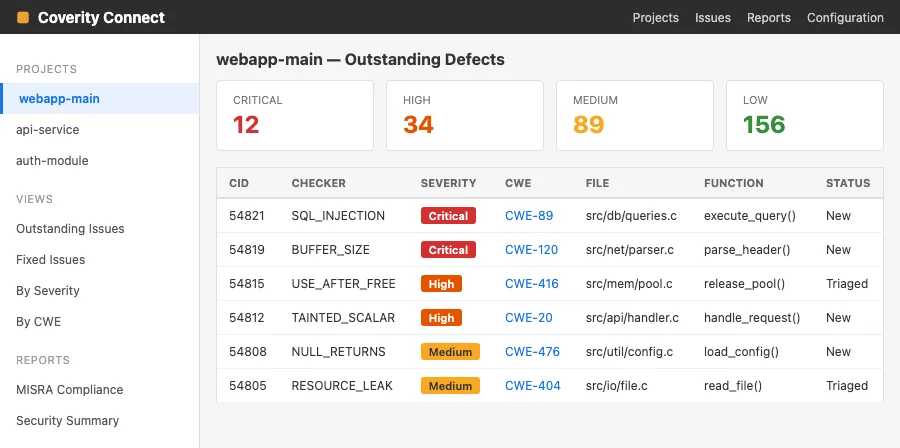
Coverity has been TUV SUD certified for safety-critical development and is widely deployed in automotive, aerospace, and industrial engineering for that reason.
The tool is particularly strong for C/C++ and Java codebases where deep analysis of complex control flow matters most. Coverity is not cheap, but its precision is among the highest in the industry.
Best for: Enterprise teams with large C/C++ or Java codebases that need precise, low-false-positive results. License: Commercial Key difference: Deepest interprocedural analysis in the market. Safety-certified for automotive (ISO 26262) and industrial (IEC 61508) use.
Coverity review · Full Coverity vs SonarQube comparison
9. Aikido Security#
Aikido is an all-in-one AppSec platform that bundles SAST, DAST, SCA, secrets, IaC, and container scanning behind one dashboard, used by 50,000+ organizations.

Unlike SonarQube’s quality-plus-security focus, Aikido leads with security breadth and noise reduction. Its AutoTriage cuts alert volume by up to 95% through deduplication and reachability analysis.
Pricing is flat per developer with a free tier and no per-line-of-code billing, which is the reason teams most often cite for leaving SonarCloud.
It now appears in nearly every 2026 SonarQube alternatives list and in Google’s AI Overview, so it belongs on the shortlist for teams that want to consolidate tools rather than run a single-purpose scanner.
Best for: Teams that want to replace SonarQube plus several point tools with one platform. License: Commercial (free tier available) Key difference: All-in-one SAST/DAST/SCA/cloud coverage with flat per-developer pricing and 95% noise reduction. No code quality metrics or quality gates.
Other SonarQube alternatives worth knowing#
These tools come up in SonarQube evaluations alongside the eight above. Each link goes to the relevant tool review or comparison page.
PMD#
PMD is the Java-first multi-language code analyzer. It is the closest open-source competitor to SonarQube’s Java SAST + linting role. The full PMD vs SonarQube comparison covers how the two stack up.
SpotBugs#
SpotBugs is the modern fork of FindBugs — a Java-only static analyzer focused on bug patterns rather than security. Pair SpotBugs with SonarQube CE for Java codebases that want both bug detection (SpotBugs) and code quality + SAST (SonarQube). SonarQube can ingest SpotBugs reports as external analyzer findings.
PHPStan#
PHPStan is the PHP-only static analyzer focused on type safety and bug detection. It is not a security scanner, but for PHP shops where SonarQube’s PHP coverage feels light, PHPStan adds depth on type and logic correctness.
Klocwork#
Klocwork is the Perforce-owned commercial SAST competitive with Coverity. Like Coverity, it is strongest on C, C++, Java, and C# with deep dataflow analysis. For organisations evaluating Coverity vs SonarQube and wanting a third commercial option, Klocwork is the third name to put on the shortlist.
JFrog Xray (and JFrog Code)#
JFrog Xray is the artifact-repository-native SCA from JFrog. JFrog has been adding SAST capabilities (JFrog Code) on top of Xray. For organisations already standardised on JFrog Artifactory, the bundle becomes an alternative to running SonarQube + Snyk separately.
DefectDojo#
DefectDojo is not a SAST scanner — it is an open-source vulnerability management platform that aggregates findings from many scanners (including SonarQube). Pick DefectDojo when the goal is centralising findings from multiple tools rather than replacing SonarQube as the SAST engine.
Open-source SonarQube alternatives#
For teams replacing SonarQube with free, self-hosted scanners, six open-source projects cover most of the ground:
- Semgrep Community Edition (LGPL-2.1) — multi-language scanner with 30+ languages and a public rule registry. The closest free analogue to SonarQube’s rule-driven approach.
- GitHub CodeQL (free for public repos) — query-based semantic analysis. Strongest free option when the codebase already lives on GitHub Actions and the team is willing to learn QL.
- Bandit (Apache-2.0) — Python-only scanner with 47 built-in security checks. Pair with SonarQube CE for code quality on the same Python codebase.
- gosec (Apache-2.0) — Go-only AST scanner with rule packs aligned to the OWASP Top 10. Integrates cleanly with golangci-lint.
- Brakeman (MIT) — Ruby on Rails-only SAST that has been the de-facto Rails security scanner for over a decade.
- PHPStan (MIT) — PHP-only static analyzer focused on type safety and bug detection. Limited security coverage, but the strongest free PHP analyzer.
The trade-off compared to SonarQube CE is breadth: SonarQube CE covers 19 languages with quality gates, duplication tracking, and a unified dashboard out of one binary, while the multi-tool open-source stack means assembling that workflow yourself. For a wider open-source SAST view, the open-source SAST tools guide ranks every active project.
Feature Comparison#
| Feature | SonarQube | Semgrep | Snyk Code | CodeQL | Checkmarx | DeepSource | Qodana | Aikido |
|---|---|---|---|---|---|---|---|---|
| License | Free CE / Commercial | CE / Commercial | Commercial (free tier) | Free (public) / Commercial | Commercial | Commercial (free tier) | Commercial (free tier) | Commercial (free tier) |
| Languages | 35+ | 30+ | 20+ | 12 | 35+ | 20+ | 60+ | 30+ |
| Code quality | Yes | No | No | No | No | Yes | Yes | No |
| Taint analysis | Paid tiers | Semgrep Code | Yes | Yes | Yes | No | Ultimate Plus | Yes |
| Custom rules | Limited | Core feature | No | Yes (QL) | Yes | No | Limited | Limited |
| AI fix suggestions | AI CodeFix | No | Yes (DeepCode) | No | Yes (Assist) | Yes (Autofix) | No | Yes (AutoFix) |
| Quality gates | Yes | No | No | No | No | No | Yes | No |
| PR decoration | Paid tiers | Yes | Yes | Yes | Yes | Yes | Yes | Yes |
| Self-hosted | Yes | Yes | No | No | Yes | Yes | Yes | No |
| CI/CD integration | Broad | Broad | Broad | GitHub-native | Broad | Broad | Broad | Broad |
SonarCloud alternatives#
SonarCloud is SonarQube’s hosted SaaS — same scanner engine, but the deployment, pricing, and onboarding story is different enough that teams replacing SonarCloud often have different priorities than teams replacing self-hosted SonarQube.
The primary reasons teams move off SonarCloud are data residency (the SaaS runs on AWS with no on-prem option), pricing (per-line-of-code billing scales aggressively above ~1M LOC), and onboarding friction with the GitHub OAuth flow on enterprise tenants. The two closest hosted SaaS alternatives are Codacy Cloud and DeepSource Cloud — both offer public per-developer pricing, both integrate natively with GitHub/GitLab/Bitbucket, and both handle the multi-repository onboarding more smoothly than SonarCloud’s organization model. Snyk Code is the third option if the team also needs SCA, container, and IaC scanning under the same dashboard.
For teams that want the SonarQube engine without the SonarCloud UI, the simplest substitute is to self-host SonarQube Community Edition on a managed Kubernetes cluster. Costs depend on infrastructure rather than per-LOC, and the same scanner rules apply.
When to Stay with SonarQube#
SonarQube remains the right choice in several scenarios:
- You need code quality and security together. No other tool matches SonarQube’s combination of bug detection, code smell tracking, duplication analysis, technical debt measurement, and security scanning in one platform.
- Quality gates are central to your workflow. SonarQube’s quality gate system is the most mature on the market. If you use pass/fail conditions on coverage, duplication, and reliability to gate deployments, switching is costly.
- You have a large SonarQube investment. Custom quality profiles, tuned rules, historical trend data, and team workflows built around SonarQube represent significant investment. The cost of migration often outweighs the benefit.
- You use SonarCloud for open-source projects. SonarCloud is free for public projects and provides the same analysis engine without self-hosting. For open-source maintainers, it is hard to beat.
- You want broad language coverage. SonarQube’s 35+ language support with a single installation is simpler than stitching together specialized tools.
For detailed reviews, check the AppSec Santa SAST tools category.
Frequently Asked Questions
What is the best free alternative to SonarQube?
Is SonarQube good for security scanning?
Can Semgrep replace SonarQube?
Which SonarQube alternative has the best AI features?
Should I use SonarCloud or self-host SonarQube?

Written & maintained by
Suphi CankurtEight years on the vendor side of application-security sales — thousands of evaluations and demos. I started AppSec Santa in 2022 to put that insider view to work for buyers. Independent of any vendor, paid by none, and honest about what fits whom.