
8 Best Snyk Alternatives for 2026 (Free + Commercial Compared)
Top Snyk Alternatives
Renovate-powered SCA + Agentic SAST in one platform
CycloneDX SBOM generator for 20+ languages
Fast Container Vulnerability Scanner
SBOM generation tool
- According to Snyk, its proprietary database catches CVEs 47 days before competing sources on average, but its free tier caps at 200 tests/month and paid plans scale with project count.
- OWASP Dependency-Check and Grype are the strongest free alternatives; Dependency-Check supports air-gapped environments, Grype scans container images in seconds.
- Socket detects malicious packages through behavioral analysis (network calls, file access, install scripts) that CVE-based scanners like Snyk miss entirely.
- According to Endor Labs, its function-level reachability analysis achieves 97% noise reduction across more languages than Snyk’s Java and JavaScript coverage.
- Black Duck covers 2,750+ licenses and 247,000+ vulnerabilities with the deepest license compliance analysis in the SCA market.
The best Snyk alternatives in 2026 are Grype , OWASP Dependency-Check , Socket , Endor Labs , Black Duck , and Mend SCA . Each addresses a gap Snyk’s CVE-first approach leaves open.
Grype scans container images and filesystems in seconds, outputs SARIF for GitHub Advanced Security, and pulls vulnerability data from NVD, GitHub Advisories, and distro-specific databases.
OWASP Dependency-Check has been a free SCA scanner since 2012, covering Java, .NET, Ruby, Python, and Node.js, and runs fully self-contained for air-gapped environments.
Socket detects malicious packages through behavioral analysis of install scripts, network calls, and file access — catching typosquatting and supply-chain attacks that CVE-based scanners miss entirely.
Endor Labs maps function-level call graphs to filter out vulnerabilities in unreachable code paths, with claimed 97% noise reduction across more languages than Snyk’s Java and JavaScript coverage.
Black Duck’s KnowledgeBase covers 2,750+ licenses and 247,000+ vulnerabilities, with license-compliance depth aimed at SBOM management and regulated industries.
Mend SCA delivers auto-remediation PRs similar to Snyk with competitive enterprise pricing, and bundles SCA + SAST into one unified platform.
| Alternative | Best for | License |
|---|---|---|
| Grype | Fast container CVE scanning | Open source |
| OWASP Dependency-Check | Air-gapped / regulated environments | Open source |
| Socket | Malicious-package detection | Freemium |
| Endor Labs | Reachability noise reduction | Commercial |
| Black Duck | Enterprise license compliance | Commercial |
| Mend SCA | Auto-remediation with SAST bundled | Commercial |
Choose Grype or OWASP Dependency-Check when you want free SCA and Snyk’s auto-fix PRs are not worth the cost. Choose Socket when your threat model is supply-chain attacks rather than known CVEs. Choose Endor Labs when alert fatigue is the bottleneck.
Stay on Snyk when automated fix PRs, the proprietary database’s 47-day CVE lead over NVD, or unified Snyk Code + Container + IaC + Open Source coverage is core to your workflow.
Why Look for Snyk Alternatives?#
Snyk Open Source is one of the most widely adopted SCA tools on the market, used by what Snyk reports as over 2.5 million developers.
Its automated fix pull requests, proprietary vulnerability database, and developer-friendly CLI have made it a default choice for many teams. But defaults are not always the right fit.
The most common reason teams explore alternatives is cost. Snyk’s free tier caps at 200 tests per month, and paid plans scale with the number of projects and contributors.
For organizations scanning hundreds of repositories, licensing costs add up quickly. Teams running primarily open-source stacks sometimes find it hard to justify the spend when free alternatives cover their core needs.
Other teams hit feature gaps. Snyk’s reachability analysis only supports Java and JavaScript today.
License compliance requires a paid plan. Self-hosted deployment needs an enterprise agreement.
And some organizations simply prefer tools they can run entirely on their own infrastructure without sending code or dependency data to a third-party cloud.
Top Snyk Alternatives#
1. OWASP Dependency-Check#
OWASP Dependency-Check is the most established open-source SCA tool. It identifies known vulnerabilities in project dependencies by matching them against the NVD and other public databases.
The project has been around since 2012 and supports Java, .NET, Ruby, Python, Node.js, and several other ecosystems.
It runs as a CLI tool, Maven plugin, Gradle plugin, Ant task, or Jenkins plugin. Reports come out in HTML, XML, JSON, and CSV formats.
The tool is fully self-contained and can run air-gapped after downloading the vulnerability database.
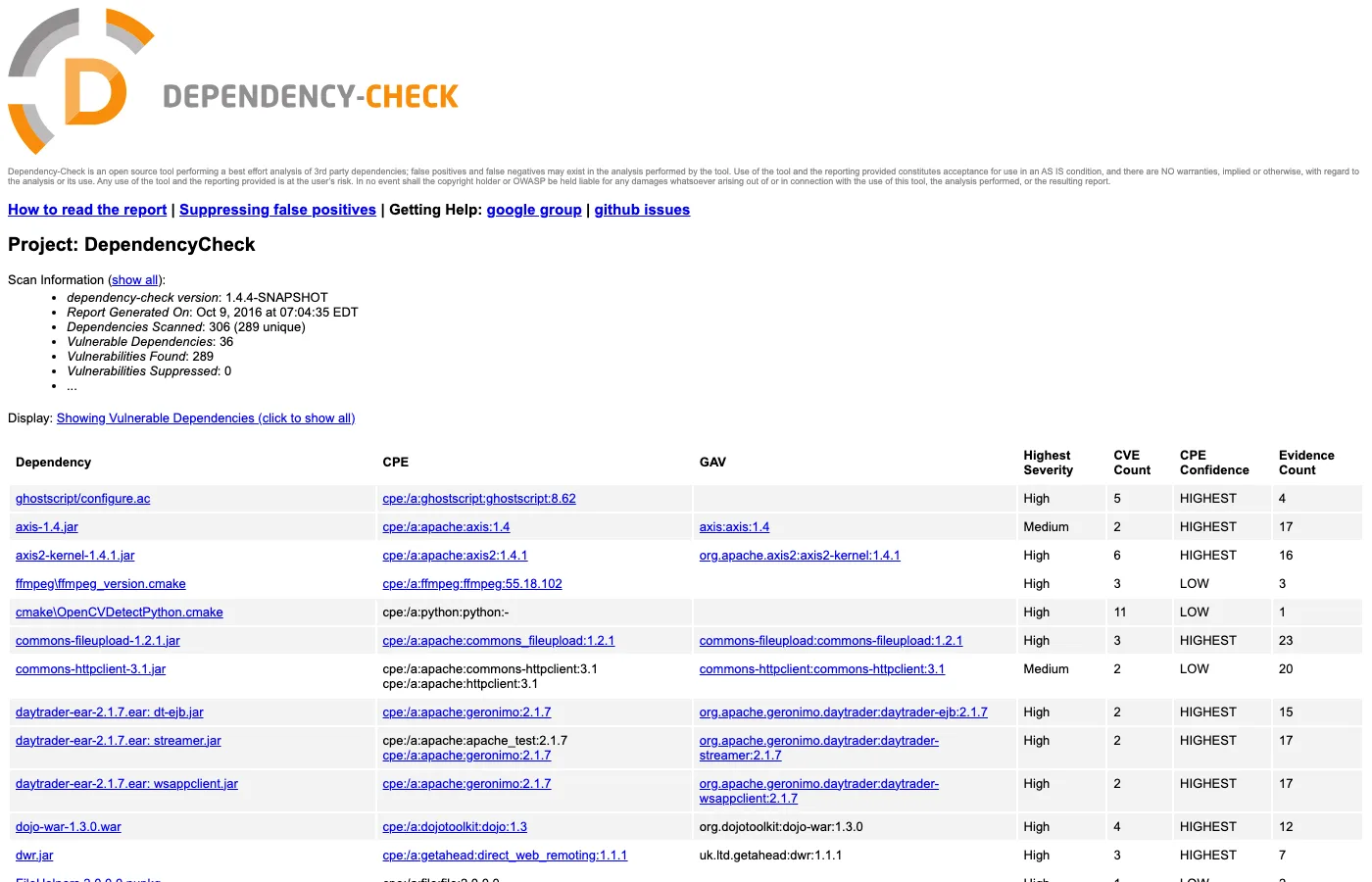
Best for: Teams that want a proven, no-cost SCA scanner they can run anywhere, including air-gapped environments. License: Open-source (Apache 2.0) Key difference: Fully self-hosted with no cloud dependency. Lacks automated fix PRs and continuous monitoring.
2. Grype#
Grype is a fast, modern vulnerability scanner from Anchore that focuses on container images and filesystems. It pulls from multiple vulnerability databases (NVD, GitHub Advisories, Alpine SecDB, and others) and scans container images, directories, SBOMs, and individual files.
Scans typically complete in seconds, even for large images. Grype pairs naturally with Syft (Anchore’s SBOM generator) for a complete open-source SCA pipeline.
It outputs JSON, table, CycloneDX, and SARIF formats for CI/CD integration.
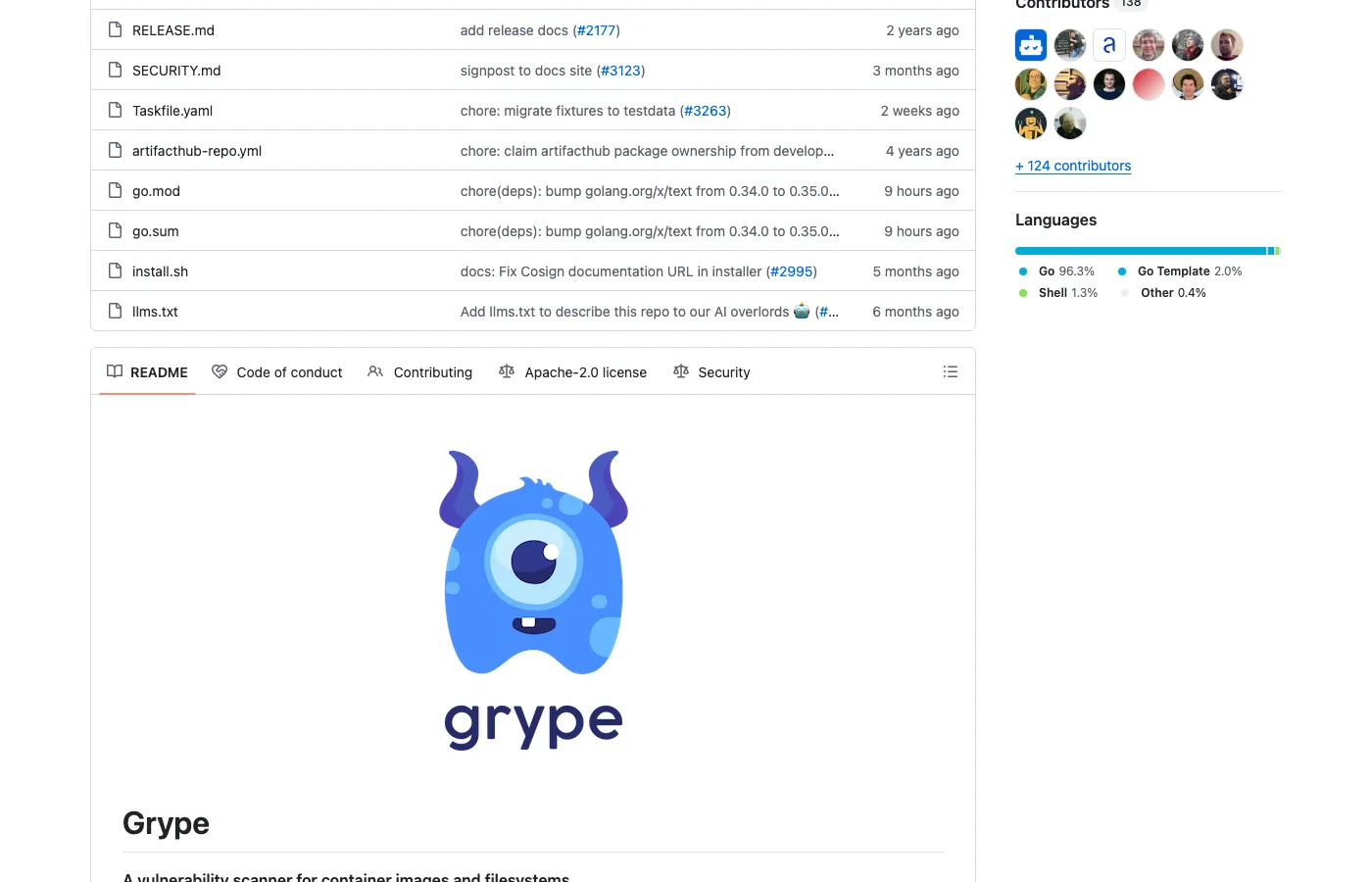
Best for: Container-heavy teams that need fast, CLI-driven vulnerability scanning without a web dashboard. License: Open-source (Apache 2.0) Key difference: Built for container workflows. No web UI, no fix PRs, no continuous monitoring — pure scanning speed.
Grype review · Full Grype vs Snyk head-to-head
3. Dependabot#
GitHub Dependabot is free and built directly into GitHub. It monitors your dependencies, opens pull requests when updates are available, and alerts you to known vulnerabilities through GitHub Security Advisories.
The tight GitHub integration means zero setup for teams already on the platform. Dependabot version updates keep dependencies current even when no vulnerability is involved, which reduces your attack surface proactively.
The downside is that it only works with GitHub-hosted repositories.
Best for: Teams fully committed to GitHub that want free, zero-configuration dependency updates. License: Free (GitHub-native) Key difference: GitHub-only but completely free.
Uses the GitHub Advisory Database rather than a proprietary database. No reachability analysis or risk scoring.
Dependabot review · Full Snyk vs Dependabot head-to-head
4. Black Duck#
Black Duck (formerly Synopsys Black Duck, now an independent company after Synopsys divested its Software Integrity Group in 2024) is the enterprise standard for open-source risk management. Its strength is deep license compliance analysis — identifying license obligations, conflicts, and IP risk across your entire software supply chain.
Black Duck maintains the KnowledgeBase, one of the largest databases of open-source component information. It covers over 2,750+ licenses and 247,000+ known vulnerabilities.
The platform generates detailed SBOMs and provides policy enforcement for license and security rules.
Best for: Large enterprises in regulated industries that need thorough license compliance analysis alongside vulnerability detection. License: Commercial Key difference: License compliance depth that no other SCA tool matches. Significantly higher price point than Snyk.
Black Duck review · Full Black Duck vs Snyk head-to-head
5. Socket#
Socket takes a fundamentally different approach to SCA. Instead of matching dependency versions against CVE databases, it analyzes package behavior — looking for malicious code, install scripts, network access, filesystem operations, and other suspicious indicators in open-source packages.
This behavioral approach catches supply chain attacks that CVE-based scanners miss entirely: typosquatting, compromised maintainer accounts, and packages that exfiltrate data. Socket also performs traditional vulnerability matching but leads with its behavioral analysis.
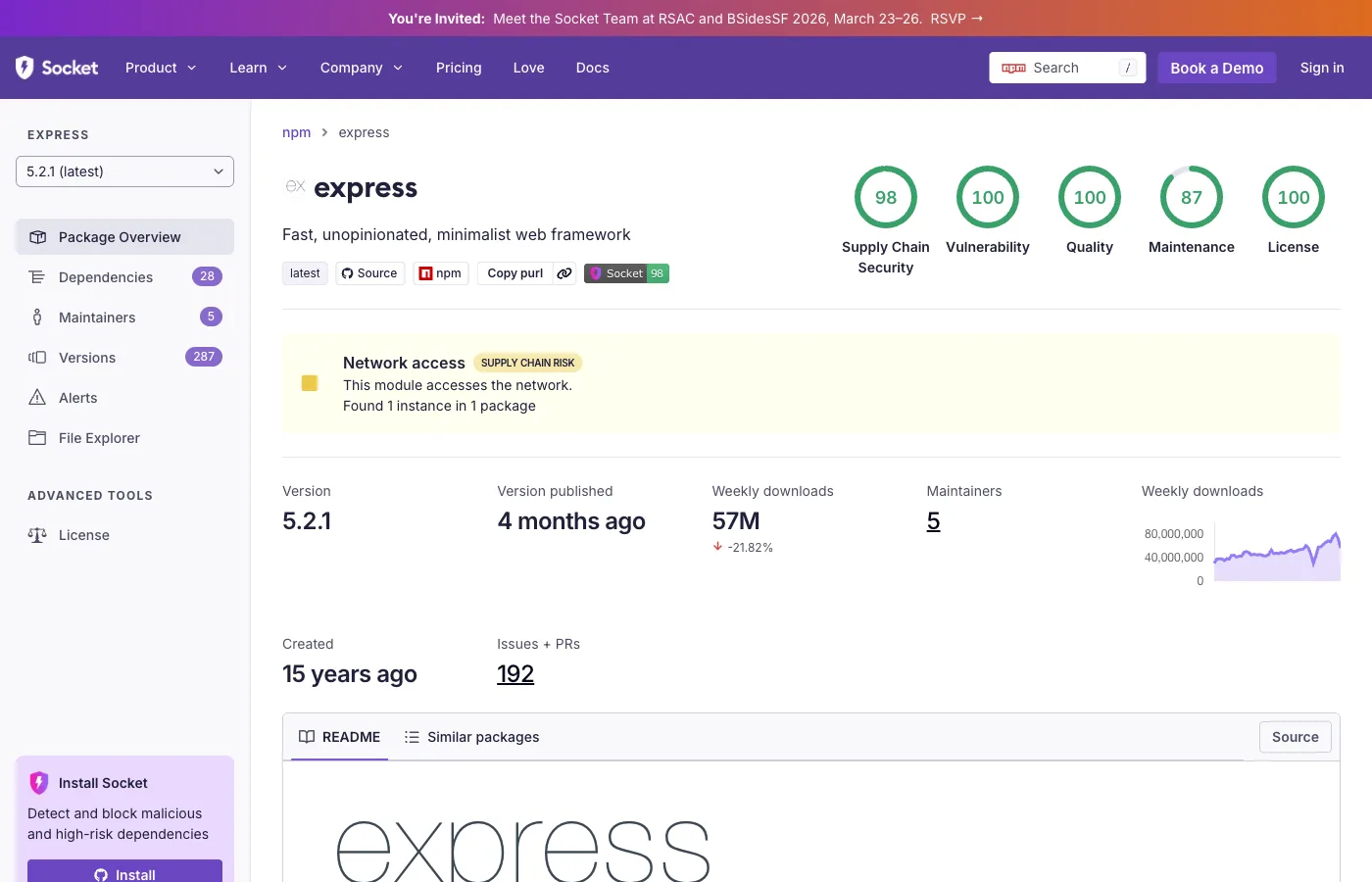
Best for: Teams concerned about supply chain attacks and malicious packages, not just known CVEs. License: Commercial (free for open source) Key difference: Behavioral analysis detects malicious packages, not just known vulnerabilities. Catches threats that CVE-matching tools cannot.
6. Endor Labs#
Endor Labs combines SCA with reachability analysis and dependency lifecycle management. According to Endor Labs, this achieves 97% noise reduction by filtering out vulnerabilities in code paths your application never executes.
The platform maps function-level call graphs to determine whether a vulnerable function is actually reachable from your code.
Beyond vulnerability scanning, Endor Labs tracks dependency health — maintenance activity, release cadence, and contributor patterns — to flag risky packages before a CVE is even published.
Best for: Teams drowning in vulnerability alerts who need intelligent noise reduction and dependency health scoring. License: Commercial Key difference: Function-level reachability analysis across more languages than Snyk currently supports. Dependency health scoring goes beyond CVE matching.
Endor Labs review · Full Endor Labs vs Snyk head-to-head
7. FOSSA#
FOSSA specializes in license compliance and open-source management. It maps license obligations across your entire dependency tree, flags conflicts, and generates compliance reports for legal teams.
The platform also provides vulnerability scanning, though license compliance is its primary focus.
FOSSA offers both cloud and on-premises deployment. The free tier covers open-source projects, and commercial plans add policy enforcement, reporting, and integrations.
Best for: Teams where license compliance is the primary concern, with vulnerability scanning as a secondary need. License: Freemium Key difference: License compliance first, vulnerability scanning second. The inverse of Snyk’s priorities.
8. Mend SCA#
Mend SCA (formerly WhiteSource) provides enterprise-grade SCA with automated remediation. The platform generates fix pull requests similar to Snyk, supports policy enforcement, and integrates with GitHub, GitLab, Bitbucket, Azure DevOps, and all major CI/CD systems.
Mend’s database covers both vulnerabilities and license information. The platform includes prioritization features that factor in exploitability, business context, and fix availability.
Best for: Enterprise teams that want Snyk-like features (auto-remediation, continuous monitoring) with a different pricing model. License: Commercial Key difference: Similar feature set to Snyk with competitive enterprise pricing. Includes both SCA and SAST in unified platform.
Mend SCA review · Full Snyk vs Mend head-to-head
Other Alternatives Worth Knowing#
These platforms come up often in Snyk evaluations but sit outside the top eight on coverage or fit. Each link goes to the relevant tool review or comparison page.
Apiiro#
Apiiro is the deep ASPM with a code-to-cloud Application Risk Graph. It does not run its own SCA scanner — instead it aggregates findings from existing scanners (Snyk included) and adds risk context. Pick Apiiro when the bottleneck is risk-context aggregation across many tools, not the SCA scanner itself.
Cycode#
Cycode is the enterprise ASPM platform with strong supply chain and CI/CD security depth alongside SCA. The differentiator versus Snyk is the supply chain and pipeline security focus — for organisations with mature AppSec programs that need source-code-to-pipeline-to-deployment risk mapping.
Docker Scout#
Docker Scout is Docker’s own container vulnerability scanner, integrated into Docker Desktop and Docker Hub. Pick Docker Scout when container image scanning is the primary need and you already operate inside the Docker ecosystem. For broader SCA across language packages and direct dependencies, Snyk remains broader.
Renovate#
Renovate is the open-source dependency-update bot that competes with Dependabot more directly than with Snyk. Pick Renovate when automated dependency updates are the goal and vulnerability detection is a secondary concern. For full SCA with prioritisation and reachability, Snyk does more.
JFrog Xray#
JFrog Xray is the artifact-repository-native SCA from JFrog. Pick Xray when your artifact pipeline already runs on JFrog Artifactory and you want SCA bundled into the same product. The full JFrog Xray vs Snyk comparison goes deeper.
Feature Comparison#
| Feature | Snyk Open Source | OWASP Dep-Check | Grype | Dependabot | Black Duck | Socket | Endor Labs |
|---|---|---|---|---|---|---|---|
| License | Freemium | Open-source | Open-source | Free | Commercial | Commercial | Commercial |
| Auto fix PRs | Yes | No | No | Yes | No | Yes | Yes |
| Reachability | Java, JS | No | No | No | No | No | Yes (broad) |
| License compliance | Paid plans | Basic | No | No | Deep | Basic | Yes |
| Malicious package detection | Limited | No | No | No | No | Core feature | No |
| Container scanning | Yes | Limited | Core feature | No | Yes | No | Yes |
| Self-hosted | Enterprise only | Yes | Yes | No | Yes | No | Yes |
| SBOM generation | Yes | No | Via Syft | No | Yes | No | Yes |
| CI/CD integration | Broad | Broad | CLI-based | GitHub only | Broad | GitHub, GitLab | Broad |
| Continuous monitoring | Yes | No | No | Yes | Yes | Yes | Yes |
When to Stay with Snyk#
Snyk Open Source remains the right choice in several scenarios:
- You rely on automated fix PRs. Snyk pioneered this workflow, and its fix PRs include compatibility scores and changelog context that competing tools do not match.
- Early vulnerability detection matters most. According to Snyk, its proprietary database catches CVEs an average of 47 days before they appear in public databases. If being first to patch is critical, this lead time is significant.
- Your team uses multiple Snyk products. If you already use Snyk Code, Snyk Container, or Snyk IaC, staying with Snyk Open Source gives you a unified dashboard across all application security domains.
- You need broad language coverage with minimal setup. Snyk supports 13 languages and 20+ package managers with native Git integrations that take minutes to configure.
- Developer experience is a priority. Snyk’s IDE plugins, CLI, and PR-based workflow are polished and well-documented. Switching to a less developer-friendly tool can reduce adoption.
AppSec Santa maintains detailed reviews of all tools mentioned here. For a broader look at the category, see the full SCA tools comparison. If you’re specifically weighing Snyk against the GitHub-native bundle, the Snyk vs GitHub Advanced Security comparison covers CodeQL SAST + Dependabot SCA against the full Snyk platform.
Frequently Asked Questions
What is the best free alternative to Snyk?
Can I replace Snyk with Dependabot?
Which Snyk alternative is best for enterprise license compliance?
Is Snyk worth the cost compared to open-source SCA tools?
Which SCA tool has the lowest false positive rate?

Written & maintained by
Suphi CankurtEight years on the vendor side of application-security sales — thousands of evaluations and demos. I started AppSec Santa in 2022 to put that insider view to work for buyers. Independent of any vendor, paid by none, and honest about what fits whom.