


Seeker IAST instruments applications at runtime and actively verifies that detected vulnerabilities are actually exploitable before reporting them. It supports Java, .NET, Node.js, Go, Python, Ruby, PHP, and JVM languages like Scala, Kotlin, and Groovy.
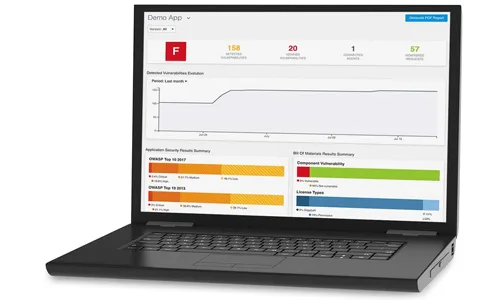
Originally developed by Synopsys, Seeker moved to Black Duck Software after Clearlake Capital and Francisco Partners acquired the Software Integrity Group from Synopsys in 2024 .
The thing that actually differentiates it from most IAST tools is active verification. Seeker doesn’t just watch data flow.
It generates safe payloads to confirm exploitability, and only verified findings make it into the report.
What is Seeker IAST?
Seeker deploys agents that instrument your application during testing. As requests move through your code, the agents observe execution paths, data flow, and configuration.
When Seeker spots a potential vulnerability, it constructs safe exploit payloads to verify the issue is real. This patented active verification approach produces near-zero false positives.
Seeker also tracks how sensitive data moves through your application, where personal information, credentials, and financial data get processed, stored, or transmitted.
That makes it useful for compliance audits on top of security testing.
| Capability | Details |
|---|---|
| Active Verification | When a potential vulnerability is detected, Seeker generates safe exploit payloads to confirm exploitability. Only verified findings get reported, producing near-zero false positives. |
| Sensitive Data Tracking | Tracks personal information, credentials, and financial data through application code. Maps where sensitive data is processed, stored, and transmitted for PCI DSS, GDPR, and HIPAA compliance. |
| Broad Language Support | Covers Java, .NET, Node.js, Go, Python, Ruby, PHP, and JVM languages (Scala, Kotlin, Groovy). Supports REST, SOAP, GraphQL, and gRPC APIs. |
What are Seeker IAST’s key features?
| Feature | Details |
|---|---|
| Supported Languages | Java, .NET, Node.js, Go, Python, Ruby, PHP, Scala, Kotlin, Groovy |
| Verification | Patented active verification with safe exploit payloads |
| API Protocols | REST, SOAP, GraphQL, gRPC |
| Compliance | OWASP Top 10, PCI DSS, GDPR, HIPAA, CWE/SANS Top 25 |
| SIEM Integration | Splunk, IBM QRadar |
| SCA Integration | Black Duck SCA for open-source vulnerability correlation |
| Deployment | Requires separate Seeker enterprise server; runs on Windows and Linux |
| Automation | REST API for CI/CD integration |
Active vulnerability verification
Where most IAST tools passively observe data flow and flag anything suspicious, Seeker takes it further.
When it spots a potential SQL injection or XSS, it constructs safe payloads and sends them through the application to confirm the issue is genuinely exploitable.
If the payload doesn’t reach the vulnerable sink, the finding gets dropped.
Development teams get a list of real, confirmed issues instead of a pile of maybes to triage.
Sensitive data tracking
Seeker maps how sensitive data moves through your application: where personal information enters the system, which code processes it, and where it ends up.
- PCI DSS — tracking cardholder data through payment flows
- GDPR — identifying where personal data is processed and stored
- HIPAA — monitoring protected health information handling
The tracking produces compliance-ready reports showing data flow paths.
API discovery
Seeker discovers API endpoints exercised during testing, including REST, SOAP, GraphQL, and gRPC. Useful for maintaining accurate API inventories and catching undocumented endpoints.
Compliance reporting
Seeker generates reports mapped to specific compliance frameworks:
- OWASP Top 10
- CWE/SANS Top 25
- PCI DSS
- GDPR
- HIPAA
The reports show which requirements are affected by detected vulnerabilities, which saves time during audits.
SIEM integration
Vulnerability data feeds into Splunk and IBM QRadar for centralized monitoring. Security teams can pull Seeker findings into existing dashboards and incident response workflows.
Active verification: the Seeker moat
What actually separates Seeker from passive IAST tools like Contrast Assess and Datadog IAST is the active verification step. When the agent spots a potential SQL injection or XSS via dataflow analysis, it does not stop at “this looks vulnerable.” Seeker constructs a safe exploit payload — one that confirms exploitability without writing data, executing commands, or persisting state — and replays it through the application. If the payload reaches the vulnerable sink unmodified, the finding is confirmed and reported. If it does not, the candidate gets dropped before it ever lands in the developer’s queue. Black Duck holds the patent on the technique, and it is the reason Seeker reports near-zero false positives on customer benchmarks.
Compliance reporting bundles
Seeker’s other competitive moat is compliance reporting. The same sensitive-data tracking that maps PII, credentials, and financial data through code feeds pre-built report templates for PCI DSS (cardholder data flow), GDPR (personal data processing), and HIPAA (protected health information handling). Each report shows which detected vulnerabilities affect which regulatory controls — the kind of artifact that compliance teams used to assemble manually from scan output and CWE-to-control mapping spreadsheets. Contrast Assess covers OWASP Top 10 reporting but does not ship the same depth of regulatory mapping; for organizations whose security program is driven by audit timelines rather than developer feedback, that gap often decides the procurement.
How do I get started with Seeker IAST?
- Set up the Seeker server — Seeker requires a separate enterprise server (Windows or Linux). Install and configure the server before deploying agents.
- Deploy agents to your application — Add the Seeker agent for your language. Java uses a JVM agent argument. Node.js, Go, Python, Ruby, and PHP have their own agent packages. No source code changes needed.
- Run your tests — Execute functional tests, integration tests, or manual testing against the instrumented application. Seeker monitors in the background and actively verifies detected vulnerabilities.
- Review verified findings — Results appear in the Seeker dashboard with active verification status. Compliance reports map findings to PCI DSS, GDPR, HIPAA, and OWASP frameworks. Use the REST API to integrate results into CI/CD pipelines.
When to use Seeker IAST
Seeker fits teams that need both security testing and compliance reporting from the same tool. The active verification is particularly useful if you’ve dealt with false positive noise from other scanners.
If you already use Black Duck for software composition analysis, you get correlated findings across IAST and SCA.
If you want IAST integrated with an existing observability stack, consider Datadog IAST .
Neither Seeker nor Contrast Assess ships a free tier in 2026 — Contrast Community Edition reached end-of-life on June 30, 2025. Both vendors gate trial access behind a sales conversation.
What are alternatives to Seeker IAST?
For teams shortlisting against Seeker, three alternatives cover the most common buyer profiles.
- Sister-page comparison: Contrast Assess. Contrast Assess is the closest passive-IAST competitor. Contrast leans on always-on agents and offers a direct path to RASP via Contrast Protect; Seeker leans on active verification (auto-confirms exploitability before reporting). For a side-by-side, see Contrast Security vs Seeker .
- APM-coupled IAST. Datadog IAST , part of the broader Datadog Code Security suite, reuses Datadog APM tracers and turns on with a single env-var. The Hdiv runtime engine that Datadog acquired in 2022 powers it underneath.
- Java enterprise SAST+IAST bundle. HCL AppScan is the regulated-industry pick that bundles SAST, DAST, IAST, and SCA in one console.
- Checkmarx One. Checkmarx IAST is part of the Checkmarx One platform — useful for teams already running Checkmarx SAST and looking to consolidate.
For the broader landscape, see the IAST tools hub.