
- SonarCloud is SonarQube’s SaaS product focused on the code you write — bugs, code smells, vulnerabilities, duplication, and coverage with 6,000+ rules across 30 languages.
- Snyk is a developer security platform spanning SAST (Snyk Code), SCA (Open Source), Container, IaC, and DAST — covering your entire application stack, not just source code.
- SonarCloud’s free tier gives 50K lines of code, 5 users, and PR analysis; Snyk’s free tier gives 700 tests/month across all products.
- SonarCloud supports 30 languages with quality gates that enforce coverage, duplication, and reliability thresholds; Snyk Code supports 16 languages with a focus on security vulnerabilities.
- Both offer AI fix suggestions — SonarCloud has AI CodeFix (LLM-powered) and Snyk has DeepCode AI — but SonarCloud adds code quality metrics that Snyk does not track.
Which is better: SonarCloud or Snyk?#
SonarCloud is a code quality and security platform that analyzes the code you write, while Snyk is a developer security platform that scans your code, dependencies, containers, and infrastructure.
Choose SonarCloud if code quality enforcement (bugs, duplication, coverage gates) matters as much as security. Choose Snyk if you need security scanning across multiple layers of your application stack.
SonarCloud is SonarQube’s SaaS product, built for teams that want code quality and security analysis without managing infrastructure.
It scans source code for bugs, vulnerabilities, code smells, duplication, and coverage gaps across 30 languages using the same 6,000+ rules as SonarQube Server.
Quality gates can block merges when code falls below configured thresholds for any of those dimensions.
Snyk is a developer security platform that covers multiple layers of the application stack. Snyk Code handles SAST, Snyk Open Source handles SCA with a proprietary vulnerability database, Snyk Container scans images, and Snyk IaC catches infrastructure misconfigurations.
It focuses on security rather than code quality, and it goes wide rather than deep on any single layer.
The difference comes down to scope. SonarCloud gives you visibility into the health of the code you write, covering quality, maintainability, and security in one place.
Snyk gives you security coverage across your code, dependencies, containers, and infrastructure. Many teams run both.
What are the main differences?#
| Feature | SonarCloud | Snyk |
|---|---|---|
| Primary focus | Code quality + security (SAST) | Security across the stack (SAST, SCA, Container, IaC) |
| Deployment | SaaS only | SaaS (Snyk Broker for hybrid) |
| Free tier | 50K LOC, 5 users, PR analysis | 200 open-source + 100 code + 100 container + 300 IaC tests/month |
| Languages | 30 | 16 (Snyk Code) |
| Analysis rules | 6,000+ | Semantic AI engine (DeepCode) |
| Quality gates | Yes (coverage, duplication, reliability, security) | No |
| Code quality metrics | Bugs, code smells, duplication, coverage, tech debt | No |
| SCA / dependency scanning | Limited | Yes (proprietary database, automated fix PRs) |
| Container scanning | No | Yes (Snyk Container) |
| IaC scanning | No | Yes (Snyk IaC) |
| AI fix suggestions | AI CodeFix (LLM-powered) | DeepCode AI Fix |
| PR decoration | GitHub, GitLab, Azure DevOps, Bitbucket | GitHub, GitLab, Bitbucket, Azure DevOps |
| SBOM generation | No | Yes (SPDX, CycloneDX) |
SonarCloud vs Snyk: how do they compare?#
Code quality vs security focus#
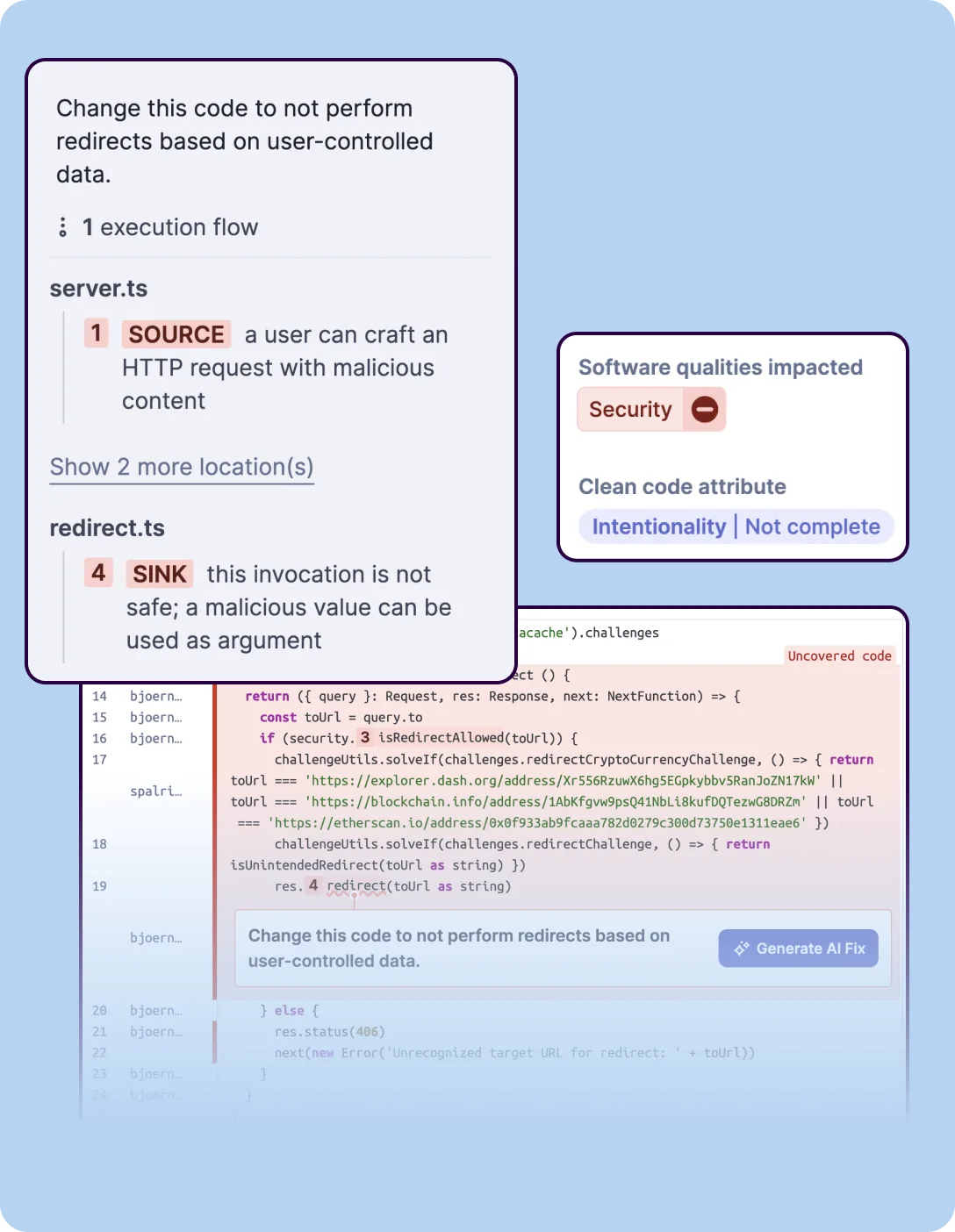 SonarCloud’s SAST analysis (shared engine with SonarQube) tracing a redirect vulnerability from a user-controlled HTTP request to an unsafe sink, with clean code attribute classification.
SonarCloud enforces code quality and security together. Snyk focuses on security across multiple application layers but does not track code quality metrics.
SonarCloud tracks five dimensions of code health: reliability (bugs), security (vulnerabilities and hotspots), maintainability (code smells), duplication, and test coverage.
Its quality gates enforce thresholds across all five, so a merge can be blocked because coverage dropped below 80% or because duplication exceeded 3%, not only when a vulnerability is found.
Snyk focuses on security. Snyk Code catches vulnerabilities in your source code, Snyk Open Source catches CVEs in your dependencies, Snyk Container finds vulnerabilities in base images, and Snyk IaC flags misconfigurations in Terraform, CloudFormation, and Kubernetes manifests.
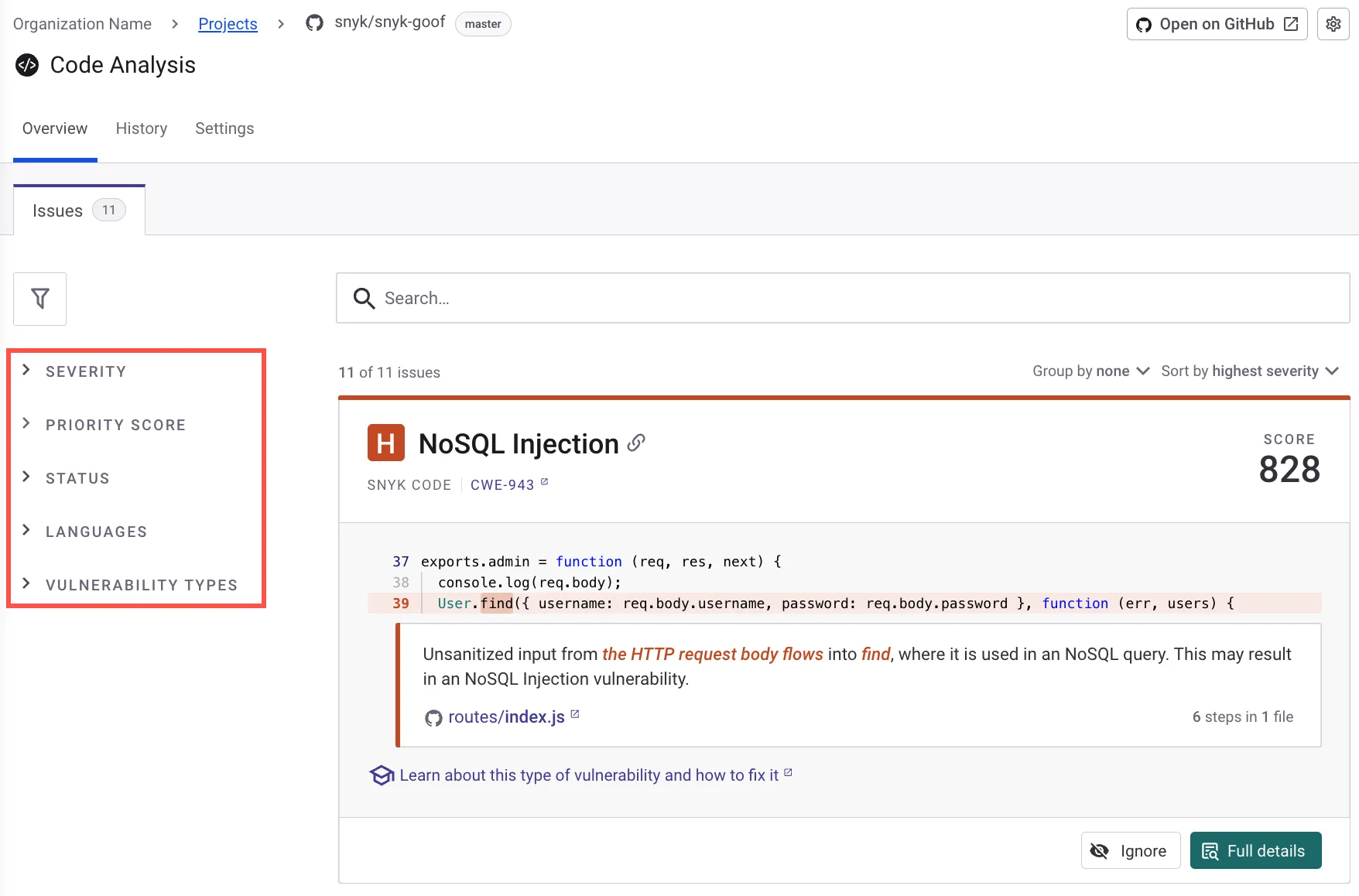 Snyk Code displaying a NoSQL Injection finding (CWE-943) with inline code context, data flow from HTTP request body to database query, and priority score of 828.
It covers security across those layers but does not track code smells, duplication, or coverage.
If your team needs one tool that enforces both code quality standards and security, SonarCloud does that. If you already handle code quality through other means and need security coverage across multiple layers, Snyk is the better fit.
Free tier comparison#
SonarCloud’s free tier is more generous for small teams, offering 50K lines of code with no scan limits. Snyk’s free tier covers more security categories but caps usage at 700 tests per month.
SonarCloud’s free plan includes 50K lines of code, 5 users, PR analysis, and quality gates across 30 languages with unlimited scans. Public open-source projects get unlimited analysis.
For a small team on a modest codebase, that is enough to run real quality enforcement at zero cost.
Snyk’s free tier gives individual developers 700 tests per month across the platform (200 open-source, 100 code, 100 container, 300 IaC). You get multi-layer security scanning, but the monthly test limit can run out quickly on active projects.
If you want unlimited code quality analysis, SonarCloud’s free tier is harder to exhaust. If you are a solo developer who wants full-stack security scanning, Snyk’s free tier covers more categories.
Language coverage#
SonarCloud supports 30 languages for free, nearly double Snyk Code’s 16+ language groups. For mainstream languages like Java, Python, JavaScript, and Go, both tools have full support.
SonarCloud covers 30 languages in its free tier, including Java, Python, JavaScript, TypeScript, C#, Go, PHP, Ruby, Kotlin, Swift, C, and C++.
The commercial SonarQube Server editions add COBOL, Apex, ABAP, PL/SQL, and T-SQL for 35+ total. For most modern stacks, SonarCloud’s free tier is enough without paid upgrades.
Snyk Code supports 16+ language groups for SAST: Java, Kotlin, JavaScript, TypeScript, Python, Go, C#, VB.NET, PHP, Ruby, Scala, Swift, Objective-C, C/C++, Apex, Dart, Groovy, and Rust.
For mainstream languages the overlap is large, but SonarCloud covers more languages overall. If you use less common languages, check Snyk Code support before committing.
PR decoration and CI/CD integration#
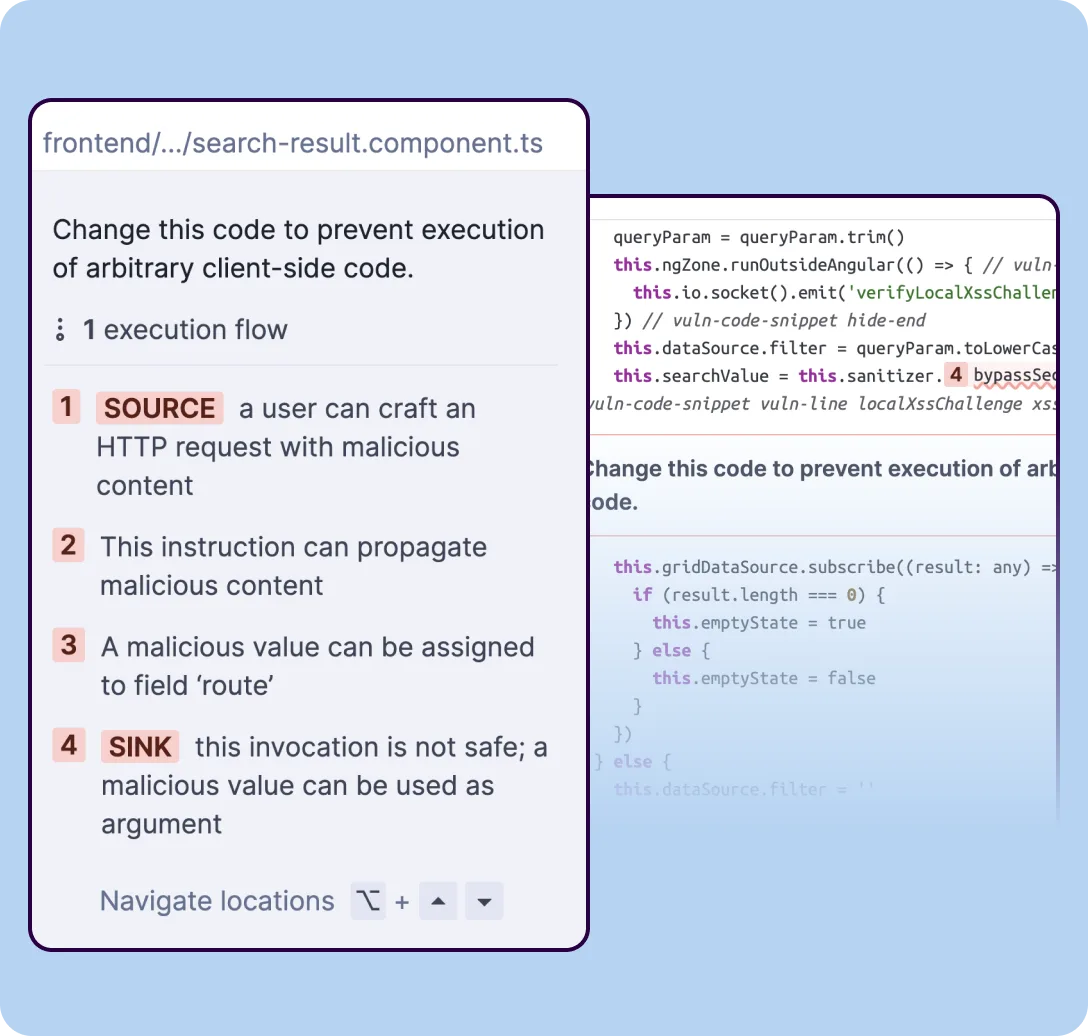 SonarCloud’s taint analysis (same engine as SonarQube) tracing data flow across files with step-by-step navigation from source to sink.
Both tools decorate pull requests, but SonarCloud shows quality metrics (coverage, duplication, reliability) alongside security findings, while Snyk focuses on security and can open automated fix PRs for vulnerable dependencies.
SonarCloud shows new issues, quality gate status, coverage changes, and duplication metrics on PRs across GitHub, GitLab, Bitbucket, and Azure DevOps. Developers see whether the new code meets quality standards, not just whether it has security findings.
Snyk decorates PRs with security findings and can open automated fix PRs for vulnerable dependencies. The scope is narrower (security only) but includes concrete remediation: upgrade this package to version X to fix CVE-Y. For dependency management, Snyk’s automated fix PRs cut manual work.
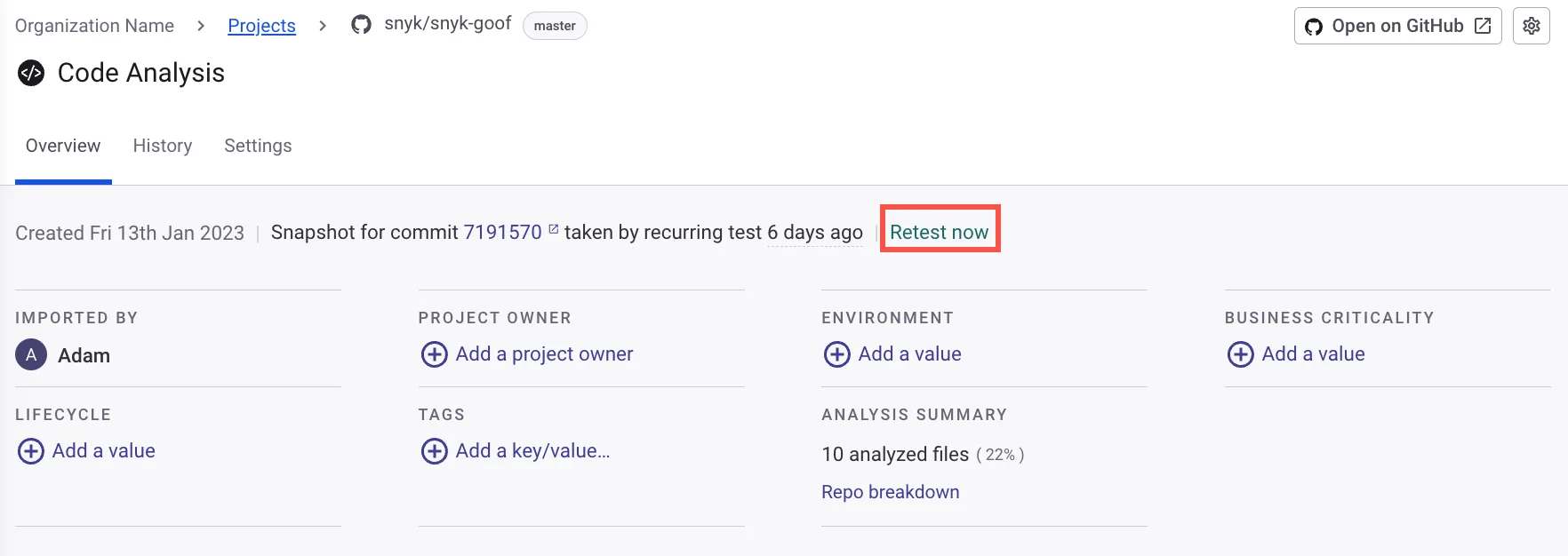 Snyk’s Code Analysis overview showing the scan snapshot with commit reference, project owner, lifecycle settings, and analysis summary for a connected repository.
The bigger difference is quality gates. A single SonarCloud gate can enforce minimum coverage, maximum duplication, zero critical bugs, and zero high-severity vulnerabilities at the same time. Snyk only gates on security severity thresholds.
When to choose SonarCloud#
- Code quality enforcement matters as much as security to your team
- You want quality gates covering coverage, duplication, reliability, and security in one tool
- Your team is small enough to fit within the free tier (50K LOC, 5 users)
- You need broad language support (30 languages) without paying
- SaaS-only deployment works for your organization (no self-hosting needed)
- You want PR decoration that shows quality metrics alongside security findings
When to choose Snyk#
- Security across multiple layers (code, dependencies, containers, IaC) is the priority
- You need SCA with automated fix PRs and a proprietary vulnerability database
- You need container image scanning and IaC misconfiguration detection
- You need SBOM generation for compliance (SPDX, CycloneDX)
- Your team already handles code quality through other tooling
- You want reachability analysis to filter SCA noise on Java, JavaScript, and Python projects
SonarCloud and Snyk solve different problems and pair well together. SonarCloud watches the quality and security of the code you write.
Snyk watches the security of everything your code depends on. Teams that run both get code quality enforcement and full-stack security coverage in a single pipeline. For more options, see the full SAST tools comparison.
Frequently Asked Questions
What is the main difference between SonarCloud and Snyk?
Which tool has a better free tier?
Can I use SonarCloud and Snyk together?
What is the difference between SonarCloud and SonarQube?
Which tool is better for security scanning?

Written & maintained by
Suphi CankurtEight years on the vendor side of application-security sales — thousands of evaluations and demos. I started AppSec Santa in 2022 to put that insider view to work for buyers. Independent of any vendor, paid by none, and honest about what fits whom.