
- Snyk scans source code directly using DeepCode AI across 16 languages; Veracode scans compiled binaries without source code access across 100+ languages and frameworks including legacy COBOL and Visual Basic 6.
- Snyk offers a free tier and Team plans from $25/dev/month; Veracode is commercial-only with no public pricing.
- Veracode’s Pipeline Scan returns results in under 90 seconds for CI/CD; Snyk Code provides near-real-time feedback in IDEs and pull requests.
- Snyk covers SAST, SCA, container, IaC, and DAST in one platform; Veracode covers SAST, DAST, SCA, and manual penetration testing.
- Snyk leads on developer experience with 2.5M+ developers on the platform; Veracode leads on binary analysis and legacy language coverage.
Which is better: Snyk or Veracode?#
Snyk is better for developer-first teams that want source code scanning, a free tier, and broad platform coverage (SAST, SCA, container, IaC, DAST).
Veracode is better for regulated enterprises that need binary analysis without sharing source code, legacy language support, and compliance-driven reporting.
Snyk grows from the developer up. It plugs into IDEs, Git repositories, and CI/CD pipelines with a free tier that lets individual developers start scanning immediately.
The platform covers five product areas under one roof: Snyk Code (SAST), Snyk Open Source (SCA), Snyk Container, Snyk IaC, and Snyk API & Web (DAST). Pricing starts at $25 per developer per month for Team plans.
Veracode takes a different approach. Instead of scanning source code, it analyzes compiled binaries – JAR files, .NET assemblies, and other bytecode formats.
Source code never leaves the organization, which matters in regulated industries. Veracode covers SAST, DAST, SCA, and manual penetration testing, with support for 100+ languages and frameworks including legacy COBOL and Visual Basic 6.
What are the main differences?#
| Feature | Snyk | Veracode |
|---|---|---|
| License | Freemium | Commercial |
| Pricing | Free tier; Team from $25/dev/month; Enterprise custom | No public pricing (contact sales) |
| Analysis approach | Source code | Binary / bytecode |
| Languages | 16 languages | 100+ languages and frameworks |
| Platform scope | SAST, SCA, Container, IaC, DAST | SAST, DAST, SCA, Pen Testing |
| AI features | DeepCode AI fix suggestions | Veracode Fix (AI) |
| Fast CI/CD scan | Near-real-time in PRs and IDEs | Pipeline Scan (under 90 seconds) |
| IDE plugins | VS Code, JetBrains, Eclipse, Cursor | VS Code, JetBrains, Eclipse, Visual Studio |
| CI/CD integrations | GitHub Actions, GitLab CI, Jenkins, Azure DevOps | 40+ integrations (Jenkins, GitHub Actions, Azure DevOps, more) |
| Deployment | Cloud (Snyk Broker for hybrid) | Cloud only |
| Free tier | Yes | No |
Snyk vs Veracode: how do they compare?#
How does source code analysis differ from binary analysis?#
Snyk scans source code; Veracode scans compiled binaries. This is the fundamental architectural difference and shapes everything else about how the two platforms work.
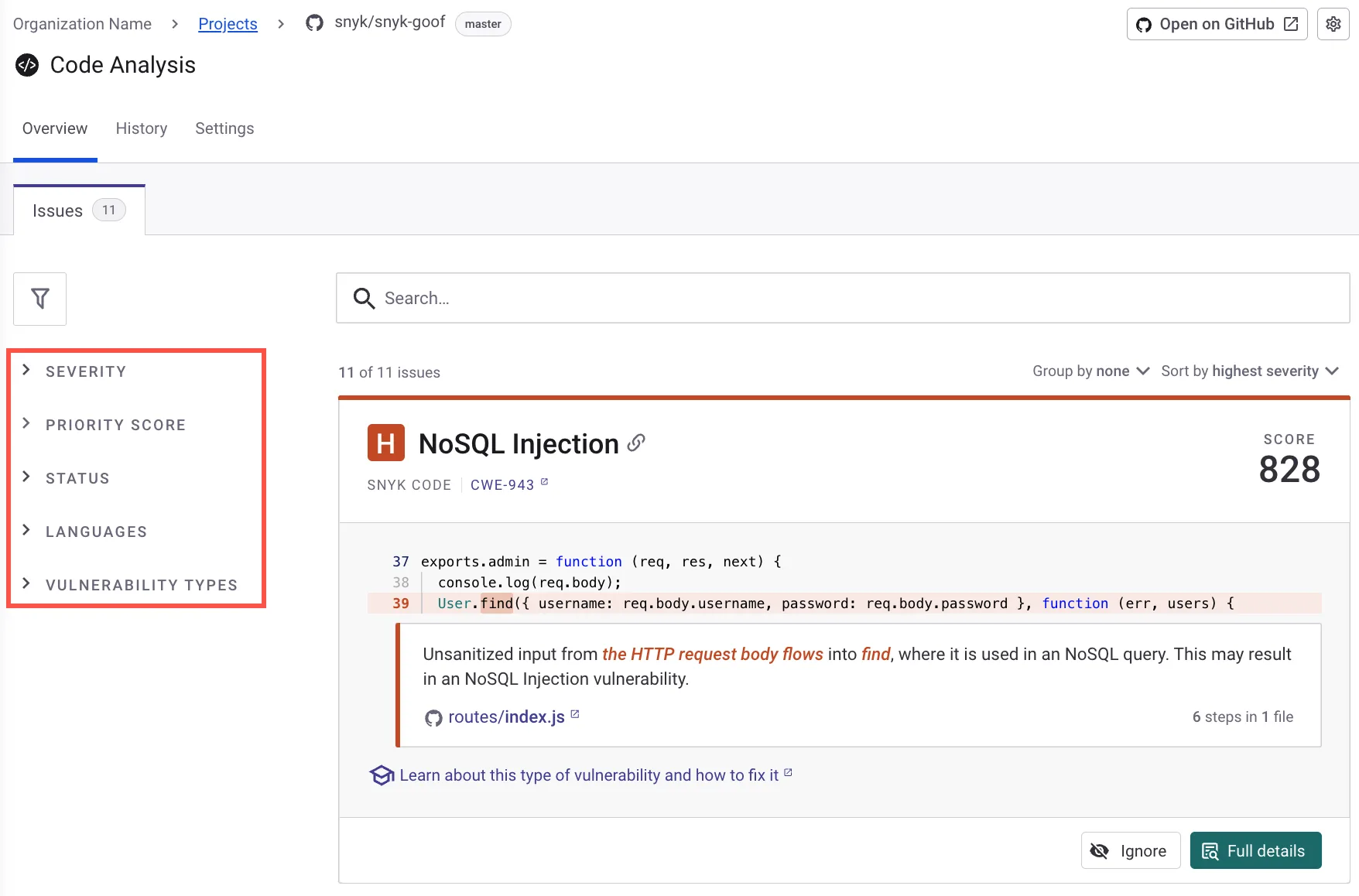 Snyk Code’s source-level analysis: a NoSQL Injection finding with CWE-943 mapping, inline code highlighting, and data flow from HTTP request body to database query.
Snyk Code scans source code directly, using the DeepCode AI engine to identify vulnerability patterns semantically across 16 languages. Findings map to specific lines of code, and developers see results in their IDE or pull request within seconds.
A developer writes code, commits, and gets security findings before the review is done.
Veracode scans compiled binaries. You build your application and upload the bytecode (JAR files, .NET assemblies, or similar formats).
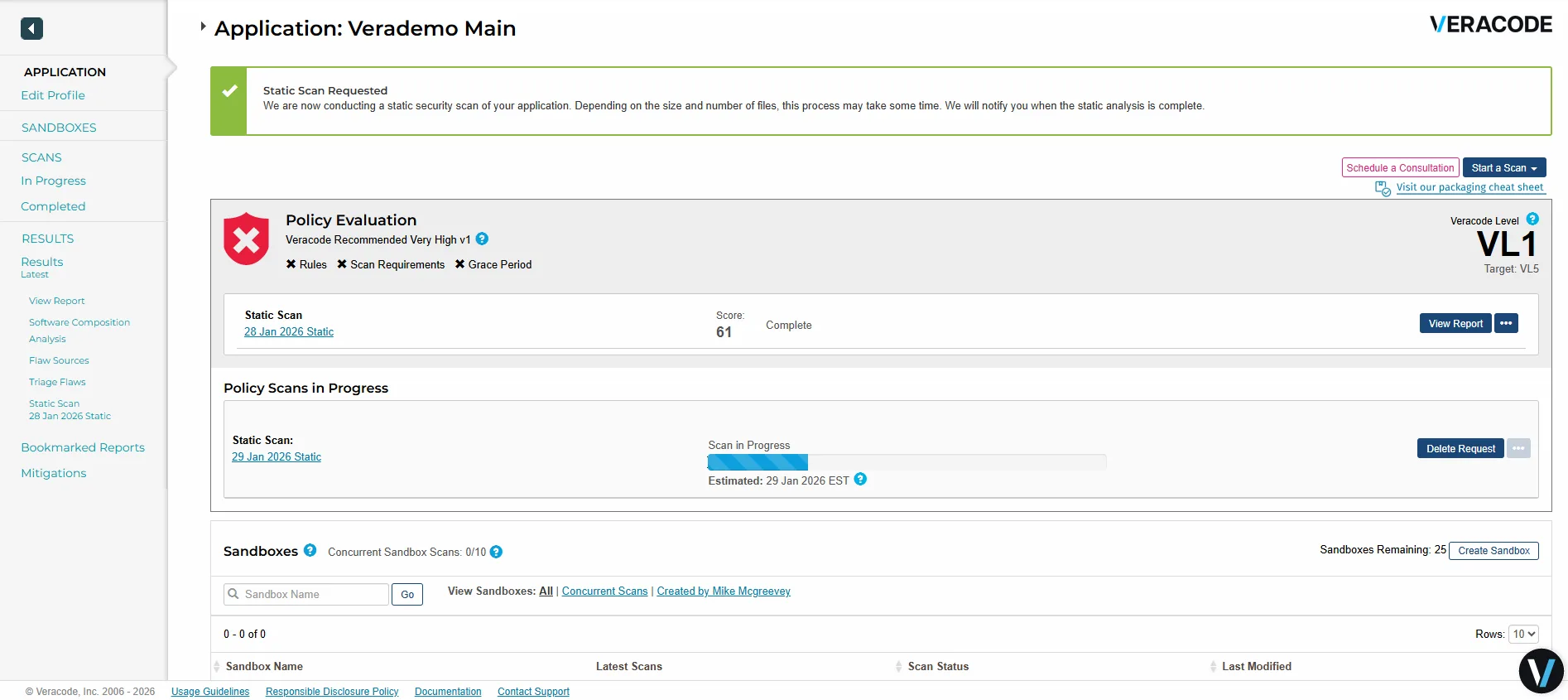 Veracode’s platform view showing a static scan with policy evaluation results, Veracode Level rating (VL1), scan progress tracking, and sandbox management for an application.
The platform analyzes the binary to find security flaws, including issues introduced by compilers or third-party libraries bundled into the build.
Source code never leaves the organization, which is a hard requirement for some regulated environments.
The tradeoff is less granular feedback – binary-level findings do not pinpoint the exact source line as precisely as source code analysis.
Which platform covers more security testing types?#
Snyk has broader platform coverage with five product areas: Snyk Code (SAST), Snyk Open Source (SCA), Snyk Container, Snyk IaC, and Snyk API & Web (DAST). Veracode covers four areas: SAST, DAST, SCA, and manual penetration testing.
All of Snyk’s products feed into a single dashboard with Snyk AppRisk for prioritization. If you want one platform covering code, dependencies, containers, and infrastructure as code, Snyk has the broader automated scope.
Veracode’s pen testing service is worth noting. Having human security testers available through the same vendor simplifies procurement for organizations that need both automated and manual testing.
Veracode’s platform is narrower than Snyk’s in automated testing categories, but the manual pen testing option fills a gap that no automated tool can replace.
Which is faster in CI/CD pipelines?#
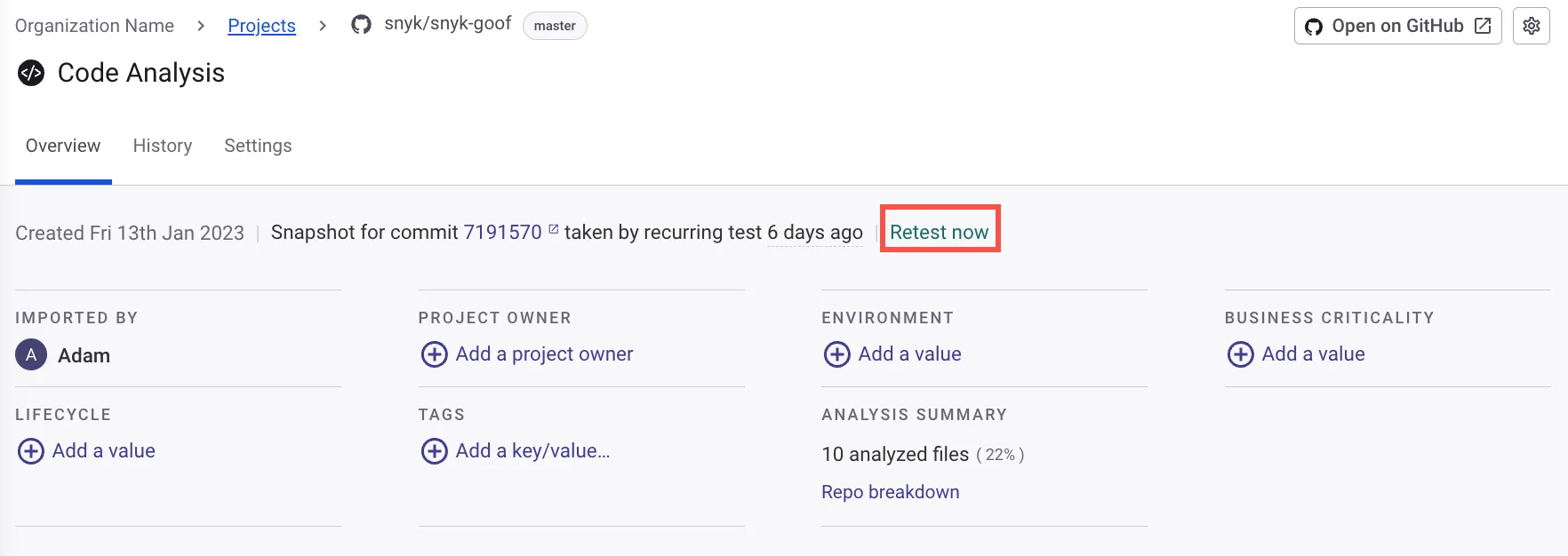 Snyk’s project overview for Code Analysis showing the scan snapshot, analysis summary with file count, and project metadata for a GitHub-connected repository.
Both tools are fast enough for CI/CD gating, but they optimize for different stages. Snyk Code returns results in seconds during pull requests and IDE use.
Veracode’s Pipeline Scan returns results in under 90 seconds on compiled binaries.
Veracode’s Pipeline Scan is built specifically for CI/CD speed. That makes it practical as a pull request gate on compiled output without slowing developers down.
The full Platform Scan takes longer but gives deeper analysis for compliance and release gates.
Snyk Code scans near-real-time on source code. For CI/CD, Snyk integrates with GitHub Actions, GitLab CI, Jenkins, and Azure DevOps.
Veracode has 40+ integrations across IDEs, CI/CD, and developer tools. The real difference is where speed matters: Veracode optimizes for pipeline speed on compiled output, while Snyk optimizes for developer speed on source code in the IDE.
Which is better for compliance and regulated industries?#
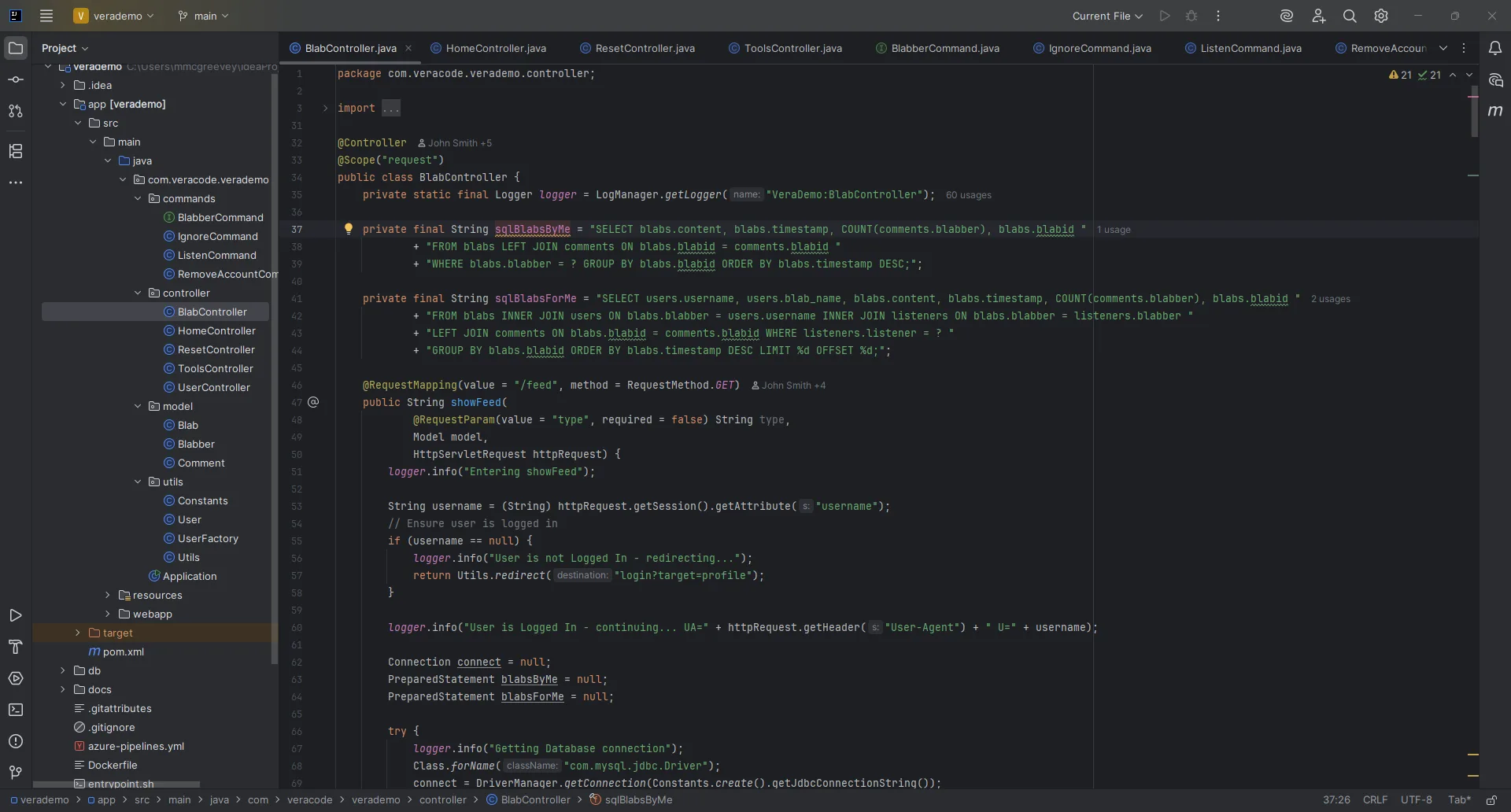 Veracode’s direct source code scanning integration showing a Java application with security-relevant code highlighted in the IDE view.
Veracode is the stronger choice for compliance-driven organizations. Binary analysis inherently keeps source code internal, satisfying strict data handling policies common in financial services, government, and defense.
The platform provides detailed compliance reporting, policy enforcement, and manual penetration testing.
Snyk is cloud-first. Organizations that cannot send source code to external services use Snyk Broker, which keeps code on-premises while analysis runs in Snyk’s cloud.
Snyk provides SOC 2 reporting and policy engines through Snyk AppRisk, but its compliance feature set is not as deep as Veracode’s.
If developer adoption matters more than compliance depth, Snyk works well. If compliance drives the decision and source code cannot leave the organization, Veracode fits better.
When should you choose Snyk?#
Choose Snyk if:
- Developer adoption and minimal friction are top priorities – Snyk’s free tier lets developers start scanning with zero procurement overhead
- You want source code scanning with line-of-code findings that map directly to your IDE and pull requests
- You need the broadest platform scope in one tool: SAST, SCA, container, IaC, and DAST under a single dashboard
- IDE-first feedback in VS Code, JetBrains, or Cursor is important for catching issues before commit
- Your stack is cloud-native (JavaScript, Python, Go, Java) and does not require legacy language support
- Automated fix suggestions via DeepCode AI would save remediation time on common vulnerability patterns
- Budget transparency matters – Team plans start at $25 per developer per month with a published pricing page
When should you choose Veracode?#
Choose Veracode if:
- Source code cannot leave the organization – binary analysis keeps all source internal by design
- You need legacy language support that other tools lack (COBOL, Visual Basic 6, PL/SQL, and 100+ languages total)
- Fast CI/CD binary scanning is a priority – Pipeline Scan returns results in under 90 seconds on compiled output
- Compliance and audit requirements drive your security program, and detailed reporting is a must
- Manual penetration testing from the same vendor simplifies procurement for organizations that need both automated and manual assessments
- Cloud-only deployment with zero infrastructure maintenance fits your operating model
Both tools are widely deployed at enterprise scale. For more comparisons, browse the AppSec Santa SAST tools category.
Frequently Asked Questions
What is the main difference between Snyk and Veracode?
Which tool supports more languages?
How do Snyk and Veracode compare for CI/CD pipelines?
Can you use Snyk and Veracode together?
Which is better for compliance?

Written & maintained by
Suphi CankurtEight years on the vendor side of application-security sales — thousands of evaluations and demos. I started AppSec Santa in 2022 to put that insider view to work for buyers. Independent of any vendor, paid by none, and honest about what fits whom.