
- Salt Security discovers shadow APIs through traffic analysis, cloud connectors, external surface scanning, and GitHub scanning; 42Crunch requires OpenAPI specifications as the foundation.
- 42Crunch IDE extensions have 2M+ downloads and run 300+ security checks with 0-100 scoring; Salt Security has no IDE integration and is designed for security teams, not developers.
- Salt's behavioral ML detects logic-based attacks (BOLA, credential stuffing, data exfiltration) that 42Crunch's contract-based firewall cannot catch with valid request structures.
- 42Crunch's micro API firewall enforces a positive security model inline; Salt operates out-of-band via traffic mirroring with zero latency but no native blocking.
- Salt maps posture against PCI DSS, HIPAA, GDPR, SOC 2, NIST, CMMC, and FedRAMP; 42Crunch provides per-API contract compliance through its audit-scan-enforce pipeline.
Which Is Better: Salt Security or 42Crunch?
Salt Security and 42Crunch both protect APIs, but they approach the problem from opposite ends of the development lifecycle.
Salt Security is a runtime API protection platform. It discovers APIs you did not know existed by analyzing live traffic, cloud environments, and your external attack surface.
Once it maps your API landscape, behavioral ML baselines normal traffic patterns and flags anomalies that indicate attacks like BOLA exploitation, credential stuffing, or data exfiltration.
Salt works after deployment — its strength is finding and protecting APIs in production.
42Crunch is a shift-left API security platform. It starts with the OpenAPI specification itself, running 300+ security checks against the definition before any code ships.
The conformance scanner tests live APIs against the documented contract. The micro API firewall then enforces that contract in production, blocking any request that falls outside the spec. 42Crunch works before and during deployment — its strength is making sure APIs are built correctly from design through runtime.
Pick Salt Security when API discovery and runtime threat detection are your priority. Pick 42Crunch when API specification quality and contract enforcement matter most.
What Are the Key Differences?
| Feature | Salt Security | 42Crunch |
|---|---|---|
| License | Commercial | Commercial (free tier available) |
| Primary Focus | Runtime API discovery & protection | Shift-left API spec security & contract enforcement |
| API Discovery | Traffic analysis, cloud connectors, external surface scan, GitHub scan | API discovery (spec-focused) |
| OpenAPI Spec Auditing | No | Yes (300+ checks, 0-100 scoring) |
| Conformance Testing | No | Yes (dynamic testing against OpenAPI contract) |
| Runtime Protection | Behavioral ML threat detection | Micro API firewall (positive security model) |
| Attack Detection | BOLA, credential stuffing, data exfiltration, account takeover, injection | Blocks non-conforming requests (schema violations, injection) |
| Detection Approach | Behavioral anomaly detection | Contract enforcement (allowlist-based) |
| AI/MCP Security | MCP Protect, Agentic AI Governance, GitHub Connect | No |
| IDE Integration | No | VS Code, JetBrains (19+ IDEs), Eclipse (2M+ downloads) |
| CI/CD Integration | Limited | GitHub Actions, GitLab, Azure Pipelines, Jenkins, Bitbucket, Bamboo, Tekton |
| Compliance Frameworks | PCI DSS, HIPAA, GDPR, SOC 2, NIST, CMMC, FedRAMP | Contract-based compliance enforcement |
| Sensitive Data Tracking | PII, PHI, payment data in API traffic | Data validation via OpenAPI schema checks |
| Deployment Model | Cloud SaaS or on-prem, agentless | SaaS platform + sidecar firewall |
| Gateway Integrations | Kong, Apigee, MuleSoft, NGINX, Istio | Platform-level integration |
| Founded | 2016 | 2016 |
| Backed By | Venture-backed (Palo Alto HQ) | Adara Ventures, Energy Impact Partners ($17M Series A) |
Salt Security vs 42Crunch: How Do They Compare?
API Discovery
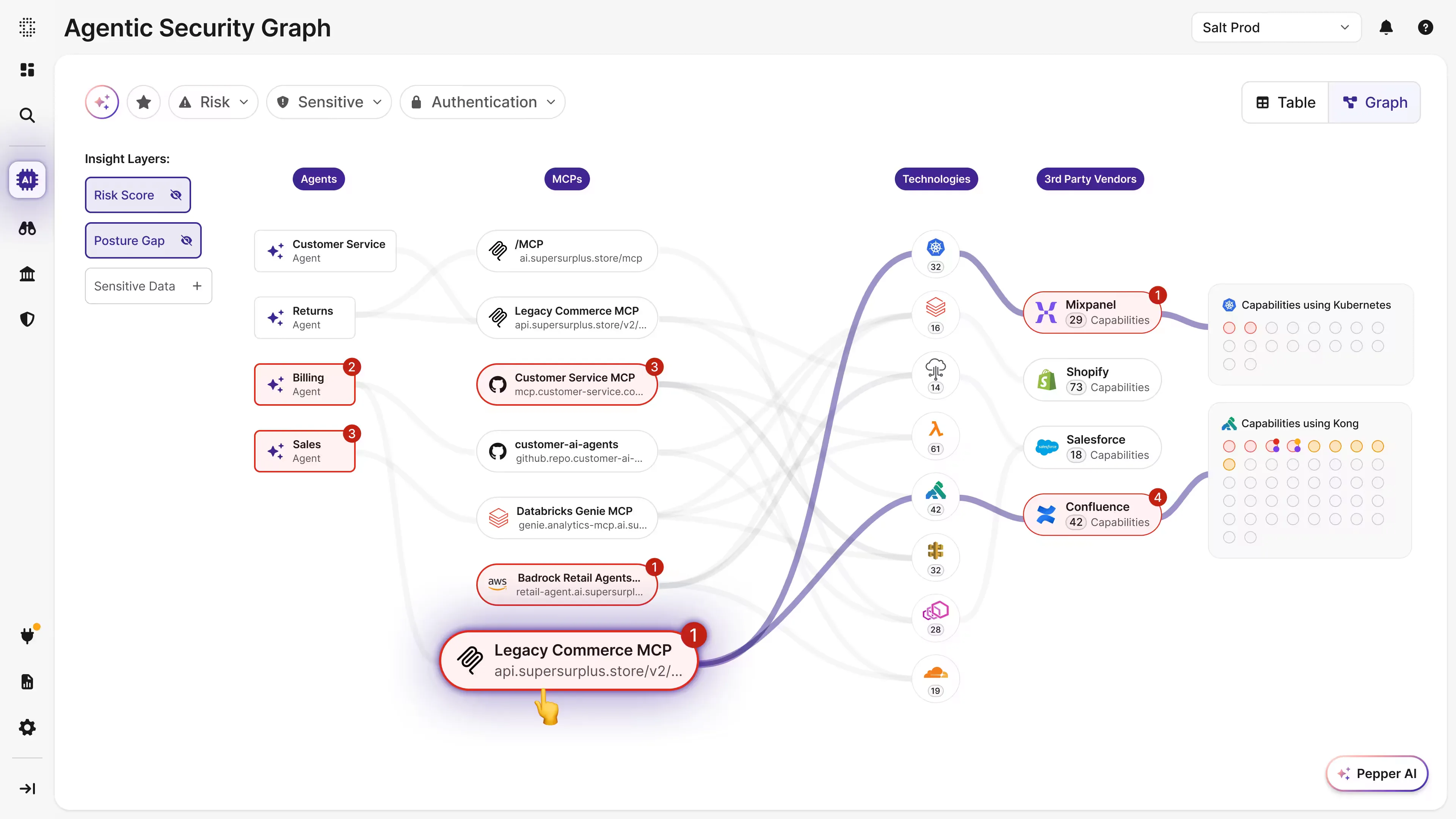
This is Salt Security’s strongest differentiator. Salt discovers APIs through four simultaneous channels: Salt Connect pulls metadata from cloud accounts and gateways like Kong, Apigee, and MuleSoft.
Salt Surface scans your external attack surface from an adversary’s perspective. Traffic analysis identifies undocumented endpoints, including shadow APIs and deprecated-but-still-active zombie APIs.
GitHub Connect scans source code repositories for API endpoints and MCP servers before deployment. According to Salt Security research, roughly 30% of APIs go undiscovered by CDN-based tools alone.
42Crunch added API discovery capabilities, but its core model assumes you already have OpenAPI definitions or are willing to create them.
The API Contract Generator helps by converting Postman Collections and HAR files into OpenAPI specs, which is a practical path for teams with undocumented APIs.
Still, 42Crunch does not perform traffic-based or external surface discovery the way Salt does.
If you suspect your actual API count is larger than what your documentation or gateway shows, Salt’s multi-source discovery approach addresses that gap directly. If your APIs are well-documented and the challenge is making sure those definitions are secure, 42Crunch’s spec-first approach is more relevant.
Design-Time vs Runtime Security
The fundamental philosophical difference between these two platforms comes down to when security gets applied.
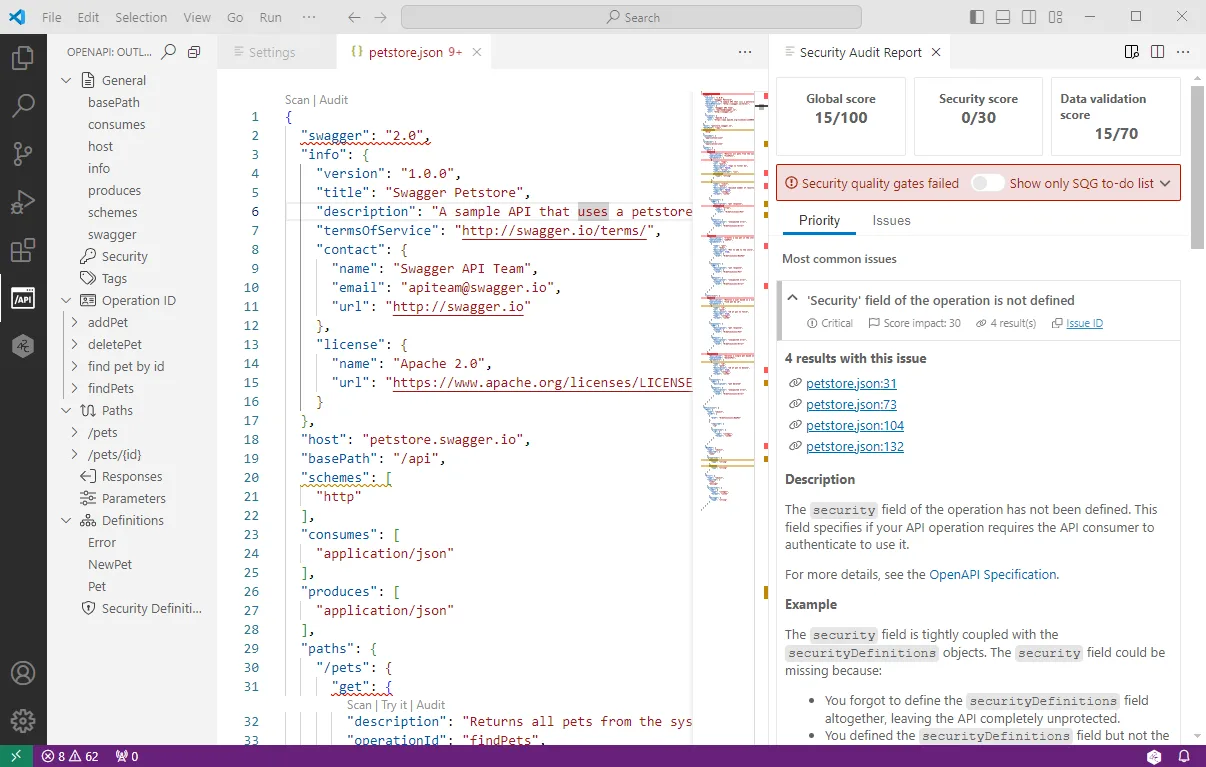
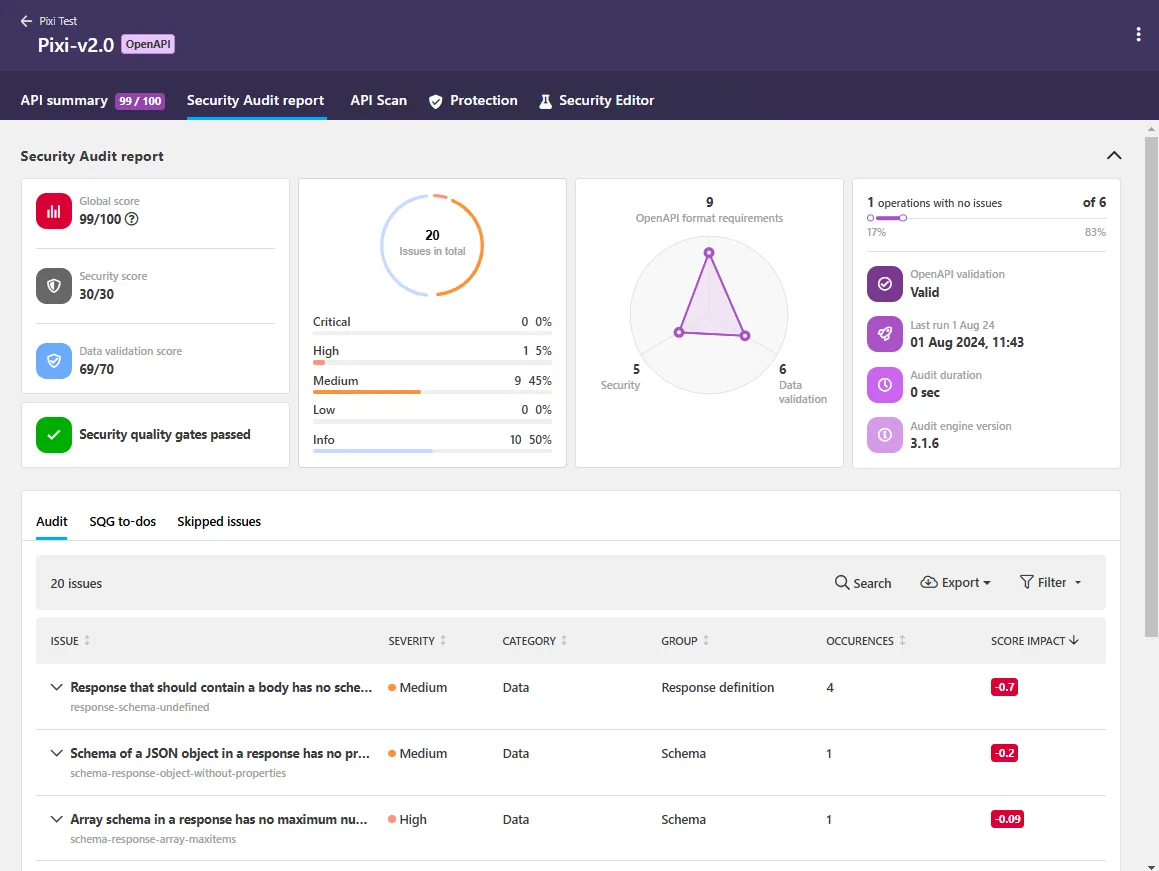
42Crunch embeds security into the development process. A developer writes or updates an OpenAPI spec, and the IDE extension immediately runs 300+ checks — scoring the definition from 0 to 100 across security definitions and data validation.
Issues get flagged with quick-fix suggestions before a pull request is opened. In CI/CD, the audit action gates merges based on minimum score thresholds.
The conformance scanner then tests the running API against the spec to verify the implementation matches the contract. This is textbook shift-left: catch problems when they are cheapest to fix.
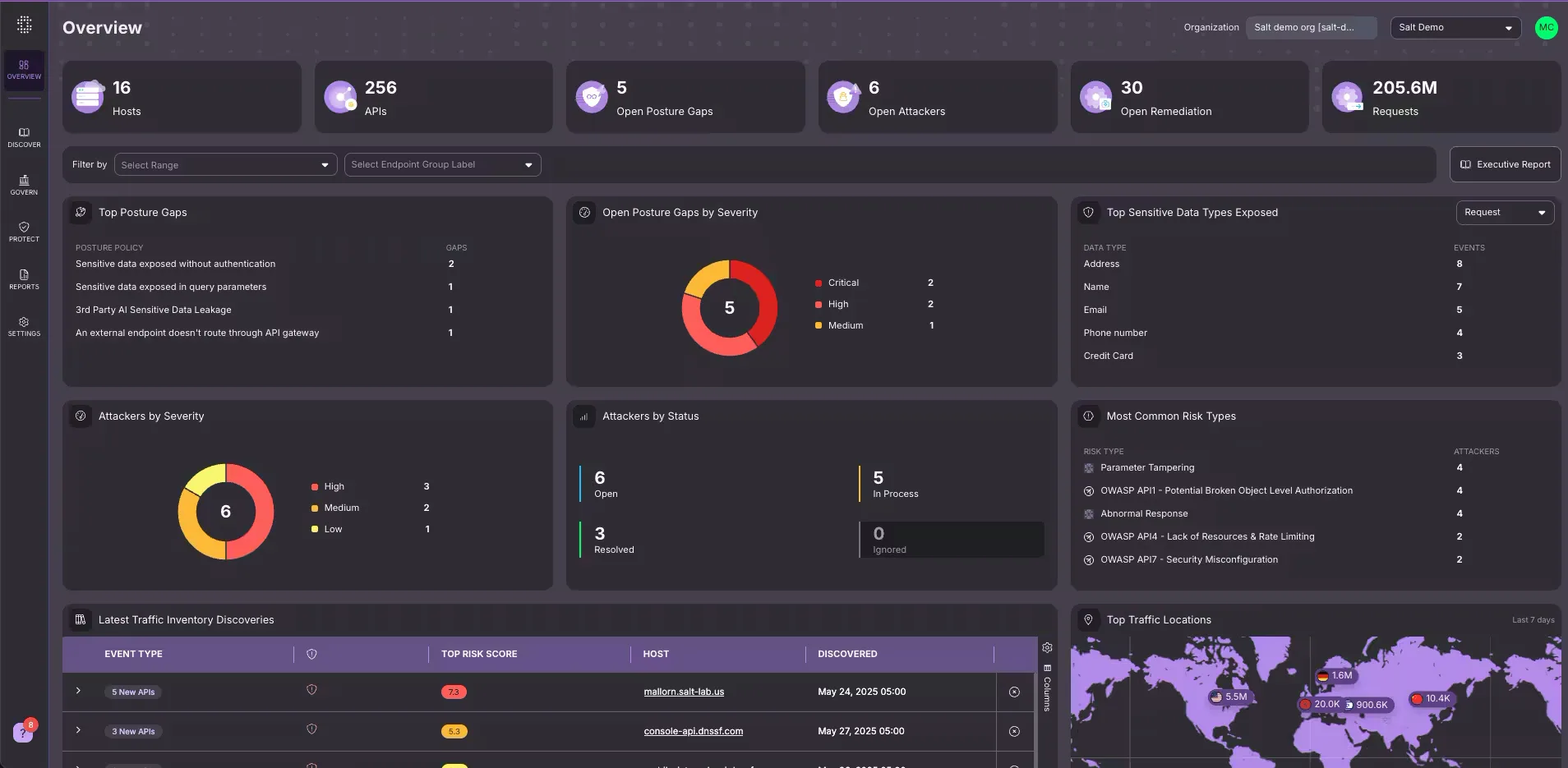
Salt Security operates after APIs are deployed. It watches live traffic, learns what normal behavior looks like over days and weeks, and then flags deviations that match attacker patterns.
This catches problems that no amount of pre-deployment testing can find — real attackers probing for BOLA vulnerabilities, gradual data scraping campaigns, or credential stuffing across multiple endpoints.
Runtime context reveals threats that static analysis and conformance testing simply cannot predict.
Neither approach replaces the other. 42Crunch prevents insecure APIs from reaching production. Salt Security catches threats that emerge after production deployment.
Attack Detection and Runtime Protection
Salt Security detects attacks through behavioral analysis. Its ML engine baselines normal API traffic patterns and identifies anomalies that indicate attacker intent.
This covers logic-based attacks that WAFs routinely miss: BOLA/IDOR exploitation, slow credential stuffing, systematic data exfiltration, account takeover via session manipulation, and API abuse patterns.
Salt operates out-of-band by analyzing mirrored traffic, so it adds zero latency to the request path.
The tradeoff is that detection is not inline blocking — Salt alerts and provides attack timelines rather than dropping malicious requests in real time.
42Crunch’s micro API firewall takes the opposite approach. It sits inline as a sidecar proxy and enforces the OpenAPI contract on every transaction.
The firewall uses a positive security model — it builds an allowlist from the API definition and blocks anything that falls outside it.
A request with an unexpected parameter, a response with an undeclared field, or a call to an undocumented endpoint all get rejected. This stops injection attacks, schema violations, and data leakage by definition.
The tradeoff is that it only blocks what the OpenAPI spec defines as invalid.
Logic-based attacks that use valid request structures (like BOLA, where the attacker sends a legitimate-looking request with someone else’s object ID) can pass through if the spec does not enforce object-level authorization rules.
Salt is stronger against behavioral and logic-based attacks. 42Crunch is stronger against contract violations and structural attacks.
Developer Experience and Shift-Left Integration
42Crunch has a clear lead in developer tooling. Its IDE extensions — over 2 million downloads across VS Code, JetBrains, and Eclipse — put API security directly in the editor.
Developers see audit scores, severity-tagged issues, and one-click fixes while writing OpenAPI definitions. The freemium tier works without an account, lowering the barrier to adoption.
CI/CD integration covers GitHub Actions, GitLab, Azure Pipelines, Jenkins, Bitbucket, Bamboo, and Tekton with SARIF output for code scanning dashboards.
Salt Security is not a developer tool in the same sense. It is a security platform that connects to cloud infrastructure and analyzes production traffic.
The primary users are security teams, not developers. Salt integrates with SIEM and SOAR platforms (Splunk, CrowdStrike, Microsoft Sentinel) and ticketing tools (Jira, Slack) rather than IDEs and CI pipelines.
GitHub Connect scans repositories for shadow APIs, but the overall workflow is security-team-centric rather than developer-centric.
Teams that want API security embedded in the development process from day one will find 42Crunch’s IDE and CI/CD integrations more immediately useful. Teams that need centralized API visibility and runtime protection across a large environment will find Salt’s security-operations approach more relevant.
Compliance and Posture Management
According to Salt Security, the platform ships with nearly 100 pre-loaded posture rules mapped to PCI DSS, HIPAA, GDPR, SOC 2, NIST, CMMC, and FedRAMP.
The Policy Hub evaluates every discovered API against these rules and surfaces posture gaps grouped by severity. Custom rules can be added, and reports can be exported for auditors.
Salt’s approach to compliance is broad — it covers the API landscape at the organizational level and measures posture across frameworks.
42Crunch approaches compliance through contract enforcement. The audit score reflects how well an API’s OpenAPI definition adheres to security best practices.
The conformance scan verifies that the implementation matches the contract. The firewall enforces the contract at runtime.
If your compliance requirement is “all APIs must have documented, tested, and enforced security controls,” 42Crunch provides verifiable evidence at each stage.
The coverage is narrower than Salt’s framework-by-framework mapping, but deeper at the individual API level.
For broad organizational compliance reporting across multiple frameworks, Salt provides more out-of-the-box coverage. For proving that each individual API meets its documented security contract, 42Crunch’s audit-scan-enforce pipeline generates stronger per-API evidence.
When Should You Choose Salt Security?
Choose Salt Security if:
- API discovery is a primary concern — you need to find shadow, zombie, and undocumented APIs across cloud environments
- Runtime threat detection for logic-based attacks (BOLA, credential stuffing, data exfiltration) is a requirement
- You need compliance posture management mapped to PCI DSS, HIPAA, GDPR, SOC 2, NIST, or FedRAMP
- Your organization is adopting agentic AI and needs visibility into MCP server interactions
- You want agentless deployment that analyzes traffic without adding latency or requiring architecture changes
- The security team (not developers) will be the primary users of the platform
When Should You Choose 42Crunch?
Choose 42Crunch if:
- Your APIs have OpenAPI specifications and you want automated security scoring in the IDE and CI/CD pipeline
- Shift-left API security is the goal — catching issues during design and build, not just at runtime
- You need a runtime firewall that enforces the API contract using a positive security model
- Developer adoption matters — IDE extensions with 2M+ downloads and a free tier lower the barrier
- CI/CD gating based on API security audit scores is part of your pipeline requirements
- You want a single platform that connects spec auditing, conformance testing, and runtime enforcement through the same OpenAPI definition
For many organizations, Salt Security and 42Crunch are complementary rather than competing. 42Crunch secures the API lifecycle from design through deployment.
Salt Security secures the API landscape after deployment with discovery and behavioral threat detection. Running both provides coverage that neither delivers alone.
AppSec Santa maintains detailed reviews of all tools mentioned here. For more options, browse our API security tools category.
Frequently Asked Questions
Is Salt Security or 42Crunch better for API security?
Can I use Salt Security and 42Crunch together?
Which tool is better for API discovery?
Does 42Crunch require OpenAPI specifications?
Which tool handles compliance better?

+7 Years in AppSec
10+ years in application security. Reviews and compares 208 AppSec tools across 11 categories to help teams pick the right solution. More about me →