


RunSybil is an AI-native offensive security platform in the DAST family, built around an autonomous agent called Sybil. It black-box tests applications, APIs, cloud, and infrastructure without source code access, reasoning about a system the way an attacker would.
The company raised $40M led by Khosla Ventures, announced in March 2026. Early customers include Cursor, Notion, Turbopuffer, Baseten, and Thinking Machines Lab, alongside financial institutions and Fortune 500 companies.
What is RunSybil?
RunSybil’s distinction, for me, is black-box offensive testing that does not need source code. Sybil explores the way expert attackers do, using only external interfaces.
That means discovering forgotten endpoints, exploring authentication boundaries, and chaining vulnerabilities together into paths a signature scanner would miss. RunSybil frames this as offensive testing that mirrors attacker intuition.
The platform runs live exploitation rather than static analysis. RunSybil says early customers saw false positives drop by over 90% compared with conventional scanning tools.
| Feature | Details |
|---|---|
| Testing approach | Black-box, no source code access |
| Coverage | Applications, APIs, cloud, infrastructure |
| Cadence | Continuous, re-evaluated on every deployment |
| Validation | Live exploitation of each finding |
| Agent model | Multi-agent (Discovery, Attack, Login agents) |
| False-positive claim | Over 90% reduction vs conventional scanners (vendor figure) |
| CTEM role | Phase 4 validation of exposures other tools flag |
How Sybil works
Sybil runs as a multi-agent system rather than a single scan pass. A Discovery Agent maps the surface, an Attack Agent validates findings such as XSS, and other agents handle tasks like authenticated exploration.
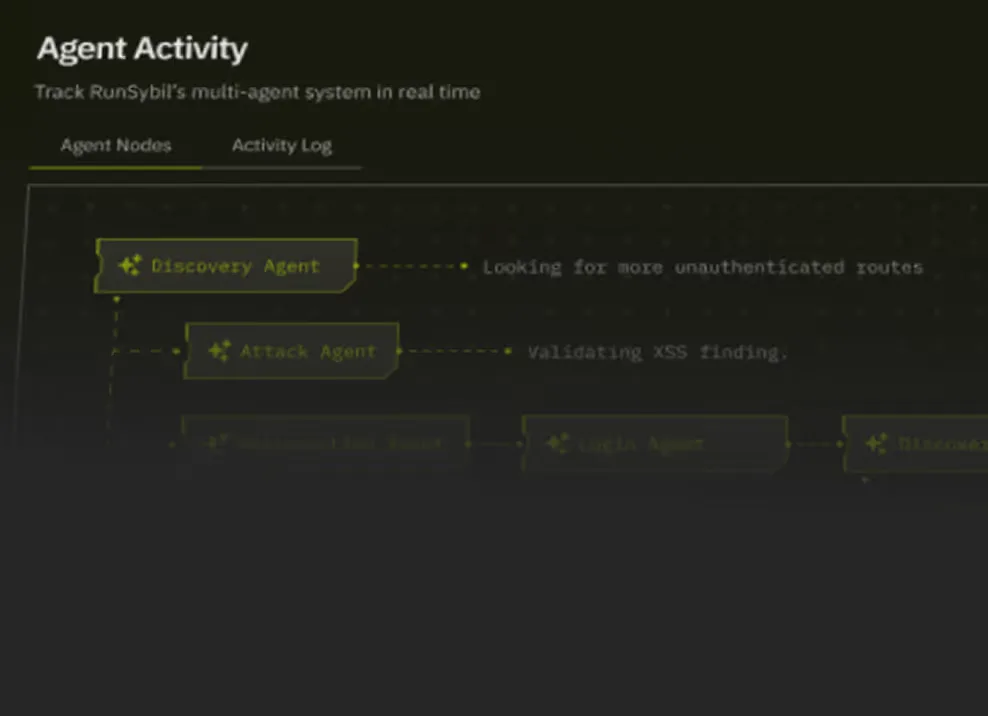
The agents learn about the target as they go, getting more efficient with experience. RunSybil contrasts this with tools that scan code without testing it live, or test blindly without understanding the system.
RunSybil published one example against a financial platform: Sybil exploited a lower-severity issue, then used that access to probe hidden endpoints. That led to a second flaw exposing all customer records through a single unauthenticated request.
Where RunSybil fits
RunSybil maps its work to the CTEM model, owning what it calls Phase 4: validation. Where many programs stop at discovering and ranking exposures by theoretical risk, Sybil attacks them to prove whether they are actually exploitable.
The vendor lists five deployment patterns: high-risk application testing, continuous attack surface monitoring, multi-tenant and business-logic testing, a bug bounty and pentest replacement, and cloud and infrastructure validation.
Sybil’s reach also goes past web-app scanning. It chains an application flaw into an infrastructure entry point, covering ground a scanner locked to a single layer never touches.
Team and backing
RunSybil was cofounded by CEO Ari Herbert-Voss, OpenAI’s first security hire and a GPT-3 and Codex research contributor. CTO Vlad Ionescu was an offensive security tech lead at Meta and a red teamer at Mandiant and NCC Group.
The $40M round was led by Khosla Ventures, with S32, the Anthology Fund, Conviction, and Elad Gil participating. The team draws from OpenAI, Meta, Mandiant, NCC Group, and Trail of Bits, with hubs in San Francisco and New York.
When to use RunSybil
RunSybil suits teams that want continuous offensive testing instead of a point-in-time pentest, especially for high-risk systems handling customer data, transactions, and access.
It also fits organizations trying to validate what other tools flag, since Sybil proves exploitability rather than adding another list of theoretical findings.
For AI-driven pentesting peers, see Beagle Security and Bright Security , or browse the full DAST tools catalog on AppSec Santa.
How does RunSybil fit into a release pipeline?
RunSybil describes Sybil as continuous testing that re-evaluates an attack surface on every deployment . It focuses on changed behavior instead of repeating a fixed checklist unchanged.
I would place it after a deployable test environment exists, not at the first source-code commit. The agent needs a running target to map, authenticate against, and attack from the outside.
A controlled rollout looks like this:
- Start with one high-risk application and a dedicated test tenant.
- Provide test identities for each role and define forbidden actions or data.
- Run against a release candidate, then review exploit evidence with the owner.
- Add recurring testing only after scope and cleanup behavior are understood.
That approach matches the vendor’s published use cases , including high-risk application testing, continuous attack-surface monitoring, and multi-tenant business-logic testing.
How is RunSybil delivered?
RunSybil is a commercial service sold through a scheduled demo . The site publishes no list pricing, self-service signup, downloadable scanner, or public API documentation.
The vendor does not publish numbered product releases. Its public materials describe a continuously operated service, while the company blog carries updates.
Buyers should ask where testing originates, how credentials are stored, which environments are supported, and how exploit artifacts are retained. Those details matter more here than a traditional scanner’s rule count.
What are RunSybil’s limitations?
RunSybil describes black-box testing without source-code access. It does not provide source-level coverage for dormant code, build-time dependency risk, or paths the agent cannot discover.
If you can share source, a whitebox service such as Trace reads the code before it attacks, which covers that gap.
Live exploitation also needs careful boundaries. Test data, rate limits, destructive actions, third-party integrations, and tenant isolation should be agreed before continuous runs begin.
The public site does not expose connector lists, CI configuration, deployment architecture, or a release changelog. I would require proof of integration and environment safety.
RunSybil’s over-90% false-positive reduction is a vendor-reported customer result, not a published independent benchmark. Buyers should measure validated findings, missed issues, and operational disruption against their own targets.
Continuous testing also creates a response obligation. A team needs an owner for new findings and a clear rule for pausing runs when the target behaves unexpectedly.
Without that operating discipline, faster validation can still produce an unattended security queue.