


Pi Security is a commercial product security platform listed in the ASPM tools catalog. It connects code with past incidents, pentest reports, and tickets for triage, remediation, and prevention workflows.
Pi calls this shared context “institutional security memory.” Its product page says the platform traces a vulnerability to its architectural source, searches for related variants, and prepares codebase-specific fixes.
What is Pi Security?
Pi describes a four-part workflow: ingest and index, find root causes, remediate in context, and enforce what was learned. The public site explains the workflow but does not provide a technical documentation portal.
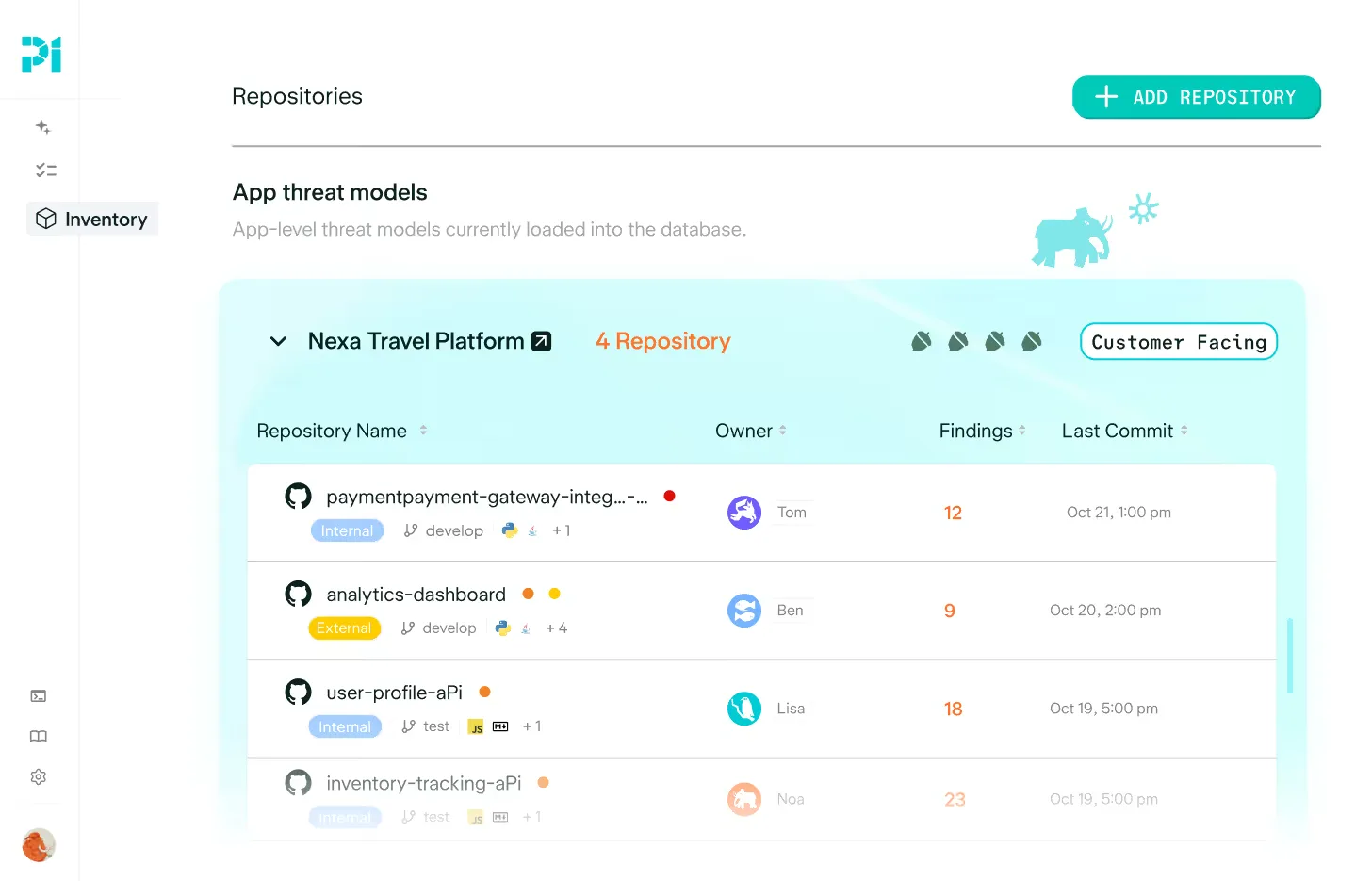
The inventory holds repositories and application threat models alongside ownership and finding counts. Past reports remain available as context instead of being treated as isolated tickets.
Key features
| Feature | What Pi does |
|---|---|
| Security memory | Indexes code, incidents, pentest reports, and tickets |
| Root-cause analysis | Traces a finding to its architectural source |
| Variant hunting | Searches the organization for related vulnerability patterns |
| Contextual remediation | Prepares fixes for the affected codebase and its conventions |
| Prevention guardrails | Applies previous lessons during design, coding, and pull requests |
| Sloane assistant | Answers questions using the organization’s indexed security context |
Root-cause analysis and variant hunting
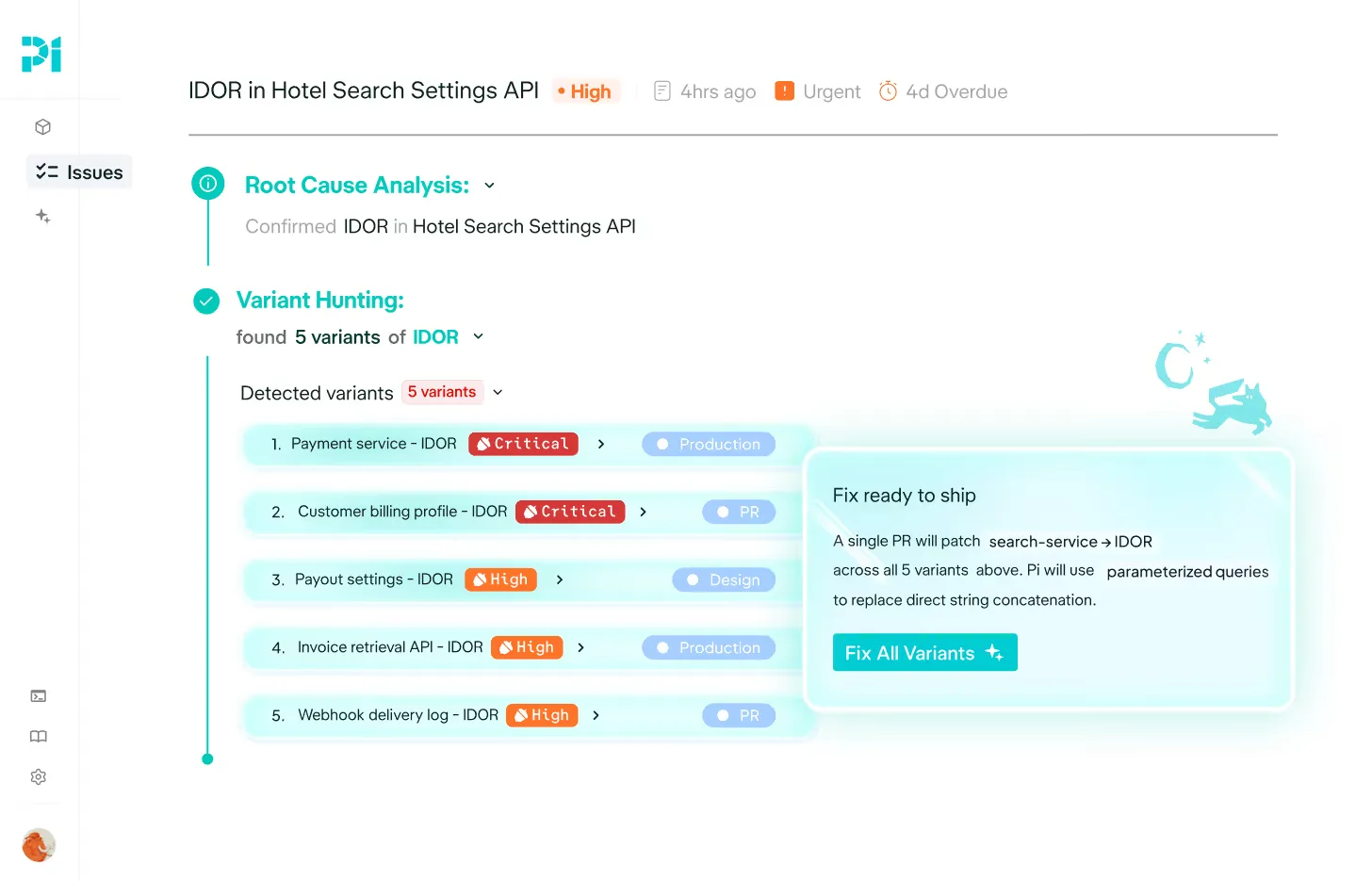
Pi groups related findings around a root cause. The vendor’s demo interface shows an IDOR example linked to five variants across payment, billing, payout, invoice, and webhook services.
Remediation in developer workflows
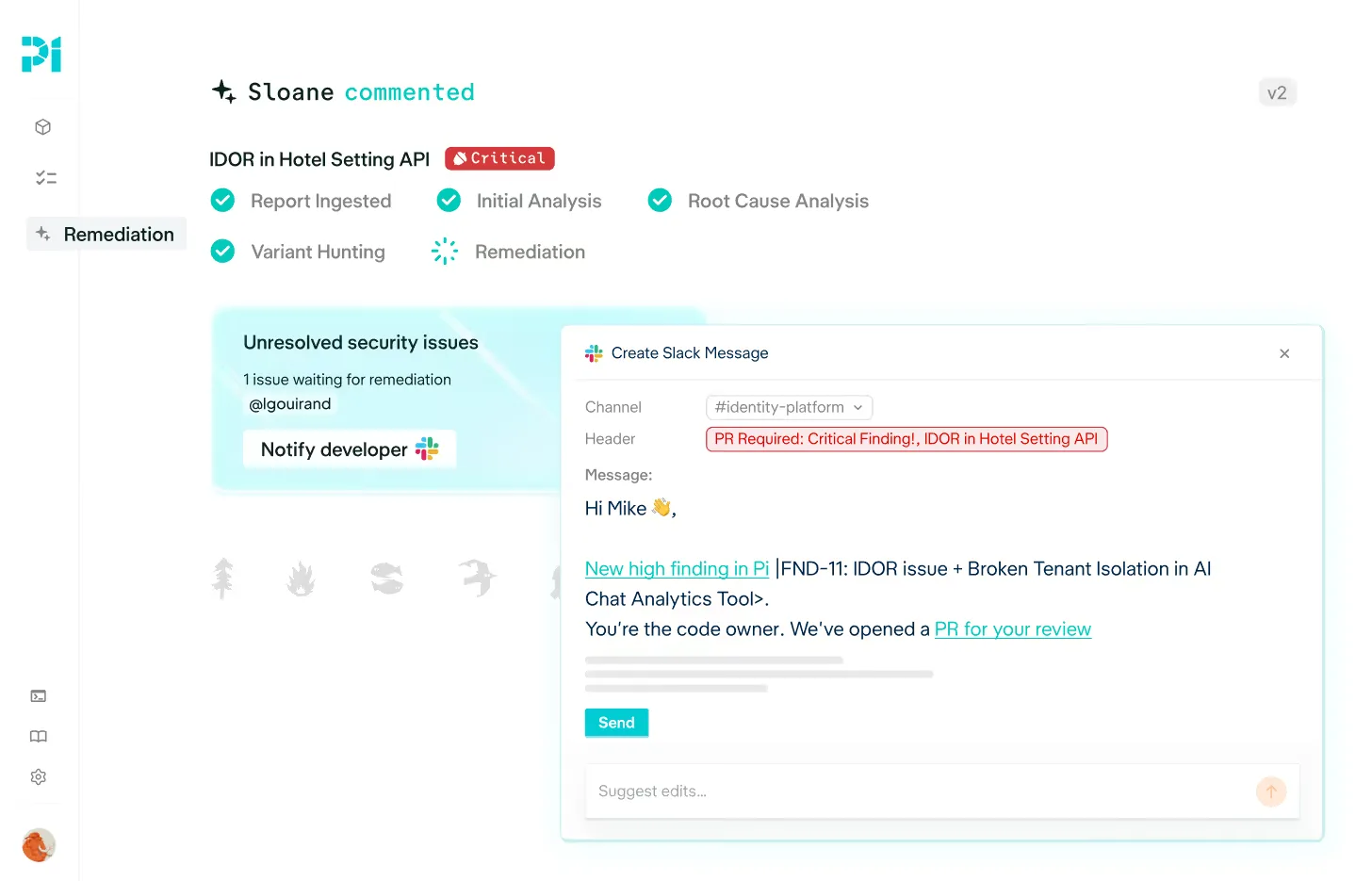
The platform prepares a contextual fix and routes it back to developers. Pi’s interface shows a remediation flow with a pull request and a draft Slack notification for the code owner.
The public site says fixes account for the repository’s language, architecture, and conventions. It does not list supported languages, source-control systems, or deployment models.
Prevention guardrails
Resolved findings can become guardrails in design, IDE, and pull-request workflows. The goal is to stop a known insecure pattern when similar code is introduced again.
Pi says these guardrails are derived from the organization’s previous findings. Its public materials do not describe a general-purpose scanner rule catalog.
How Pi fits an AppSec stack
Pi is not presented as a standalone SAST, SCA, or DAST scanner. Its public materials focus on ingesting security history, connecting findings with code, and carrying remediation context into development.
I read Pi as closer to an AppSec operations and remediation layer than a point scanner. Teams still need evidence that their existing finding sources and development systems are supported during evaluation.
The ASPM catalog also includes Jit and Cycode . Evaluate each product against the same repositories, finding sources, and developer workflows.
When to use Pi
Pi fits teams that already have a large history of findings but keep rediscovering the same vulnerability patterns. Its value depends on connecting that history to repositories and developer workflows.
How does Pi fit into a delivery pipeline?
Pi starts with security evidence that already exists. Its published workflow ingests code, past incidents, pentest reports, and tickets before connecting related findings to a shared root cause.
That makes the first rollout step an evidence-mapping exercise. Security teams need to decide which repositories, historical reports, and issue records Pi should use as organizational memory.
The prevention layer then moves what Pi learned into IDE and pull-request checks. Resolved patterns become guardrails that can flag a repeated design or coding mistake before another finding reaches triage.
I would evaluate the workflow in three stages:
- Import a small set of repositories and resolved findings with clear ownership.
- Confirm that root-cause grouping and variant searches match the team’s understanding.
- Review proposed fixes and prevention guardrails inside normal developer review paths.
This sequence tests Pi’s main value without treating generated fixes as trusted by default. The vendor’s interface shows draft pull requests and developer notifications, so human review remains part of the operating model.
How is Pi evaluated and purchased?
Pi is sold as a commercial service through a demo request . The vendor does not publish plans, list prices, a self-service trial, or a public installation guide.
The public site also does not specify whether customer code is processed in a dedicated tenant, a customer-controlled environment, or another deployment model. Buyers need those answers during security review.
I would ask for the supported repository hosts, ticket sources, identity options, retention settings, and data boundaries in the first technical session. Those details determine whether Pi can ingest the history it needs.
What are Pi Security’s limitations?
Pi’s public materials describe a remediation and prevention layer, not a replacement for SAST, SCA, DAST, or penetration testing. It needs findings and organizational context to build useful security memory.
The product page names IDE and pull-request guardrails but does not publish supported languages, repository systems, scanner connectors, APIs, or deployment requirements. That makes connector validation a procurement gate.
Root-cause grouping and generated fixes also require review. I would measure whether Pi links genuinely related variants and produces small, testable changes before expanding it across the portfolio.
Finally, the Pi website has no public versioned documentation or release notes. Buyers cannot independently inspect change cadence, compatibility history, or upgrade behavior before entering the sales process.
The platform also depends on historical evidence being usable. I would clean duplicate tickets, identify authoritative reports, and establish repository ownership before judging the quality of Pi’s institutional memory.
That preparation is ordinary AppSec program work, but it affects the evaluation. A weak input set can make a sound correlation workflow look less useful than it is.