


OSV-Scanner is Google’s free, open-source vulnerability scanner for open-source dependencies.
I put it in the baseline-SCA bucket because it is free, open source, and anchored on OSV.dev’s normalized advisory data.
With the Synopsys 2024 OSSRA report finding that 96% of commercial codebases contain open-source components, free tooling like OSV-Scanner makes baseline SCA accessible to every team.
Version 2.0, released in March 2025, transformed OSV-Scanner from a basic dependency checker into a full remediation tool with container image scanning, guided upgrade recommendations, and interactive HTML reports. The project has over 10,500 GitHub stars and is written in Go.
The latest release, v2.3.5
(March 2026), enables transitive scanning for Python requirements.txt files using the deps.dev API, giving Python projects visibility into vulnerabilities hiding in indirect dependencies.
What is OSV-Scanner?
OSV-Scanner reads your project’s manifest and lockfiles, identifies every dependency in the tree, and checks each one against the OSV.dev database. Unlike databases that rely solely on CVE identifiers, OSV.dev normalizes advisories across ecosystems so a single vulnerability affecting multiple package managers is tracked consistently.
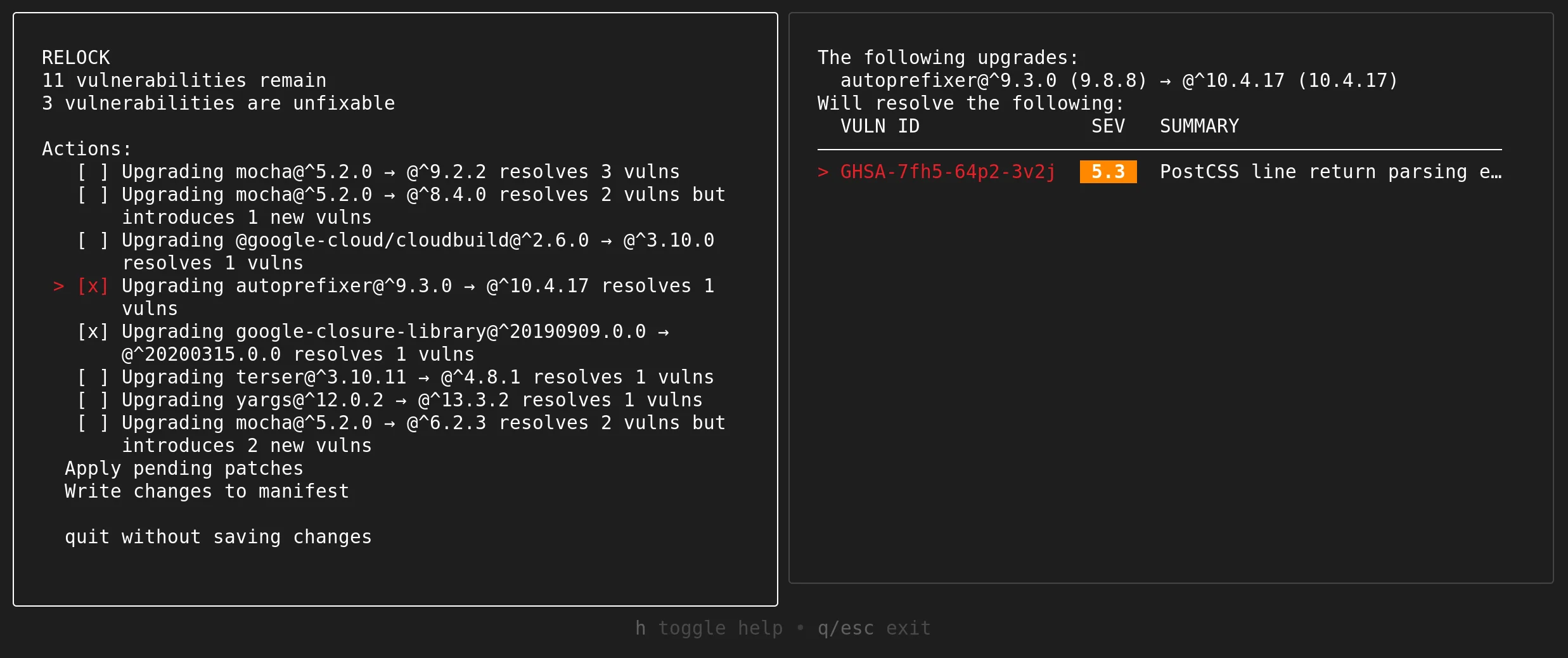
The scanner goes beyond detection. Its guided remediation engine analyzes your dependency graph and recommends the minimum set of upgrades needed to resolve vulnerabilities, ranked by factors like dependency depth, severity, and return on investment.
| Capability | Details |
|---|---|
| Guided Remediation | Analyzes your dependency graph and recommends prioritized upgrade paths. Considers dependency depth, severity, fix strategy, and ROI to suggest the minimum changes needed. Supports npm and Maven pom.xml. |
| Container Scanning | Layer-aware scanning for Debian, Ubuntu, and Alpine images. Shows which layer introduced each package, identifies the base image, and filters vulnerabilities unlikely to affect the container. |
| OSV.dev Database | The largest open-source vulnerability database, aggregating advisories from NVD, GitHub, PyPI, RubyGems, Go, Rust, and dozens more sources into a normalized, machine-readable format. |
What are OSV-Scanner’s key features?
Guided remediation
This is OSV-Scanner’s standout feature. Rather than dumping a list of CVEs and leaving you to figure out what to upgrade, it calculates the optimal set of dependency upgrades. The engine considers:
- Dependency depth – Direct dependencies are easier to upgrade than transitive ones
- Severity – Critical and high findings get priority
- Fix strategy – Whether to use in-place upgrades or relaxed constraints
- Return on investment – How many vulnerabilities a single upgrade resolves
Guided remediation currently supports npm (package.json / package-lock.json) and Maven (pom.xml), with more ecosystems planned.
Layer-aware container scanning
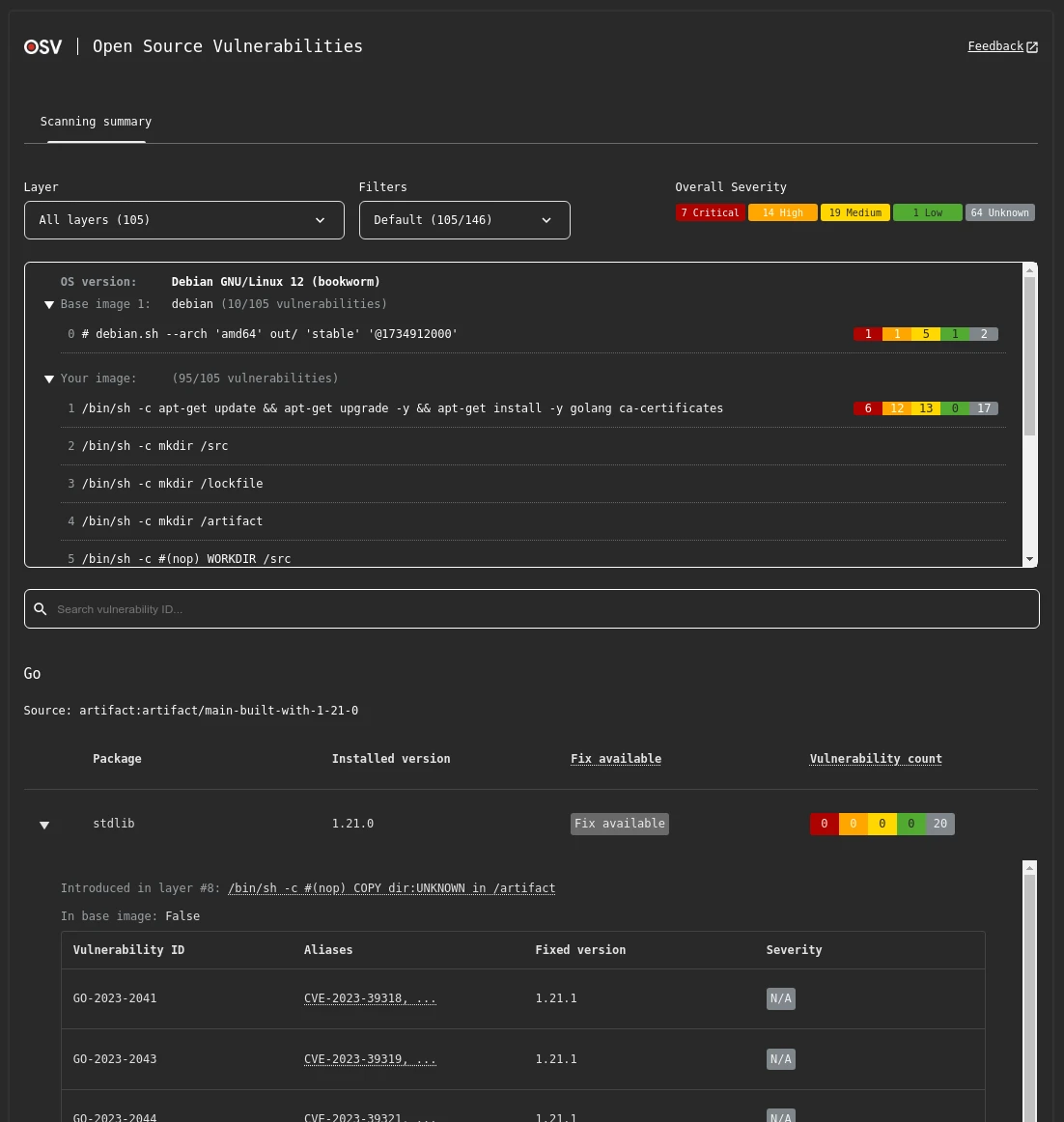
OSV-Scanner V2 doesn’t just scan container images. It understands their layer structure.
For each package found, it reports which layer introduced it, the layer history and commands, the base image, and the OS distribution.
It also filters out vulnerabilities that are unlikely to affect the container in practice, reducing noise compared to flat image scanners.
This feature currently supports Alpine, Debian, and Ubuntu-based images.
Broad ecosystem coverage
OSV-Scanner extracts dependencies from source manifests, lockfiles, and compiled artifacts.
| Source Type | Formats |
|---|---|
| JavaScript | package-lock.json, yarn.lock, pnpm-lock.yaml, bun.lock |
| Python | requirements.txt, poetry.lock, Pipfile.lock, uv.lock |
| Java | pom.xml, gradle.lockfile |
| Go | go.sum |
| Rust | Cargo.lock |
| .NET | deps.json, packages.lock.json |
| Ruby | Gemfile.lock |
| PHP | composer.lock |
| Dart | pubspec.lock |
| Haskell | cabal.project.freeze, stack.yaml.lock |
| Elixir | mix.lock |
| Containers | Alpine, Debian, Ubuntu images |
| Artifacts | Go binaries, Java uber JARs, Python wheels, Node modules |
Interactive HTML output
OSV-Scanner V2 can generate an interactive HTML report that visualizes scan results. This makes it easier to share findings with team members who do not work in the terminal, and provides filtering and sorting without additional tooling.
OSV.dev aggregates vulnerability data from over 30 ecosystem-specific sources. When a vulnerability is disclosed in a Python package, for example, OSV.dev pulls the advisory from PyPI, cross-references it with NVD and GitHub, and presents a single normalized record.
This means OSV-Scanner often has advisory coverage before tools relying solely on NVD.
Installation and usage
- Install the CLI – Use Go, Homebrew, or download a prebuilt binary from the GitHub releases page:
go install github.com/google/osv-scanner/v2/cmd/osv-scanner@latest - Scan your project – Run
osv-scanner scan -r /path/to/projectto recursively scan all supported lockfiles in a directory. - Scan a container image – Run
osv-scanner scan image image:tagto perform layer-aware scanning on a container image. - Get remediation advice – Run
osv-scanner fix -M package.json -L package-lock.jsonto get guided upgrade recommendations.
# Install via Go
go install github.com/google/osv-scanner/v2/cmd/osv-scanner@latest

# Install via Homebrew
brew install osv-scanner

# Scan a directory recursively
osv-scanner scan -r .

# Scan a specific lockfile
osv-scanner scan -L package-lock.json

# Scan a container image
osv-scanner scan image alpine:latest

# Scan an SBOM
osv-scanner scan -L sbom.cdx.json

# Guided remediation for npm
osv-scanner fix -M package.json -L package-lock.json

# Guided remediation for Maven
osv-scanner fix -M pom.xml

# Output as JSON
osv-scanner scan -r . --format json

# Generate HTML report
osv-scanner scan -r . --format html > report.html
CI/CD integration
GitHub Actions
name: OSV-Scanner
on:
  pull_request:
    branches: [main]
  schedule:
    - cron: '0 6 * * 1'

jobs:
  osv-scan:
    uses: "google/osv-scanner-action/.github/workflows/osv-scanner-reusable.yml@v2.0.0"
Note: OSV-Scanner V2 uses a reusable workflow called at the job level, not a regular action step.
OSV-Scanner also supports scheduled scanning via the osv-scanner-action/osv-reporter-action to monitor for newly disclosed vulnerabilities between code changes.
When to use OSV-Scanner
OSV-Scanner is a strong choice for teams that want a free, no-strings-attached vulnerability scanner backed by Google’s infrastructure and the broadest open-source vulnerability database available.
Strengths:
- Completely free with no usage limits or account requirements
- Guided remediation saves time on figuring out which upgrades to apply
- OSV.dev database aggregates 30+ sources for broad coverage
- Layer-aware container scanning filters irrelevant findings
- Interactive HTML reports for non-terminal users
Limitations:
- Guided remediation currently limited to npm and Maven
- No web dashboard or continuous monitoring (CLI-only)
- Container scanning restricted to Debian, Ubuntu, and Alpine images
- No license compliance scanning
- No automated fix PRs (you apply the recommendations manually)
How it compares:
| vs. | Key difference |
|---|---|
| Grype | Grype has EPSS and KEV risk scoring and deeper container support. OSV-Scanner has guided remediation and the broader OSV.dev database. |
| Snyk Open Source | Snyk offers automated fix PRs, a web dashboard, and continuous monitoring. OSV-Scanner is completely free with no limits. |
| Dependabot | Dependabot auto-opens PRs on GitHub. OSV-Scanner works anywhere and offers guided remediation with ROI-based prioritization. |
| OWASP Dependency-Check | Dependency-Check uses NVD data only. OSV-Scanner queries 30+ sources through OSV.dev for broader coverage. |
Further reading: What is SCA? | SCA in CI/CD Pipelines