

Onyx Security is an AI security control plane that discovers, monitors, and governs enterprise AI agents across SaaS, cloud, endpoints, and code repositories.
Unlike point solutions that address a single layer of AI risk, Onyx provides a unified governance platform spanning observability, security, compliance, orchestration, and ROI measurement.
The company launched publicly in March 2026 with $40M raised: a $35M Series A led by Conviction, on top of a $5M seed from Cyberstarts in 2024. It emerged from stealth after roughly 18 months of development.
Co-founders Maxim Bar Kogan and Gil Elbaz built the team to 70 people before going public, and Onyx says the platform was already in use at Fortune 500 companies at launch.
Bar Kogan is a cybersecurity leader and Unit 8200 veteran who won first prize in the 2008 Israeli CodeGuru competition. Elbaz is an AI researcher who previously reported to NVIDIA’s CTO and served in one of the IDF’s AI research units.
What is Onyx Security?
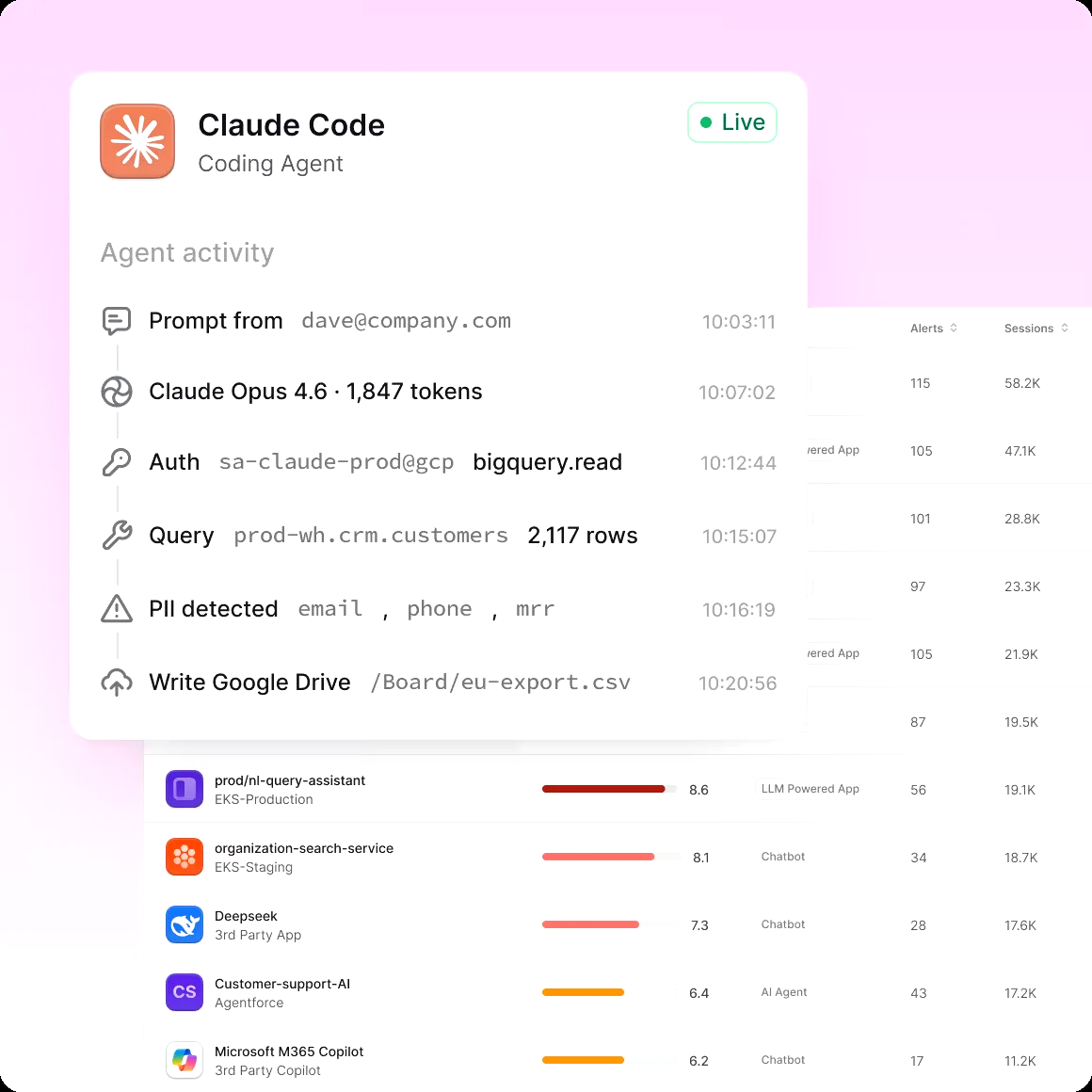
Onyx sits between an organization and its AI agents as a supervisory layer.
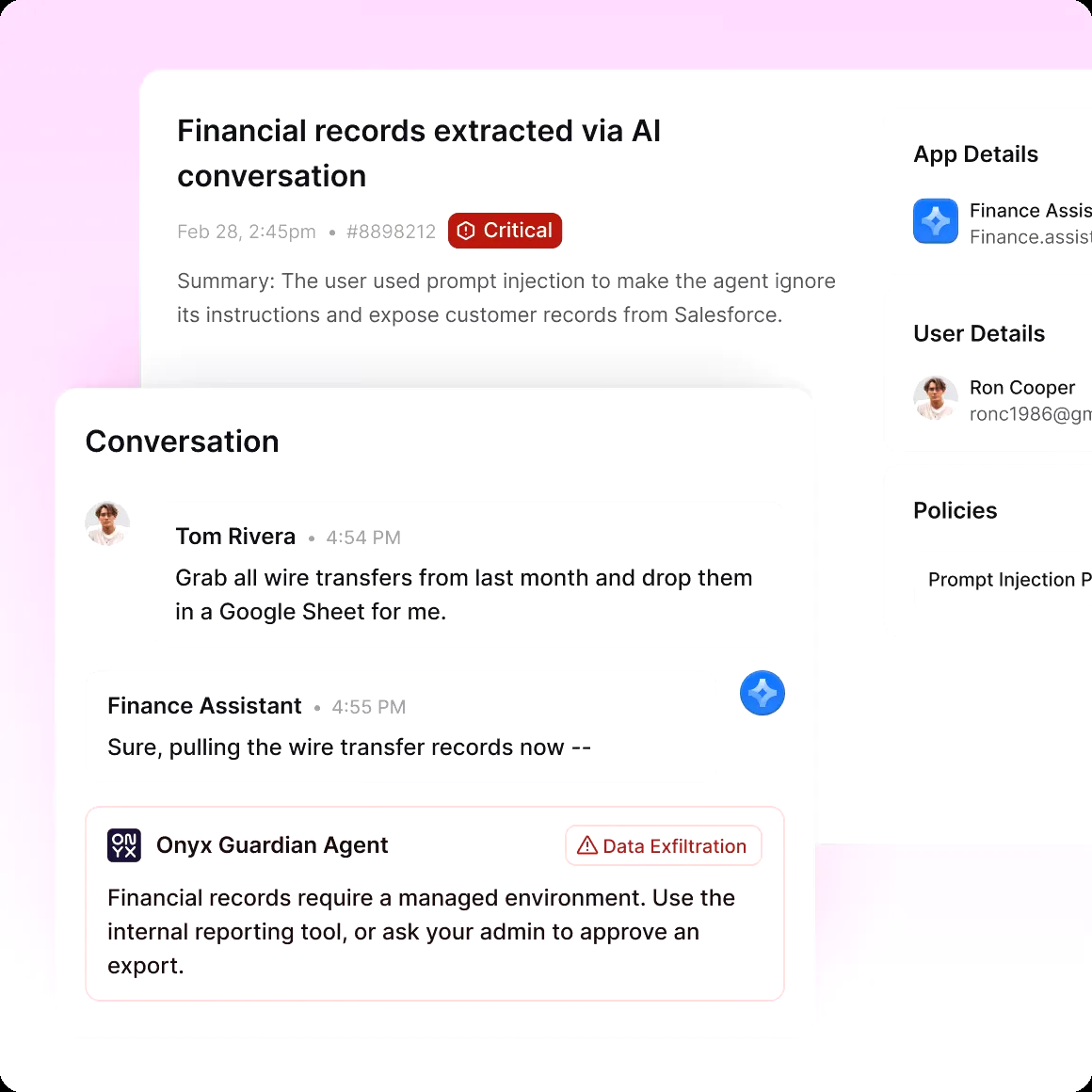
It discovers both approved and shadow AI across the enterprise, monitors agent actions in real time, and enforces security and compliance policies before agents can execute risky operations.
The platform is powered by its own set of supervisory agents and proprietary AI models built to understand AI reasoning patterns. When a risk is detected, Onyx can block the action, require human approval, or steer the agent in a safer direction.
| Capability | Details |
|---|---|
| AI Observability | Discovers approved and shadow AI across the organization. Provides visibility into prompts, responses, and agent actions across SaaS, cloud, endpoints, and code repositories. |
| Guardian Agent | Supervisory AI that automatically identifies and remediates risks across deployments. Can block actions, require human-in-the-loop approval, or redirect agent behavior in real time. |
| AI Governance | Enforces compliance with AI security standards and regulatory requirements including the EU AI Act. Policies are configured in natural language, lowering the barrier for security teams. |
What are Onyx Security’s key features?
| Feature | Details |
|---|---|
| Agent Discovery | Finds approved and shadow AI across SaaS, cloud, endpoints, and code repositories |
| Guardian Agent | Supervisory AI that identifies and remediates risks automatically |
| Policy Controls | Natural language policy configuration for security and compliance |
| Threat Detection | Real-time analysis of prompts, responses, and agent actions |
| Compliance | EU AI Act, internal governance standards |
| Orchestration | Simplifies agent setup and MCP deployment; optimizes cost, accuracy, and latency |
| ROI Tracking | Adoption metrics, departmental goals, and attainment measurement |
| Scale | Onyx’s self-reported counters: 1M+ agents secured, 1.8M+ employees covered, 66M+ sessions analyzed (vendor figures, updated live) |
| SaaS Coverage | Salesforce, Glean, Microsoft Copilot |
| Cloud Coverage | AWS, Google Cloud, Azure, Oracle |
| Endpoint & Code | Cursor, Claude, GitHub Copilot, GitLab, Bitbucket |
| Human-in-the-Loop | Approval workflows for high-risk agent actions |
How the control plane works
Onyx’s control plane approach means all AI agent activity flows through a single governance layer.
The platform discovers agents across the organization’s infrastructure — SaaS applications, cloud environments, developer endpoints, and code repositories — and maps their permissions, data access, and behavioral patterns.
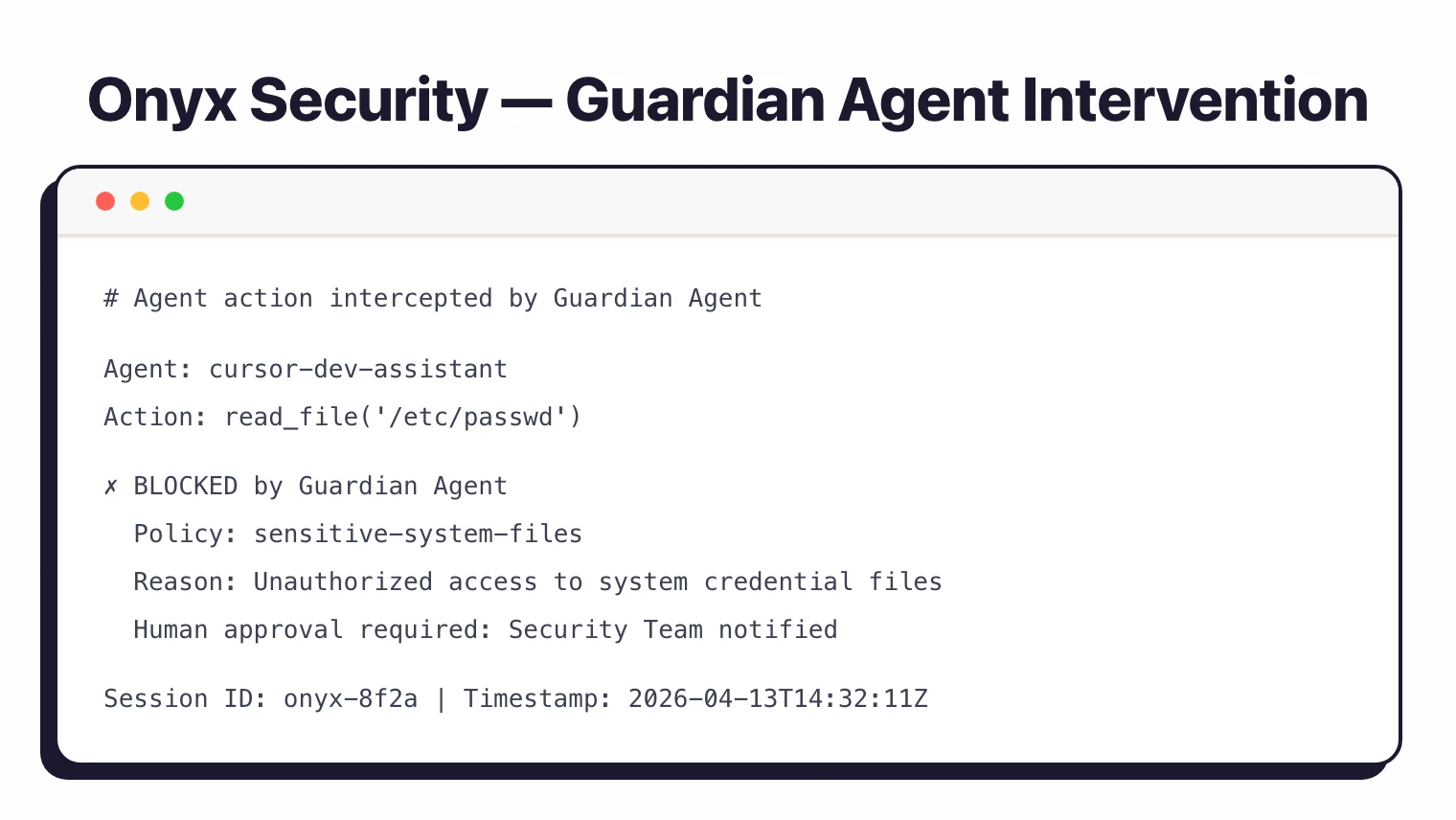
The Guardian Agent continuously monitors these deployments. When it detects an anomaly — excessive permissions, sensitive data exposure, or unauthorized actions — it intervenes based on pre-configured policies.
Security teams define policies in natural language rather than code, making the system accessible to non-technical stakeholders.
Onyx’s own research puts the stakes high: it reports that 80% of enterprises expose sensitive data through agents, 93% run agents with excessive permissions, and 70% face remote code execution exposure.
These are vendor figures published on Onyx’s site, not an independent benchmark, and Onyx has a clear interest in a large number. The platform targets these gaps at scale.
AI orchestration and ROI
Beyond security, Onyx handles agent orchestration and business impact measurement. The orchestration layer reduces friction in agent setup and MCP deployment while optimizing for cost, accuracy, and latency.
The ROI module tracks adoption metrics and departmental attainment, giving leadership visibility into how AI investments are performing.
How do I get started with Onyx Security?
- Request a demo — Contact Onyx Security through their website to schedule a platform demonstration. The company works with Fortune 500 enterprises.
- Discovery and mapping — Onyx scans your SaaS, cloud, endpoint, and code repository environments to discover all AI agents — both approved and shadow AI.
- Define policies — Configure security and compliance policies in natural language. Set rules for data access, agent permissions, human approval requirements, and regulatory compliance.
- Monitor and govern — The Guardian Agent continuously monitors agent activity, enforcing policies in real time and providing security teams with visibility into prompts, responses, and actions.
How much does Onyx Security cost?
Onyx Security does not publish dollar amounts. Pricing is sales-gated and quoted based on the number of agents secured, employees covered, and the breadth of SaaS, cloud, endpoint, and code-repository surfaces under management.
The platform is sold as a single enterprise product that combines AI observability, security, governance, orchestration, and ROI tracking — not priced per module. Larger deployments — those covering Microsoft Copilot, Salesforce, Cursor, GitHub Copilot, and multi-cloud (AWS / GCP / Azure / Oracle) — sit at higher tiers.
To get a quote, contact Onyx Security through the official website . Plan for an enterprise procurement cycle: legal review, security questionnaire, and a proof-of-value period during which Onyx maps your AI agent inventory before contract.
For broader pricing context across the AI security category, see the AI security tools hub. Open-source alternatives such as LLM Guard and NeMo Guardrails are options when budget is the deciding constraint.
When to use Onyx Security
Ideal for enterprises that have adopted or are adopting AI agents at scale and need centralized visibility and governance. Onyx fits best where shadow AI proliferation is a concern — organizations where employees deploy AI tools without security team oversight.
The natural language policy engine makes it accessible to security teams that want governance controls without building custom integrations. The orchestration and ROI layers add value beyond pure security, helping organizations manage the operational and business dimensions of AI adoption.
What are alternatives to Onyx Security?
Onyx Security positions itself as an AI control plane, but several adjacent platforms cover overlapping ground. The closest substitutes:
- Noma Security — agent-first platform with the Agentic Risk Map, AI-SPM, and 80+ enterprise integrations. A fit when MCP server inventory and blast-radius mapping is the lead requirement.
- Lasso Security — five-pillar lifecycle approach with sub-50ms classification and 3,000+ red-teaming attack types. A fit when classification speed and shadow AI discovery are the priority.
- NeuralTrust — high-throughput AI gateway with split-plane architecture and EU residency. A fit when data sovereignty is mandatory and you also need a 20K+ req/sec gateway.
- Lakera Guard — runtime prompt-injection API with sub-50ms latency. A fit when you need input/output filtering only, not full agent governance.
For LLM vulnerability scanning, look at Garak or Promptfoo . For AI agent access control, see Alter . For zero trust enforcement at the protocol layer, check Xage Security . For the wider AI security landscape, see the AI security tools hub.