


Noma Security is an AI security platform that unifies discovery, posture management, red teaming, and runtime protection for enterprise AI and autonomous agents in a single product. Where tools like Garak or Promptfoo focus on specific testing stages, Noma covers the full AI security lifecycle from inventory through production defense.
The company was founded in 2023 by Niv Braun (CEO) and Alon Tron (CTO), who met during their service in the IDF’s Unit 8200 intelligence unit.
Noma emerged from stealth in October 2024 and has since raised $132M in total funding, including a $100M Series B led by Evolution Equity Partners with continued backing from Ballistic Ventures and Glilot Capital.
Since its public launch, Noma has reported 1,300% annual recurring revenue growth and dozens of enterprise customers across financial services, life sciences, retail, and technology, naming UiPath, Best Buy, and Nielsen. These are vendor figures from its funding announcements — self-reported growth and customer counts, not independently audited.
Noma also says it has flagged over 1 million AI and agent risks across its customer base, another company-supplied number.
What is Noma Security?
Noma’s platform addresses the security gaps created by the rapid adoption of generative AI, LLMs, RAG systems, and autonomous agents. It works through a three-step approach: discover the full AI landscape, secure it with policies and controls, and protect it with real-time enforcement.
The platform automatically discovers every AI model, agent, MCP server, and data source in an organization’s environment — and maps how they interconnect. From there, security teams can define policies, run automated red team assessments, and enforce guardrails in production.
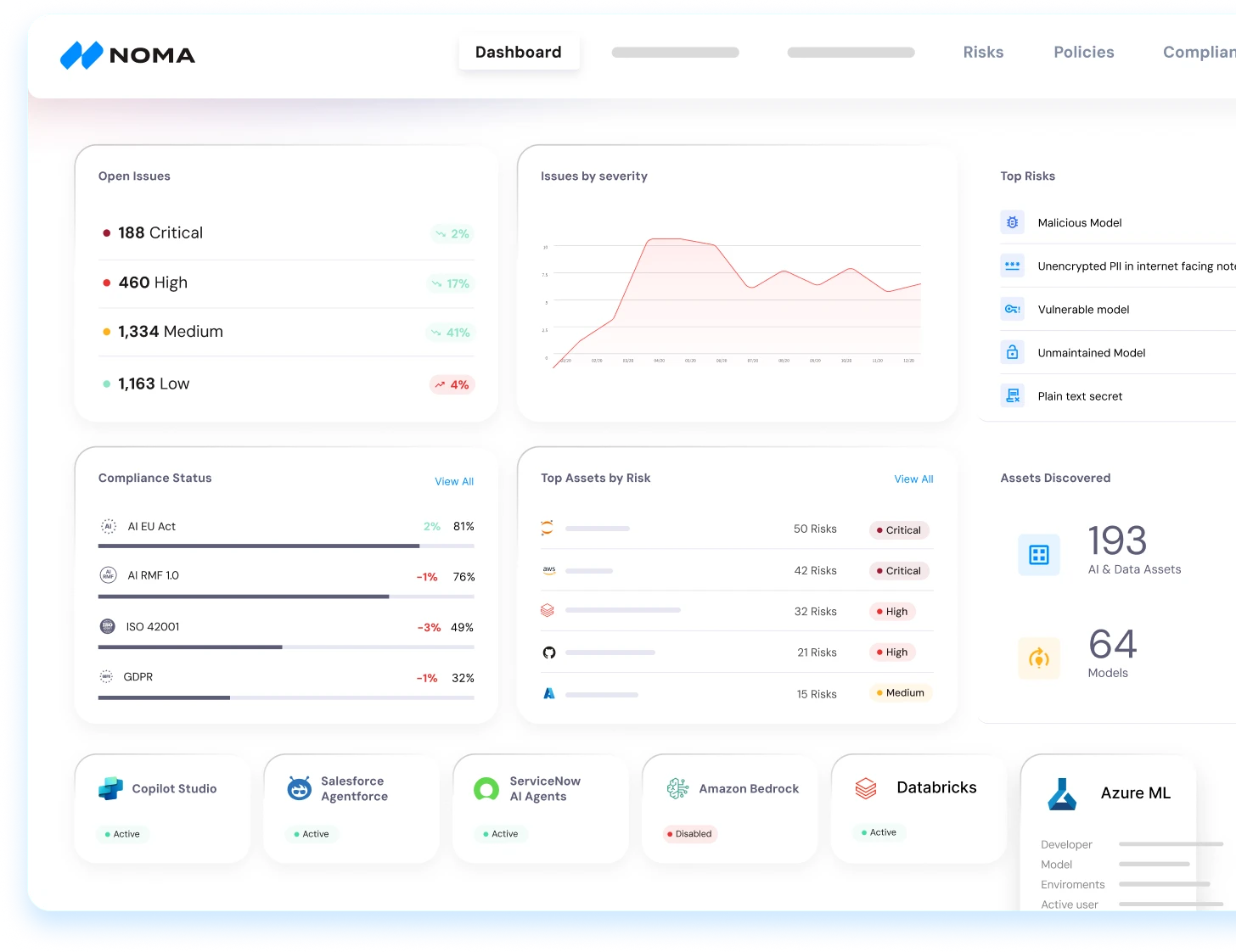
| Capability | Details |
|---|---|
| AI Agent Discovery | Automatically discovers every agent within an environment with deep contextual profiling — toolsets, functionality, data access permissions, MCP server connections, and operations. |
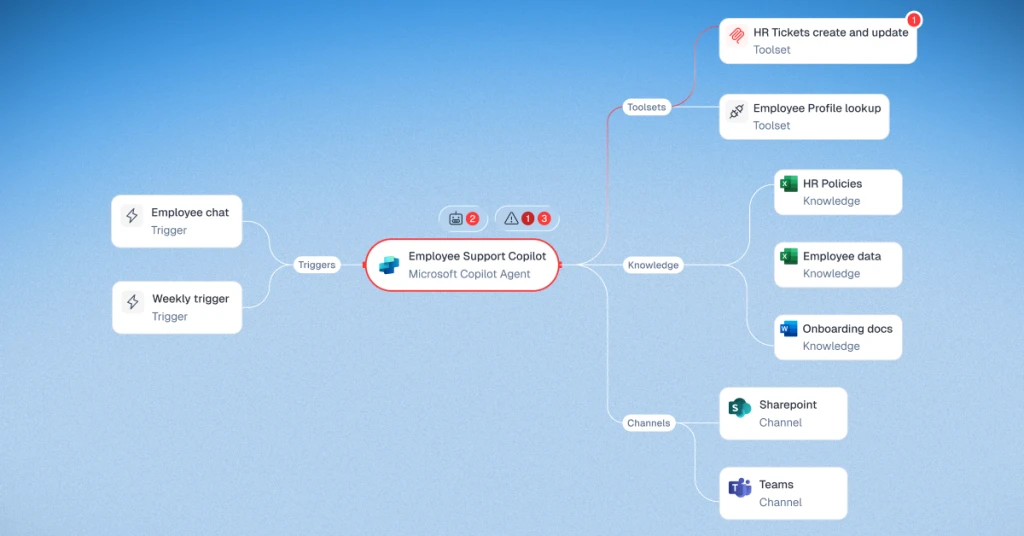
| Agentic Risk Map | Visualizes each agent’s connections, tools, identities, and knowledge sources. Uncovers cascading risk scenarios by mapping the blast radius of agent actions across the organization. |
| Runtime Protection | Enforces real-time guardrails on models and agents in production. Detects and blocks malicious prompts, rogue outputs, and unauthorized agent actions before they execute. |
What are Noma Security’s key features?
| Feature | Details |
|---|---|
| Agent Discovery | Automatic profiling of agents, toolsets, permissions, MCP connections |
| Agentic Risk Map (ARM) | Blast radius visualization and cascading risk analysis |
| AI-SPM | Security posture management with continuous risk assessment |
| Red Teaming | Automated offensive testing including prompt injection and jailbreak validation |
| Runtime Protection | Real-time guardrails blocking malicious prompts, rogue outputs, unauthorized actions |
| MCP Server Security | Discovery and monitoring of Model Context Protocol server connections |
| Policy Enforcement | Enterprise policies for agent permissions, data access, and actions |
| Integrations | 80+ platforms: Microsoft Copilot Studio, Salesforce AgentForce, ServiceNow, AWS, Databricks, LangChain, CrewAI, Cursor, Windsurf |
| API & SDKs | REST API, native Python and JavaScript SDKs |
| AWS Security Hub | Available through AWS Security Hub Extended plan |
| Scale | 1M+ AI and agent risks identified (Noma-reported) |
How the platform works
Noma operates in three stages:
Discover — The platform scans the entire AI ecosystem to build a complete inventory. It identifies every model, agent, MCP server, and data source, then maps their interconnections.
This visibility layer catches shadow AI deployments and unmanaged agents that security teams may not know about.
Secure — Once the landscape is mapped, teams build security controls. This includes defining approved AI supply chains, configuring identity and access management policies, and running continuous red team validation to test defenses.
The red teaming module probes for prompt injection, jailbreaks, and other AI-specific attack vectors.
Protect — In production, Noma monitors all AI communication in real time. The runtime protection layer enforces security, privacy, and compliance policies before autonomous actions execute.
If an agent attempts an unauthorized action or a malicious prompt is detected, Noma blocks it before it reaches the model or downstream system.
Agentic Risk Map in detail
The Agentic Risk Map is Noma’s signature capability for autonomous agent security. It provides a visual representation of each agent’s blast radius — the set of systems, data sources, and other agents that could be affected if the agent is compromised or behaves unexpectedly.
ARM maps:
- Agent connections — Which tools, APIs, and services each agent can access
- Identity chains — Credentials and permissions accumulated across agent workflows
- Data exposure — Sensitive data accessible through agent pathways
- MCP server relationships — How agents interact with Model Context Protocol servers
This mapping helps security teams prioritize risks by understanding which agents have the largest potential impact if compromised.
How do I get started with Noma Security?
- Request a demo — Contact Noma Security through their website. The platform targets enterprise organizations with significant AI deployments.
- Discovery scan — Noma scans your environment to discover all AI models, agents, MCP servers, and data sources. This builds the initial inventory and relationship map.
- Configure policies — Define security policies for agent permissions, data access, and allowable actions. Set up approved AI supply chains and identity controls.
- Enable runtime protection — Activate real-time guardrails that monitor all AI communication and enforce policies before autonomous actions execute.
- Red team continuously — Run automated red team assessments to validate defenses against prompt injection, jailbreaks, and other AI-specific attack vectors.
How much does Noma Security cost?
Noma Security does not publish dollar amounts. Pricing is sales-gated and based on the number of agents secured, MCP servers covered, integrations enabled, and deployment scope across cloud providers.
The platform is sold as a single enterprise product covering discovery, posture management, red teaming, and runtime protection — not priced per module. Larger deployments that span multiple AI environments (Microsoft Copilot Studio, Salesforce AgentForce, ServiceNow, Amazon Bedrock, Databricks) typically sit at higher tiers.
To get a quote, request a demo through the Noma Security website . Plan for an enterprise procurement cycle: legal review, security questionnaire, and a proof-of-value period during which Noma maps your AI inventory and agent risks before contract.
For broader pricing context across the AI security category, see the AI security tools hub. Open-source alternatives such as LLM Guard and NeMo Guardrails are options when budget is the deciding constraint.
When to use Noma Security
Ideal for enterprises with complex AI environments — multiple agent frameworks, numerous MCP servers, and diverse model deployments across cloud providers. The platform is strongest when organizations need full lifecycle coverage: discovery through runtime protection.
Regulated industries get the most from Noma, since compliance requirements demand continuous monitoring and audit trails for AI systems. The native integrations with Microsoft Copilot Studio, Salesforce AgentForce, ServiceNow, and AWS Security Hub mean it plugs into existing enterprise toolchains without custom integration work.
What are alternatives to Noma Security?
Noma Security competes with several AI security platforms; the right alternative depends on which capability matters most. The closest substitutes:
- Lasso Security — five-pillar lifecycle approach with sub-50ms classification and 3,000+ red-teaming attack types. A fit when classification speed and shadow AI discovery are the lead requirements.
- Onyx Security — AI control plane with Guardian Agent supervisory AI and natural-language policy controls. A fit when centralized governance across SaaS, cloud, and developer endpoints is the priority.
- Straiker — agentic AI security platform focused on autonomous agents and MCP-connected workflows. A fit when securing agent behavior is the lead concern rather than model inventory.
- Protect AI Guardian — model-supply-chain scanning across 35+ formats, now part of Palo Alto Prisma AIRS. A fit when ML model file scanning is the gap, not agent runtime defense.
- Lakera Guard — runtime prompt-injection API with sub-50ms latency. A fit when you only need input/output filtering, not the full lifecycle.
For dedicated LLM vulnerability scanning, look at Garak or Promptfoo . For AI agent access control, see Alter . For the wider AI security landscape, see the AI security tools hub.
If runtime prompt filtering is the actual gap rather than agent inventory, consider Lakera Guard for managed input/output classification or LLM Guard for self-hosted scanning — Noma optimizes for agent governance, not low-latency prompt filtering.