


Sonatype Lifecycle (formerly Nexus Lifecycle) is an enterprise SCA platform backed by a component intelligence database tracking 140M+ components.
Named a Leader in the Forrester Wave for SCA (Q4 2024) with highest possible scores, it embeds security at every SDLC stage: IDE plugins, repository firewalls, CI/CD gates, and AI-powered remediation.
With the Sonatype 2024 State of the Software Supply Chain report finding that one in eight open-source downloads contains a known vulnerability , repository-level firewalling has become a critical defense layer.
Sonatype’s security research team proactively identifies vulnerabilities before CVE assignment. Their 2026 State of Software Supply Chain Report found 65% of OSS CVEs lack CVSS scores from NVD, and 1 in 7 CVEs differ from NVD by 3+ CVSS points.
The platform’s repository firewall blocks risky components at download time.
What is Sonatype Lifecycle?
Sonatype Lifecycle integrates at every development stage. IDE plugins warn developers before adding risky dependencies.
Repository firewalls block vulnerable components at download time. CI/CD integrations enforce policies at build and release.
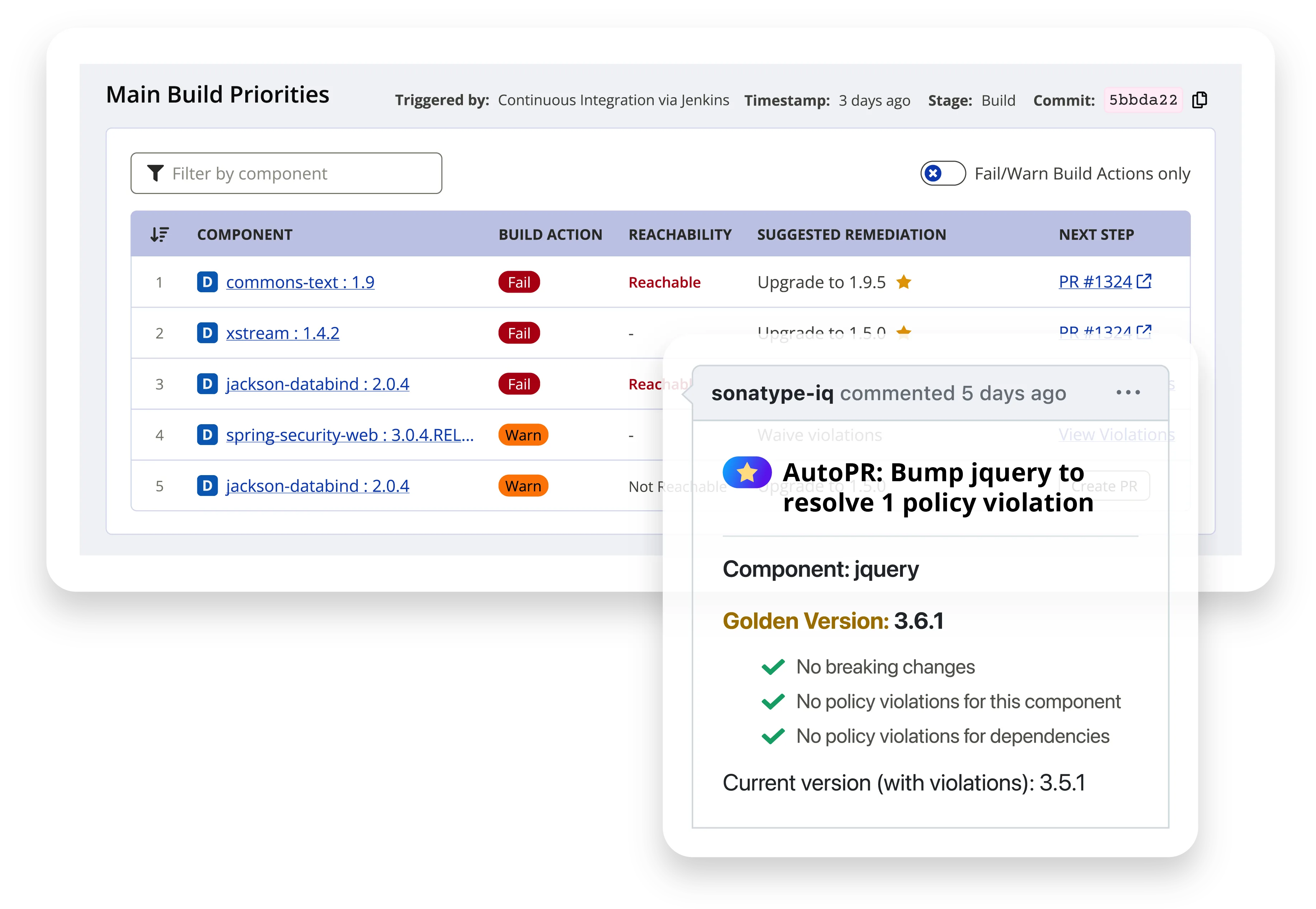
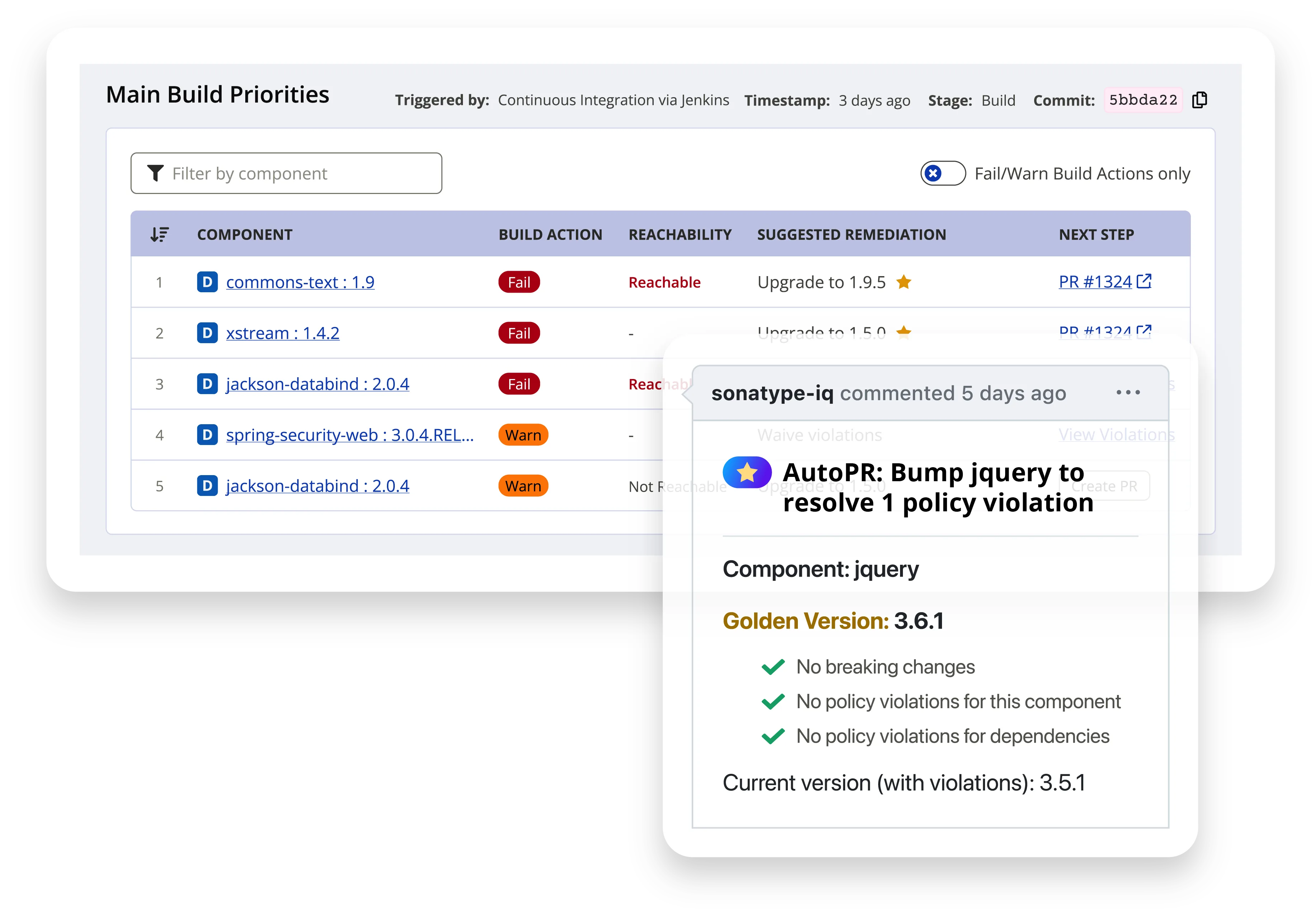
Golden Pull Requests recommend the minimal safe upgrade with zero expected breakage.
| Capability | Details |
|---|---|
| Intelligence Database | Tracks 140M+ components with proprietary vulnerability data, often disclosed before CVE assignment. Covers Maven, npm, PyPI, NuGet, Go, and 15+ additional ecosystems. |
| Repository Firewall | Blocks risky packages at download time. When developers try to install a malicious or policy-violating component, the firewall blocks the request and suggests alternatives. |
| Golden Pull Requests | AI-generated upgrade recommendations that guarantee no build breaks. Considers transitive dependencies, breaking changes, and available patches for zero-breakage upgrades. |
What are Sonatype Lifecycle’s key features?
| Feature | Details |
|---|---|
| Component intelligence | 140M+ tracked components; proactive disclosure before CVE assignment |
| NVD accuracy gap | 20,362 false positives and 167,286 false negatives identified in public CVE data |
| Golden Pull Requests | Zero-breakage upgrades considering transitive deps and breaking changes |
| Policy engine | 18 default policies + 30+ customizable constraints |
| License database | 2,000+ open-source licenses with threat categorization |
| Ecosystems | Maven, npm, PyPI, NuGet, Gradle, Cargo, Go, Docker, Helm, CocoaPods, Composer, Conda, RubyGems |
| Reachability analysis | Call flow analysis for contextual vulnerability prioritization |
| Deployment | Cloud, on-premises, or air-gapped (SAGE) |
Sonatype Intelligence Database
Sonatype maintains one of the most extensive component intelligence databases. Security researchers identify new threats daily, often disclosing vulnerabilities before public CVE publication.
Their research found 20,362 false positives and 167,286 false negatives in public NVD data.
Repository firewall
The firewall blocks risky packages before they enter your artifact repository. When developers attempt to download a known-malicious or policy-violating component, the firewall blocks the request and suggests safe alternatives.
Policy management
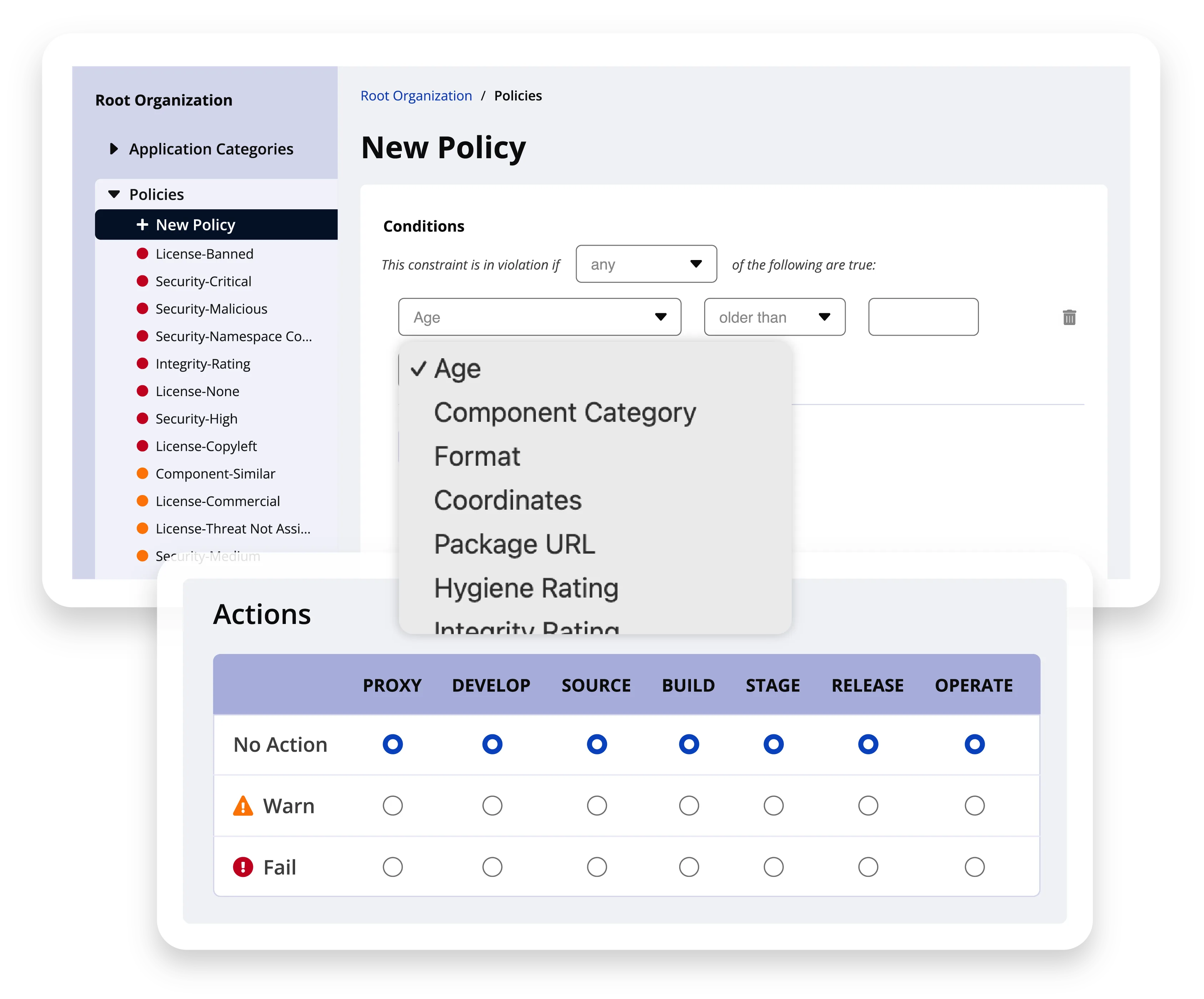
18 default policies plus 30+ customizable rules based on vulnerability severity, license type, component age, and risk tolerance. Policies enforce different standards for development vs. production, support exception workflows, and auto-fail builds on critical thresholds.
Waiver management
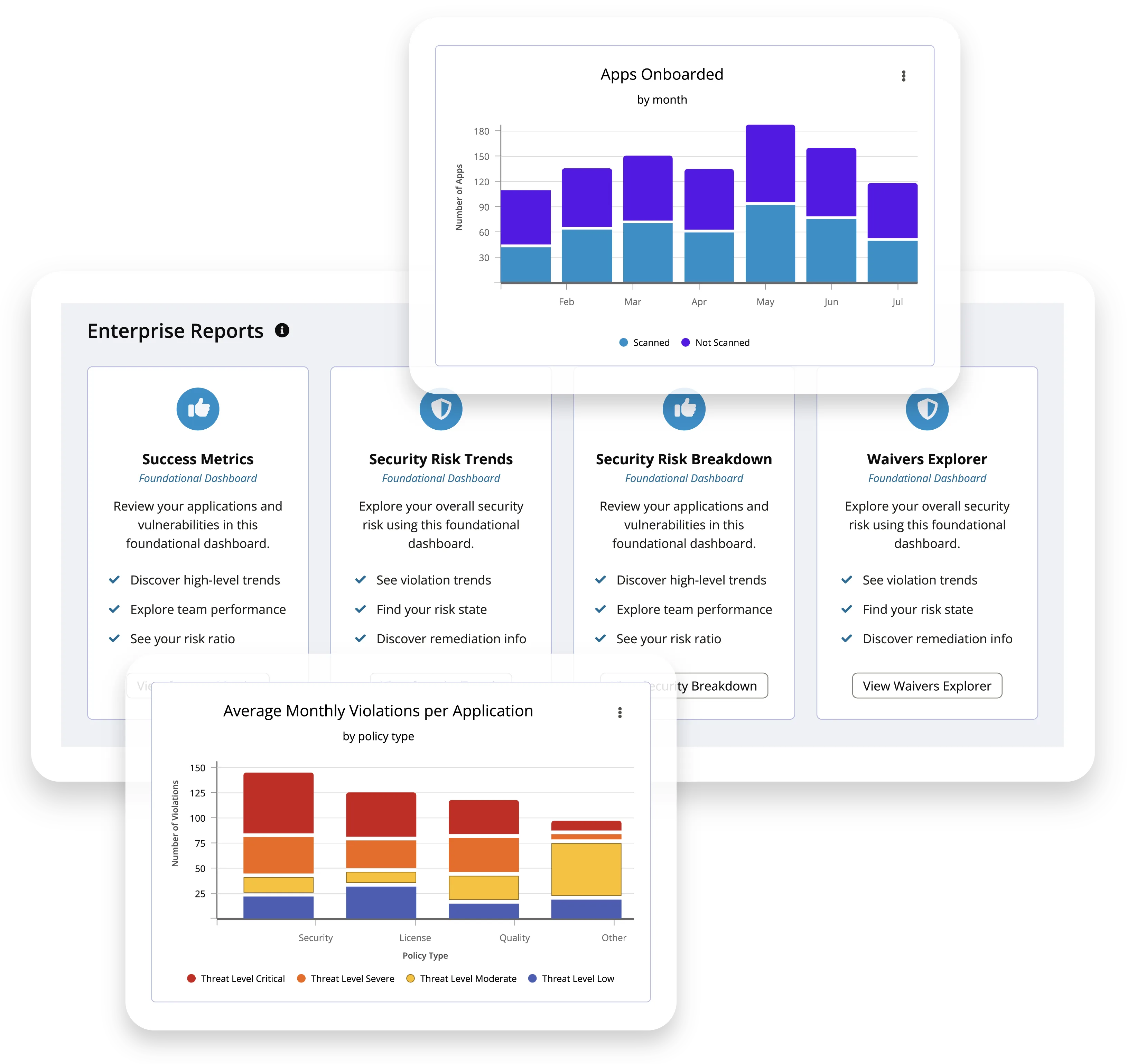
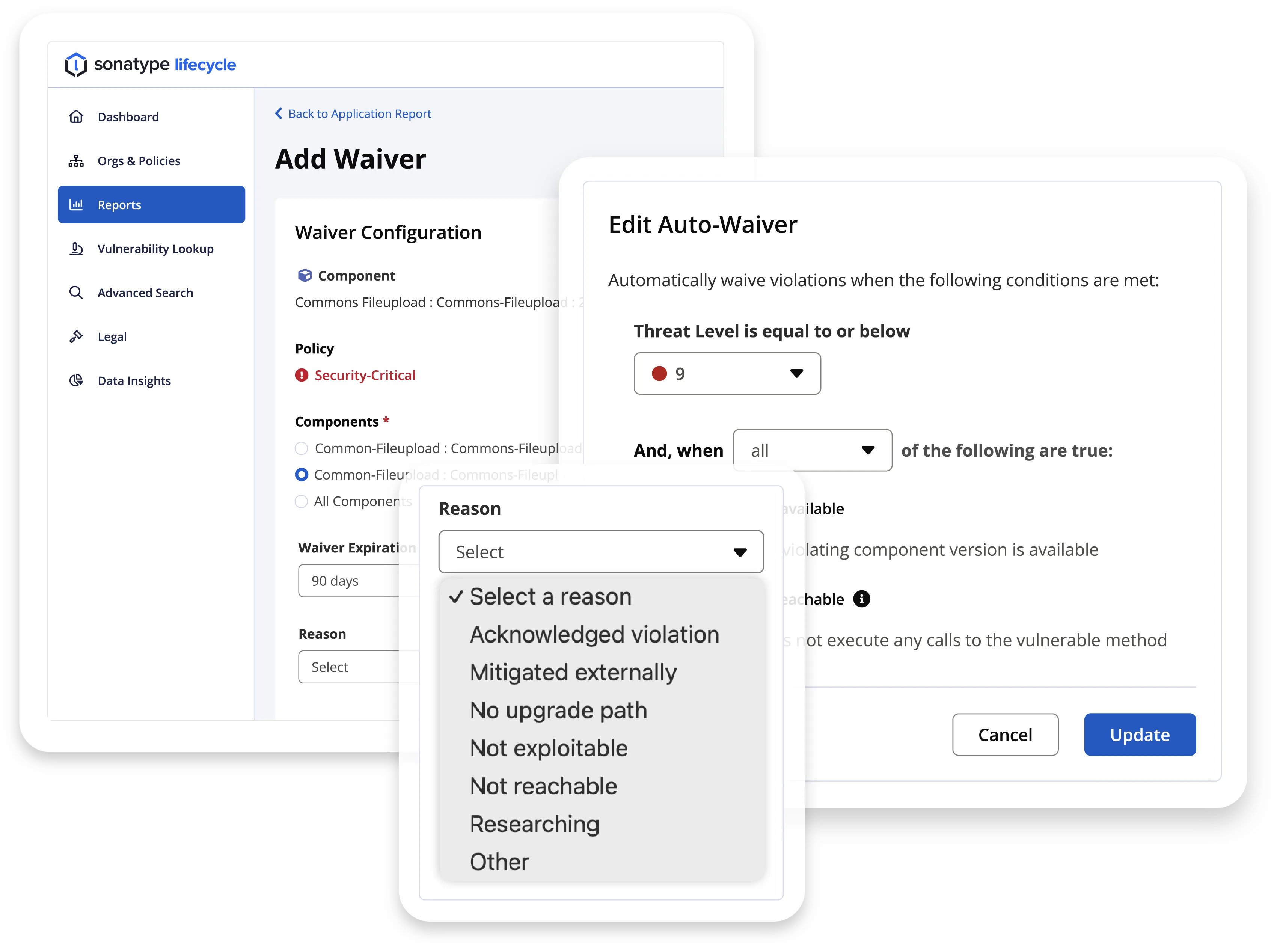
The Waiver Dashboard tracks SCA exemptions with automated waivers for low-risk violations and temporary risk acceptance workflows. This addresses the reality that not every finding can be fixed immediately.
AI-powered remediation
Golden Pull Requests recommend optimal upgrade paths considering transitive dependencies, breaking changes, and available patches. Sonatype guarantees zero build breakage from these recommendations.
AI model risk assessment
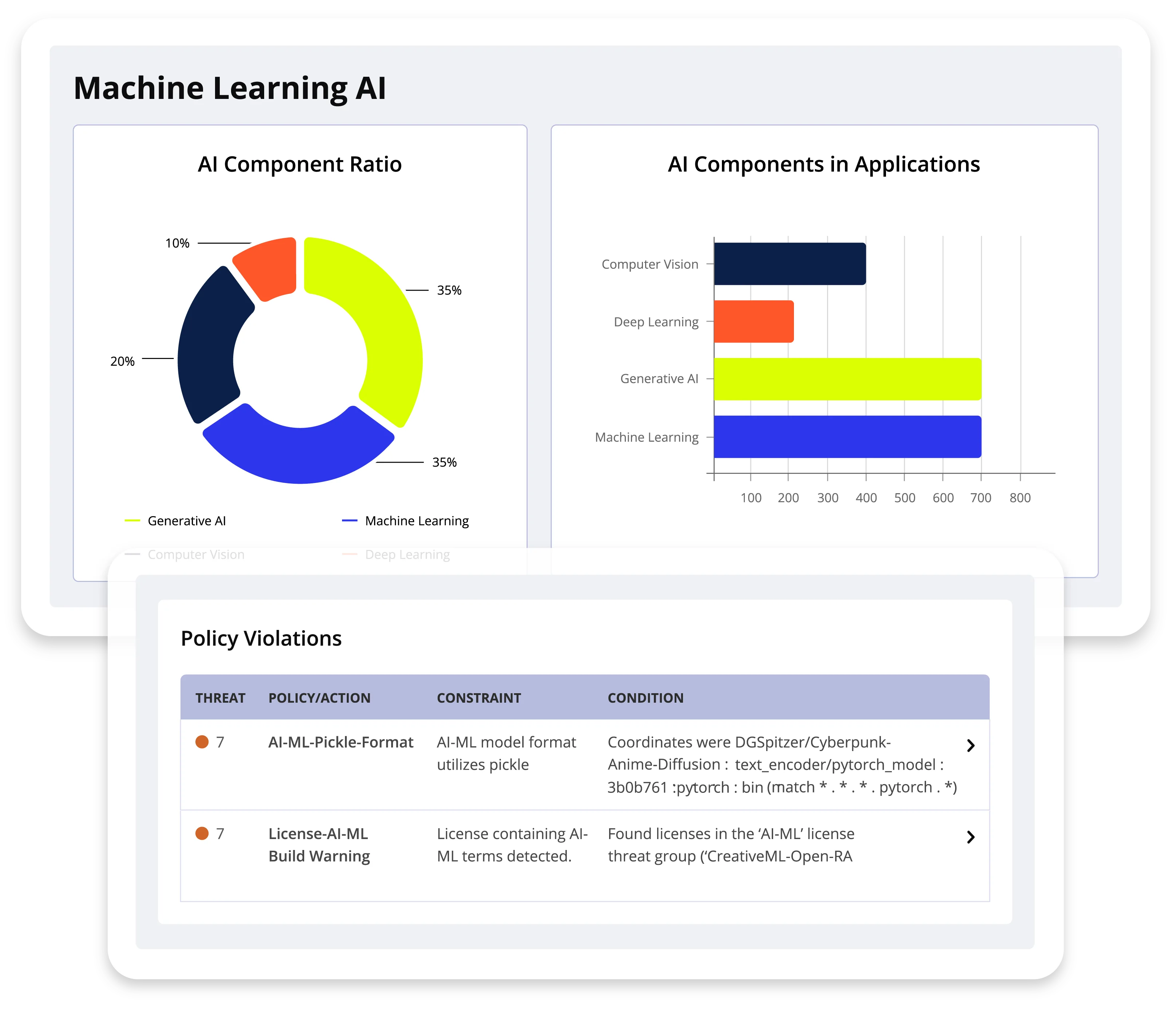
The platform includes visibility into AI model dependencies, letting teams track and manage risk from ML components alongside traditional software dependencies.
What does Sonatype Lifecycle integrate with?
 GitHub
 GitLab
 Azure DevOps
 Jenkins
 IntelliJ IDEA
 VS Code
 Eclipse
 Visual Studio
 Nexus Repository
 Artifactory
How do I get started with Sonatype Lifecycle?
- Deploy the platform — Use the Docker image for evaluation:
docker run -d -p 8070:8070 sonatype/nexus-iq-server:latest. Production deployments use Kubernetes or on-premises installation. - Install IDE plugins — Add the Sonatype plugin for IntelliJ, VS Code, or Eclipse for real-time dependency risk feedback.
- Configure CI/CD — Integrate the Nexus IQ CLI or CI plugins to scan builds and enforce policies at each SDLC stage.
- Enable the firewall — Connect Sonatype Lifecycle to Nexus Repository Manager to block risky components at download time.
When to use Sonatype Lifecycle
Sonatype Lifecycle suits enterprises requiring comprehensive SCA with policy enforcement across the SDLC. The repository firewall is unique among SCA tools, preventing vulnerable components from entering the codebase rather than finding them after the fact.
The platform is strongest for Java/Maven organizations using Nexus Repository, though it supports 20+ language ecosystems. The air-gapped deployment option (SAGE) makes it suitable for classified or regulated environments.
It is a commercial product with no free tier and more complex setup than developer-first tools.
How it compares:
| vs. | Key difference |
|---|---|
| Snyk Open Source | Snyk is more developer-friendly with a free tier. Sonatype has deeper intelligence data and the repository firewall. |
| JFrog Xray | Both offer repository-level scanning. Sonatype has its own repository manager; Xray integrates with Artifactory. Sonatype has deeper intelligence data. |
| Mend SCA | Mend has Renovate-powered remediation. Sonatype has the repository firewall and proprietary vulnerability intelligence. |
Further reading: What is SCA? | SCA in CI/CD Pipelines | Software Supply Chain Security