


Language coverage was the SAST industry’s scoreboard for over a decade.
I spent eight years on the vendor side of AppSec deals. The language-support slide was in every competitive deck, and buyers always asked about the one language their team shipped.
That slide stopped working this month. Free tools broke it.
My take: The AI code-security harness became a free category in about six months. The capability list your SAST vendor sells against has changed shape, and most renewal conversations have not caught up.
What shipped: nine free harnesses
Nine open-source AI code security harnesses now point a frontier model at a codebase and hunt for vulnerabilities. They come from Google, Visa, Cisco, Capital One, Cloudflare, Vercel, Trail of Bits, Anthropic, and one community project, with nearly 29,000 GitHub stars between them.
Semgrep published the first comparison I have seen on July 20. Useful taxonomy, but the author is a SAST vendor with its own announcement scheduled for Black Hat.
I pulled fresh numbers this morning, because Semgrep’s are already stale.
| Harness | From | Stars | Class |
|---|---|---|---|
defending-code-reference-harness | Anthropic | 6,860 | exploit generation |
deepsec | Vercel Labs | 6,425 | SAST + LLM |
skills | Trail of Bits | 6,295 | skill boosting |
raptor | community | 3,413 | SAST + LLM, maximalist |
security-audit-skill | Cloudflare | 2,675 | skill boosting |
visa-vulnerability-agentic-harness | Visa | 1,781 | SAST + LLM |
vulnhunter | Capital One | 794 | skill boosting |
mantis | 576 | skill boosting | |
ai-deep-sast | Cisco | 39 | SAST + LLM |
Visa sat at roughly 600 stars when Semgrep counted, eight days ago. It is at 1,781 now.
The churn shows in governance too. Visa’s code is Apache-licensed but takes no outside contributions, and Semgrep already describes Anthropic’s harness as unmaintained while pointing to its own fork of it.
That is the category’s speed. No comparison written this quarter survives into the next, including my table.
The model is not the product
Every project above runs on the same handful of frontier models. The harness is what surrounds the model: what gets fed in, in what order, and what must happen before a claim reaches a human.
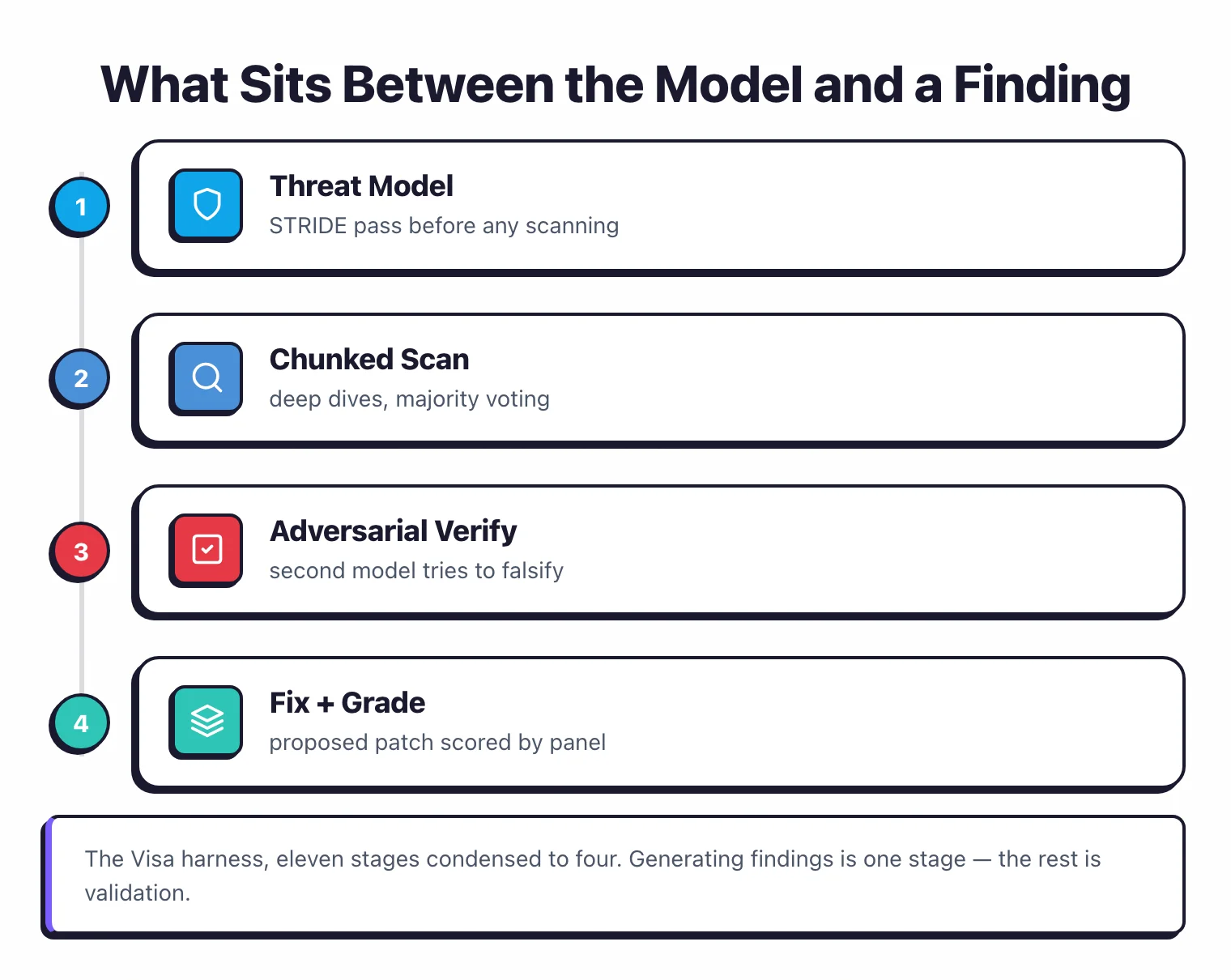
Visa’s is the clearest example: eleven stages that threat-model the code, scan it in chunks, send a second reviewer to falsify every finding, score what survives, then propose a fix and grade that fix with a separate panel.
So when a vendor says “we added AI,” ask which stage they added. Generating findings is the cheap stage. Validating them is the part worth paying for.
Three renewal-call facts
Language coverage is dead as a differentiator. Traditional SAST needed a parser and ruleset per language, each taking years; an LLM reads nearly all of them out of the box, and Visa’s free harness claims 42. If a renewal quote is still priced on the language matrix, reopen it.
A “finding” now means five different things across these harnesses. Put this table in front of anyone comparing two tools on volume.
| Tool | A “finding” is |
|---|---|
ai-deep-sast | a triaged static match |
deepsec | a re-validated static match |
visa-vulnerability-agentic-harness | a verified candidate from an LLM pipeline |
raptor | a static finding or pipeline candidate, sometimes with a PoC |
defending-code-reference-harness | a reproducible crash under ASAN |
A triaged regex match and a reproducible crash are not the same object. Counting them against each other produces a number that means nothing, which is roughly where I left issue #17 .
Adversarial validation is the new line. A second model tries to falsify each finding before you see it. Cloudflare runs it as phase three, Visa as stage six with a CVSS score, Trail of Bits as an fp-check plugin, Anthropic in a fresh container.
Four teams converged on the same control independently. That is what a real capability looks like, and the cleanest question to put to a vendor.
The gap nobody is filling
One harness runs fully local: Cisco’s ai-deep-sast, fast-scanning against Foundation-Sec-8B on your own hardware, so no code leaves the machine. It has 39 stars and has not been pushed since June 10.
Everything else assumes you will send source code to a frontier model. For a bank, a defence supplier, or anyone under a data-residency clause, that assumption is the whole evaluation.
Eight tools for the easy case, one for the hard one — and the hard one is abandoned.
Where this goes
Semgrep announces at Black Hat, and I expect other SAST vendors to follow within a quarter or two, repriced around validation instead of coverage. I also expect a third of my table stale by then. Two projects already show the signs.
The durable opening is local. The first vendor that ships adversarial validation on a model regulated buyers can run inside their own network gets a market these nine free tools cannot touch.
Before your next renewal
Which class am I buying? Exploit generation, skill boosting, or SAST-plus-LLM. A vendor that will not place itself is selling a category, not a tool.
What validates a finding before I see it? “The model is very accurate” is the wrong answer. Second-model falsification is the bar, and it is free in four places.
What runs locally, in writing. Which model, where it runs, what leaves the network.
What does free actually cost? These harnesses need someone to run, tune, and triage them, and that person costs more than most licences. Compare total cost, not zero against a quote.
One question for you
I keep comparisons of SAST tools and AI security tools on the site, and this class fits neither cleanly. Where would you file an AI code-security harness: SAST, AI security, or its own category?
I will publish the sharpest answers next issue, including the ones that tell me I have it wrong. The email edition and full archive live on the newsletter page .
Sources
- Comparing Open-Source AI Code Security Harnesses — Isaac Evans, Semgrep, July 20, 2026. Vendor-authored.
- Repository stars and last-push dates pulled from the GitHub API on July 28, 2026.