


Mindgard is an AI security platform that provides automated red teaming and continuous security testing for LLMs, AI agents, and multimodal models. It is a Dynamic Application Security Testing for AI (DAST-AI) solution built specifically to detect runtime AI vulnerabilities.
Founded in 2022 as a spinout from Lancaster University by Dr. Peter Garraghan, Dr. Neeraj Suri, and Steve Street, Mindgard draws on over a decade of academic AI security research.
Mindgard appointed James Brear as CEO in October 2025; founder Dr. Peter Garraghan moved to Chief Science Officer at the same time.
The company is headquartered in London and Boston, and has raised over $11.6M in funding, including an $8M round in December 2024 led by .406 Ventures with participation from Atlantic Bridge and Willowtree Investments.
Mindgard reports 11 PhDs on staff. It is listed in the OWASP LLM and Generative AI Security Solutions Landscape Guide and won Best AI Security Solution at the 2025 Cybersecurity Excellence Awards.
What is Mindgard?
Mindgard sits at the testing layer of the AI security stack. Rather than filtering inputs and outputs at runtime like a firewall, it proactively attacks your AI systems to find vulnerabilities before adversaries do.
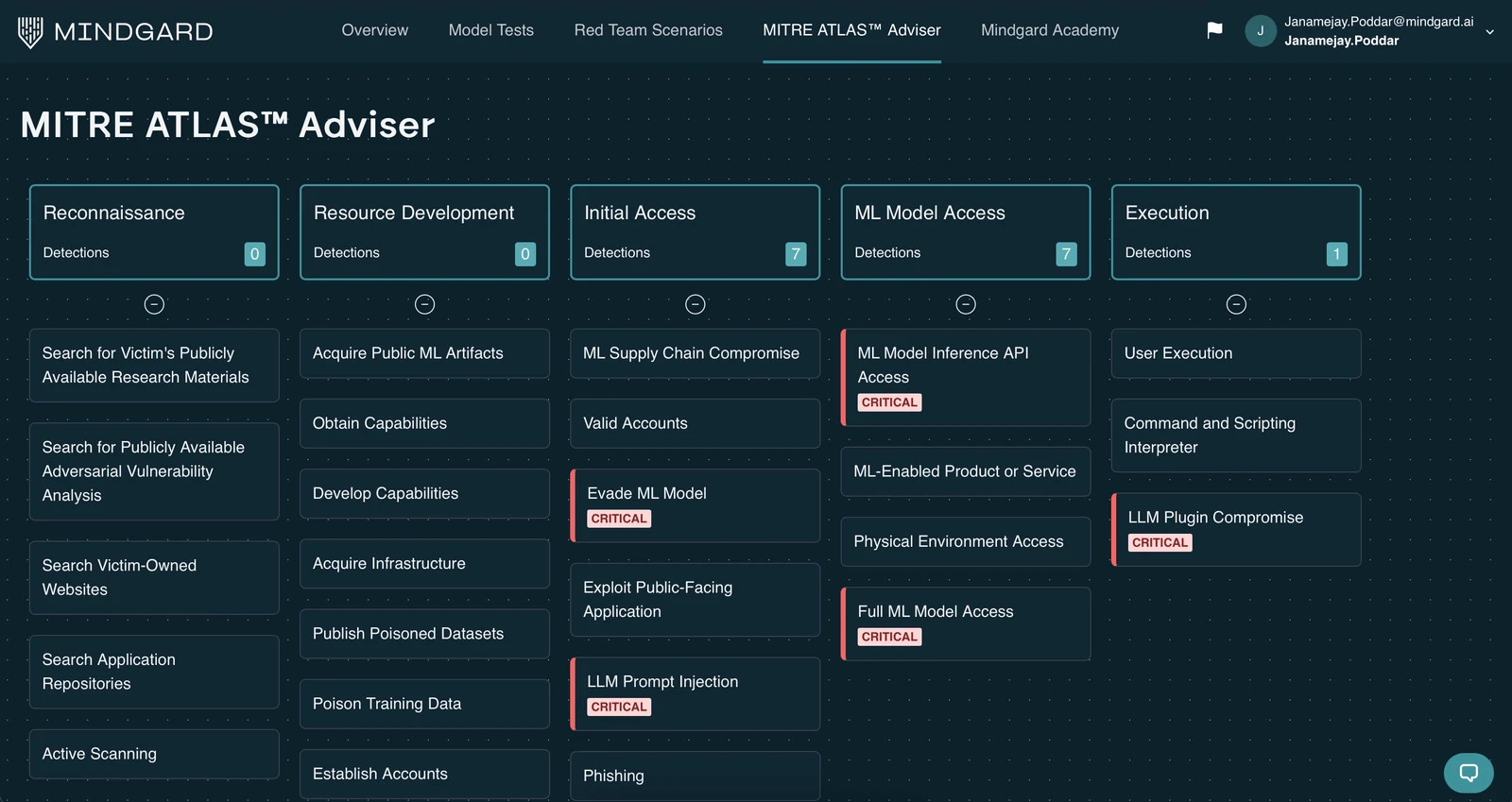
Mindgard reports that the platform simulates thousands of adversarial attack scenarios against your models and agents, then maps findings to industry frameworks like MITRE ATLAS and OWASP Top 10 for LLMs . The attack-library size is a vendor figure, not an independently audited count.
The platform is neural-network agnostic, meaning it works across generative AI, LLMs, NLP, computer vision, audio, and multi-modal models. It also tests the broader attack surface around AI systems, including agents, tools, APIs, data sources, and orchestration workflows.
| Capability | Details |
|---|---|
| Automated AI Red Teaming | Continuously simulates adversarial attacks using an attacker-aligned library that Mindgard describes as thousands of threat scenarios. Mindgard reports this cuts testing timelines from months to minutes using PhD-curated attack techniques. |
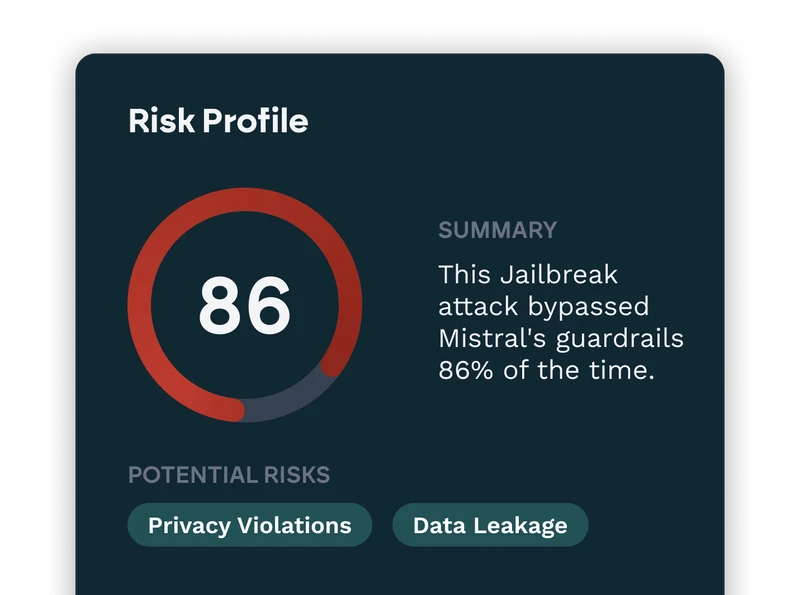
| DAST-AI Testing | A dynamic application security testing solution built for AI. Detects runtime vulnerabilities that static analysis and pre-deployment scanning cannot catch, including prompt injection, jailbreaks, and model manipulation. |
| MITRE ATLAS Alignment | Full attack library mapped to the MITRE ATLAS framework for standardized threat categorization. The ATLAS Adviser feature helps enterprise teams standardize their AI red teaming reporting and risk assessment. |
What are Mindgard’s key features?
| Feature | Details |
|---|---|
| Testing Approach | Dynamic Application Security Testing for AI (DAST-AI) |
| Attack Library | Thousands of threat scenarios (Mindgard-reported), continuously updated |
| Model Support | LLMs, NLP, computer vision, audio, multi-modal, AI agents |
| Framework Alignment | MITRE ATLAS, OWASP Top 10 for LLMs |
| CI/CD Integration | GitHub Actions, CLI, automated pipeline testing |
| Compliance | SOC 2 Type II, GDPR compliant; Mindgard states ISO 27001 in progress |
| Deployment | SaaS platform; requires only an inference or API endpoint |
| Reporting | Compliance-ready reports, SIEM integration |
How testing works
Mindgard follows a five-stage workflow. First, you point the platform at your existing AI products and environments.
Then you schedule or execute security tests with one click. The platform runs its attack library against your models, collects and analyzes detailed risk scenarios, and generates reports viewable within your existing systems and SIEM tools.
Teams then review findings and take corrective action with prioritized remediation guidance.
CI/CD integration
The Mindgard GitHub Action pulls the latest version of the Mindgard CLI each time a workflow runs.
This means the pipeline tests not only your model and application changes but also automatically incorporates every new attack technique and testing enhancement the moment Mindgard publishes it.
Integration requires only an inference or API endpoint for the model under test.
AI artifact scanning
Beyond runtime testing, Mindgard also scans AI artifacts — model files, configurations, and dependencies — for known vulnerabilities and supply chain risks before deployment.
How do I get started with Mindgard?
- Request access — Visit mindgard.ai and request a demo or trial. Mindgard uses custom enterprise pricing based on deployment scope.
- Connect your AI systems — Point Mindgard at your AI models, agents, or applications. The platform needs only an inference or API endpoint to begin testing.
- Run automated red teaming — Schedule or launch security tests against your AI systems. Mindgard runs its attack library aligned with MITRE ATLAS and OWASP frameworks.
- Integrate into CI/CD — Add the Mindgard GitHub Action or CLI to your development pipeline so security tests run automatically with every code or model change.
- Review and remediate — Analyze findings in Mindgard’s dashboard or your existing SIEM tools. Prioritize vulnerabilities and apply remediation guidance to harden your AI systems.
How much does Mindgard cost?
Mindgard does not publish a public pricing page. The DAST-AI platform is sold through enterprise sales with quotes scoped to the number of AI systems under test, the categories of models in scope (LLM, NLP, computer vision, audio, multimodal, agents), and CI/CD pipeline integration depth. There is no advertised free or self-serve tier.
I do not publish dollar amounts for sales-gated tools. To get a quote, request a demo from mindgard.ai and prepare to share the number of model endpoints in scope, target frameworks (MITRE ATLAS, OWASP Top 10 for LLMs), and any compliance constraints (SOC 2 Type II, GDPR, ISO 27001). The platform is delivered as SaaS, so deployment lead time runs days rather than weeks once the contract is signed.
When to use Mindgard
Mindgard is built for organizations that want to proactively test the security of their AI systems rather than relying solely on runtime defenses. It is particularly valuable for teams running AI in production who need continuous assurance that their models, agents, and workflows remain secure as they evolve.
The DAST-AI approach catches vulnerabilities that static scanning and pre-deployment reviews miss — issues that only surface when the model is actually running and processing inputs. The CI/CD integration means security testing becomes part of the development cycle rather than a manual gate.
What are alternatives to Mindgard?
Mindgard’s wedge is continuous DAST-AI red teaming with strong MITRE ATLAS coverage and academic E-E-A-T from the Lancaster University team. When the workflow points elsewhere, these are the closest alternatives:
- Garak — NVIDIA’s open-source LLM vulnerability scanner with 50+ probes. Pick Garak for free, self-hosted offline red teaming when you do not need Mindgard’s continuous CI/CD-integrated automation or multimodal coverage.
- Promptfoo — Open-source evaluation framework with red teaming, regression testing, and YAML-defined CI configs. Choose Promptfoo when you want broad eval plus red teaming in one tool and prefer an open-source license.
- PyRIT — Microsoft’s red-teaming orchestrator with multi-turn agent support. Better when threat modeling targets long agent loops on Azure OpenAI and you want a Microsoft-maintained option.
- HiddenLayer — Commercial enterprise platform that adds model-file scanning and runtime defense alongside red teaming. Pick HiddenLayer when ML model supply chain (binary artifacts, deserialization attacks) is part of the threat model rather than just runtime inference.
- Holistic AI — Governance-and-compliance-first platform with EU AI Act, NIST AI RMF, and ISO/IEC 42001 mapping. Better when audit-ready evidence and AI inventory matter more than offensive testing depth.
For a wider catalog, the AI security tools hub groups these by sub-category (continuous red teaming, runtime guardrails, model scanning, governance).