


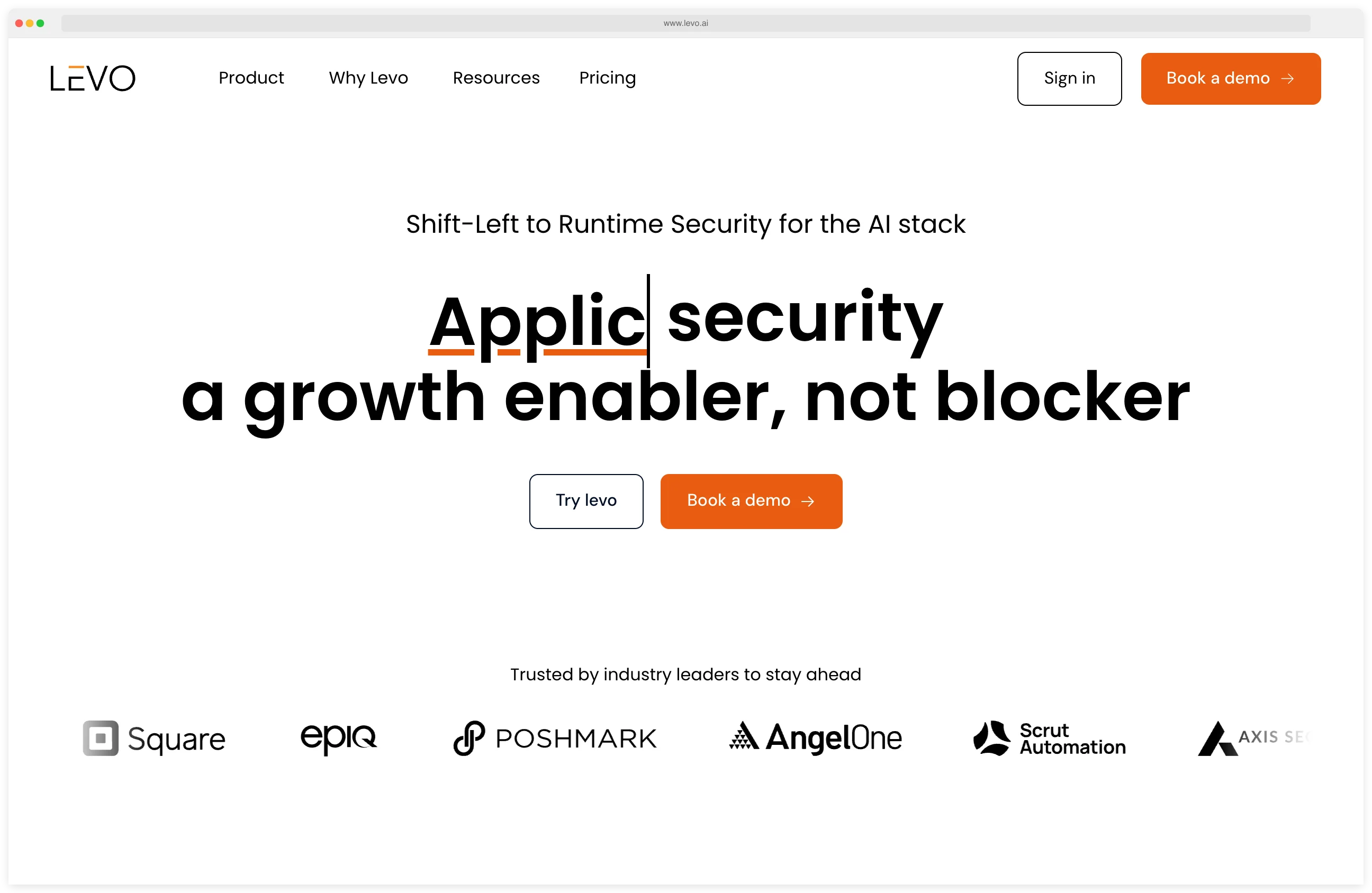
Levo.ai is an API security platform that uses eBPF technology to discover APIs automatically, generate accurate OpenAPI specifications from real traffic, and test APIs for vulnerabilities without code changes or agent deployment.
The platform has expanded from traditional API security into AI application security, covering AI agents, LLMs, MCP servers, and vector stores with the same runtime observability approach.
What is Levo.ai?
Most API security tools require you to know what APIs exist before you can secure them. Levo flips that model by observing actual traffic to discover APIs automatically, then securing what it finds.
| Capability | Details |
|---|---|
| Discover | eBPF sensors capture API traffic at the kernel level. Every endpoint, schema, authentication method, and data type is cataloged automatically, including shadow, zombie, and undocumented APIs. |
| Test | Auto-generated OpenAPI specs feed directly into security testing. The platform tests against OWASP API Top 10, authorization bypasses, and business logic flaws with zero manual configuration. |
| Monitor | Runtime observability detects drift, anomalies, and policy violations across APIs and AI components. Sensitive data flows are tracked without sending data to the cloud. |
Levo’s approach eliminates the manual work of maintaining API inventories and writing test cases. The platform builds both from observed traffic.
What are Levo.ai’s key features?
eBPF-powered API discovery
Levo’s eBPF sensor operates at the Linux kernel level, observing network traffic without modifying applications:
| What eBPF captures | Why it matters |
|---|---|
| API endpoints and paths | Complete inventory including undocumented APIs |
| Request/response schemas | Accurate data models from real traffic |
| Authentication methods | Identifies APIs with missing or weak auth |
| Data types and sensitivity | Flags PII, PHI, and secrets in API payloads |
| Rate limits and quotas | Maps API usage patterns and constraints |
Because eBPF works at the kernel level, it catches all API traffic regardless of protocol, framework, or language. No code changes, no SDK integration, no proxy deployment.
Automatic OpenAPI spec generation
Levo generates OpenAPI specifications from observed traffic rather than requiring teams to maintain specs manually:
- Specs reflect actual API behavior, not just what documentation says
- Automatically updated as APIs change
- Includes authentication requirements, data types, and error responses
- Serves as the foundation for automated security testing
- Detects spec drift when implementation diverges from documentation
This solves a persistent pain point: most organizations have incomplete or outdated API documentation. Levo creates accurate specs from reality.
OWASP API Top 10 testing
The platform tests APIs against the full OWASP API Top 10 automatically:
| Vulnerability | Levo coverage |
|---|---|
| Broken Object Level Authorization (BOLA) | Tests for IDOR vulnerabilities across endpoints |
| Broken Authentication | Identifies weak auth, missing tokens, and session issues |
| Broken Object Property Level Authorization | Tests field-level access controls |
| Unrestricted Resource Consumption | Checks rate limiting and resource exhaustion |
| Broken Function Level Authorization | Tests for privilege escalation across API functions |
| Server-Side Request Forgery (SSRF) | Tests for SSRF vectors in API parameters |
| Security Misconfiguration | Identifies exposed debug endpoints, verbose errors, missing headers |
| Lack of Protection from Automated Threats | Tests bot protection and abuse prevention |
Tests are generated automatically from discovered API behavior, with no manual test case creation required.
Sensitive data flow detection
Levo tracks sensitive data across API payloads without sending data to the cloud:
- Detects PII (names, emails, SSNs, phone numbers) in API requests and responses
- Identifies PHI (health records, diagnosis codes) for HIPAA compliance
- Flags secrets (API keys, tokens, credentials) appearing in payloads
- Maps data flows between services to identify unauthorized data exposure
- Privacy-safe processing keeps sensitive data within your environment
AI agent and LLM security
In 2025, Levo expanded to cover AI application security using the same runtime observability approach:
| AI component | Security coverage |
|---|---|
| AI agents | Discovery, behavior monitoring, tool abuse detection |
| LLMs | Prompt injection testing, data exfiltration monitoring |
| MCP servers | Configuration security, tool authorization validation |
| Vector stores | Data poisoning detection, query monitoring |
| API-to-LLM connections | Data flow tracking between traditional APIs and AI services |
The platform maps AI components the same way it maps APIs: by observing actual traffic and interactions rather than relying on documentation.
What does Levo.ai integrate with?
 GitHub
 GitLab
 Jenkins
 CircleCI
 AWS
AWS Azure
Azure GCP
GCP Kubernetes
 Datadog
 Splunk
 Elasticsearch
 Slack
SlackHow do I get started with Levo.ai?
- Deploy eBPF sensor — Install the lightweight eBPF sensor on your infrastructure. No code changes, SDKs, or proxy configuration required. Works on Kubernetes, VMs, and bare metal.
- Automatic API discovery — The sensor begins capturing API traffic immediately. Within hours, you have a complete inventory of all APIs including shadow and zombie endpoints.
- OpenAPI spec generation — Levo generates accurate OpenAPI specifications from observed traffic, including authentication methods, data types, and response schemas.
- Continuous testing and monitoring — Automated security testing runs against discovered APIs. Runtime monitoring detects drift, anomalies, and sensitive data exposure on an ongoing basis.
When to use Levo.ai
Levo.ai fits organizations that lack visibility into their API landscape.
If you do not have an accurate API inventory, have incomplete or outdated API documentation, or suspect shadow APIs exist in your environment, Levo’s eBPF-based discovery provides that foundation without requiring any changes to existing applications.
If you need deeper microservices tracing and distributed architecture analysis, Traceable AI (now Harness) focuses on that through OpenTelemetry integration.
If you want an API-first DAST scanner rather than an observability platform, Escape or StackHawk take that approach.