


KubeArmor is a CNCF Sandbox runtime security enforcement system that restricts container and pod behavior at the kernel level using Linux Security Modules (LSMs) and eBPF. Unlike detection-only tools, KubeArmor actively prevents policy violations by enforcing controls on process execution, file access, and network operations.
The project has 2.3k GitHub stars and 121 contributors. AccuKnox reports over 1.2 million downloads — a vendor figure, not an independently audited count. The latest release is v1.7.1 (May 2026).
KubeArmor was created and is maintained by AccuKnox , which builds its commercial ASPM and CNAPP platform on the same runtime engine.
KubeArmor is available on the AWS, Red Hat, Oracle, and DigitalOcean marketplaces. AccuKnox positions it as the first Kubernetes security engine to use BPF-LSM for inline mitigation — a vendor claim, not an independently verified milestone.
What is KubeArmor?
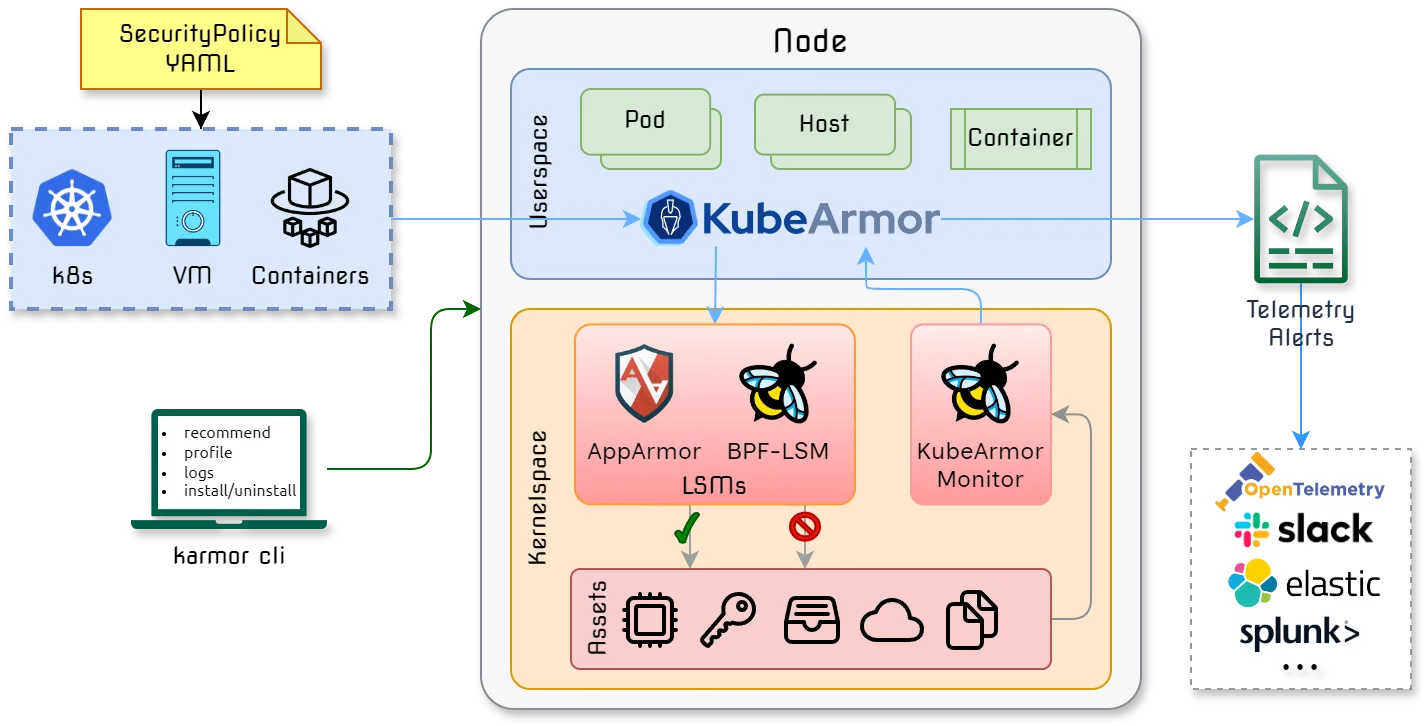
KubeArmor deploys as a non-privileged DaemonSet on Kubernetes nodes. When workloads start, it applies security policies that define allowed behaviors.
Any attempt to violate a policy — a container trying to execute an unauthorized binary or access a restricted file — is blocked by the LSM before it can occur.
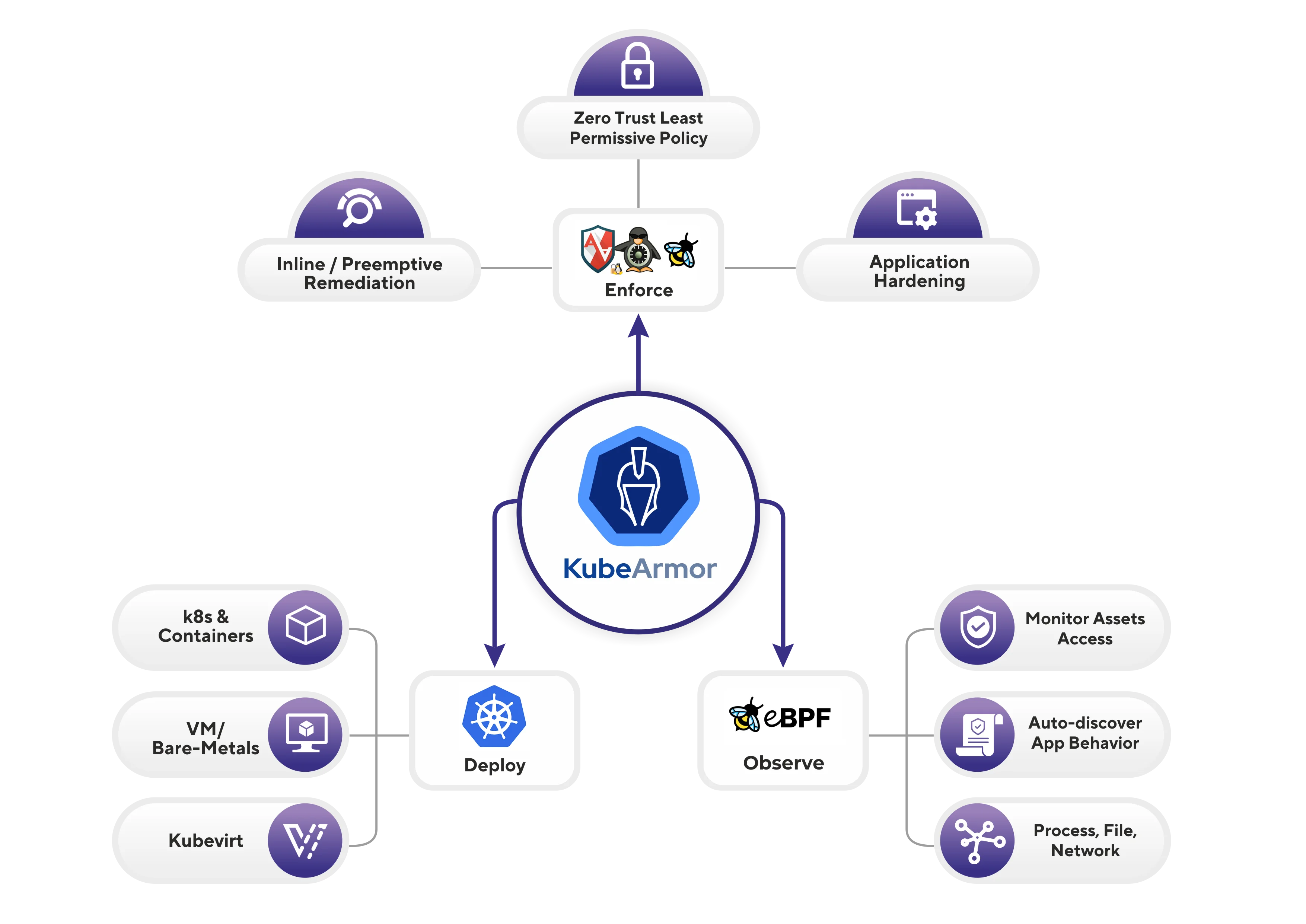
The tool uses eBPF to instrument kernel security hooks with minimal overhead. KubeArmor automatically selects the most appropriate LSM based on what’s available in the kernel (AppArmor, SELinux, or BPF-LSM).
Policies are defined using Kubernetes CRDs that specify match criteria (which pods or namespaces to apply to) and security rules (what behaviors to allow or deny). Teams can write custom policies or use pre-built policy libraries based on compliance frameworks like CIS, MITRE ATT&CK, NIST 800-53, and STIGs.
| Capability | Details |
|---|---|
| Least-Privilege Enforcement | Automatically restricts workloads to only necessary capabilities, reducing attack surface without manual security context configuration |
| Zero-Code Hardening | Apply security policies to existing applications without modifying code, rebuilding images, or changing deployment manifests |
| Compliance Libraries | Deploy pre-built policies based on CIS, MITRE, NIST, and STIG frameworks to meet regulatory requirements out-of-the-box |
What are KubeArmor’s key features?
| Feature | Details |
|---|---|
| Enforcement mechanism | Linux Security Modules (AppArmor, SELinux, BPF-LSM) |
| Instrumentation | eBPF-based telemetry with container/pod/namespace identities |
| Policy scope | Process execution, file access, network operations |
| Compliance rules | MITRE ATT&CK , STIGs, CIS -based pre-built policies |
| Deployment | Non-privileged DaemonSet on Kubernetes, containers, VMs/bare-metal |
| Marketplaces | AWS, Red Hat, Oracle, DigitalOcean |
| CNCF status | Sandbox |
| License | Apache 2.0 |
Multi-LSM Support
KubeArmor works with AppArmor on Ubuntu/Debian systems, SELinux on Red Hat/CentOS, and BPF-LSM on modern kernels (5.7+). This flexibility covers different Linux distributions and Kubernetes environments.
Process Control: Policies can restrict which binaries containers can execute. For example, a web server container might be limited to running only nginx and related utilities, preventing attackers from running shells or other tools after compromise.
File System Protection: Fine-grained control over file access prevents containers from reading sensitive files or writing to system directories. Policies can specify read/write/execute permissions for specific paths or patterns.
Network Restrictions: KubeArmor can limit network connectivity from containers, restricting which ports or protocols workloads can use. This capability helps prevent lateral movement after initial compromise.
Kubernetes Integration: Policies reference Kubernetes metadata like namespaces, labels, and container names. This native integration allows security teams to think in Kubernetes terms rather than low-level kernel constructs.
How do I get started with KubeArmor?
- Install KubeArmor — Deploy via Helm or from the AWS/Red Hat/Oracle/DigitalOcean marketplace. KubeArmor runs as a non-privileged DaemonSet on every node.
- Apply a pre-built policy — Start with MITRE, STIGs, or CIS-based compliance policies from the KubeArmor policy library. These cover common hardening requirements out of the box.
- Write custom policies — Define policies using Kubernetes CRDs that specify match criteria (pods, namespaces) and enforcement rules (allow/deny for processes, files, network).
- Monitor violations — KubeArmor logs policy violations with full container/pod/namespace identity context via eBPF telemetry.
When to Use KubeArmor
Strengths:
- Active prevention rather than detection-only monitoring
- Uses proven kernel security mechanisms (LSMs)
- No application code or image changes required
- Pre-built compliance policies accelerate deployment
- Native Kubernetes integration with CRD-based policies
- Supports major managed Kubernetes services including EKS
- CNCF project with growing community adoption
Limitations:
- Requires kernel LSM support (not available in all environments)
- Policy development requires understanding of application behavior
- Overly restrictive policies can break legitimate functionality
- Debugging policy violations can be challenging
- Limited tooling compared to more mature projects
- Performance impact from LSM enforcement on high-throughput workloads
For a broader view of container security strategy, see the cloud infrastructure security guide . KubeArmor complements other IaC security tools in a defense-in-depth strategy.
Combining KubeArmor’s enforcement with Falco ’s detection provides both prevention and monitoring. Policy engines like Kyverno prevent misconfigured workloads from being admitted, while KubeArmor enforces runtime behavior restrictions.
This layered approach addresses security at admission, deployment, and runtime phases of the workload lifecycle.