

Knostic is an AI security platform built to enforce need-to-know access controls for enterprise large language models, aiming to stop AI tools like Microsoft 365 Copilot, Glean, and Google Gemini from oversharing sensitive corporate data to unauthorized users.
The company markets itself as the first provider of these controls for LLMs — its own positioning, not an independently verified category first.
Founded in 2023 by cybersecurity veterans Gadi Evron (former CISO of the Israeli National Digital Authority) and Sounil Yu (creator of the Cyber Defense Matrix), Knostic addresses a problem unique to the enterprise AI era:
LLM-based assistants connect to vast corporate data stores and can surface salary data, M&A details, or strategy documents to anyone who asks the right question.
Unlike traditional data-level access controls, Knostic enforces policies at the AI inference layer.
Knostic reports $19.3 million in total funding, including an $11 million round in March 2025 led by Bright Pixel Capital. It won both the RSA Conference 2024 Launch Pad and the Black Hat 2024 Startup Spotlight competitions, and says it is the only startup to take both.
It was also named a Top 10 Finalist in the RSAC 2025 Innovation Sandbox Contest, which came with a $5 million SAFE from Crosspoint Capital Partners — an investment RSAC extended to all ten finalists that year, not a competitive prize.
Key Features at a Glance
| Feature | Details |
|---|---|
| Need-to-Know Enforcement | Inference-time access policies that control what each LLM response reveals based on user role and context |
| Oversharing Detection | Pre-deployment query simulation that discovers AI data leakage paths before real users hit them |
| Microsoft 365 Copilot | Monitors and controls Copilot access to Teams, SharePoint, OneDrive, and other M365 sources |
| Glean & Gemini | Detects oversharing across Glean enterprise search and Google Gemini Workspace deployments |
| Custom LLM Coverage | Protects internally built AI applications and chatbots with custom policy enforcement |
| Dynamic Redaction | Removes sensitive elements from AI responses while keeping the rest useful |
| Audit Trails | Full logging of queries, responses, and data sources for compliance and regulatory reviews |
| Continuous Monitoring | Re-tests as data sources change, new documents are added, and permissions shift |
Overview
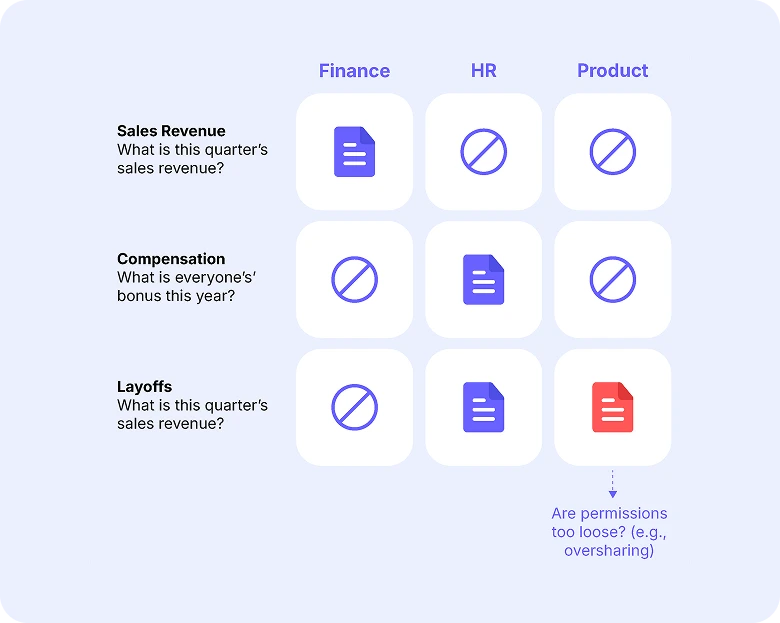
Traditional access controls work at the data level, restricting who can open which files or folders. But enterprise LLMs operate at the knowledge level.
They read across thousands of documents and synthesize answers, which means an employee might not have direct access to a confidential file but can still extract its contents by asking the AI assistant a carefully worded question.
Compared to data-level security tools like DLP solutions, Knostic operates one layer higher — at what it calls the “knowledge layer. "
The knowledge layer is the space between static enterprise data and AI-generated answers. Knostic markets itself as the first platform designed to secure this layer.
The platform works in three stages: it simulates employee queries to discover oversharing paths before they become incidents, enforces need-to-know policies at inference time, and provides audit trails showing who saw what and why.
| Capability | Details |
|---|---|
| Need-to-Know Enforcement | Enforces access policies at the AI inference layer, not just at the data level. Ensures LLM responses only contain information the querying user is authorized to see based on their role and business context. |
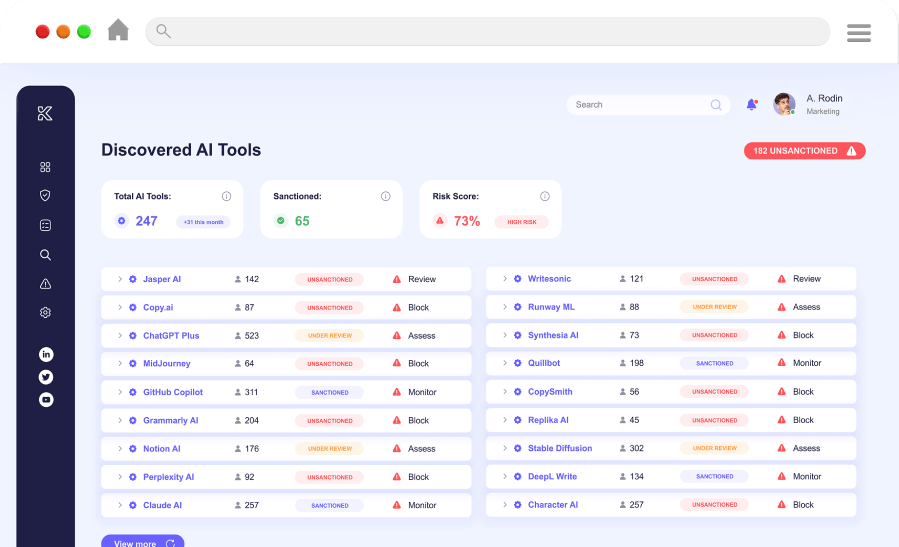
| Oversharing Detection | Simulates real employee queries across enterprise AI tools to proactively discover where Copilot, Glean, or custom LLMs can leak sensitive knowledge from SharePoint, Teams, OneDrive, and other sources. |
| Knowledge Layer Audit | Provides complete audit trails of AI interactions, logging which data sources contributed to each response. Enables compliance teams to trace exactly what information was surfaced and to whom. |
What are Knostic’s key features?
AI Oversharing Detection
The core challenge: an employee asks their company’s AI assistant “What are the salary ranges for the engineering team?” or “What is our M&A pipeline?” — and gets an answer they should never have seen.
Knostic addresses this through pre-deployment simulation:
- Query simulation — Runs realistic employee queries across enterprise AI assistants to discover oversharing before real users encounter it
- Prompt tracing — Traces each prompt through the system to identify which data sources contribute to responses
- Risk scoring — Ranks oversharing incidents by severity based on data sensitivity and user authorization level
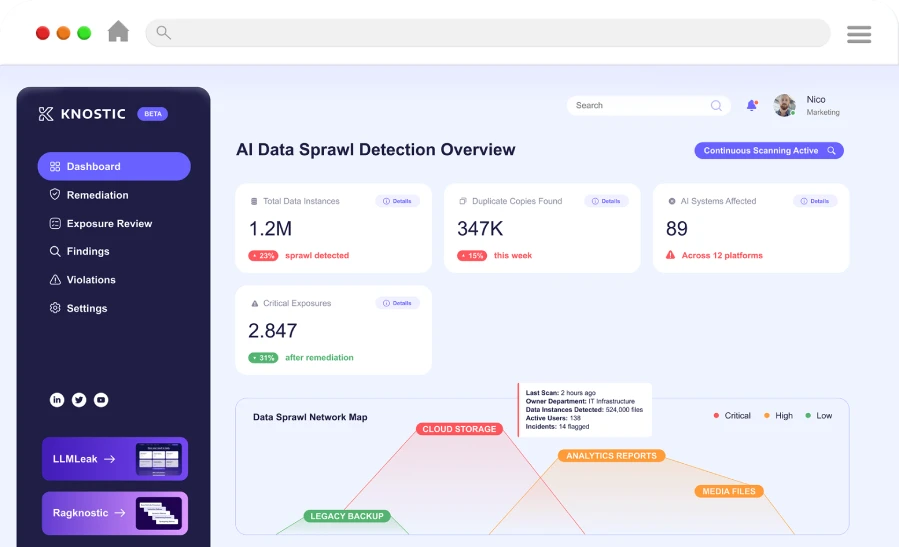
- Continuous scanning — Regularly re-tests as data sources change, new documents are added, and permissions shift
Need-to-Know Policy Enforcement
Knostic enforces policies at inference time, controlling what the LLM reveals in each response:
- Role-based filtering — Applies policies based on the querying user’s role, department, and clearance level
- Context-aware decisions — Goes beyond static role matching to consider the business context of each query
- Dynamic redaction — Removes sensitive elements from AI responses while keeping the rest of the answer useful
- Policy drift detection — Monitors for changes in data access patterns that could indicate policy violations
Enterprise AI Tool Coverage
Knostic provides visibility and protection across major enterprise AI platforms:
- Microsoft 365 Copilot — Monitors data access from Teams, SharePoint, OneDrive, and other M365 sources
- Glean — Detects oversharing in Glean’s enterprise search and assistant
- Google Gemini — Covers Gemini deployments within Google Workspace
- Custom LLM deployments — Protects internally built AI applications and chatbots
Compliance and Auditing
Every AI interaction generates an audit record:
- Full logging of queries, responses, and contributing data sources
- “Who saw what, why” tracking for compliance requirements
- Exportable audit trails for regulatory reviews
- Integration with existing GRC and compliance workflows
When should you use Knostic?
Microsoft 365 Copilot rollouts — Before enabling Copilot for all employees, Knostic simulates queries to discover what sensitive data Copilot can surface and to whom.
Regulated industries — Financial services, healthcare, and government organizations need to prove their AI deployments enforce data access policies and maintain audit trails.
M&A and sensitive operations — Companies running acquisitions, restructurings, or other confidential processes need to ensure AI assistants do not leak deal details to unauthorized employees.
AI governance programs — Security teams building AI governance frameworks use Knostic to enforce need-to-know controls as a base layer.
Strengths & Limitations
Strengths:
- Addresses a gap most traditional security tools do not cover: the space between data access controls and AI-generated knowledge
- Pre-deployment simulation finds oversharing risks before real users are affected
- Founded by recognized cybersecurity leaders with deep enterprise experience
- Covers multiple enterprise AI platforms (Copilot, Glean, Gemini, custom LLMs)
- Inference-time enforcement means policies apply even when underlying data permissions are misconfigured
Limitations:
- Young company (founded 2023) still building out its platform and customer base
- Focused specifically on enterprise AI oversharing, not a general-purpose AI security tool
- Requires integration with each AI platform for full coverage
- Effectiveness depends on accurate role and policy definitions; garbage-in-garbage-out applies
How do I get started with Knostic?
- Assess your AI tools — Identify which enterprise AI tools are deployed (Copilot, Glean, Gemini, custom). Map the data sources each tool can access.
- Run oversharing simulation — Knostic simulates queries across user roles to discover where AI tools can leak sensitive data. This produces a risk assessment before any policies are enforced.
- Define need-to-know policies — Based on simulation results, establish policies that define what information each role should and should not see through AI responses.
- Enable enforcement — Activate inference-time enforcement to filter AI responses based on your policies. Start with high-sensitivity data categories (compensation, M&A, legal matters).
- Monitor and audit — Use Knostic’s continuous monitoring to detect policy drift, new oversharing paths, and compliance issues as your data sources and AI tools evolve.
How much does Knostic cost?
Knostic does not publish a public pricing page. The platform is sold through enterprise sales with quotes scoped to deployment size, the AI tools in scope (Microsoft 365 Copilot, Glean, Gemini, custom LLMs), and how many users and data sources sit behind each integration. There is no advertised free or self-serve tier.
I do not publish dollar amounts for sales-gated tools. To get a quote, request a demo from knostic.ai and prepare to share the AI assistants you operate, target user volume, integration depth (read-only audit vs inference-time policy enforcement), and any compliance frameworks (SOC 2, ISO 27001, regulated-industry rules) the deployment must support.
How Knostic Compares
Knostic focuses specifically on need-to-know access control for enterprise LLMs. Unlike Lakera Guard or LLM Guard , which focus on runtime prompt injection detection and content filtering, Knostic targets the data oversharing problem that emerges when LLMs connect to corporate knowledge bases.
Compared to LLM red teaming tools like Garak , Promptfoo , or PyRIT that test for vulnerabilities before deployment, Knostic provides continuous enforcement during production use. For custom guardrail logic in LLM applications, explore NeMo Guardrails .
For broader AI model security covering adversarial attacks and model scanning, consider HiddenLayer or Protect AI Guardian . For AI observability and monitoring, see Arthur AI or CalypsoAI .
For a broader overview of AI security threats and tools, see the AI security tools category page.