
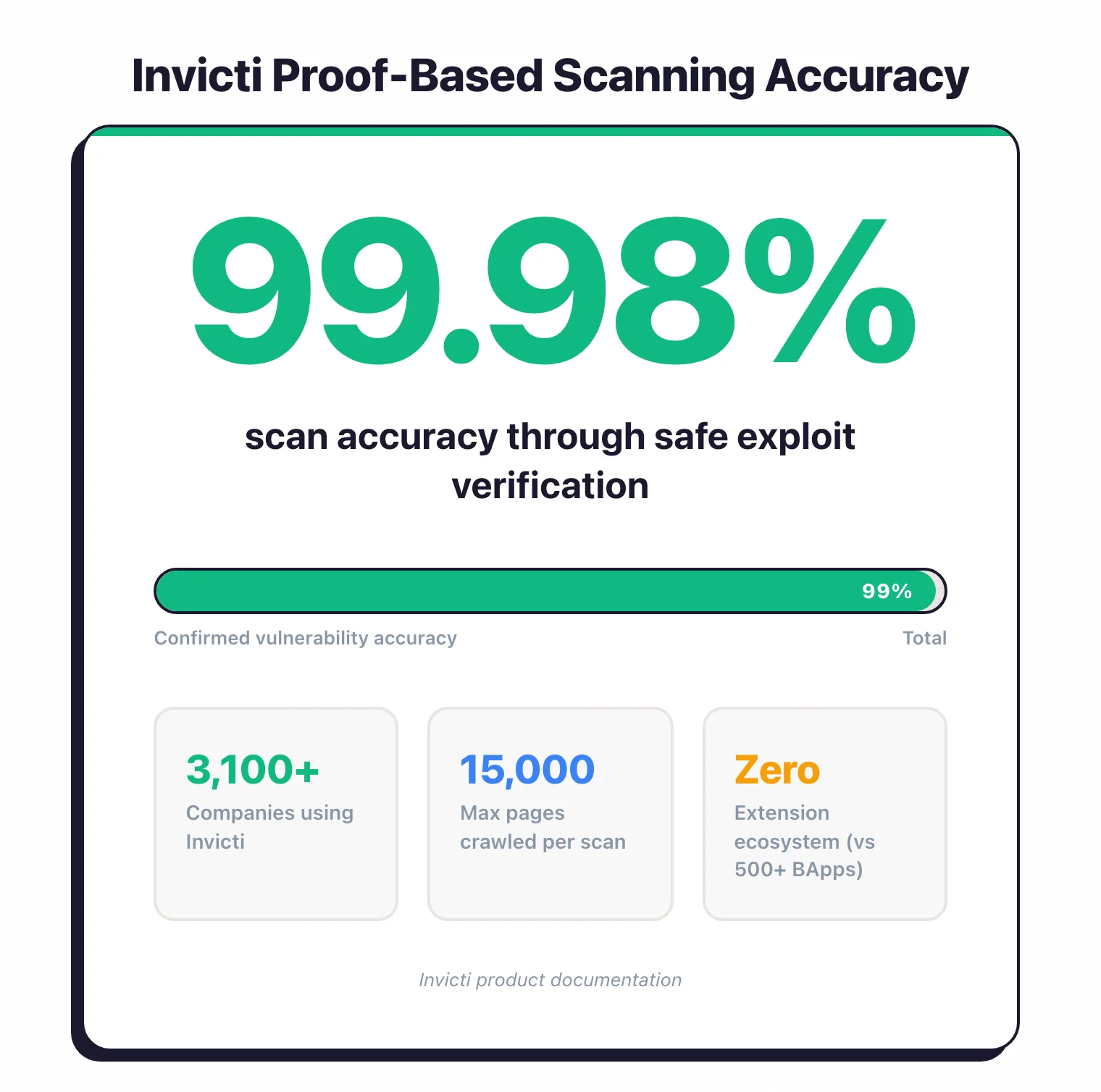
- Invicti’s proof-based scanning safely exploits findings to confirm they are real, claiming 99.98% accuracy and near-zero false positives.
- Burp Suite Professional costs ~$475/year per user; Invicti uses custom enterprise pricing with no public rates.
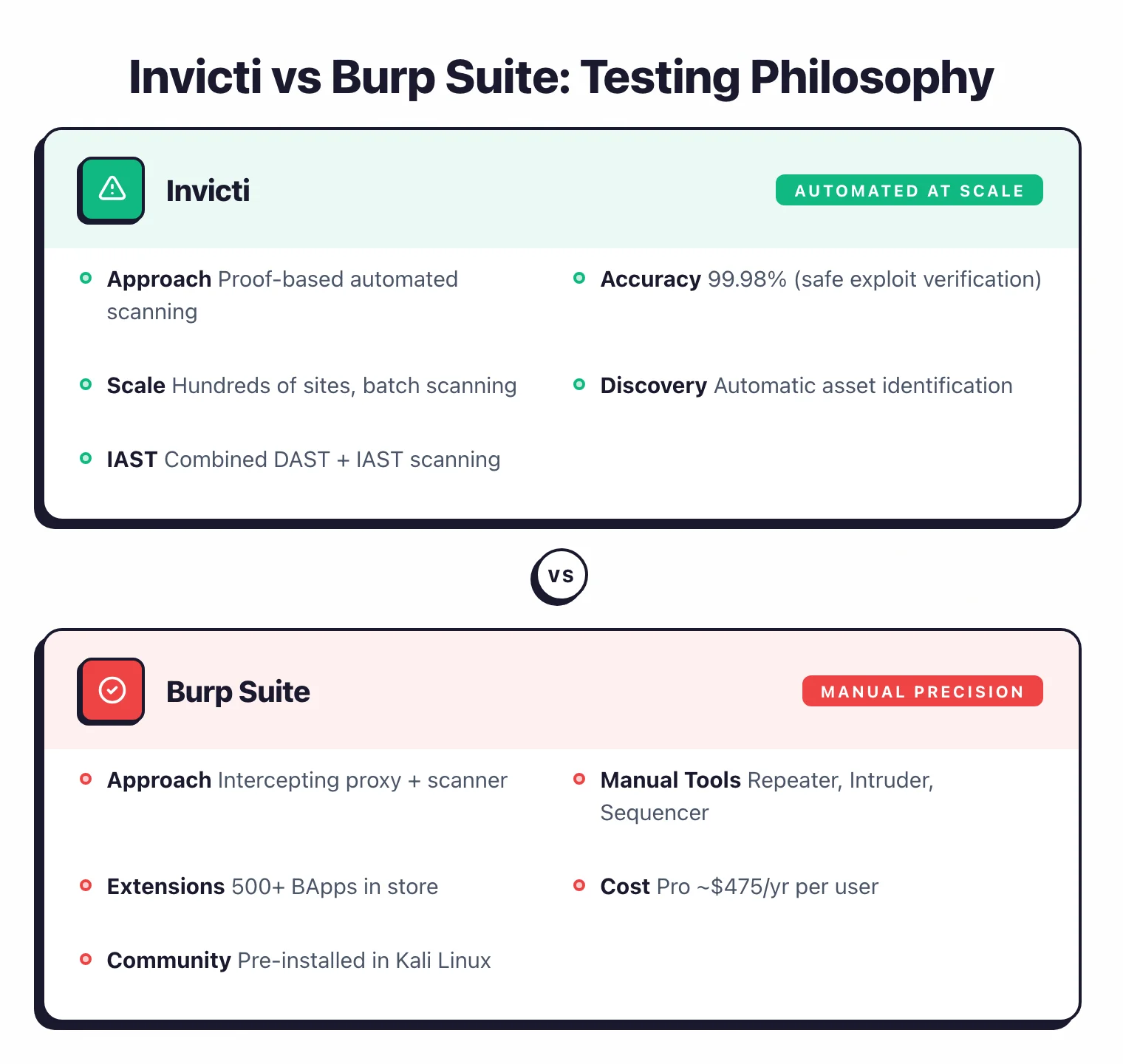
- Burp Suite offers 500+ BApp Store extensions and manual testing tools (Repeater, Intruder, Sequencer); Invicti has no extension ecosystem or intercepting proxy.
- Invicti includes automatic website discovery, combined DAST+IAST scanning, and role-based access control for managing hundreds of web applications at scale.
- Many organizations run both: Invicti for continuous automated scanning across the portfolio, Burp Suite for manual pen testing on high-risk targets.
Which Is Better: Invicti or Burp Suite?#
For security teams scanning hundreds of apps continuously, Invicti fits because proof-based scanning eliminates triage at scale. For penetration testers who manually probe individual targets, Burp Suite fits because of its proxy, Repeater, Intruder, and 500+ extensions.
Choose Invicti if your job is portfolio coverage; choose Burp Suite if your job is hands-on application testing.
Invicti and Burp Suite solve different problems within DAST. Invicti is an automated scanning platform for security teams that need to scan hundreds of web applications without babysitting each one.
Its proof-based scanning safely exploits findings to confirm they are real, which nearly eliminates false positives.
Burp Suite is what pentesters actually use day to day: intercepting proxy, manual testing tools, and an extensible scanner with 500+ community extensions. Invicti automates at scale. Burp Suite lets testers go deep on individual targets.
What Are the Key Differences?#
| Feature | Invicti | Burp Suite |
|---|---|---|
| Primary Use | Automated enterprise DAST | Manual pentesting + automated scanning |
| License | Commercial (custom pricing) | Community (free), Pro (~$475/yr), DAST (custom) |
| Free Tier | No | Community Edition (limited) |
| Proof-Based Scanning | Yes (safe exploit verification) | No |
| Intercepting Proxy | No | Yes (core feature) |
| Manual Testing Tools | Limited | Repeater, Intruder, Comparer, Decoder, Sequencer |
| Automated Scanner | Yes (primary mode) | Yes (Pro and DAST editions) |
| IAST Capability | Yes (combined DAST+IAST) | No |
| SCA Detection | Yes (out-of-date library detection) | No |
| AI Features | AI-powered remediation guidance | Burp AI (scan analysis, attack suggestions) |
| CI/CD Integration | Jenkins, GitLab, Azure DevOps, custom | Jenkins, GitHub Actions, GitLab CI, Azure DevOps (DAST edition) |
| Asset Discovery | Yes (automatic website discovery) | No |
| Deployment | Cloud (AWS US/EU) or on-premises | Desktop (Pro), Docker containers (DAST) |
| Extensions | No | 500+ BApps in BApp Store |
| Scan Policies | OWASP Top 10, PCI, custom | Configurable scan profiles |
| Companies Using | 3,100+ | Widely used (pre-installed in Kali Linux) |
| Editions | Standard, Team, Enterprise | Community, Professional, DAST |
What the table does not show: scan-time feel and reporting voice. Invicti’s portfolio scans run for hours and surface confirmed-vs-probable findings with executive-summary reports built for compliance audiences.
Burp Suite Professional reports come from interactive sessions and read more like pentester notes — useful when manual judgment matters, less useful for board-level reviews.
False-positive density on a typical app is dramatically lower in Invicti because of proof-based exploitation. Burp Suite’s automated scanner is strong but assumes a human will validate findings, which is fine for pentesters and painful at portfolio scale.
Invicti vs Burp Suite: How Do They Compare?#
Scanning Approach#
Invicti is automation-first. You add targets, configure scan policies (OWASP Top 10, PCI, or custom), and let the platform crawl and attack.
The crawler handles up to 15,000 pages per scan, supports JavaScript-heavy single-page applications, and manages authentication automatically.
The scanner runs against the full target in one pass, producing a report with confirmed, probable, and informational findings.
Proof-based scanning is what separates Invicti from other automated scanners. Instead of reporting that a SQL injection might exist, the scanner safely exploits it to prove it does.
No more triaging probable findings that turn out to be noise. Invicti claims 99.98% accuracy as a result.
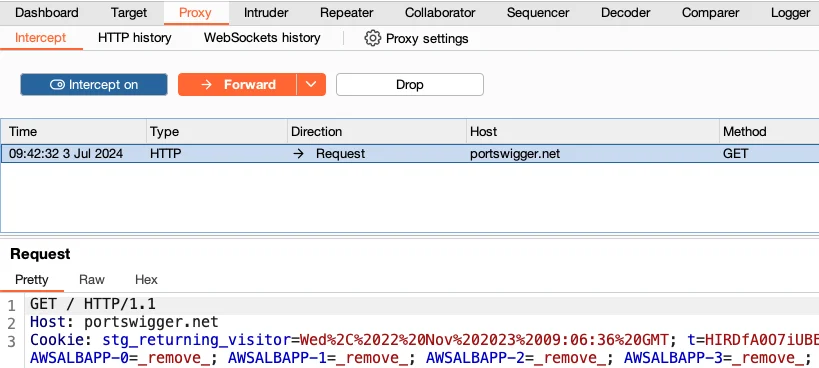
Burp Suite works differently at every level. The intercepting proxy sits between your browser and the target, capturing every request.
You browse the application manually, build a site map, and understand how the application behaves.
Then you send interesting requests to Repeater for manual testing, Intruder for automated attacks, or the active scanner for vulnerability detection.
The automated scanner was designed to help manual testers, not replace them.
Burp Suite DAST (the enterprise edition) shifts closer to Invicti’s model — it runs automated scans from Docker containers in CI/CD pipelines without manual interaction.
But the underlying scanner was built for pentesters, not for autonomous operation.
Enterprise Scale#
Invicti was built for managing large application portfolios.
The Discovery feature finds websites associated with your organization through email domain matching, IP address correlation, SSL certificate analysis, and domain keyword matching.
Website groups let you organize targets by infrastructure, team, or priority, and group scanning runs batch scans across related targets.
Scan profiles can be saved and shared across team members. Role-based access control manages who can configure and run scans.
If you have multiple teams scanning hundreds of applications across different business units, these governance features are not optional.
Burp Suite Professional is a single-user desktop tool. No centralized management, no discovery, no multi-user governance.
Burp Suite DAST adds some of this (multiple users, CI/CD integration) but still lacks the asset discovery and scan organization that Invicti has.
PortSwigger built Burp for skilled testers who work on one target at a time, not for security programs managing a portfolio of 500 web applications.
Manual Testing Capability#
Burp Suite owns this category. Invicti does not even try to compete here.
Burp’s manual testing tools are why pentesters have used it for over two decades:
- Repeater lets you modify and resend individual requests to test specific behaviors
- Intruder automates fuzzing with four attack types (Sniper, Battering Ram, Pitchfork, Cluster Bomb)
- Comparer diffs two responses to spot subtle differences
- Decoder encodes and decodes data in multiple formats
- Sequencer analyzes token randomness
The BApp Store adds 500+ extensions. Autorize tests access control. JWT Editor manipulates tokens.
Logger++ provides traffic analysis. You can write custom extensions in Java or Python.
Invicti has no intercepting proxy, no request manipulation tools, and no extension ecosystem.
If you need to manually verify findings, chain vulnerabilities, or test application logic, you need Burp Suite (or a similar proxy tool) alongside Invicti.
CI/CD Integration#
Both tools integrate into pipelines, but differently.
Invicti’s CI/CD integration is built into the product: configure a scan policy, connect your pipeline, and results flow into your ticketing system.
Integrations cover Jenkins, GitLab, Azure DevOps, Jira, and others. Scans trigger automatically on deployment.
Burp Suite DAST runs from Docker containers and supports Jenkins, GitHub Actions, GitLab CI, Azure DevOps, and TeamCity.
It outputs SARIF for code scanning platforms and JUnit XML for build gating.
The integration works well, but you lose access to Burp’s manual testing tools — the DAST edition is the automated scanner extracted from the full toolkit.
Both support scan-based gating (fail builds on critical findings), but Invicti’s webhook-driven workflow and built-in ticketing integrations are more mature for continuous scanning programs.
When Should You Choose Invicti?#
Choose Invicti if:
- You need to scan hundreds of web applications automatically with minimal manual effort
- False positive elimination through proof-based scanning is a priority
- Asset discovery — automatically finding your organization’s web properties — matters
- Combined DAST + IAST scanning in a single platform is valuable
- Enterprise governance (role-based access, scan policies, website grouping) is required
- Your team focuses on managing vulnerability programs rather than hands-on testing
When Should You Choose Burp Suite?#
Choose Burp Suite if:
- Manual penetration testing is your primary workflow
- You need an intercepting proxy with request manipulation (Repeater, Intruder)
- Extensibility through 500+ BApps and custom extensions matters
- Your budget is limited — Professional costs ~$475/year versus Invicti’s enterprise pricing
- Your team consists of skilled security testers who go deep on individual targets
- You need both manual testing and automated CI/CD scanning (Professional for manual work, DAST edition for pipelines)
Many organizations run both. Invicti handles continuous automated scanning across the application portfolio.
Burp Suite Professional comes out for manual assessments on high-risk targets. Used this way, the two tools cover different ground rather than overlapping.
For more options, browse the AppSec Santa DAST tools directory or see the Burp Suite alternatives guide.
Frequently Asked Questions
Is Invicti better than Burp Suite for automated scanning?
Can Burp Suite replace Invicti for enterprise DAST?
How much does Invicti cost compared to Burp Suite?
Does Burp Suite have proof-based scanning like Invicti?
Which tool is better for penetration testing?

Written & maintained by
Suphi CankurtEight years on the vendor side of application-security sales — thousands of evaluations and demos. I started AppSec Santa in 2022 to put that insider view to work for buyers. Independent of any vendor, paid by none, and honest about what fits whom.