

Invicti Alternatives
Considering switching from Invicti? Compare top competitors including Burp Suite, OWASP ZAP, Nuclei, Qualys WAS, StackHawk, and Escape.
Top Invicti Alternatives
View all 28 alternatives →





- Invicti's proof-based scanning achieves 99.98% accuracy on direct-impact vulnerabilities — no other DAST tool matches this level of automated false positive elimination.
- Burp Suite Pro (~$475/year) offers the industry-standard manual testing toolkit with hundreds of BApp extensions; Invicti focuses on automated scanning with minimal manual intervention.
- OWASP ZAP is the most widely used free DAST tool but lacks proof-based verification, requiring more manual triage of findings.
- Nuclei's 11,000+ community templates enable fast template-based scanning; Escape is purpose-built for API security with deep GraphQL, gRPC, REST, and SOAP testing.
- Acunetix shares Invicti's scanning engine and parent company but targets SMBs with a simpler interface and lower price point.
Why Look for Invicti Alternatives?
The best Invicti alternatives in 2026 are Burp Suite, ZAP, Nuclei, Qualys WAS, StackHawk, Escape, Acunetix, Detectify, Astra Security, and Probely.
Invicti (formerly Netsparker) has built its reputation on proof-based DAST scanning. The technology automatically verifies vulnerabilities by exploiting them safely and providing proof of exploitability, achieving 99.98% accuracy on direct-impact vulnerabilities according to Invicti.
This cuts false positives to near zero, which is the single biggest pain point with most DAST tools. Invicti supports web application scanning, API testing (REST, SOAP, gRPC, GraphQL), and includes IAST capabilities via its Shark agent.
The platform has expanded into SAST, SCA, container security, and ASPM in recent years.
The most common reason teams explore alternatives is pricing. Invicti uses custom enterprise pricing with no published price list, which places it firmly in the commercial enterprise tier.
For startups, small businesses, or teams that only need to scan a few web applications, free tools like OWASP ZAP or Nuclei may provide sufficient coverage.
The quote-based pricing model makes budgeting harder for procurement teams that prefer transparent pricing.
Another driver is scope. Security teams increasingly need API-focused testing that goes beyond traditional web application crawling.
Invicti handles APIs, but purpose-built API security tools like Escape offer deeper coverage for GraphQL, gRPC, and business logic vulnerabilities.
Teams that rely heavily on manual penetration testing workflows may prefer Burp Suite’s extensibility over Invicti’s automation-first approach.
And organizations already invested in cloud-native security platforms may want DAST bundled with their existing SAST and SCA tools rather than maintaining a separate scanner.
Top Invicti Alternatives
1. Burp Suite
Burp Suite by PortSwigger is the industry standard for web application security testing, used by penetration testers and security researchers worldwide.
Burp Suite Professional provides a broad toolkit for manual and semi-automated testing, including an intercepting proxy, scanner, repeater, intruder, and dozens of other tools.
The BApp Store offers hundreds of community and commercial extensions that expand its capabilities.
Burp Suite Enterprise automates scanning across large application portfolios with CI/CD integration, scheduled scans, and team management features. PortSwigger’s research team continuously adds detection for new vulnerability classes, and the tool’s scanner regularly tops independent benchmarks.
The PortSwigger Web Security Academy, a free training resource, has built the largest community of web security practitioners around the tool.
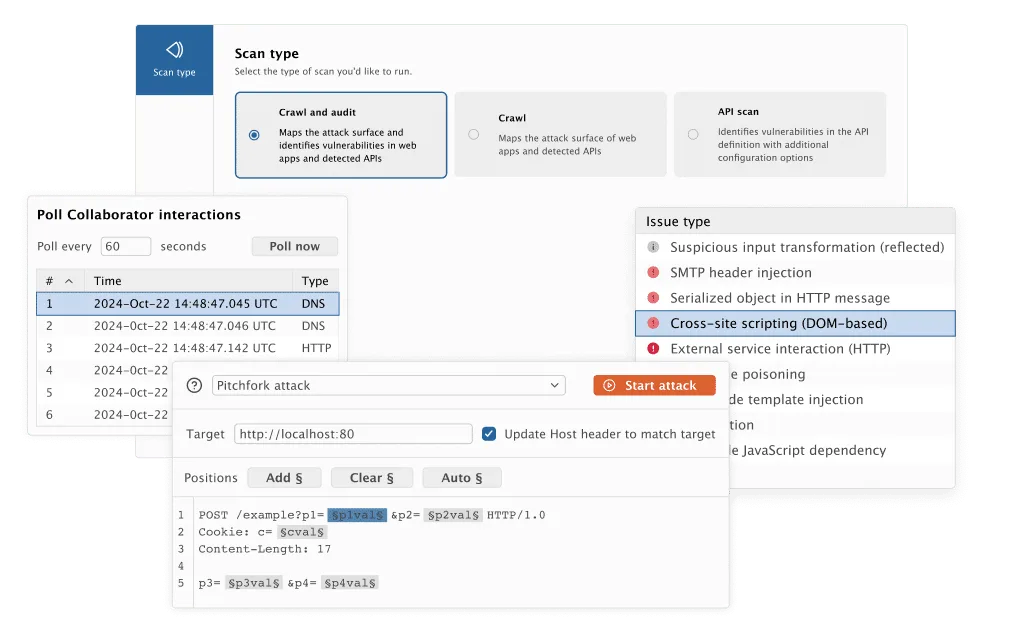
Compared to Invicti, Burp Suite offers deeper manual testing capabilities and greater extensibility. Invicti provides better automation and proof-based verification for teams that want to minimize manual effort.
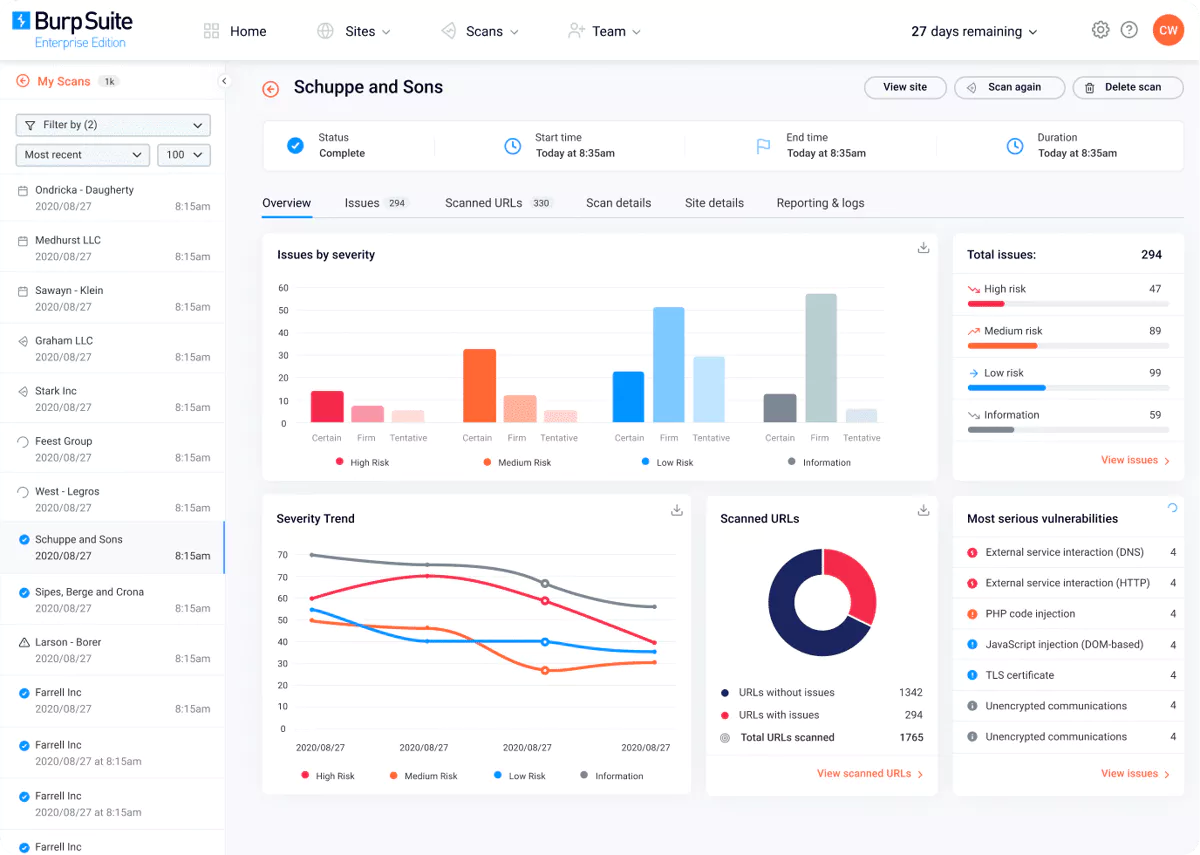
Burp Suite Professional costs around ~$475/year per user, making it more accessible for individual testers. Burp Suite Enterprise scales pricing with the number of applications scanned.
Best for: Security teams that need both deep manual testing and automated scanning with a highly extensible platform. License: Commercial (~$475/year Professional) Key difference: Industry-standard manual testing toolkit. Hundreds of extensions via BApp Store. Largest community of web security practitioners.
2. OWASP ZAP
OWASP ZAP (Zed Attack Proxy) is the most widely used open-source DAST tool, maintained by Checkmarx and an international community of contributors.
It offers automated scanning, passive analysis, active probing, spidering, WebSocket testing, and a robust API for CI/CD integration.
ZAP covers the OWASP Top 10 vulnerability types and hundreds of additional checks through its extensive library of detection rules.
ZAP runs as a desktop application for interactive testing or as a headless daemon for pipeline integration. Docker images make deployment in CI/CD straightforward.
The tool supports custom scan policies, authentication handling, and context-aware scanning. As an OWASP flagship project, it carries community trust and vendor independence.
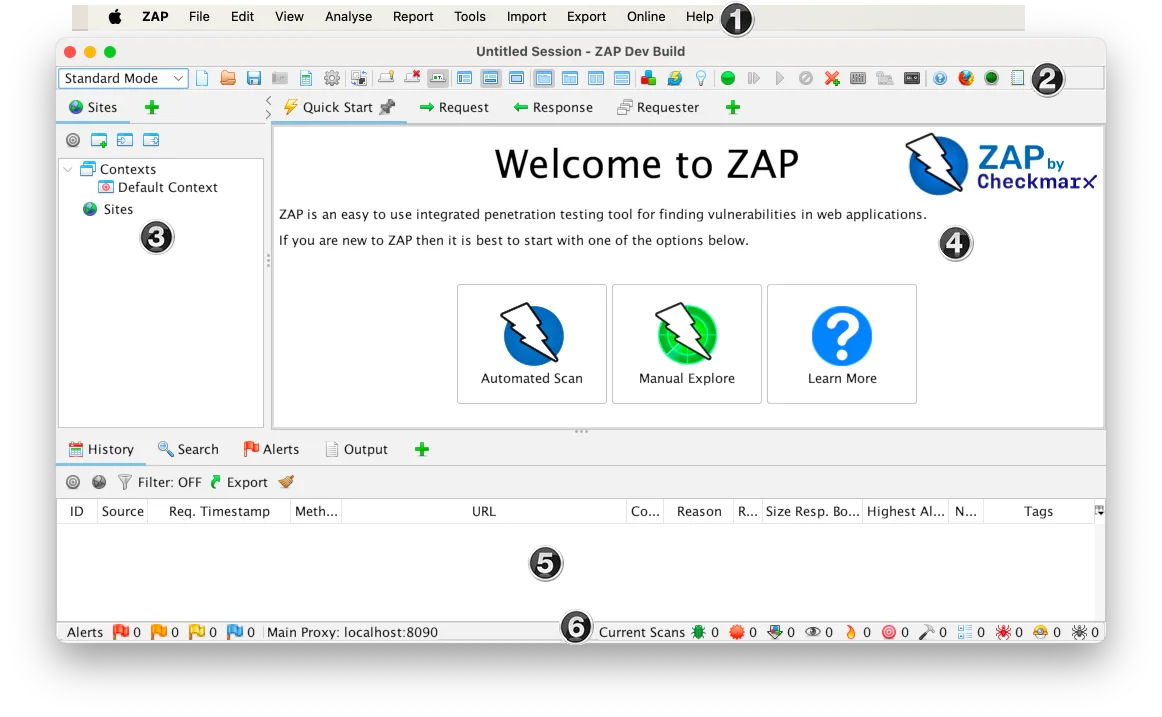
The main limitation compared to Invicti is accuracy. ZAP does not perform proof-based verification, so false positive rates are higher.
Results require more manual triage. The user interface is functional but less polished than commercial tools.
There are no enterprise features like role-based access, executive dashboards, or SLA tracking. But for teams that need capable DAST at zero cost, ZAP remains the benchmark.
Best for: Teams wanting capable, vendor-independent DAST at no cost with strong CI/CD integration. License: Open Source (Apache 2.0) Key difference: Most widely used open-source DAST tool. Zero cost. OWASP flagship project with strong community support.
3. Nuclei
Nuclei by ProjectDiscovery takes a template-based approach to vulnerability scanning. 11,000+ community-contributed YAML templates define detection logic for specific vulnerabilities, misconfigurations, and exposed services.
The template syntax is simple enough that security teams can write custom detections in minutes. Nuclei supports HTTP, TCP, DNS, SSL, WebSocket, and other protocols, making it versatile beyond just web application testing.
The performance is outstanding. Nuclei uses parallel processing and request clustering to scan targets at high speed.
The community actively contributes templates for newly disclosed vulnerabilities, often within hours of public disclosure. ProjectDiscovery’s AI template editor accelerates template creation.
With 27,100+ GitHub stars, Nuclei has built one of the largest security tool communities.
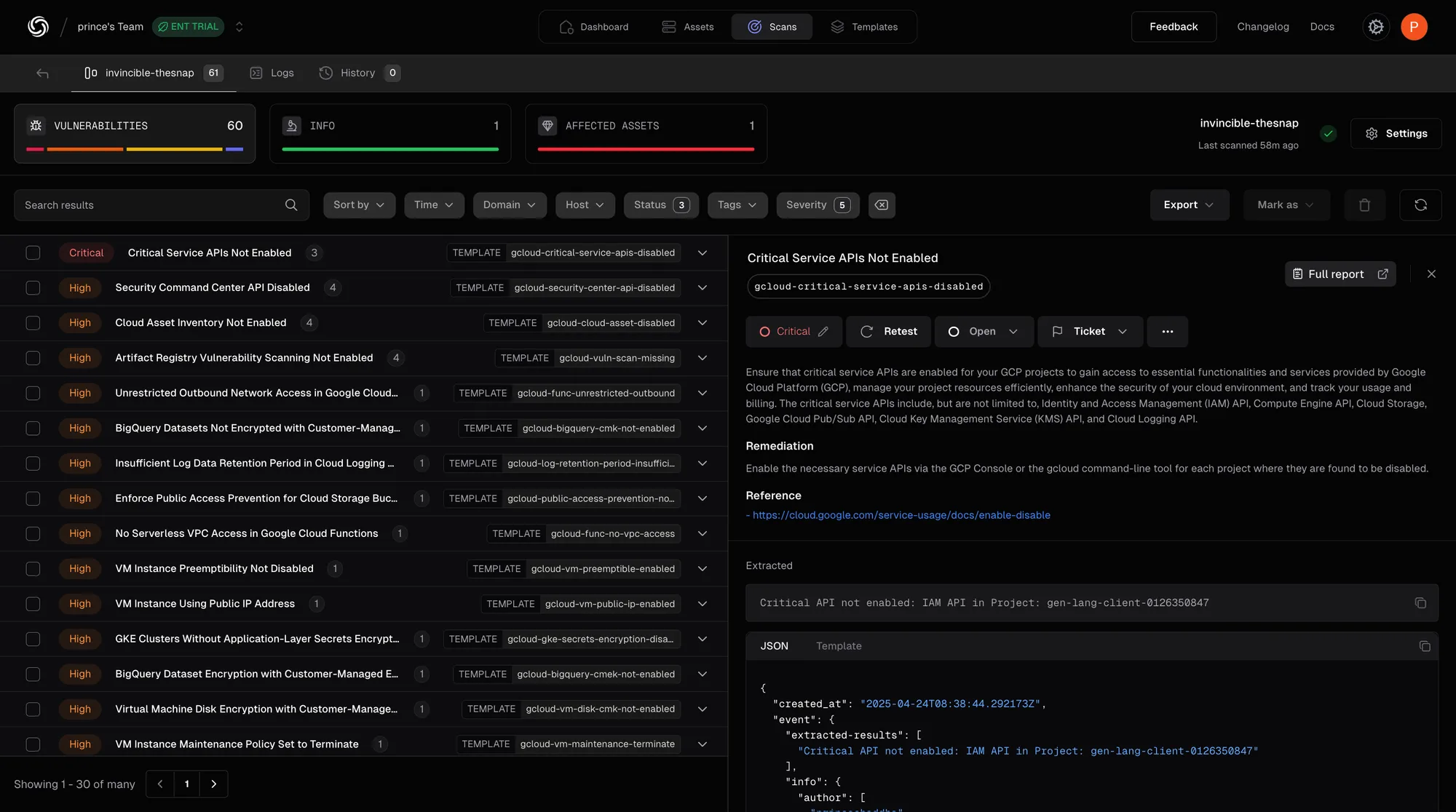
Compared to Invicti, Nuclei requires more configuration and security expertise. There is no proof-based verification, no enterprise dashboard, and no built-in workflow management.
Nuclei excels as a fast, flexible scanner for security teams that want control over exactly what they test and how.
Invicti excels as an automated, low-touch scanner for teams that want minimal configuration and maximum accuracy.
Best for: Security teams wanting fast, customizable vulnerability scanning with a massive community template library. License: Open Source (MIT) Key difference: 11,000+ community templates covering CVEs, misconfigurations, and exposed services. Template authoring in minutes via simple YAML.
4. Qualys WAS
Qualys Web Application Scanning is part of the broader Qualys Cloud Platform, which includes vulnerability management, policy compliance, and asset inventory.
For organizations already using Qualys for infrastructure security, adding WAS provides unified vulnerability management across networks, servers, and web applications from a single platform.
The tool supports automated discovery of web applications across an organization’s attack surface.
Qualys WAS provides progressive scanning that combines broad coverage with deep testing, detecting OWASP Top 10 vulnerabilities, misconfigurations, and sensitive data exposure.
The platform supports authenticated scanning, API testing, and malware detection on web applications. Integration with Qualys VMDR (Vulnerability Management, Detection, and Response) provides unified remediation workflows.
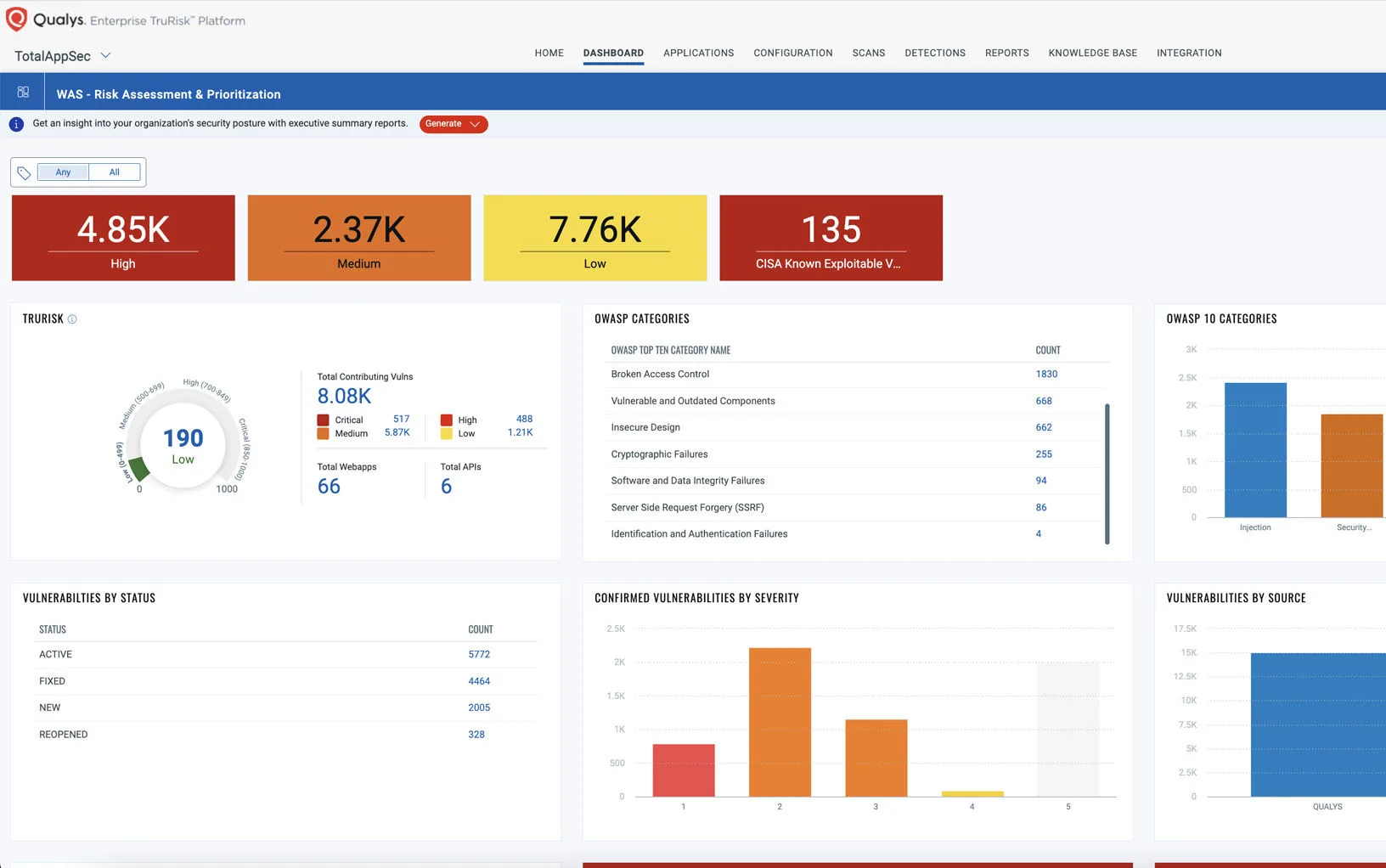
Compared to Invicti, Qualys WAS offers broader platform integration but less specialized DAST depth. Proof-based scanning is not available, so false positive rates are higher.
But for organizations that standardize on the Qualys platform, WAS reduces tool sprawl and provides a consistent vulnerability management experience.
Best for: Organizations already using Qualys for infrastructure security that want unified web application scanning. License: Commercial Key difference: Part of the Qualys Cloud Platform for unified vulnerability management across infrastructure and applications.
5. StackHawk
StackHawk is a developer-first DAST tool designed to run in CI/CD pipelines.
It uses a YAML configuration file to define scan targets, authentication, and test scope, making it feel familiar to developers who work with infrastructure-as-code.
Scans are fast, typically completing in minutes, and results appear directly in pull requests with developer-friendly remediation guidance.
The tool is built on OWASP ZAP’s scanning engine but adds a layer of developer experience on top: simplified configuration, faster scan times, better CI/CD integration, and a cleaner interface. StackHawk supports API scanning for REST, GraphQL, SOAP, and gRPC.
The Snyk integration allows teams to view DAST findings alongside Snyk’s SCA and SAST results.
StackHawk trades some scanning depth for developer experience and pipeline speed. It will not replace Invicti for comprehensive web application assessments, but it fills a different need: fast DAST feedback in every PR. A 14-day free trial is available for evaluation.
Best for: Developer teams wanting fast, pipeline-native DAST with YAML-based configuration and PR integration. License: Commercial (14-day free trial) Key difference: Developer-first DAST built for CI/CD pipelines. YAML configuration familiar to developers. Built on ZAP engine with better UX.
6. Escape
Escape is purpose-built for API security testing, with deep support for REST, GraphQL, gRPC, and SOAP APIs.
Where traditional DAST tools crawl web pages, Escape focuses on API endpoints and can test business logic vulnerabilities that web crawlers miss.
The tool discovers API endpoints from code, documentation, and traffic, then tests them for authentication flaws, authorization bypasses, injection attacks, and data exposure.
Escape’s GraphQL testing is particularly strong, covering introspection issues, nested query attacks, and batch query abuse. The tool integrates into CI/CD pipelines and provides developer-friendly output.
For teams building API-first applications, Escape covers attack surfaces that traditional DAST tools like Invicti may not fully reach.
Best for: Teams building API-first applications that need deep API security testing beyond traditional web crawling. License: Commercial Key difference: Purpose-built for APIs. Deep GraphQL, gRPC, REST, and SOAP testing. Business logic vulnerability detection.
7. Acunetix
Acunetix is a DAST tool owned by Invicti (the parent company) that targets SMBs and mid-market organizations. It offers many of the same scanning capabilities as Invicti at a lower price point.
The tool covers web application scanning, API testing, and includes AcuSensor for IAST-like capabilities. Acunetix shares vulnerability detection technology with Invicti but provides a simpler interface and lighter operational footprint.
Best for: SMBs wanting Invicti-grade scanning technology at a more accessible price point. License: Commercial Key difference: Same parent company and scanning technology as Invicti. Simpler interface and lower price for SMBs.
8. Detectify
Detectify combines automated DAST with crowdsourced vulnerability research from ethical hackers. The platform’s scanner is continuously updated with new vulnerabilities discovered by the Detectify Crowdsource community, which means detection coverage for emerging threats is often faster than traditional DAST tools. Asset discovery maps an organization’s external attack surface automatically.
Best for: Teams wanting DAST powered by crowdsourced security research with attack surface discovery. License: Commercial Key difference: Crowdsourced vulnerability research from ethical hackers. Rapid coverage for emerging threats. Built-in attack surface discovery.
9. Astra Security
Astra Security provides DAST with a managed penetration testing component. Beyond automated scanning, the platform offers access to security experts who manually verify findings and test for business logic vulnerabilities that automated scanners miss.
This hybrid approach bridges the gap between fully automated DAST and manual penetration testing.
Best for: Teams that want automated DAST combined with expert manual verification and penetration testing. License: Commercial Key difference: Hybrid automated + manual approach. Human experts verify findings and test business logic beyond automated scanner capabilities.
10. Probely
Probely provides developer-friendly DAST with a focus on API security and CI/CD integration. The tool supports OpenAPI/Swagger spec import, authenticated scanning, and provides remediation guidance tailored to the technology stack.
Probely’s lightweight approach makes it fast to set up and run, with scans typically completing in minutes rather than hours.
Best for: Developer teams wanting lightweight DAST with strong API scanning and fast CI/CD integration. License: Commercial (free tier available) Key difference: OpenAPI spec import for API-first testing. Fast, lightweight scanning designed for CI/CD pipeline integration.
Feature Comparison
| Feature | Invicti | Burp Suite | OWASP ZAP | Nuclei | Qualys WAS | StackHawk | Escape |
|---|---|---|---|---|---|---|---|
| License | Commercial | Commercial (~$475/yr Pro) | Open Source | Open Source (MIT) | Commercial | Commercial (14-day trial) | Commercial |
| Proof-based scanning | Yes (99.98%) | No | No | No | No | No | No |
| Web app scanning | Yes | Yes | Yes | Yes | Yes | Yes | Limited |
| API testing | REST, SOAP, gRPC, GraphQL | Yes (manual) | Yes | Yes | Yes | REST, GraphQL, SOAP, gRPC | Core feature |
| IAST capability | Yes (Shark) | No | No | No | No | No | No |
| CI/CD integration | Yes | Enterprise tier | Yes (API/Docker) | Yes | Yes | Core feature | Yes |
| Manual testing | Limited | Core feature | Yes | No | No | No | No |
| Custom checks | Limited | Extensions (BApps) | Plugins | Templates (11,000+) | Limited | Limited | Limited |
| Authentication handling | Advanced | Advanced | Yes | Basic | Yes | YAML-based | Yes |
| Enterprise dashboard | Yes | Enterprise tier | No | No (Cloud tier) | Yes | Yes | Yes |
When to Stay with Invicti
Invicti remains the right choice when automated accuracy is the priority. Proof-based scanning at 99.98% accuracy (according to Invicti) means your security team spends virtually no time verifying whether findings are real.
For organizations scanning dozens or hundreds of web applications regularly, this time savings adds up. No other DAST tool matches this level of automated verification.
The platform’s expansion into SAST, SCA, container security, and ASPM means teams can consolidate application security scanning under one vendor.
The combined DAST and IAST approach through the Shark agent confirms vulnerabilities from both outside and inside the application, which is a unique capability in the market.
For enterprise security programs that need low-touch, high-confidence web application scanning with workflow management and compliance reporting, Invicti provides a polished solution that open-source tools cannot replicate without significant operational investment. Browse all AppSec Santa DAST tool reviews for more options.
Frequently Asked Questions
What is the best free alternative to Invicti?
How does Invicti compare to Burp Suite?
Can OWASP ZAP replace Invicti?
Which DAST tool is best for API security testing?
Is Invicti worth the enterprise pricing?

+7 Years in AppSec
10+ years in application security. Reviews and compares 208 AppSec tools across 11 categories to help teams pick the right solution. More about me →