
- Both are agentless-first CNAPPs that promise a full cloud risk profile within 24 hours, and both ship CSPM, CWPP, CIEM, DSPM, and AI-SPM in a single console. The meaningful differences are cloud breadth, correlation model, and buyer profile.
- Wiz covers AWS, Azure, GCP, OCI, Alibaba Cloud, VMware vSphere, Kubernetes, and OpenShift. Orca’s native multi-cloud set is AWS, Azure, and GCP.
- Wiz sells the Security Graph as an attack-path engine that correlates misconfigurations, identities, vulnerabilities, and network exposure. Orca sells SideScanning as a patented agentless read of workload file systems and memory snapshots.
- Neither vendor publishes list prices. Both require a sales conversation and custom quotes, so plan for enterprise-grade contract values either way.
- Wiz counts roughly 40-50% of the Fortune 100 as customers and completed a $32B acquisition by Google in March 2026. Orca is FedRAMP Moderate Authorized (since February 2025), which matters for federal workloads.
Which Is Better: Wiz or Orca Security?#
Wiz and Orca Security are the two best-known agentless CNAPPs on the market, and they look strikingly similar in a data sheet. Both scan AWS, Azure, and GCP without deploying agents. Both promise a full cloud risk profile within 24 hours of connecting cloud accounts.
Both ship CSPM, CWPP, CIEM, DSPM, and AI-SPM in a single console. The real differences show up in cloud breadth, the correlation model, and who ends up buying them.
One important context point for 2026: Google completed its $32B acquisition of Wiz in March 2026 , so Wiz is now part of Google Cloud — a factor that shapes the vendor-lock-in calculus for some buyers.

Note
Don't conflate agentless with zero-agent — both vendors ship optional eBPF sensors that look and feel like agents once deployed.
I wrote this page because most comparisons online read like vendor press releases. This page focuses on the Wiz vs Orca angle specifically: two agentless-first CNAPPs with different correlation models, different cloud breadth, and (after March 2026) different ownership structures. For the Wiz vs Prisma Cloud angle — greenfield CNAPP versus an acquired product stack — see Wiz vs Prisma Cloud . For a broader category view, see the IaC security tools hub or the What is CNAPP explainer.
Here is the short version:
- Pick Wiz if you run a large multi-cloud estate that includes OCI, Alibaba Cloud, or VMware, or if you want the widest integration ecosystem and the most complete code-to-cloud story.
- Pick Orca if you need FedRAMP Moderate authorization (Orca has been authorized since February 2025), want a focused CNAPP without committing to a Google-owned platform roadmap, or prefer an independent vendor.
- Tie: AWS-only or AWS+Azure shops, teams that only care about posture plus vulnerability management, and buyers who weight DSPM heavily.
How Each Scans the Cloud#
Both platforms are agentless-first, but they market the underlying mechanics very differently.
Wiz Security Graph#
Wiz connects to cloud provider APIs with read-only permissions and scans every layer of infrastructure — VMs, containers, serverless, storage, databases, identity, and networking — without installing agents. The data then feeds the Security Graph.
The Security Graph is Wiz’s core differentiator in marketing. It maps every cloud resource, identity, network path, and vulnerability into a single graph, and surfaces attack paths where multiple risks combine into something exploitable.
A critical CVE on an isolated internal workload is not the same as the same CVE on a public-facing service that holds admin credentials. Wiz prioritizes the second one and tells you why.
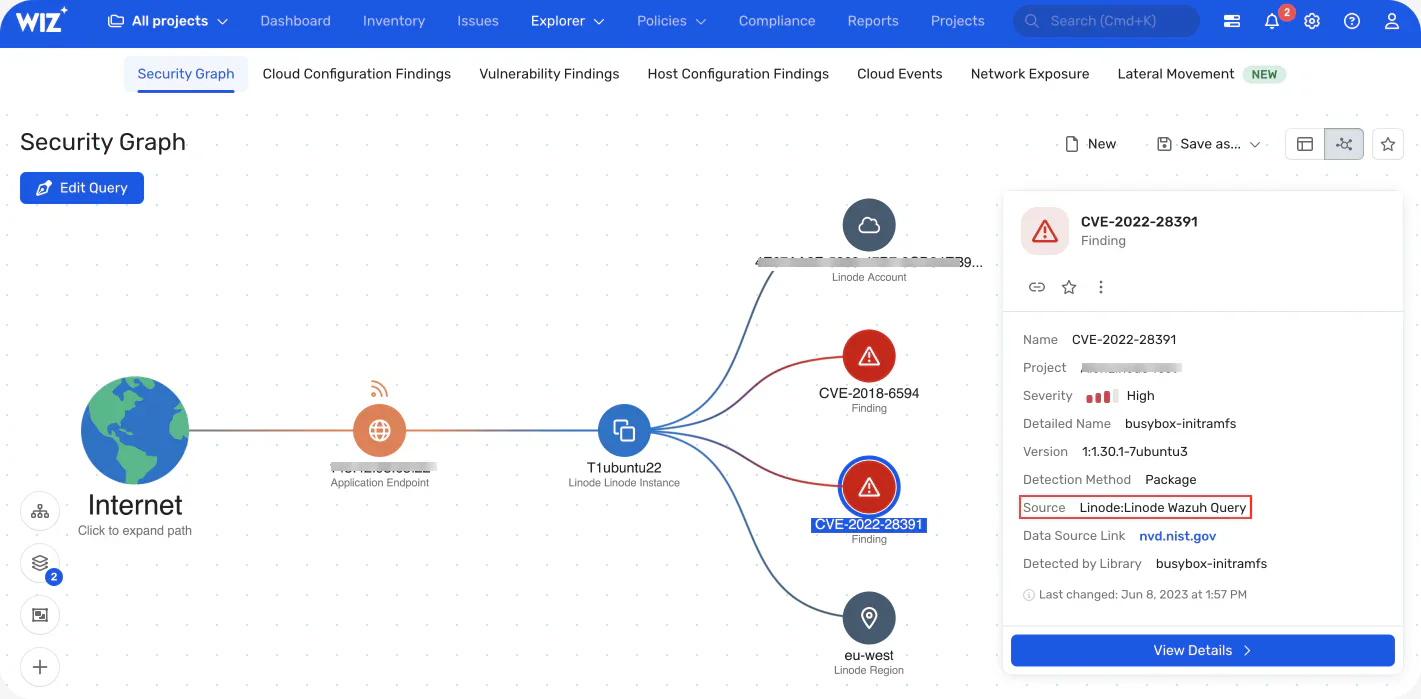
For workloads that need real-time protection, Wiz Defend adds an optional eBPF-based sensor. Most customers deploy it selectively on internet-facing and sensitive workloads rather than everywhere.
Orca SideScanning#
Orca’s equivalent is called SideScanning , and the vendor has a patent on it . The technique reads cloud workload file systems and memory snapshots out-of-band through cloud provider APIs — no agents, no network packets inside customer environments, no code execution on production systems.
The output is workload-deep visibility: installed packages, running processes, file permissions, network connections, and configuration state. That data feeds Orca’s unified data model, which correlates vulnerabilities with network exposure, identity privileges, and data sensitivity.
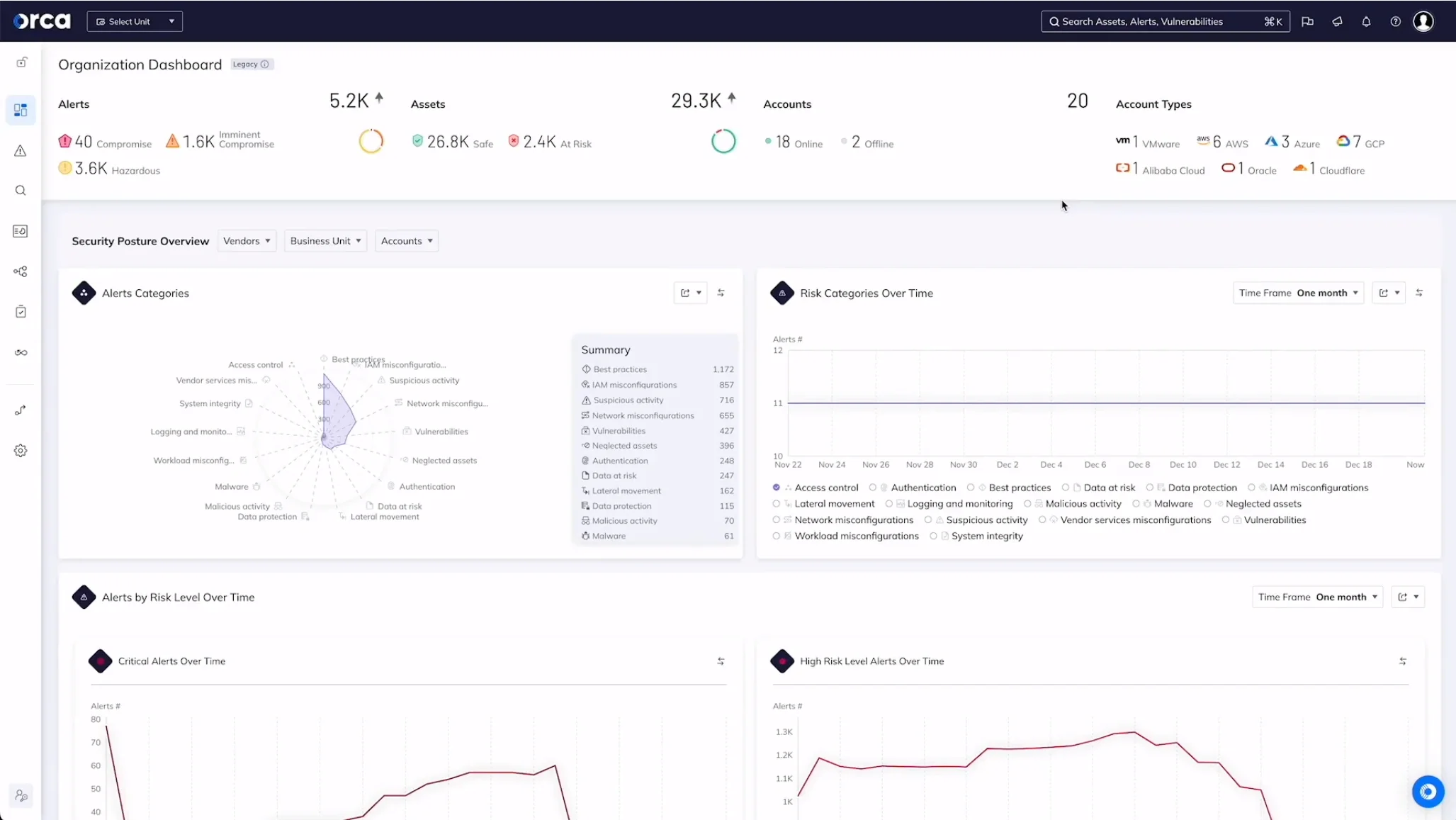
Orca ships an optional eBPF-based runtime sensor alongside SideScanning for teams that want real-time prevention. Orca AI, the platform’s GenAI assistant, helps triage findings through natural-language queries.
The net result is that both vendors solve the same core problem — agentless cloud visibility plus cross-domain risk correlation — with different underlying mechanics. The outputs feel more similar in practice than vendor decks suggest.
In plain terms: Orca SideScanning is a data-collection mechanism (how it reads workloads without agents). Wiz Security Graph is a correlation mechanism (how it connects findings into attack paths). A useful shorthand: Orca tells you what is on each workload; Wiz tells you which misconfigurations together create a path to exploitation.
Coverage Compared#
| Dimension | Wiz | Orca Security |
|---|---|---|
| License | Commercial (contact sales) | Commercial (contact sales) |
| Free tier | No (14-day trial) | No |
| Cloud providers | AWS, Azure, GCP, OCI, Alibaba Cloud, VMware vSphere | AWS, Azure, GCP |
| Kubernetes / OpenShift | Yes, including Red Hat OpenShift | Yes |
| CSPM | Yes | Yes |
| CWPP | Yes (agentless + optional eBPF sensor) | Yes (SideScanning + optional eBPF sensor) |
| CIEM | Yes | Yes |
| DSPM | Yes | Yes |
| AI-SPM | Yes | Yes |
| CDR / runtime detection | Wiz Defend (eBPF) | Orca CDR + optional sensor |
| API security | Via partners / WIN | Native API discovery + drift detection |
| IaC / code scanning | Wiz Code (1-click fix PRs, IDE plugins, CI/CD) | Shift-left checks; not a dedicated SAST |
| Correlation model | Security Graph (attack-path focused) | Unified data model |
| Integration count | 200+ (Wiz Integration Network) | Not publicly enumerated |
| FedRAMP | Not on civilian FedRAMP boundary | Moderate Authorized |
| Notable customers | Morgan Stanley, Salesforce, BMW, Siemens, Snowflake, Slack (~40-50% of Fortune 100) | Autodesk, Unity, SAP, Sisense, Lemonade |
| Acquisition status | Acquired by Google ($32B, closed March 2026) | Independent |
Two things stand out in this comparison. First, Wiz has a meaningful lead on cloud breadth: OCI, Alibaba Cloud, and VMware vSphere matter for a subset of enterprises that Orca does not serve natively.
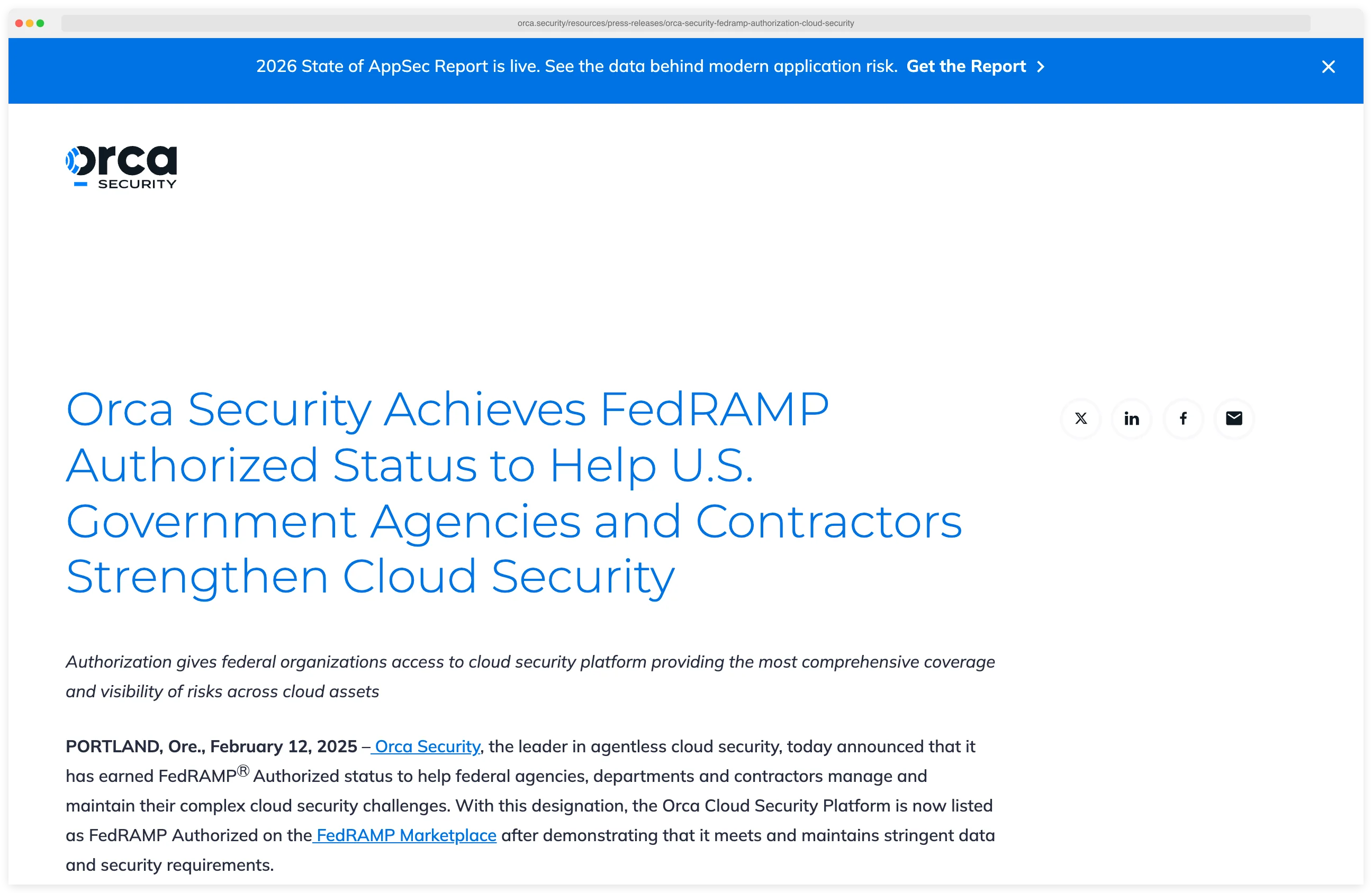
Second, Orca has a meaningful lead on federal workloads. FedRAMP Moderate Authorization — which Orca earned in February 2025 — is table stakes for civilian agency buyers, and Wiz does not carry it on the standard FedRAMP boundary.
Key Insight
Wiz has a meaningful lead on cloud breadth; Orca has a meaningful lead on federal workloads. The choice is rarely about capability parity; it's about where your risk lives.
For comparisons focused on dedicated IaC scanning rather than full CNAPP, see Checkov vs KICS .
Deployment & Onboarding#
Both platforms start with the same onboarding flow: grant read-only API access to your cloud accounts, wait for the first scan, and review findings.
Wiz advertises a full risk profile within 24 hours of connecting cloud accounts, with the initial scan completing in minutes. New resources get picked up automatically.
Orca makes the same 24-hour promise and auto-discovers new assets on the same schedule.
The practical difference is surface area. If your estate is AWS-only or AWS + Azure, the two deployments feel nearly identical.
If you need OCI, Alibaba Cloud, or VMware vSphere coverage in the same platform, Wiz is the cleaner path — Orca would require a separate tool for those clouds. If you need FedRAMP Moderate authorization, Orca is the only option between the two.
Both vendors ship optional eBPF-based runtime sensors (Wiz Defend, Orca Sensor) for workloads that need real-time detection. Both recommend deploying the sensor selectively on internet-facing and sensitive workloads rather than everywhere, which keeps operational overhead low.
Wiz Code adds a code-to-cloud layer that Orca does not match as directly. It scans repositories, CI/CD pipelines, container registries, and images, and generates 1-click fix PRs.
IDE plugins for JetBrains and VS Code complete the shift-left story. If you want the CNAPP vendor to also own your IDE and CI experience, Wiz has the stronger offering.
Pricing#
Both Wiz and Orca sell through sales. Neither publishes list prices or offers self-serve checkout.
What that means in practice: expect a proof-of-value engagement, custom quote based on cloud workload count and features, and annual contracts. Both Wiz and Orca are enterprise CNAPP purchases — quotes scale with cloud account count, workload volume, and which optional modules (DSPM, AI-SPM, runtime sensors) you include.
If you need a buyer-side sense of typical CNAPP contract sizes before opening a sales conversation, the AppSec tools pricing guide consolidates aggregated procurement data across vendors.
The operational implication is that neither tool is suitable for a credit-card trial or a small team that wants to stand up coverage without procurement involvement. Both are enterprise-scale purchases with enterprise-scale evaluation cycles.
For teams that need a free or open-source starting point in adjacent categories, the IaC security tools and SAST tools hubs list options with transparent or open-source licensing.
Which to Choose#
Choose Wiz if#
- You run a multi-cloud estate that includes OCI, Alibaba Cloud, or VMware vSphere in addition to the big three.
- You want the broadest integration marketplace (200+ via the Wiz Integration Network ) into existing SIEM, ticketing, and orchestration workflows.
- You value the Security Graph attack-path narrative and the code-to-cloud story (Wiz Code, IDE plugins, 1-click fix PRs).
- Your peers are Fortune 100 security teams and the reference list (Morgan Stanley, Salesforce, BMW, Siemens, Snowflake, Slack) matches your profile.
- You are comfortable with Wiz operating as part of Google Cloud and the roadmap implications that brings.
Choose Orca Security if#
- You need FedRAMP Moderate Authorization for federal civilian workloads.
- You want a more focused CNAPP without committing to a hyperscaler’s security platform roadmap.
- You value a patented agentless mechanism (SideScanning) and a vendor that operates independently, outside of any hyperscaler’s product portfolio.
- Your cloud footprint is AWS + Azure + GCP and you do not need OCI or Alibaba Cloud.
- Customers like Autodesk, Unity, SAP, Sisense, and Lemonade feel like the right peer set.
It’s basically a tie if#
- You run AWS-only or AWS + Azure and only care about CSPM + CWPP + vulnerability management.
- DSPM is your primary driver — both platforms have mature DSPM modules.
- You already have a SAST and CI/CD pipeline security story and only need the CNAPP layer.
If neither shortlist matches your constraints, I cover the rest of the CNAPP field in Wiz alternatives .
For related head-to-heads in the cloud and supply-chain space, see Aikido vs Snyk , Endor Labs vs Snyk , and CSPM vs CNAPP for category-level framing.
Frequently Asked Questions
Is Wiz or Orca Security better in 2026?
What is the difference between Wiz Security Graph and Orca SideScanning?
Do Wiz and Orca publish their pricing?
Which tool is easier to deploy?
Is Wiz still independent after the Google acquisition?

Written & maintained by
Suphi CankurtEight years on the vendor side of application-security sales — thousands of evaluations and demos. I started AppSec Santa in 2022 to put that insider view to work for buyers. Independent of any vendor, paid by none, and honest about what fits whom.