


HCL AppScan DAST is an enterprise dynamic application security testing tool and the scanning core of the AppScan 360° platform. It evolved from IBM AppScan, one of the oldest enterprise DAST products on the market.
The tool evolved from IBM AppScan, which HCL acquired in 2019. Since then, HCL has added AI-enabled scanning, agentic triage (RapidFix), API security testing, and a cloud-native deployment option alongside the traditional on-premises install.
FIPS 140-3 compliance makes it one of the few DAST tools approved for US federal government use.
Key features at a glance
| Feature | Detail |
|---|---|
| Platform | AppScan 360° (DAST, SAST, IAST, SCA, API, IaC) |
| AI Features | AI-enabled scanning + RapidFix agentic triage |
| Federal Compliance | FIPS 140-3 certified |
| Regulatory Reports | PCI DSS, HIPAA, GDPR, SOC 2 |
| API Testing | REST, SOAP, OpenAPI/Swagger, GraphQL schema import |
| Deployment | Cloud (AppScan on Cloud), on-premises (Standard/Enterprise), AppScan 360 (anywhere) |
| Presence Agent | Docker container for hybrid cloud/on-prem scanning |
| CI/CD | GitHub Actions, Jenkins, Azure DevOps (official actions) |
| Origin | IBM AppScan → HCL (acquired 2019) |
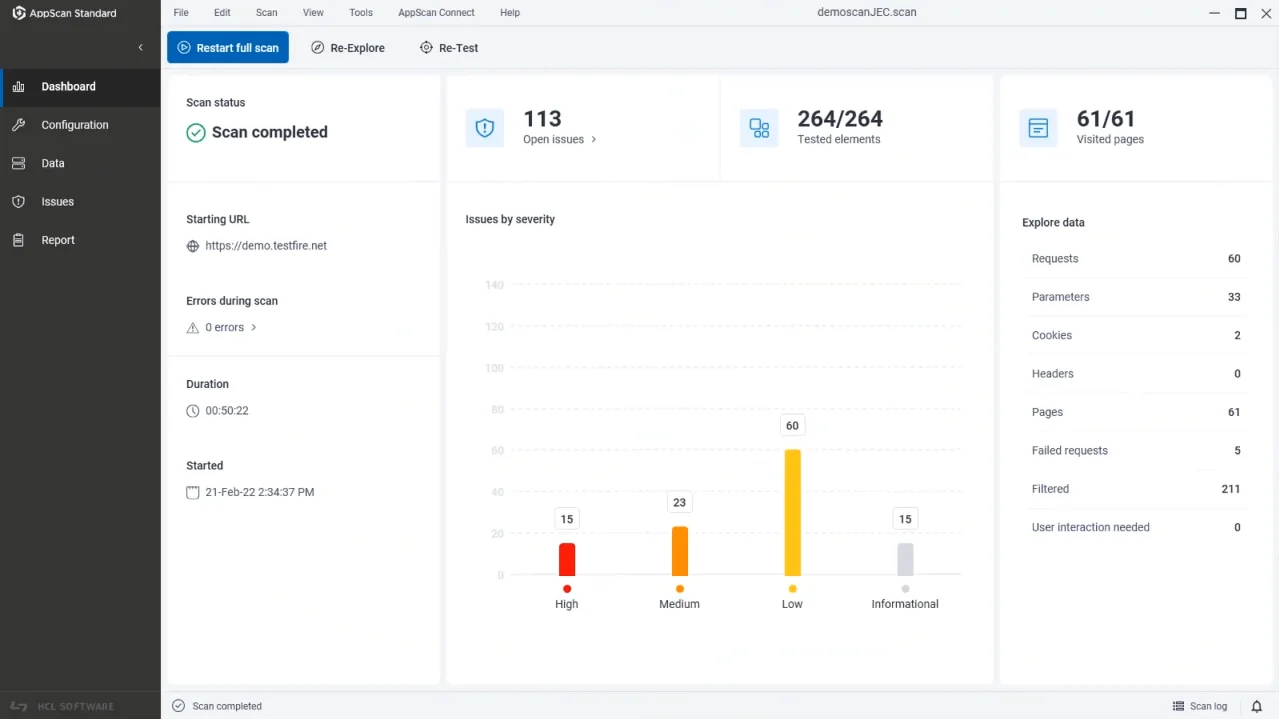
What is HCL AppScan DAST?
AppScan performs black-box security testing by crawling and attacking running web applications. It targets SQL injection, XSS, authentication flaws, and other runtime vulnerabilities that static analysis can’t find.
According to the OWASP Testing Guide, dynamic testing is the only way to detect certain classes of runtime vulnerabilities such as authentication bypass and session management flaws.
The AI engine learns application behavior patterns to focus testing on high-risk areas. Smart crawling adapts to application structure, which helps reduce scan time on large apps without sacrificing coverage.
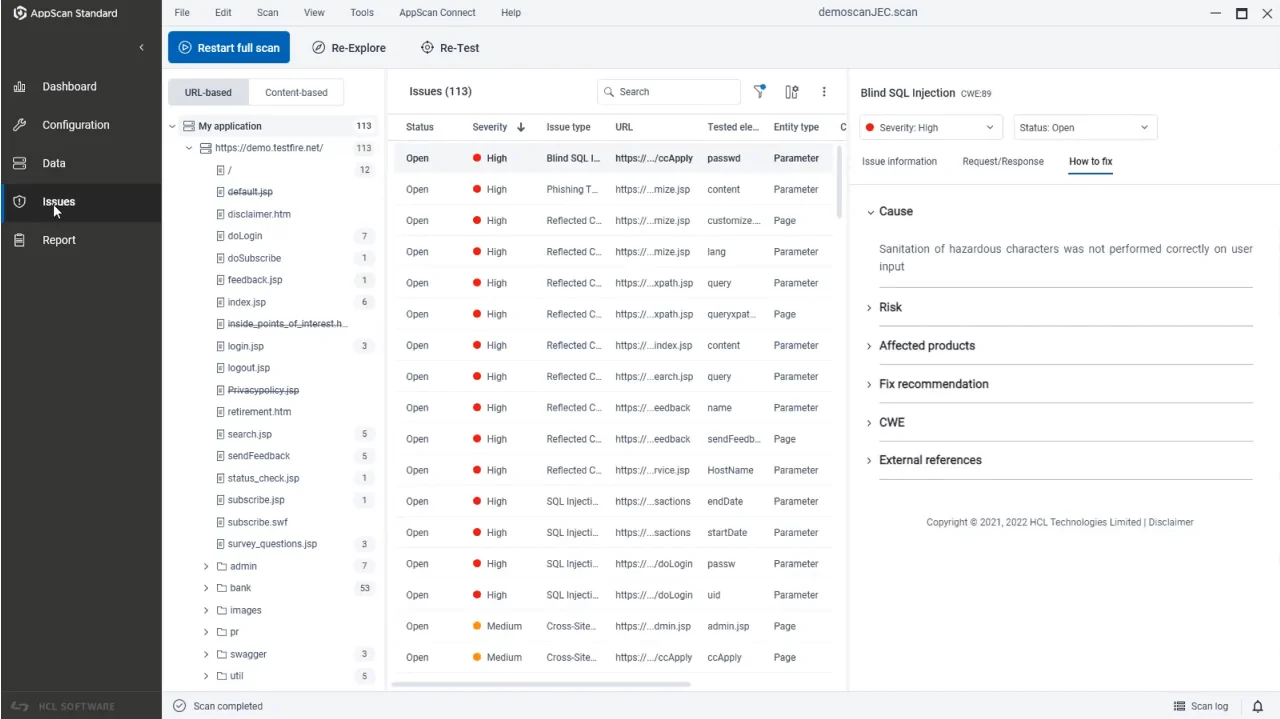
| Capability | Details |
|---|---|
| AI-Enabled Scanning | Machine learning optimizes test coverage and reduces scan times. The AI engine identifies high-risk application areas and reduces redundant test cases. Smart crawling adapts to each app’s structure. |
| AppScan 360° Platform | DAST sits alongside SAST, IAST, SCA, IaC security, and API testing. Findings from all scanners correlate in a single dashboard. Deploy on cloud or on-premises. |
| FIPS 140-3 Compliance | The FIPS-compliant option meets US federal cryptographic security requirements. Necessary for government agencies and federal contractors — a requirement that disqualifies most DAST competitors. |
| RapidFix Triage | Agentic AI automates vulnerability triage and generates fix recommendations. Reduces the manual review burden on security teams dealing with large scan result sets. |
AppScan 360° platform
DAST is one component of the broader AppScan 360° platform. The full suite includes:
- AppScan on Cloud — Cloud-based SaaS with DAST, SAST, IAST, SCA, and API testing
- AppScan 360 — Cloud-native architecture deployable anywhere (cloud, on-prem, hybrid)
- AppScan Standard — Desktop DAST tool for web apps and APIs
- AppScan Enterprise — Enterprise-scale DAST, IAST, and SAST with centralized management
- AppScan Source — Static analysis (SAST)
- AppScan CodeSweep — Developer-focused SAST
- AppScan API Security — API discovery, testing, and posture governance
- AppScan RapidFix — AI-driven triage and fix recommendations
Findings from all products correlate in a single dashboard, so a vulnerability found by both DAST and SAST shows up as one item, not two.
Deployment options
AppScan supports three deployment models:
- Cloud: AppScan on Cloud — no installation, managed by HCL
- On-premises: AppScan Standard (desktop) or Enterprise (server) for air-gapped environments
- Hybrid: AppScan Presence agent (Docker container) connects on-prem targets to cloud scanning
The Presence agent is useful for organizations that want cloud-based management but need to scan internal applications that aren’t internet-accessible.
The on-premises deployment with FIPS 140-3 compliance is a hard requirement for US government agencies and many financial institutions. NIST SP 800-53 mandates the use of FIPS-validated cryptographic modules for systems processing federal data.
If you need DAST in an air-gapped environment with federal security certification, AppScan is one of very few options.
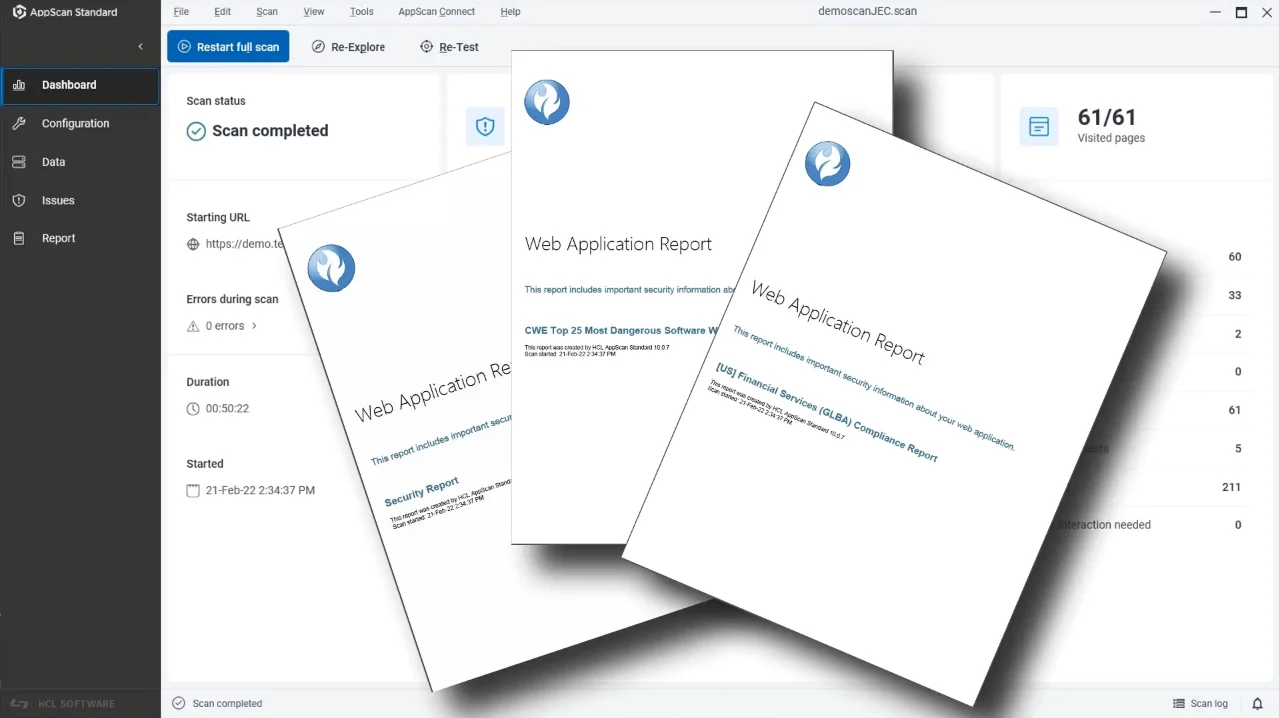
How to use HCL AppScan DAST
- Choose deployment — Select AppScan on Cloud (SaaS), AppScan Standard (desktop), AppScan Enterprise (on-prem server), or AppScan 360 (cloud-native, deploy anywhere).
- Add applications — Configure target URLs, set authentication credentials, and define scan scope. Import OpenAPI/Swagger specs for API testing.
- Select compliance policies — Enable PCI DSS, HIPAA, GDPR, or SOC 2 mapping to get compliance-mapped findings in reports.
- Run scans and triage — Execute scans manually, via CLI, or through CI/CD. Use RapidFix for AI-assisted triage and fix recommendations.
CI/CD integration
# GitHub Actions
name: HCL AppScan DAST
on: [push]

jobs:
  appscan:
    runs-on: ubuntu-latest
    steps:
      - uses: actions/checkout@v4
      - name: Run AppScan DAST
        uses: HCL-TECH-SOFTWARE/appscan-dast-action@v1
        with:
          asoc_key: ${{ secrets.APPSCAN_KEY }}
          asoc_secret: ${{ secrets.APPSCAN_SECRET }}
          application_id: ${{ secrets.APP_ID }}
          dynamic_scan_type: "dast"
          starting_URL: "https://staging.example.com"
AppScan also has official plugins for Jenkins and Azure DevOps.
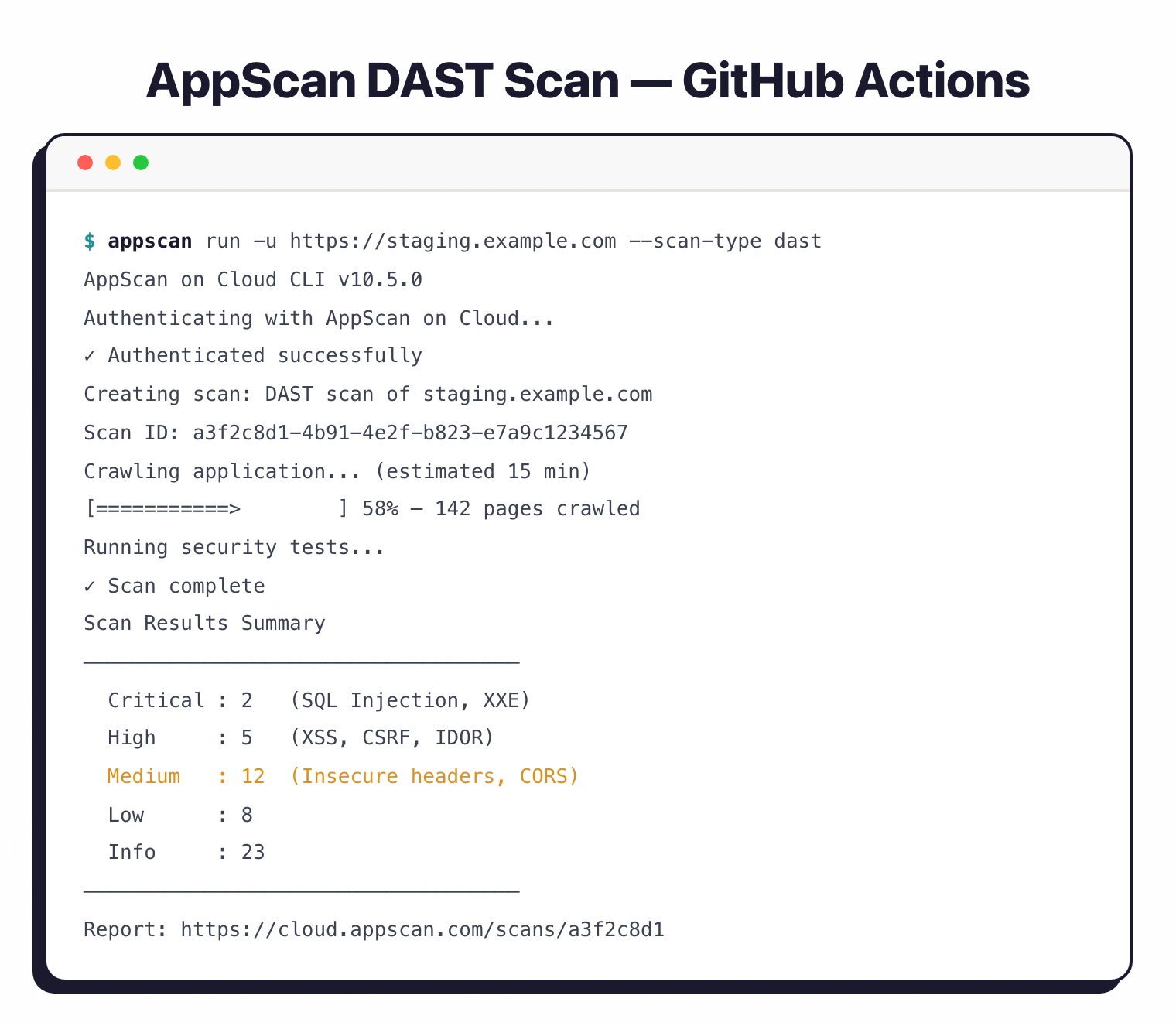
What does HCL AppScan (DAST) integrate with?
These integrations are how I plug AppScan DAST into a broader DevSecOps workflow — alongside other enterprise options in the DAST tools landscape like Fortify WebInspect , with results forwarded into Jira and the AppScan 360° management console.
 GitHub Actions
 Jenkins
 Azure DevOps
 Jira
JiraWhen to use HCL AppScan DAST
AppScan fits enterprises that need DAST with compliance reporting, flexible deployment, and the option to run everything on-premises. The FIPS 140-3 certification makes it one of the few DAST tools suitable for US federal government use cases.
Good fit when you need:
- A mature enterprise DAST platform with decades of IBM AppScan heritage
- FIPS 140-3 compliance for federal or regulated environments
- On-premises deployment for air-gapped networks
- Unified platform across DAST, SAST, IAST, and SCA
- Compliance reporting for PCI DSS, HIPAA, GDPR, SOC 2
- AI-powered triage to manage large volumes of findings
Organizations already in the HCL ecosystem benefit from the unified AppScan 360 platform.
Cloud-native teams without strict data residency requirements may find cloud-first DAST tools like Bright Security or Invicti easier to adopt.
For open-source alternatives, ZAP remains the most widely used free DAST scanner.
To understand how DAST fits alongside SAST and IAST in a testing strategy, see the SAST vs DAST vs IAST comparison.
HCL AppScan DAST pricing
HCL does not publish list prices on hcltechsw.com for AppScan DAST. Paid licenses are quoted by sales after a scoping conversation, with separate pricing paths for the on-premises Standard / Enterprise editions, the SaaS AppScan on Cloud, and the cloud-native AppScan 360° platform.
What drives cost is the deployment model (on-prem perpetual licensing vs SaaS subscription), the application count under scan, and which pieces of the AppScan 360° platform you need bundled (DAST + SAST + IAST + SCA + API). The free CodeSweep IDE plugin is the no-cost developer-side entry point — but CodeSweep is SAST, not the DAST scanner.
I treat AppScan DAST as upper-enterprise pricing — it sits next to platforms like Invicti and Fortify WebInspect rather than budget scanners. If you need a published-price option in the DAST tools landscape , StackHawk or open-source ZAP are easier to defend in procurement.
HCL AppScan DAST alternatives
If AppScan’s enterprise posture or licensing model does not fit, these are the alternatives I’d weigh in the DAST tools landscape :
- Invicti — Enterprise DAST with proof-based scanning. Better fit when you want broad regulated-industry compliance reporting without OpenText or HCL ecosystem lock-in. Strong on false-positive elimination.
- Fortify WebInspect — Closest peer in the federal-compliance DAST space, also part of a unified static + dynamic suite. Worth evaluating when air-gapped on-prem and FIPS validation are hard requirements.
- Veracode DAST — Enterprise platform that bundles DAST, SAST, and SCA on a unified dashboard. Worth evaluating when your buyer profile is enterprise software security with FedRAMP-class compliance pressures.
- Qualys WAS — Cloud-native web application scanning from a vendor your operations team probably already uses for vulnerability management. Lower friction when Qualys is the incumbent platform.
- Checkmarx DAST — Part of the Checkmarx One platform alongside SAST and SCA. Worth evaluating when your buyer profile is already in the Checkmarx ecosystem.