

HCL AppScan Alternatives
Thinking of switching from HCL AppScan? Compare top competitors including Checkmarx, Fortify, Veracode, Snyk, and Semgrep.



- HCL AppScan (formerly IBM AppScan) bundles SAST, DAST, IAST, and SCA in one product; Checkmarx One covers the same plus IaC, containers, API, secrets, and ASPM and is often cited as more cost-effective.
- According to Semgrep, its 10-second median CI scan time and custom rule authoring in code-like syntax contrasts with AppScan's minutes-to-hours scan times and heavier configuration.
- Snyk Code scans in real time inside IDEs with AI fix suggestions but lacks DAST and IAST that are core AppScan capabilities.
- Veracode offers FedRAMP authorization with binary SAST so source code never leaves the organization; AppScan provides on-premises deployment for air-gapped environments.
- Aikido provides comparable SAST, DAST, SCA, IaC, and secrets coverage at $300/month for 10 users — at a fraction of the cost compared to HCL AppScan's custom enterprise pricing.
Why Look for HCL AppScan Alternatives?
The best HCL AppScan alternatives in 2026 are Checkmarx One, Fortify, Semgrep, Veracode, Snyk Code, Aikido, Invicti, SonarQube, Codacy, and OpenText SAST.
HCL AppScan (originally IBM AppScan, acquired by HCL in 2019) has been used in enterprise application security for over two decades.
The platform provides SAST, DAST, IAST, and SCA in a unified product, powered by AI and machine learning to reduce false positives and prioritize findings.
It scans source code, running web applications, APIs, mobile applications, containers, and open-source components.
Organizations in banking, healthcare, government, and other regulated industries have relied on AppScan for its compliance coverage across PCI DSS, HIPAA, OWASP Top 10, and SANS Top 25.
The most common driver for exploring alternatives is cost. HCL AppScan’s pricing is entirely quote-based with no published price list, and enterprise licensing is positioned at the higher end of the market.
Modern tools like Snyk, Semgrep, and Beagle Security are typically more accessible in pricing for equivalent coverage. For organizations not mandated by compliance or procurement to use AppScan, the economics often favor alternatives.
Beyond pricing, the developer experience gap has widened. Modern SAST tools like Semgrep scan in seconds, integrate into IDEs for real-time feedback, and let developers write custom rules in familiar syntax.
AppScan’s architecture predates the DevSecOps movement, and while HCL has added CI/CD integrations and IDE plugins, the tool feels heavier and slower than purpose-built developer tools.
Teams moving toward shift-left security models often find AppScan better suited for centralized security team workflows than developer self-service scanning.
Top HCL AppScan Alternatives
1. Checkmarx One
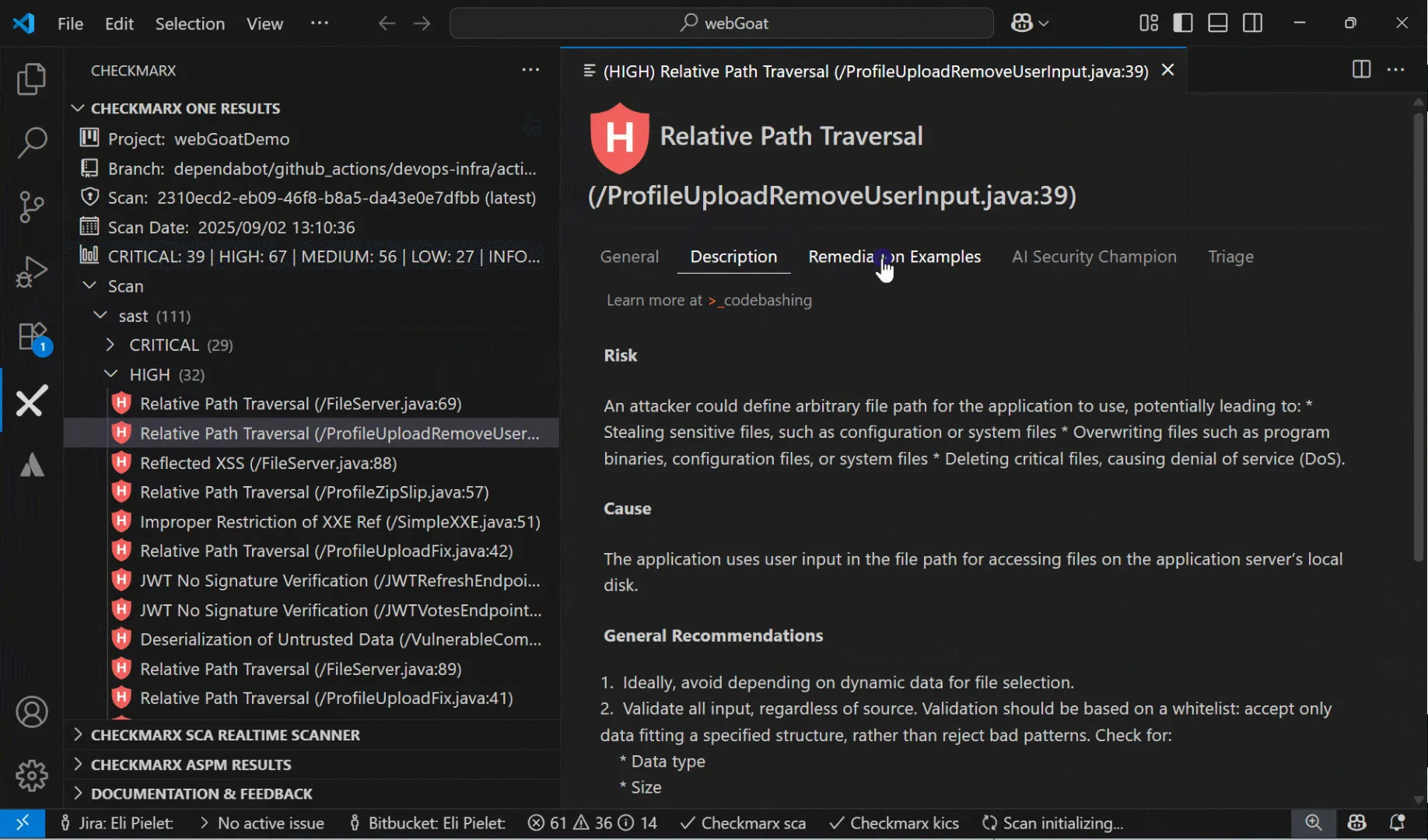
Checkmarx One is the most direct competitor to HCL AppScan: a full application security platform covering SAST, SCA, DAST, IAST, API security, IaC scanning, container security, and secrets detection.
Its SAST engine supports 35+ languages and 100+ frameworks, substantially exceeding AppScan’s language coverage. The platform is a consistent Gartner Magic Quadrant Leader, used by organizations including Apple, Salesforce, and Walmart.
The ASPM (Application Security Posture Management) layer is what separates Checkmarx from AppScan’s approach.
Rather than presenting SAST, DAST, and SCA findings as separate result sets, the ASPM correlates findings across all scan types, deduplicates them, and prioritizes by application context, exploitability, and business criticality. This cross-scan correlation significantly reduces the manual triage burden. The AI-assisted remediation feature suggests fixes for detected vulnerabilities.
Checkmarx One supports cloud, on-premises, and hybrid deployment, matching AppScan’s flexibility. Custom query authoring, role-based access control, and enterprise reporting cover the governance needs that regulated organizations require.
Pricing is often cited as more cost-effective than HCL AppScan for comparable deployments.
Best for: Enterprise teams migrating from HCL AppScan that need the same breadth of scanning with a more modern platform. License: Commercial Key difference: 35+ language SAST with ASPM for cross-scan correlation and prioritization. Often cited as more cost-effective than HCL AppScan.
2. Fortify (OpenText)
Fortify Static Code Analyzer has been a Gartner Leader for SAST for over a decade, longer than almost any other tool.
It supports 33+ languages including legacy platforms like COBOL, ABAP, and PL/SQL. Deep interprocedural analysis traces data flow across function boundaries, catching complex vulnerability patterns.
The rule set covers 1,700+ vulnerability categories, one of the broadest in the industry.
Fortify offers the same deployment flexibility as HCL AppScan: on-premises (Fortify SCA), SaaS (Fortify on Demand), and hybrid models. Audit Workbench provides desktop-based triage with detailed trace information.
Fortify WebInspect handles DAST, and together with Fortify SCA, provides the SAST-plus-DAST combination that AppScan users expect.
The comparison with AppScan is particularly relevant because both tools serve the same enterprise market segment.
Fortify’s SAST engine is generally considered deeper for complex vulnerability patterns, while AppScan’s integrated DAST and IAST provide a more unified experience.
Scan performance is comparable: both take minutes to hours for large codebases. For organizations already in the OpenText (formerly Micro Focus) ecosystem, Fortify is a natural migration path.
Best for: Enterprises needing deep SAST with legacy language support and flexible on-premises or SaaS deployment. License: Commercial Key difference: Gartner Leader for over a decade. 33+ languages including COBOL and ABAP. On-premises, SaaS, and hybrid deployment.
3. Snyk
Snyk provides a developer-focused application security platform that represents the opposite architectural philosophy from HCL AppScan. Where AppScan is built for centralized security teams, Snyk is built for developers.
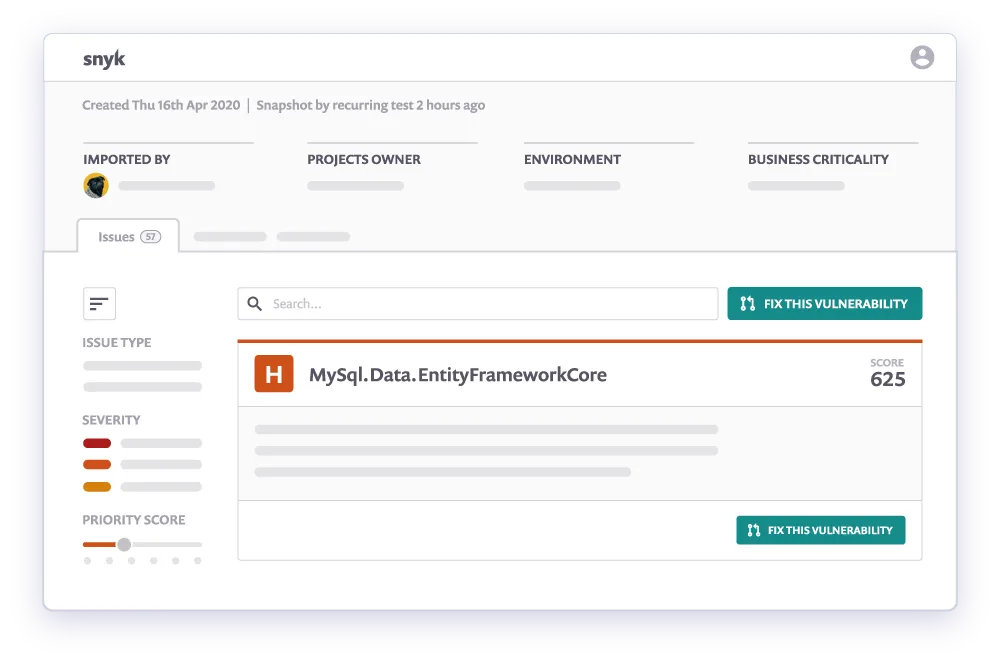
Snyk Code (SAST) scans in real time inside IDEs, showing vulnerabilities as developers write code.
Snyk Open Source (SCA) provides automated fix pull requests with a proprietary database that catches CVEs 47 days before NVD. Snyk Container and Snyk IaC complete the platform.
The developer experience gap between Snyk and HCL AppScan is significant. Snyk scans in seconds where AppScan takes minutes to hours.
IDE plugins provide inline feedback. The CLI works in any CI/CD pipeline.
AI-powered fix suggestions from the DeepCode engine propose specific code changes. Snyk is a Gartner Leader and is used by over 2.5 million developers.
Snyk does not include DAST or IAST, which are core AppScan capabilities. Teams replacing AppScan with Snyk need to source DAST separately.
Snyk’s products are priced individually, so the total cost for SAST plus SCA plus containers plus IaC can approach enterprise pricing.
But for organizations shifting security left toward developers, Snyk delivers a fundamentally better workflow.
Best for: Developer teams wanting shift-left security with real-time IDE feedback and AI-powered fix suggestions. License: Commercial (free tier available) Key difference: Real-time IDE scanning with AI fix suggestions. Developer-first experience vs. AppScan’s security-team-first design. Gartner Leader.
4. Semgrep
Semgrep provides fast, lightweight SAST with a custom rule engine that has become a favorite among security engineers. The rule syntax resembles the code it matches, making rule authoring accessible without learning a specialized query language.
Semgrep CE supports 30+ languages and runs in seconds, compared to AppScan’s minutes-to-hours scan times. Semgrep Code adds cross-file taint analysis, secrets detection, and supply chain scanning.
For organizations replacing AppScan primarily for SAST, Semgrep offers several advantages: dramatically faster scan times (10-second median, according to Semgrep), simpler CI/CD integration, and a custom rule ecosystem with 20,000+ community and proprietary rules.
Semgrep CE is genuinely useful on its own, reducing the barrier to adoption. Semgrep’s focus on code analysis means it does not try to replace AppScan’s DAST or IAST capabilities.
The trade-off is scope. Semgrep does not include DAST, IAST, or comprehensive SCA (though Semgrep Supply Chain covers dependency analysis with reachability).
Teams migrating from AppScan need additional tools for dynamic and interactive testing.
But many organizations find that a combination of Semgrep for SAST, OWASP ZAP for DAST, and Snyk or Dependabot for SCA provides better coverage at lower cost than HCL AppScan alone.
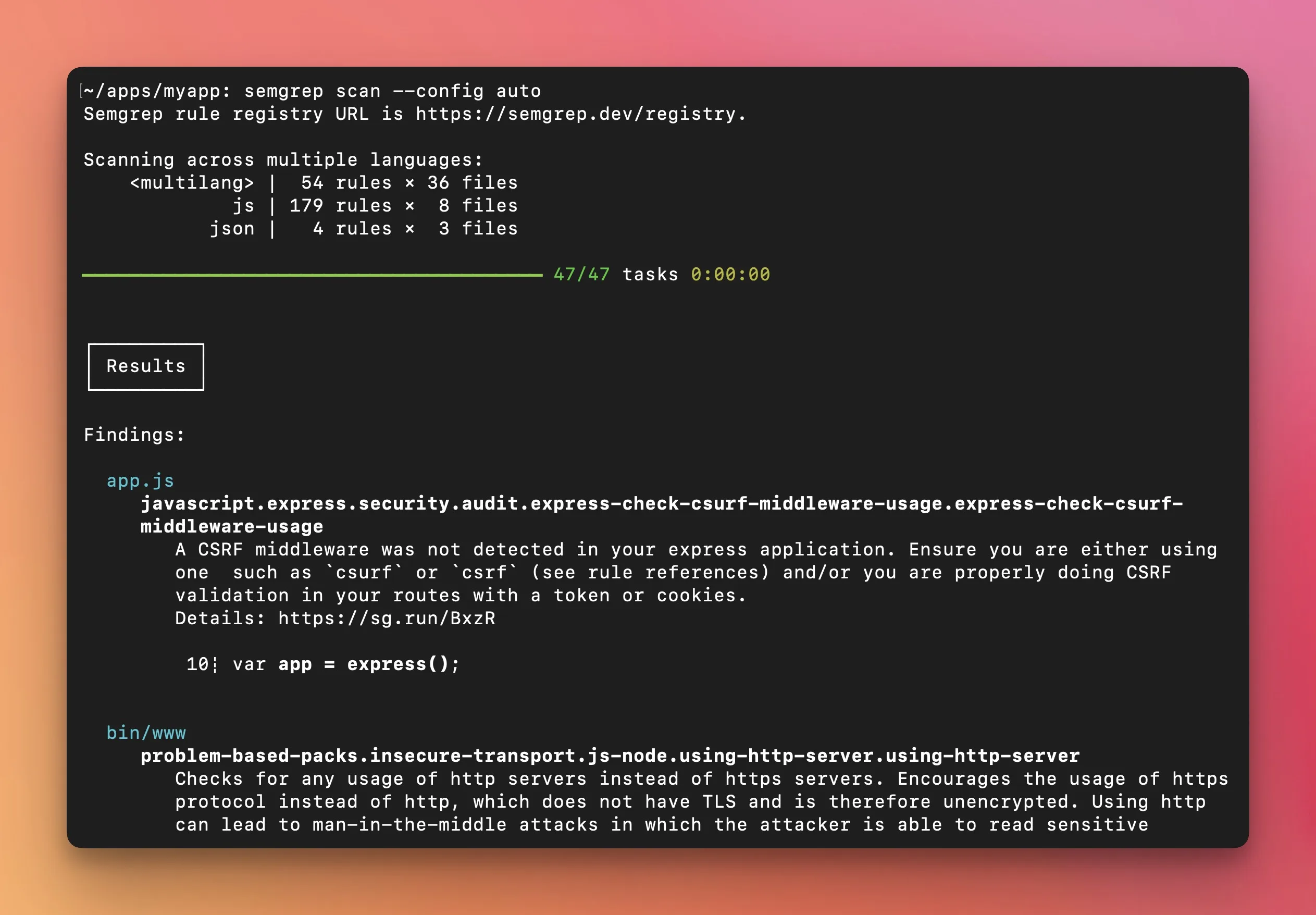
Best for: Security engineers who want fast, customizable SAST with accessible rule authoring and sub-second CI/CD integration. License: Open Source / Commercial Key difference: 10-second median scan time (according to Semgrep). Custom rules in code-like syntax. Semgrep CE CLI free for single-file analysis.
5. Veracode
Veracode offers an enterprise application security platform with SAST, SCA, DAST, and container scanning.
The platform has been in the market for over two decades, similar to HCL AppScan, and carries strong compliance certifications including FedRAMP authorization. Veracode Fix uses AI to generate code remediation for detected vulnerabilities. The cloud-only deployment model means no infrastructure to manage.
Veracode’s binary SAST approach is unique: it analyzes compiled applications rather than source code, which means developers can scan without providing source code access to the security team. This matters in outsourced development scenarios.
The platform integrates with major IDEs and CI/CD systems, though developer experience trails Snyk and Semgrep.
Compared to HCL AppScan, Veracode offers a more modern cloud platform with better developer integrations. AppScan provides on-premises deployment that Veracode does not offer, which matters for air-gapped environments.
Both tools serve the enterprise compliance market, with Veracode’s FedRAMP authorization being a differentiator for U.S. government work.
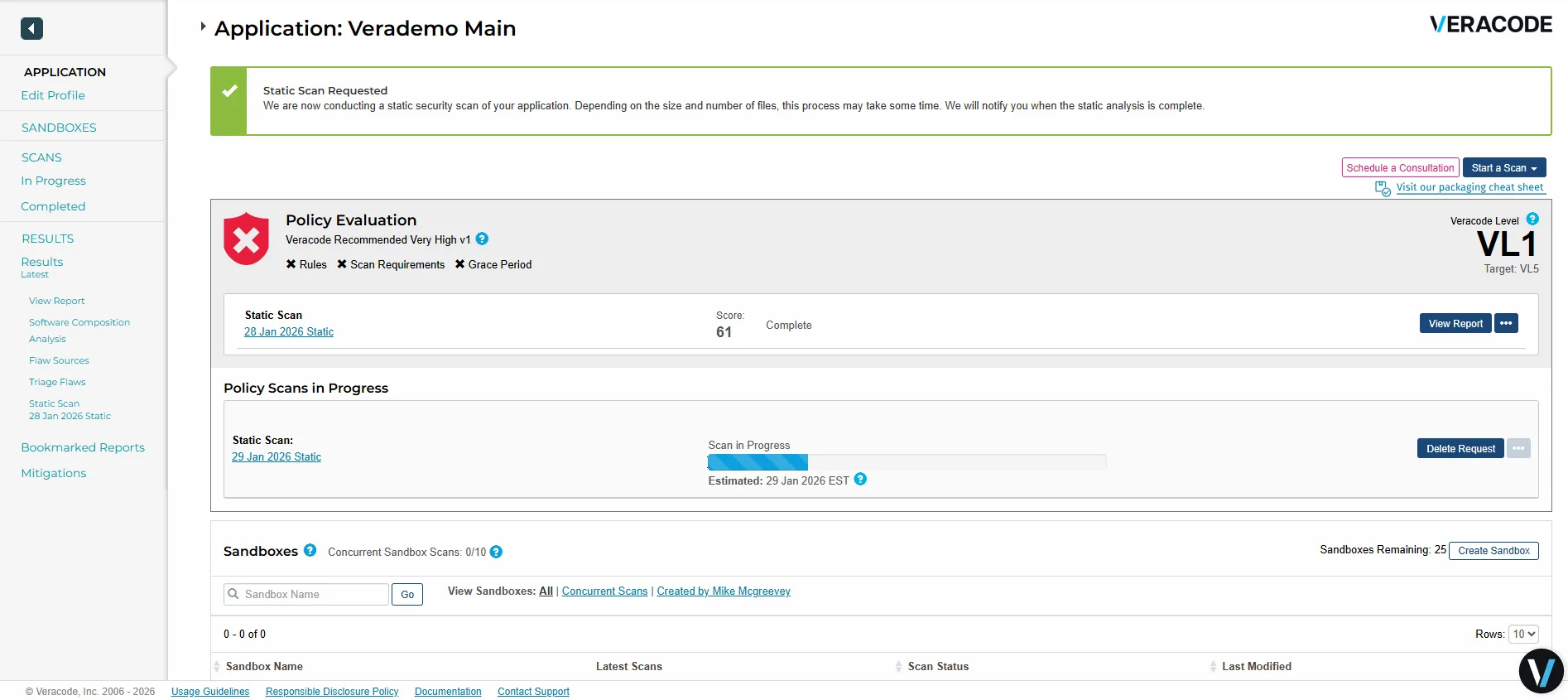
Best for: Enterprises needing FedRAMP-authorized AST with binary SAST for outsourced development scenarios. License: Commercial Key difference: FedRAMP authorization. Binary SAST analyzes compiled apps without source code access. Cloud-only with zero infrastructure management.
6. SonarQube
SonarQube is the most widely deployed code analysis platform, combining code quality and security scanning across 35+ languages. The quality gate system enforces pass/fail conditions on coverage, duplication, complexity, and security rating.
Where HCL AppScan focuses purely on security, SonarQube tracks bugs, code smells, technical debt, and test coverage alongside vulnerability detection.
The Community Edition is free and self-hosted, covering basic security rules and code quality. The Developer Edition adds taint analysis and advanced security rules.
For organizations that want security alongside code quality governance, SonarQube provides a unified view that AppScan cannot match.
Best for: Teams wanting combined code quality and security analysis with quality gates and free self-hosted option. License: Free Community Edition / Commercial Key difference: Code quality metrics alongside security scanning. Quality gates enforce standards. Free self-hosted Community Edition.
7. Invicti
Invicti specializes in DAST with proof-based scanning that verifies vulnerabilities at 99.98% accuracy. For teams replacing HCL AppScan primarily for its DAST capabilities, Invicti offers the highest automated accuracy available.
The IAST component (Invicti Shark) confirms DAST findings from inside the application. The platform has expanded to include SAST, SCA, and ASPM.
Best for: Teams replacing AppScan’s DAST capabilities that need the highest automated scanning accuracy. License: Commercial Key difference: Proof-based DAST at 99.98% accuracy. Combined DAST and IAST verification. Expanding into full AST platform.
8. Aikido Security
Aikido provides an all-in-one AppSec platform covering SAST, DAST, SCA, secrets detection, IaC scanning, container scanning, and cloud posture management.
For organizations that want to replace HCL AppScan’s breadth of coverage with a single modern tool, Aikido provides comparable scope at a fraction of the cost. Pricing starts at $300/month for 10 users.
Best for: SMBs wanting AppScan-level coverage breadth at a fraction of the enterprise cost. License: Commercial (free tier available) Key difference: SAST, DAST, SCA, IaC, secrets, containers, and CSPM in one platform. Priced at a fraction of HCL AppScan’s custom enterprise pricing.
9. Mend.io Platform
The Mend AppSec Platform bundles SCA, SAST, container security, and AI security under a single per-developer license.
For teams replacing AppScan’s SAST and SCA capabilities, Mend provides modern alternatives with reachability analysis, malicious package detection, and agentic SAST via MCP protocol. Mend does not include DAST or IAST.
Best for: Teams replacing AppScan’s SAST and SCA with a modern platform that includes reachability and supply chain protection. License: Commercial Key difference: Bundled SCA, SAST, containers, and AI security. Reachability analysis for noise reduction. Agentic SAST via MCP.
10. Coverity
Coverity (now under Black Duck / Software Integrity Group) provides enterprise SAST with deep analysis capabilities. It supports 22+ languages and uses advanced dataflow analysis to detect complex vulnerability patterns with low false positive rates.
Coverity is widely used in industries requiring high code reliability, including automotive, medical devices, and aerospace.
Best for: Organizations in safety-critical industries needing deep SAST analysis with low false positive rates. License: Commercial Key difference: Deep dataflow analysis for complex vulnerability patterns. Strong track record in safety-critical industries (automotive, medical, aerospace).
Feature Comparison
| Feature | HCL AppScan | Checkmarx One | Fortify | Snyk | Semgrep | Veracode | SonarQube |
|---|---|---|---|---|---|---|---|
| SAST | Yes | Yes (35+ langs) | Yes (33+ langs) | Yes (20+ langs) | Yes (30+ langs) | Yes (binary) | Yes (35+ langs) |
| DAST | Yes | Yes | Yes (WebInspect) | No | No | Yes | No |
| IAST | Yes | Yes | No | No | No | No | No |
| SCA | Yes | Yes | Yes (Fortify SCA) | Yes | Supply Chain | Yes | No |
| Scan speed | Minutes-hours | Minutes | Minutes-hours | Seconds (IDE) | 10s median | Minutes | Minutes |
| Custom rules | Yes | Yes | Yes | No | Core feature | Limited | Limited |
| AI fix suggestions | Yes | Assist | Aviator | DeepCode AI | Assistant | Fix | AI CodeFix |
| On-premises | Yes | Yes | Yes | Enterprise only | Yes | No (cloud only) | Yes |
| Free tier | No | No | No | Yes | CE engine | No | Community Edition |
| Code quality | No | No | No | No | No | No | Core feature |
| Compliance | PCI, HIPAA, OWASP | PCI, HIPAA, OWASP | PCI, HIPAA, OWASP | OWASP | OWASP | FedRAMP, PCI, HIPAA | OWASP |
When to Stay with HCL AppScan
HCL AppScan remains the right choice for organizations where established compliance certifications, vendor continuity, and unified SAST-DAST-IAST scanning matter more than developer experience or scan speed.
If your organization has built compliance workflows around AppScan’s reporting, switching tools means re-establishing those workflows with a new product. The sunk cost in training, integrations, and institutional knowledge is real.
AppScan’s on-premises deployment supports air-gapped environments that cloud-only tools like Veracode and Snyk cannot serve.
The combined SAST, DAST, IAST, and SCA in a single product reduces the integration complexity of managing separate tools for each testing methodology.
And for organizations with long-standing HCL relationships and enterprise agreements, the procurement and support experience is already established.
Migration is worth pursuing when the developer experience gap, scan speed, or cost differential becomes a bottleneck for your security program.
But if the current setup meets your compliance and coverage needs, the switching cost alone is a valid reason to stay. See more AppSec Santa comparisons in our SAST tools hub.
Frequently Asked Questions
What is the best free alternative to HCL AppScan?
How does HCL AppScan compare to Checkmarx?
Can Snyk replace HCL AppScan?
Is HCL AppScan still competitive in 2026?
What is the most cost-effective alternative to HCL AppScan?

+7 Years in AppSec
10+ years in application security. Reviews and compares 208 AppSec tools across 11 categories to help teams pick the right solution. More about me →