

Guardsquare is a mobile application security company that provides code obfuscation, app shielding, and runtime protection for Android and iOS apps.
The company is best known as the creator of ProGuard, the open-source Java bytecode optimizer originally included in the Android SDK (R8 is now the default), and its commercial products DexGuard and iXGuard that extend ProGuard with advanced security features.
The platform takes a build-level approach to mobile protection. Rather than wrapping compiled binaries, Guardsquare’s tools integrate into the compilation process itself, applying obfuscation and hardening at the code level.
This produces protection that is structurally embedded in the application rather than layered on top.
What is Guardsquare?
Guardsquare provides a complete mobile security lifecycle: test with AppSweep, protect with DexGuard/iXGuard, and monitor in production.
The tools integrate into standard build systems (Gradle for Android, Xcode for iOS) and fit into existing CI/CD pipelines without requiring changes to application architecture.
| Capability | Details |
|---|---|
| DexGuard (Android) | Multilayered, polymorphic obfuscation with control flow randomization, string encryption, code virtualization, and built-in RASP for native and cross-platform Android apps. |
| iXGuard (iOS) | Obfuscation and runtime protection for native iOS (Objective-C, Swift) and cross-platform apps. Applies name obfuscation, string encryption, and anti-tampering checks. |
| AppSweep (Free) | Developer-friendly mobile application security testing that identifies vulnerabilities in your app and its dependencies. Free tier available for individual developers. |
What are Guardsquare’s key features?
DexGuard (Android Protection)
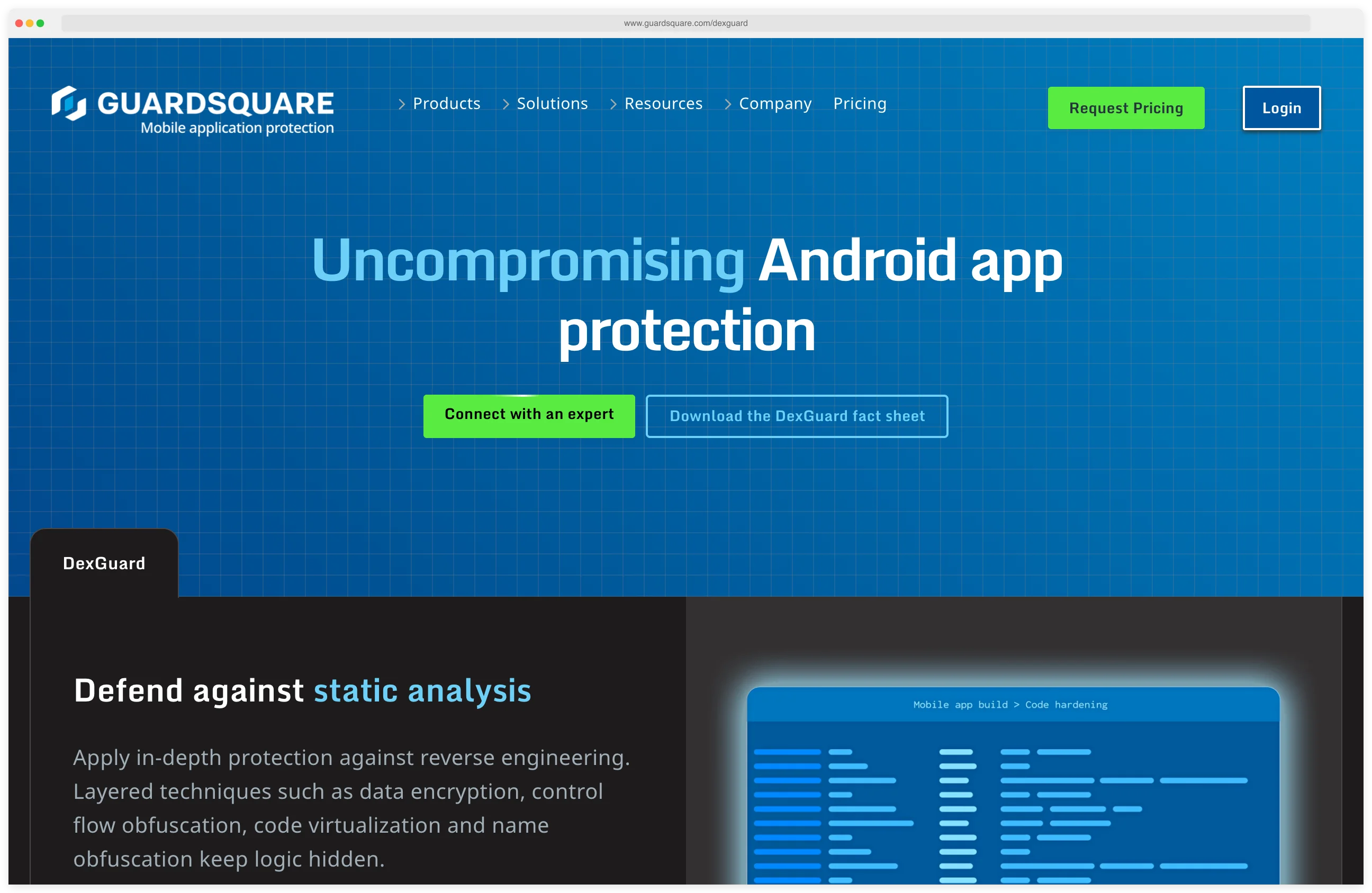
DexGuard is Guardsquare’s commercial Android protection tool. It applies multiple layers of obfuscation and hardening during the build process:
- Control flow obfuscation: Restructures code logic so decompiled output is difficult to follow
- Name obfuscation: Renames classes, methods, and fields to meaningless identifiers
- String encryption: Encrypts hardcoded strings so they cannot be read from decompiled code
- Code virtualization: Converts critical code sections into custom bytecode that runs on an embedded virtual machine
- Asset and resource encryption: Protects app resources from extraction
- RASP protections: Root detection, tamper detection, debugger detection, and emulator detection at runtime
DexGuard builds on ProGuard, so teams already using ProGuard can upgrade without reworking their build configuration. The tool integrates as a Gradle plugin and runs during the standard Android build process.
iXGuard (iOS Protection)
iXGuard provides equivalent protections for iOS apps built with Objective-C, Swift, or cross-platform frameworks. It integrates into Xcode build workflows and applies obfuscation at compile time.
The tool covers name obfuscation, string encryption, control flow obfuscation, and runtime integrity checks.
Both DexGuard and iXGuard support cross-platform frameworks including Flutter, React Native, Unity, Cordova, and Ionic. This means a single security tool chain can protect apps regardless of how they were built.
ProGuard (Open Source)
ProGuard is the free, open-source Java bytecode optimizer originally included in the Android SDK (R8 has since replaced ProGuard as the default optimizer in Android builds, though ProGuard remains available).
It shrinks, optimizes, and obfuscates Java and Kotlin code.
While it provides basic protection through code shrinking and name obfuscation, it lacks the security-focused features of DexGuard such as string encryption, control flow obfuscation, and runtime protection.
ProGuard remains a solid baseline for apps that do not face targeted reverse-engineering threats. For apps handling sensitive logic, financial transactions, or proprietary algorithms, DexGuard provides the additional hardening layers.
AppSweep Security Testing
AppSweep is Guardsquare’s mobile application security testing tool. It analyzes Android and iOS app binaries to identify security vulnerabilities in your code and third-party dependencies.
The free tier lets individual developers scan their apps at no cost, while AppSweep Enterprise adds role-based access control, SSO, and custom data retention policies for organizations.
AppSweep provides remediation guidance alongside its findings, helping developers understand and fix issues rather than simply flagging them.
OWASP MASVS-RESILIENCE Mapping
DexGuard and iXGuard cover the OWASP MASVS-RESILIENCE control family — the part of the standard that resists reverse engineering and runtime tampering. Anti-tamper checks address MASVS-R-1, anti-debugging covers MASVS-R-2, root and jailbreak detection slot into MASVS-R-3, and the build-level integrity checks line up with MASVS-R-4.
The polymorphic obfuscation engine — control-flow randomization plus name and string encryption that varies build to build — is what makes Guardsquare’s output resistant to signature-based deobfuscation tooling, and is the lever most teams cite when they pick DexGuard over a binary-wrapping alternative.
How do I get started with Guardsquare?
- Test with AppSweep — Upload your APK or IPA to AppSweep (free tier available) to identify existing vulnerabilities in your app and its dependencies.
- Add DexGuard or iXGuard — Integrate the protection plugin into your Gradle (Android) or Xcode (iOS) build configuration. Existing ProGuard users can upgrade DexGuard with minimal config changes.
- Configure protection layers — Select which obfuscation and RASP features to enable. Fine-tune protection levels for different parts of your codebase based on sensitivity.
- Build and verify — Run your standard build process. DexGuard/iXGuard applies protections automatically. Review the build report for protection coverage details.
How much does Guardsquare cost?
Guardsquare does not publish dollar amounts on its website — every commercial plan is enterprise-quoted by sales. The model is per-app or per-organization licensing for DexGuard and iXGuard, scaled by the number of protected apps and platforms (Android and iOS are separate SKUs but typically bundled in larger contracts).
ProGuard is fully free under an open-source license (GPLv2+). AppSweep has a free tier for individual developers; AppSweep Enterprise adds SSO, role-based access, and longer data retention through a separate commercial license. The full Mobile Application Security Testing platform — DexGuard + iXGuard + AppSweep Enterprise — is bundled in enterprise contracts.
For a quote, contact Guardsquare with app counts and platform mix.
When to Use Guardsquare
Guardsquare is the right choice when your primary concern is preventing reverse engineering of your mobile app’s code.
The build-level obfuscation approach produces stronger protection against static analysis than binary-wrapping alternatives, because the obfuscation is woven into the compiled output itself.
Consider Guardsquare for apps that contain proprietary algorithms, DRM logic, payment processing code, or other intellectual property that competitors or attackers might try to extract. Financial services, gaming, and media companies are common adopters.
If your needs extend beyond code protection into fraud prevention, bot defense, and geo-compliance, tools like Appdome cover that broader scope.
For runtime-only protection without build integration, Talsec offers a lighter-weight SDK approach with a free tier.
What are alternatives to Guardsquare?
Guardsquare sits in a competitive mobile RASP and shielding market. The closest alternatives, depending on the slice you care about most:
- Appdome . No-code mobile defense that patches the binary post-build. Broader scope (anti-fraud, bot defense, geo-compliance) than Guardsquare, but lighter on deep code obfuscation. The natural Guardsquare alternative for teams that cannot or will not change their build pipeline.
- Talsec RASP+. SDK-based runtime protection with a free tier (freeRASP) and a paid AppiCrypt SDK. Lighter integration than DexGuard, focused on RASP rather than obfuscation; many teams pair Talsec for runtime checks with Guardsquare for code hardening.
- Promon SHIELD. Norwegian app-shielding vendor used heavily in mobile banking. Comparable RASP scope to Guardsquare with strong fintech case studies, particularly in EMEA.
- Verimatrix XTD. Extended threat-defense platform pairing app shielding with telemetry and incident response. Note: Guardsquare acquired Verimatrix XTD in February 2026, so it is no longer an independent alternative.
- Zimperium zShield. App-shielding component of the Zimperium MAPS bundle, often paired with their on-device zDefend SDK for full runtime + scan coverage.
For a wider category view, see my mobile security tools hub.