

GitGuardian Alternatives
Thinking of switching from GitGuardian? Compare top competitors including TruffleHog, Gitleaks, GitHub Secret Scanning, and Cycode for secrets detection.




- GitGuardian detects 450+ secret types and monitors collaboration tools (Slack, Jira, Confluence); TruffleHog covers 800+ detectors with live API verification.
- Gitleaks (24,500+ GitHub stars, MIT license) runs in milliseconds for pre-commit hooks but does not perform active secret verification.
- GitHub Secret Scanning partners with 200+ service providers for automatic credential revocation but only covers GitHub repositories.
- TruffleHog's active verification tests detected credentials against live APIs to confirm validity, producing the lowest false positive rates among secrets scanners.
- Semgrep Secrets uses semantic code analysis to understand context around detected secrets, distinguishing real API keys from test strings — reducing false positives beyond regex matching.
The best GitGuardian alternatives in 2026 are TruffleHog, Gitleaks, GitHub Secret Scanning, and Semgrep Secrets — offering different approaches to detecting hardcoded credentials in code repositories.
Why Look for GitGuardian Alternatives?
GitGuardian is one of the most widely used secrets detection platforms, monitoring both public and private repositories for hardcoded credentials.
With detection for 450+ secret types, validity checking, and integration with collaboration tools like Slack, Jira, and Confluence, it goes well beyond basic pattern matching.
The Secrets Analyzer feature automatically gathers metadata about detected credentials, including the scopes and permissions associated with each secret. And the platform’s NHI (Non-Human Identity) governance capabilities help organizations track and manage machine credentials at scale.
The most common reason teams look for alternatives is cost. GitGuardian’s per-developer pricing can add up for larger organizations, and the free tier is limited to repositories under a single GitHub organization.
Teams running self-hosted Git infrastructure or using GitLab, Bitbucket Server, or Azure DevOps may find GitGuardian’s integrations less mature for their setup.
Some security teams also prefer open-source tools they can audit, customize, and run entirely on their own infrastructure without sending repository data to a third-party service.
There is also the question of scope. GitGuardian focuses specifically on secrets detection and NHI governance.
Organizations that want secrets scanning bundled with SAST, SCA, or other AppSec capabilities may prefer a platform that handles multiple scanning types rather than maintaining a separate tool for each.
And for teams that primarily need pre-commit hooks to block secrets before they enter version control, lighter-weight open-source tools may offer all the coverage they need without the overhead of a full platform.
Top GitGuardian Alternatives
1. TruffleHog
TruffleHog is the most popular open-source secrets scanner, maintained by Truffle Security. The v3 rewrite in Go introduced over 800 credential detectors, each with active verification against its respective API.
When TruffleHog finds what looks like an AWS key, it tests that key against the AWS API to confirm whether it is valid and active.
This verification step eliminates a class of false positives that plague regex-only scanners, and it tells you immediately whether a leaked credential needs emergency rotation.
TruffleHog scans Git repositories, S3 buckets, GCS buckets, Docker images, filesystems, CircleCI, and Travis CI. The tool supports custom regex detectors with keyword anchoring, so teams can define patterns for internal credential formats.
Driftwood technology can verify private keys against millions of GitHub users and billions of TLS certificates. The CLI-first design integrates well into CI/CD pipelines and pre-commit hooks.
The trade-off compared to GitGuardian is the operational model. TruffleHog’s open-source version is a CLI tool without a management dashboard, team workflows, or centralized policy enforcement.
Truffle Security offers a commercial platform called TruffleHog Enterprise for these features, but pricing is not public.
For teams comfortable running CLI tools in pipelines and reviewing results in their existing workflow, the open-source version is extremely capable.
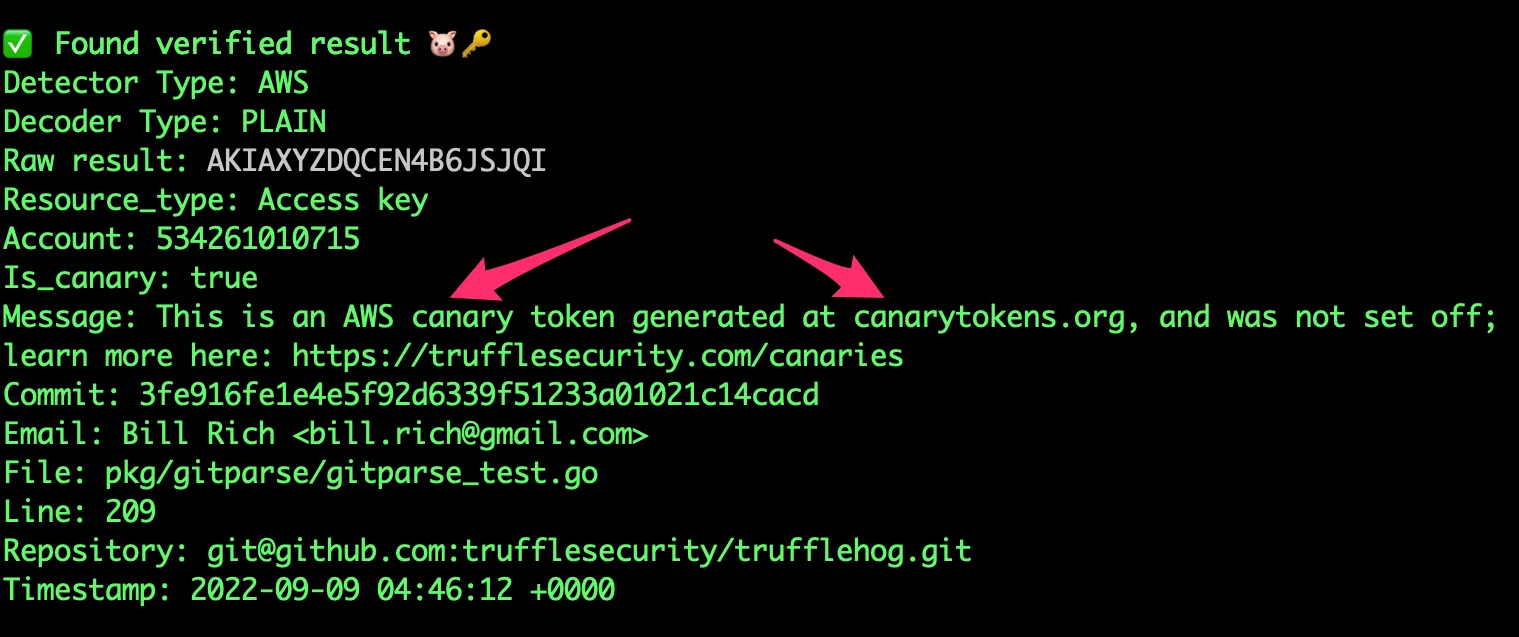
Best for: Security teams wanting the broadest credential detection with active API verification in an open-source tool. License: Open Source (AGPL-3.0) / Commercial (Enterprise) Key difference: 800+ detectors with active verification against live APIs. Confirms whether secrets are valid and active, not just pattern matches.
2. Gitleaks
Gitleaks is a lightweight, fast secrets scanner written in Go. It scans Git repositories for hardcoded secrets using regex patterns defined in a TOML configuration file.
The tool is popular for pre-commit hooks because it runs in milliseconds and catches secrets before they enter version control. With 24,500+ GitHub stars, it has strong community adoption.
Gitleaks works well as a first line of defense. The default ruleset covers common API keys, tokens, passwords, and private keys.
Custom rules are straightforward to add. The tool runs as a GitHub Action, GitLab CI step, or standalone CLI.
Compared to TruffleHog, Gitleaks is simpler and faster but does not perform active verification of detected secrets. It tells you a string matches a pattern, not whether it is a valid credential.
For teams that want pre-commit blocking without the complexity of a full platform, Gitleaks is often the right choice. It pairs well with a more comprehensive scanner like TruffleHog or GitGuardian running in CI/CD for deeper analysis. The tool is fully open-source under the MIT license.
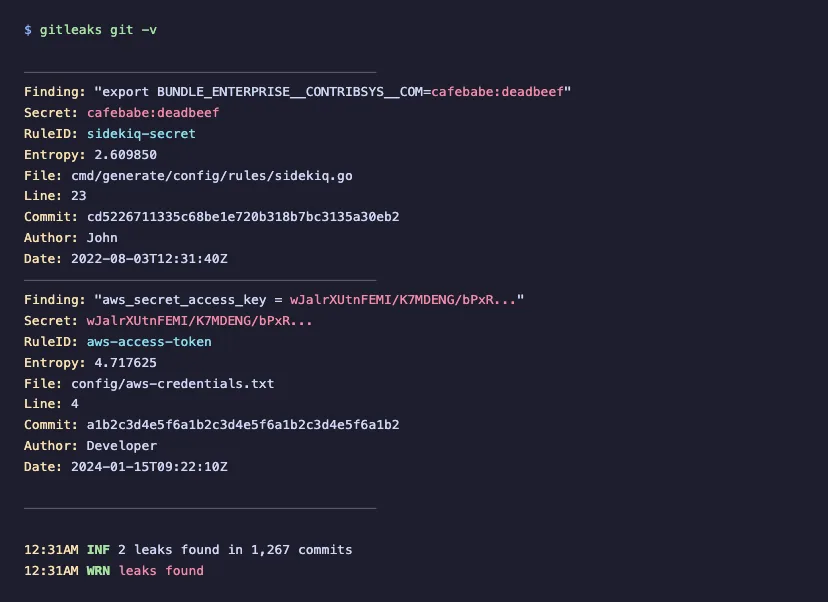
Best for: Developers wanting fast, lightweight pre-commit secret scanning with simple configuration. License: Open Source (MIT) Key difference: Fastest secrets scanner available. Runs in milliseconds for pre-commit hooks. Simple TOML-based rule configuration.
3. GitHub Secret Scanning
GitHub Secret Scanning is built directly into GitHub and provides native secrets detection for repositories on the platform.
It partners with over 200 service providers (AWS, Google Cloud, Stripe, Twilio, and many others) who register their token patterns with GitHub.
When a matching pattern is found, GitHub can notify the service provider to revoke the credential automatically. Push protection can block commits containing detected secrets before they reach the repository.
The native integration is the key advantage. There is no separate tool to install, configure, or maintain.
Alerts appear in the Security tab alongside code scanning and dependency alerts. For organizations standardized on GitHub, this reduces tool sprawl and simplifies workflows.
The feature is free for public repositories and requires GitHub Advanced Security for private repos.
The limitations are scope and depth. GitHub Secret Scanning only covers GitHub repositories, not other Git hosts, collaboration tools, or CI/CD logs.
The detector count (200+ partner patterns) is smaller than TruffleHog’s 800+ or GitGuardian’s 450+. Custom pattern support exists but is less flexible than dedicated tools.
For GitHub-only teams, it covers the baseline effectively. For multi-platform environments, a dedicated tool is necessary.
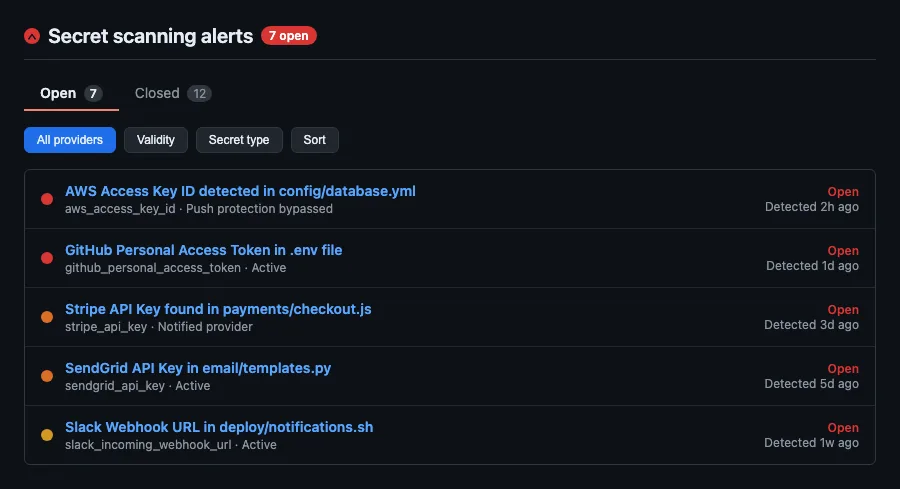
Best for: GitHub-native teams wanting zero-configuration secrets detection with automatic credential revocation. License: Free (public repos) / Commercial (GHAS for private repos) Key difference: Native GitHub integration with automatic credential revocation through service provider partnerships. Zero setup required.
4. Cycode
Cycode provides secrets detection as part of a broader software supply chain security platform. Beyond scanning repositories for hardcoded credentials, Cycode monitors CI/CD pipelines, build systems, and artifact registries for exposed secrets.
The platform maps the entire code-to-cloud pipeline to understand where secrets might leak at any stage.
Cycode’s secrets detection covers common credential types and supports custom patterns. The remediation workflow guides developers through rotating compromised credentials and removing them from version control history.
What distinguishes Cycode from GitGuardian is the broader scope: it treats secrets detection as one component of pipeline security rather than a standalone capability. The platform also provides code integrity checks and SBOM management.
Best for: Teams wanting secrets detection integrated with broader CI/CD and supply chain security. License: Commercial Key difference: Secrets scanning across the entire SDLC pipeline, not just Git repositories. Code integrity and supply chain security bundled together.
5. Semgrep Secrets
Semgrep Secrets brings semantic analysis to secrets detection. Instead of relying solely on regex patterns, it uses Semgrep’s code analysis engine to understand the context around a detected secret.
This means it can distinguish between a real API key assignment and a string that happens to match a key pattern in a test file or documentation.
The semantic approach significantly reduces false positives compared to pure pattern matching.
Semgrep Secrets validates detected credentials against their respective APIs, similar to TruffleHog.
It is part of the broader Semgrep platform, so teams already using Semgrep for SAST get secrets detection without adding another tool.
The capability requires a Semgrep Team or Enterprise subscription and is not available in Semgrep CE.
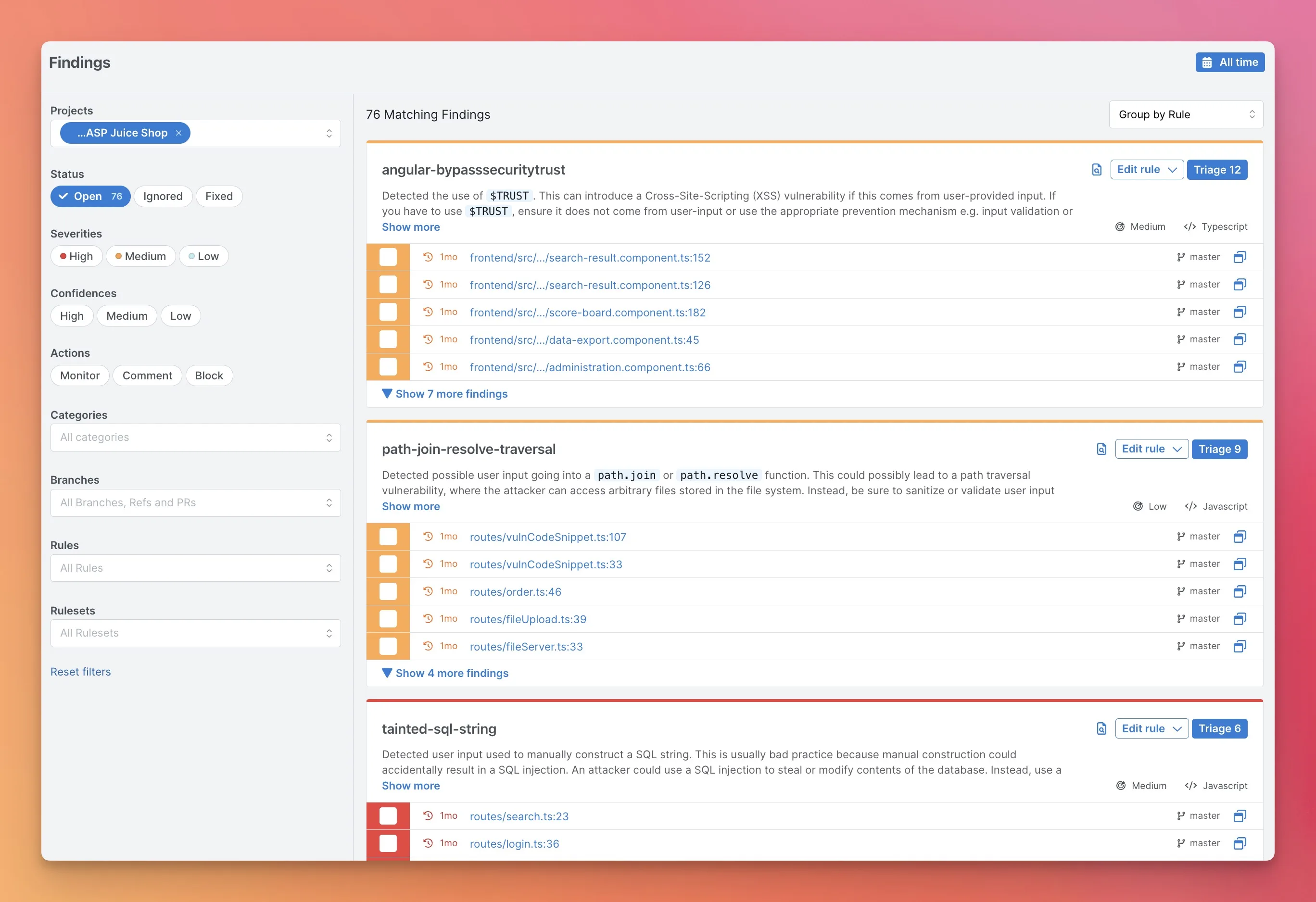
Best for: Teams already using Semgrep for SAST who want secrets detection with semantic context analysis. License: Commercial (Semgrep Team/Enterprise) Key difference: Semantic analysis understands code context around secrets, reducing false positives. Integrated with Semgrep’s SAST platform.
6. SpectralOps (Check Point)
SpectralOps, acquired by Check Point, provides a single self-contained binary for scanning source code and CI/CD pipelines for hardcoded secrets and IaC misconfigurations.
The tool combines secrets detection with infrastructure security scanning, covering two common problem domains in one tool. SpectralOps supports custom detectors and integrates with GitHub, GitLab, Bitbucket, and Azure DevOps.
Best for: Teams wanting combined secrets and IaC misconfiguration scanning in a single tool. License: Commercial (Check Point) Key difference: Combines secrets detection with Infrastructure-as-Code security scanning. Single binary deployment.
7. AWS Secrets Manager / HashiCorp Vault
These are secrets management solutions rather than secrets detection tools, but they address the root cause. AWS Secrets Manager and HashiCorp Vault provide centralized credential storage with automatic rotation, access policies, and audit logging.
By eliminating the need to hardcode secrets in the first place, they reduce the attack surface that secrets scanners are designed to catch.
Best for: Organizations that want to prevent hardcoded secrets by implementing proper secrets management infrastructure. License: Commercial (AWS) / Source-Available (BSL) + Commercial (Vault) Key difference: Addresses the root cause by providing infrastructure for managing and rotating secrets automatically.
8. Nightfall AI
Nightfall AI uses machine learning to detect secrets, PII, and other sensitive data across code repositories, Slack, Jira, Confluence, Google Drive, and other SaaS applications.
The ML-based detection goes beyond regex patterns to identify credentials in unstructured text and conversation threads. Nightfall’s scope is broader than most secrets scanners because it covers collaboration tools natively.
Best for: Organizations needing sensitive data detection across both code and SaaS collaboration tools. License: Commercial Key difference: ML-based detection covers secrets, PII, and sensitive data across code and SaaS tools simultaneously.
9. Aikido Security
Aikido includes secrets detection as part of its all-in-one AppSec platform alongside SAST, DAST, SCA, IaC scanning, and cloud posture management. For teams that want to consolidate multiple security scanning tools under a single vendor, Aikido’s secrets detection provides reliable, low-noise coverage without requiring a separate tool or vendor relationship.
Best for: Teams wanting secrets detection bundled with a comprehensive AppSec platform. License: Commercial (free tier available) Key difference: Secrets detection is one module within a full AppSec platform that includes SAST, DAST, SCA, and cloud security.
10. detect-secrets (Yelp)
Yelp’s detect-secrets is an open-source tool focused on preventing new secrets from entering codebases.
It maintains a baseline of known secrets and flags only new ones, which makes it practical for legacy codebases where fixing all existing secrets at once is not feasible. The tool supports custom plugins for detecting organization-specific credential formats.
Best for: Teams with legacy codebases that want to prevent new secrets without remediating all existing ones first. License: Open Source (Apache 2.0) Key difference: Baseline approach flags only new secrets, making it practical for incremental adoption on legacy codebases.
Feature Comparison
| Feature | GitGuardian | TruffleHog | Gitleaks | GitHub Secret Scanning | Cycode | Semgrep Secrets |
|---|---|---|---|---|---|---|
| License | Commercial (free tier) | OSS (AGPL) / Commercial | OSS (MIT) | Free (public) / GHAS | Commercial | Commercial |
| Detector count | 450+ | 800+ | 150+ | 200+ partners | 100+ | 100+ |
| Active verification | Yes | Yes | No | Partner revocation | Yes | Yes |
| Git history scanning | Yes | Yes | Yes | Yes | Yes | Yes |
| Collaboration tools | Slack, Jira, Confluence | No | No | No | CI/CD, builds | No |
| Push protection | Yes | Pre-commit | Pre-commit | Yes | Yes | Pre-commit |
| Custom detectors | Yes | Yes | Yes (TOML) | Yes | Yes | Yes (YAML rules) |
| Dashboard | Yes | Enterprise only | No | GitHub Security tab | Yes | Semgrep Platform |
| NHI governance | Yes | No | No | No | No | No |
| Self-hosted | Yes | Yes | Yes | No (GitHub only) | Yes | Yes |
When to Stay with GitGuardian
GitGuardian remains the right choice when your security program needs more than just detection. The platform’s remediation workflows, incident management, and NHI governance capabilities go beyond what any open-source scanner provides.
If your organization needs to monitor collaboration tools like Slack and Confluence for credential leaks, GitGuardian is one of the few tools that covers those surfaces natively.
The Secrets Analyzer’s ability to determine the scope and permissions of detected credentials adds context that helps security teams prioritize response.
For organizations managing hundreds or thousands of repositories across multiple Git hosts, GitGuardian’s centralized dashboard and policy engine reduce the operational burden of tracking and remediating secrets at scale.
And the platform’s public monitoring capability, which detects credentials leaked to public GitHub, provides an early warning system that CLI tools running on your own infrastructure cannot replicate.
For more AppSec Santa reviews, browse our SAST tools category.
Frequently Asked Questions
What is the best free alternative to GitGuardian?
How does GitGuardian compare to TruffleHog?
Can GitHub Secret Scanning replace GitGuardian?
Which secrets detection tool has the lowest false positive rate?
Do I need a dedicated secrets detection tool or is SCA enough?

+7 Years in AppSec
10+ years in application security. Reviews and compares 208 AppSec tools across 11 categories to help teams pick the right solution. More about me →