

What ASPM is#
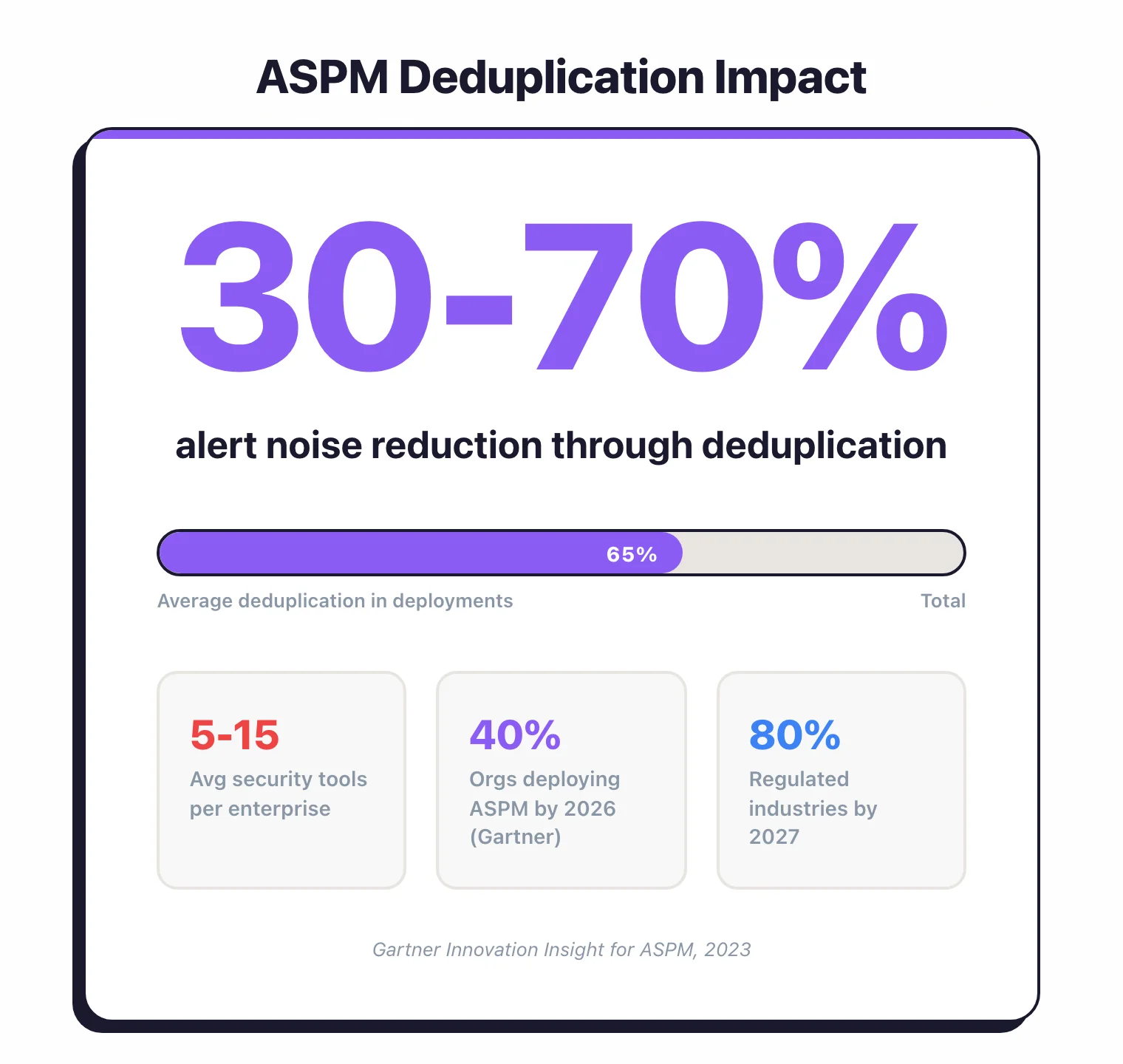
Application Security Posture Management (ASPM) is a category of tools that provides a unified view of security risk across all the applications an organization develops.
Instead of forcing security teams to check SAST dashboards, SCA reports, DAST results, IaC scanners, and container security tools separately, ASPM pulls all of those findings into a single pane of glass.
The term was formalized by Gartner in 2023 to describe the growing need for an orchestration layer above individual AppSec tools.
The problem it solves is straightforward: modern development teams generate findings from a dozen different scanners, and nobody has the time to manually correlate and prioritize thousands of alerts scattered across separate interfaces.
ASPM ingests vulnerability data from across the software development lifecycle, from code commit to production runtime. It deduplicates overlapping findings, enriches them with context like asset criticality and exploit availability, and produces a prioritized risk score that reflects actual business impact rather than raw CVSS numbers.
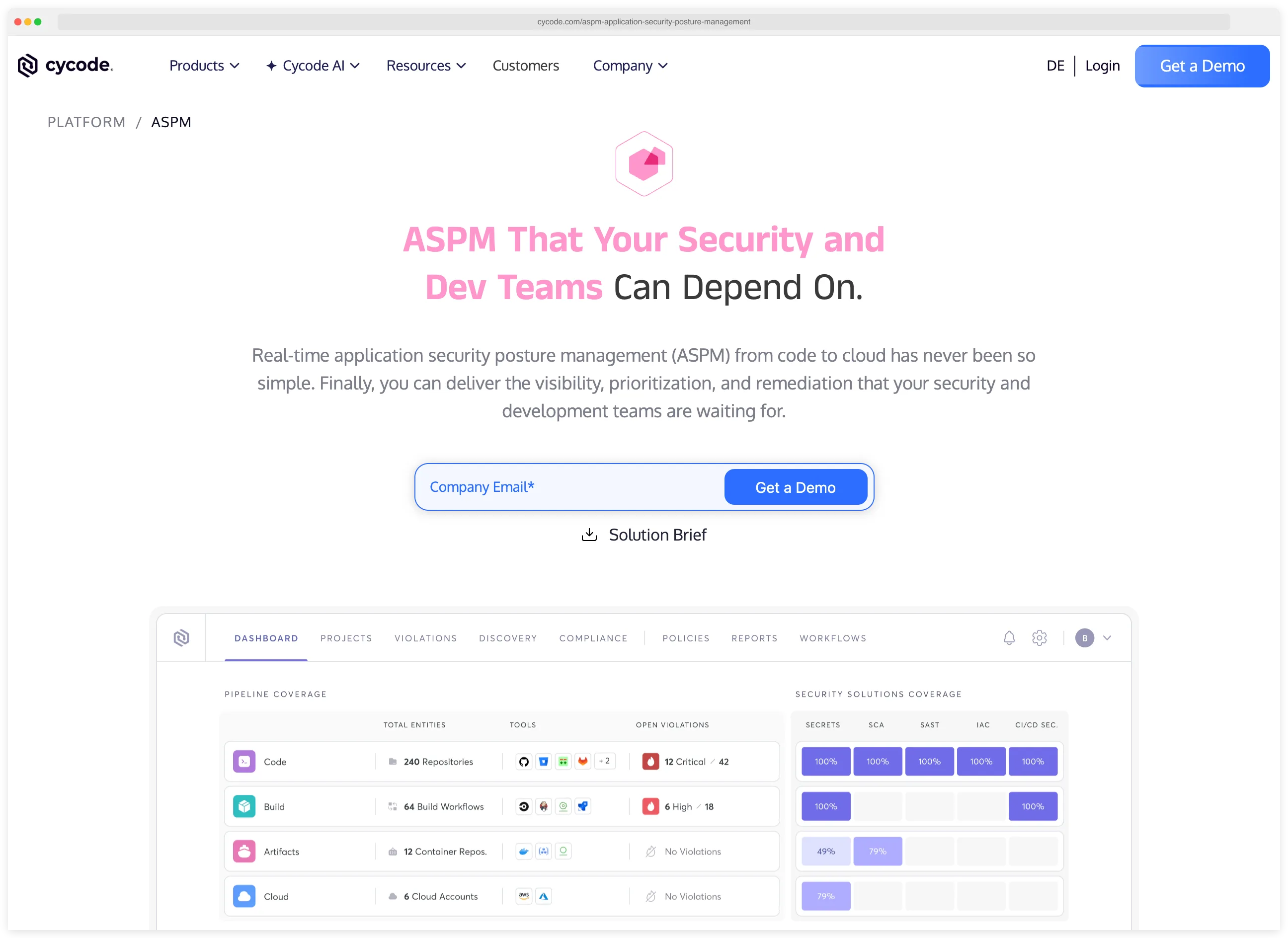
Gartner projects that 40 percent of organizations developing proprietary applications will deploy ASPM frameworks by 2026 (Gartner, Innovation Insight for Application Security Posture Management, 2023 ). For organizations in regulated industries, that figure rises to 80 percent by 2027.
Why does ASPM matter?#
The average enterprise development team runs between five and fifteen distinct security tools (industry estimate). Each tool produces its own findings in its own format with its own severity scale.
The result is alert fatigue, duplicated effort, and a security team that cannot answer a simple question: “What is the most important thing to fix right now?”
ASPM solves three specific problems:
Alert fatigue and deduplication. A single vulnerability in a shared library might trigger alerts in your SCA tool, your container scanner, and your IaC checker.
Without ASPM, a developer might receive three separate tickets for the same issue. ASPM correlates these into a single finding.
Context-aware prioritization. A critical CVE in a library that is only used in a test environment is not the same as a critical CVE in a library that handles payment processing in production.
ASPM combines vulnerability severity with business context, asset exposure, reachability analysis, and exploit intelligence to produce a risk score that reflects reality.
Governance and visibility. Security leaders need to report on posture across the entire application portfolio.
ASPM provides dashboards and metrics that show trends over time, team-level performance, compliance coverage, and mean time to remediation, all without manual spreadsheet aggregation.
What are the key ASPM capabilities?#
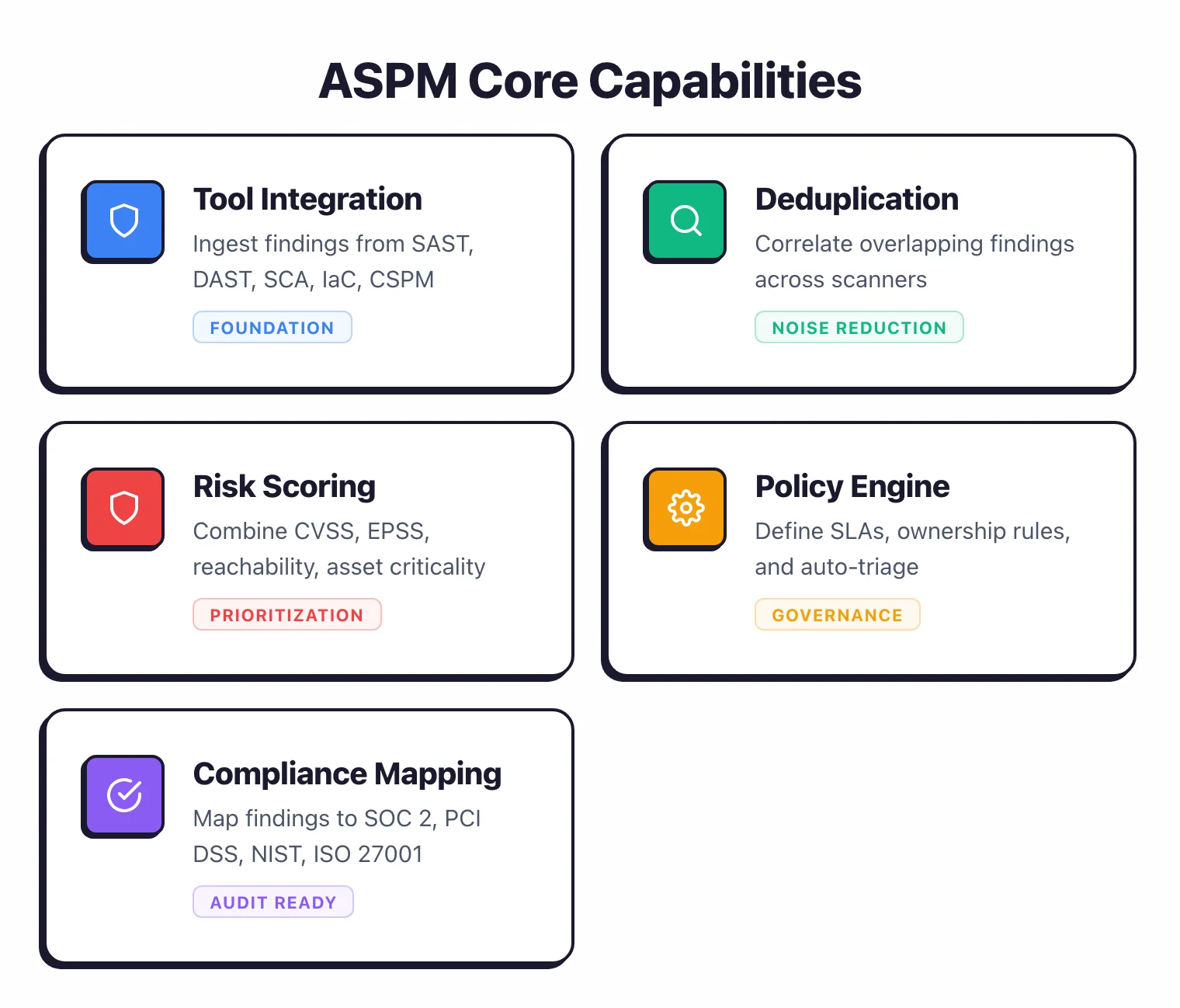
Not every ASPM platform offers the same depth. Here are the core capabilities to evaluate:
| Capability | What It Does | Why It Matters |
|---|---|---|
| Tool integration | Ingests findings from SAST, DAST, SCA, IaC, CSPM, container, secrets scanners | More integrations = more complete risk picture |
| Deduplication | Identifies overlapping findings from multiple tools | Reduces noise by 30-70% in most deployments (industry estimate based on vendor benchmarks) |
| Risk scoring | Combines CVSS, EPSS, reachability, asset criticality, and exploit data | Moves prioritization from severity to actual risk |
| Policy engine | Defines rules for SLAs, ownership, and auto-triage | Enforces consistent standards across teams |
| Developer workflow | Creates tickets in Jira, GitHub Issues, or Slack with remediation guidance | Keeps developers in their existing tools |
| Compliance mapping | Maps findings to SOC 2, PCI DSS, NIST, ISO 27001 | Simplifies audit evidence collection |
| SBOM management | Tracks software components across the portfolio | Supports supply chain transparency requirements |
The more mature platforms also offer attack-path analysis (tracing how a vulnerability could be exploited from the internet to sensitive data) and AI-assisted remediation suggestions that reduce the time developers spend researching fixes.
ASPM vs traditional tools#
ASPM is not a replacement for your existing security scanners. It sits on top of them.
Here is how it compares to the tools you already have:
| Aspect | Traditional AppSec Tools (SAST, SCA, DAST) | ASPM |
|---|---|---|
| Scope | Single vulnerability type or phase | Entire SDLC, all vulnerability types |
| Output | Raw findings with tool-specific severity | Correlated, deduplicated, risk-ranked findings |
| Prioritization | CVSS-based, no business context | Business impact, reachability, exploit data |
| Visibility | Per-tool dashboards | Portfolio-wide risk posture |
| Governance | Manual aggregation for reporting | Automated compliance mapping and SLA tracking |
| Remediation | Developer must switch between tool UIs | Unified workflow with ticket creation and tracking |
The analogy that works best: traditional AppSec tools are individual security cameras. ASPM is the monitoring room where all feeds come together and an operator can focus on what actually requires attention.
One common question is whether ASPM overlaps with CSPM (Cloud Security Posture Management). CSPM focuses on cloud infrastructure misconfigurations (S3 buckets, IAM policies, network rules).
ASPM focuses on application-level vulnerabilities (code flaws, dependency risks, API weaknesses). Some vendors are merging both under broader posture management platforms, but the focus areas remain distinct.
The other common confusion is with ASOC, the label Gartner used before retiring it in 2023 — I trace that evolution in ASPM vs ASOC .
Getting started#
Adopting ASPM requires preparation. Here is a practical path:
Inventory your current tools. List every security scanner you run, the vulnerability types it covers, and where in the SDLC it sits. This becomes your integration checklist.
If you are running fewer than three tools, ASPM may be premature.
Define your risk model. Decide what “critical” means for your organization. Which applications handle sensitive data? Which are internet-facing?
Which serve revenue-generating functions? ASPM needs this business context to prioritize effectively.
Start with integration, not replacement. Connect your existing scanners to the ASPM platform. Do not rip out tools you already use.
The value of ASPM comes from correlation across tools, and that only works if the tools are feeding data in.
Establish ownership and SLAs. ASPM is most effective when every finding has a clear owner and a remediation deadline.
Map applications to teams, set SLA targets by severity, and let the ASPM platform enforce them.
Iterate on triage rules. The first week will surface noise. Tune your deduplication rules, suppress confirmed false positives, and adjust risk weights.
Most teams reach a stable configuration within the first month.
Measure progress. Track mean time to remediation, open vulnerability counts by severity, and SLA compliance rates.
ASPM gives you these metrics automatically. Use them to demonstrate value and justify continued investment.