
How AppSec tool pricing actually works#
Tool budgets are one slice of a broader application security program , and pricing ranges from free open-source scanners to $500,000+ enterprise platforms. Most organizations spend between $30,000 and $150,000 annually for a mid-market AppSec stack.
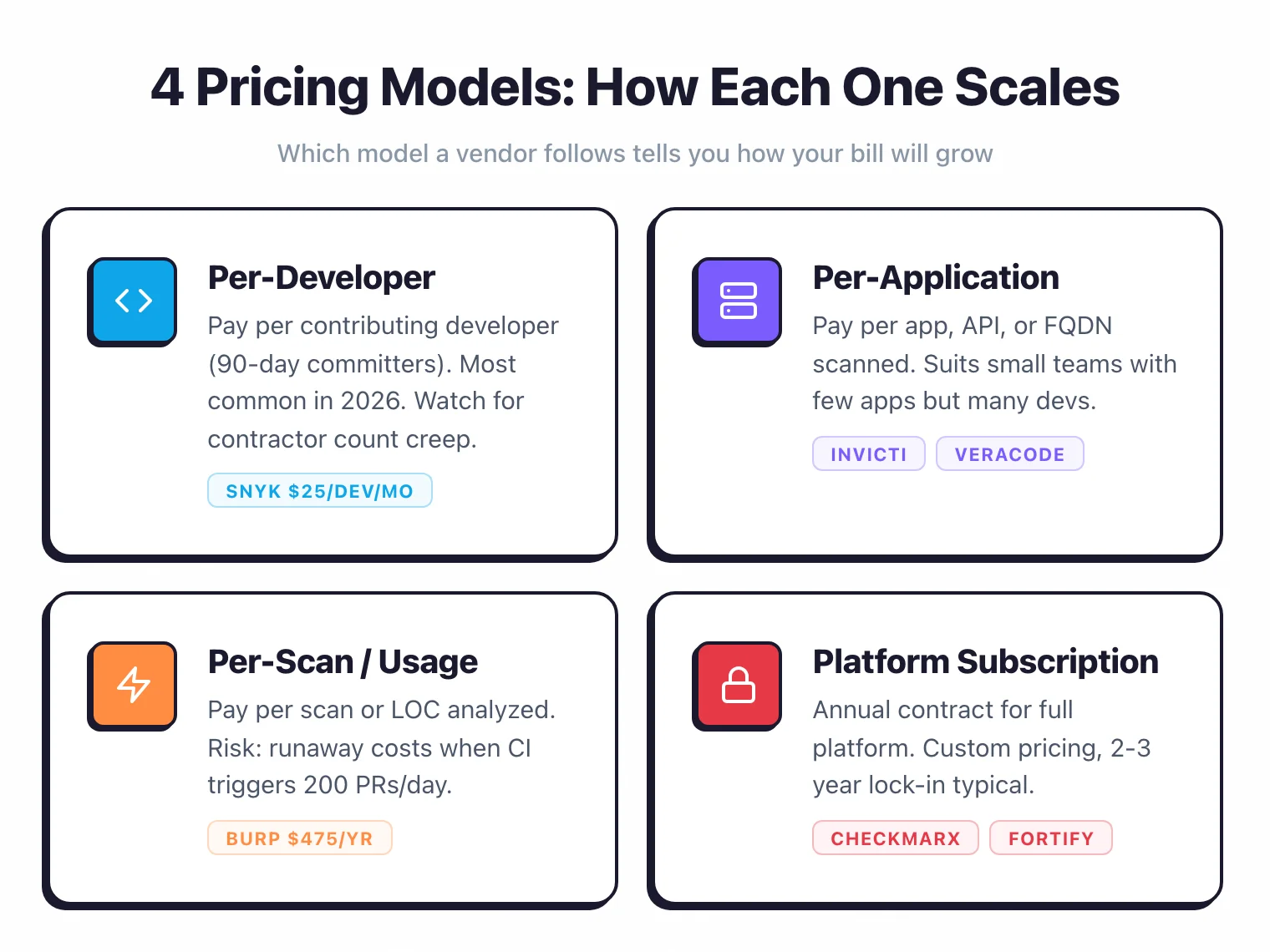
AppSec vendors use four main pricing models. Which one a vendor follows tells you a lot about how your bill will grow over time.
Per-developer (per-seat) pricing#
You pay based on “contributing developers” – usually anyone who committed to a monitored repo in the last 90 days. This is the most common model in 2026.
Snyk uses this approach, starting at $25/developer/month on the Team plan . The median Snyk annual contract is $45,000 — enterprise deals range from $15,000 to $182,000 depending on developer count and modules selected.
The trap here is developer count creep. Contractors, part-time contributors, and open-source contributors can inflate your headcount.
Some vendors count unique committers across all repos, so a developer working on three projects still counts as one seat. Others count differently. Ask before you sign.
This model works well if you have a large application portfolio but a relatively small development team.
Per-application pricing#
You pay based on the number of applications, APIs, or targets you scan. This is common in DAST and some SAST products.
Veracode and Invicti follow this model. Neither publishes list prices, so exact costs require a sales conversation.
Invicti prices by the number of FQDNs (fully qualified domain names) in your scanning scope.
The tricky part is how the vendor defines “application.” Some count each microservice separately. Others treat a monorepo with 12 services as one application. Get this clarified in writing before signing.
This model suits smaller teams with few applications but many developers contributing to each one.
Per-scan or usage-based pricing#
You pay based on scanning volume: number of scans, lines of code analyzed, or scanning hours consumed.
Some vendors price by lines of code or scanning volume. Burp Suite Professional costs ~$499/year per user .
Beagle Security charges only for tests run, not targets managed.
The risk is runaway costs when scanning is automated. If your CI pipeline triggers a scan on every pull request and you process 200 PRs per day, usage-based pricing gets expensive fast.
This model works for organizations with variable scanning needs or teams that are just getting started and want to keep initial costs low.
Platform subscription#
An annual or multi-year subscription for a full security platform, usually with tiered plans (Essentials, Professional, Enterprise).
Checkmarx One, Fortify, and most ASPM vendors follow this model. Pricing is custom and negotiated with sales.
None of these vendors publish list prices, so expect a sales conversation to get a quote.
The downside is lock-in. Platform subscriptions often come with 2-3 year commitments and auto-renewal clauses. Read the termination terms before you commit.
This model makes sense for enterprises that want a single platform covering SAST, SCA, DAST, and IaC scanning.
Price ranges by category#
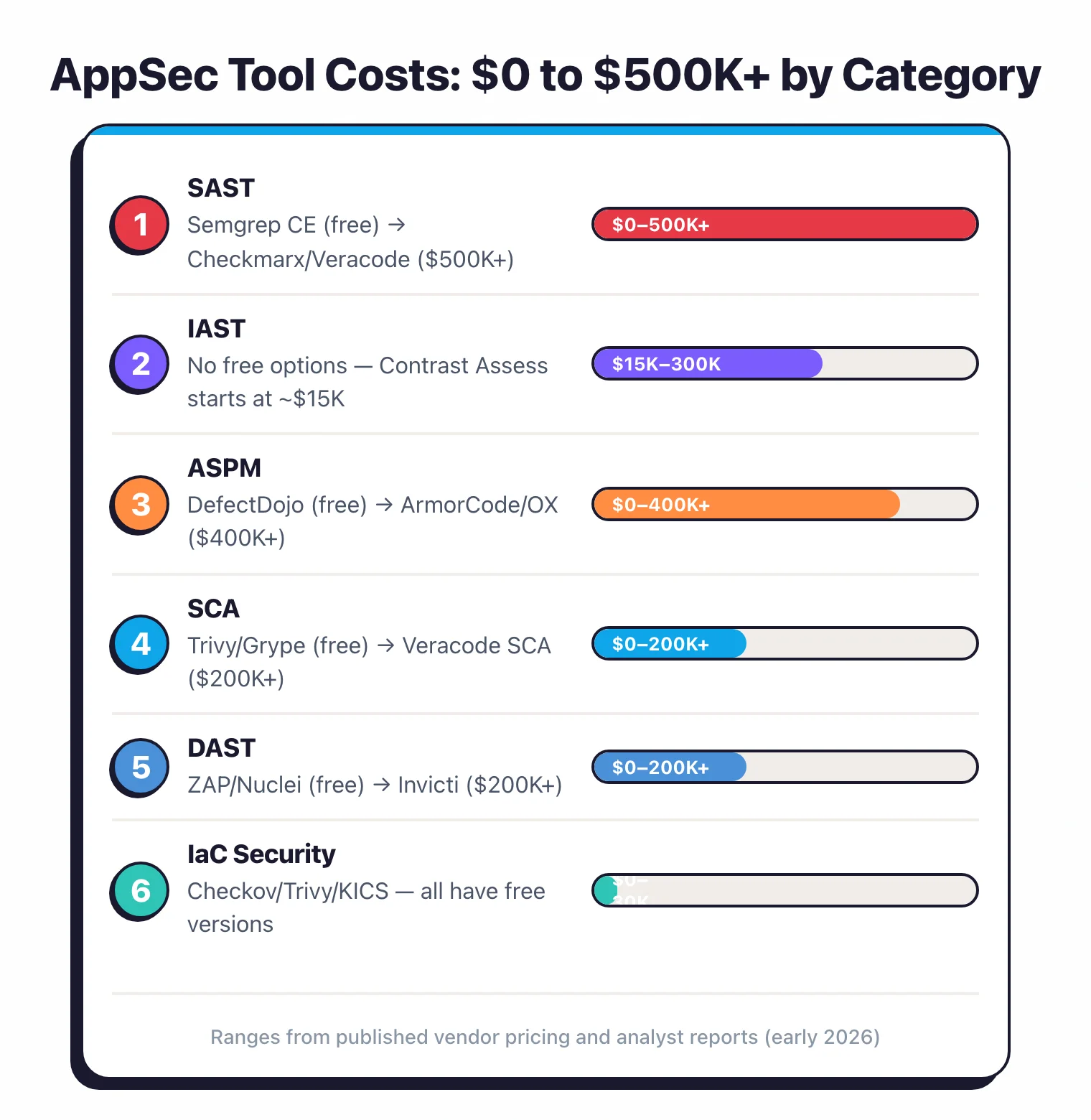
The ranges below come from published pricing, vendor disclosures, analyst reports, and Vendr marketplace data as of early 2026. Your actual price will vary depending on organization size, scope, and how hard you negotiate.
SAST (Static Application Security Testing)#
| Tier | Annual Cost | Examples |
|---|---|---|
| Free / Open-Source | $0 | Semgrep CE , Bandit , SpotBugs , PMD |
| Mid-Market | $10,000 - $60,000 | Snyk Code , SonarQube Developer , Qodana |
| Enterprise | $50,000 - $500,000+ | Checkmarx , Veracode Static Analysis , Fortify |
Snyk Code is included in Snyk’s per-developer pricing. Checkmarx One and Veracode pricing is entirely custom and requires a sales conversation. The median annual contract is $54,000 for Checkmarx and $19,000 for Veracode, though enterprise deployments commonly reach six figures.
SCA (Software Composition Analysis)#
| Tier | Annual Cost | Examples |
|---|---|---|
| Free / Open-Source | $0 | Trivy , Grype , OWASP Dependency-Check |
| Mid-Market | $5,000 - $40,000 | Snyk Open Source , Dependabot , Socket |
| Enterprise | $30,000 - $200,000+ | Veracode SCA , Mend SCA , Sonatype Lifecycle |
SCA pricing often bundles with SAST from the same vendor. Veracode and Mend use custom pricing that requires a sales conversation.
The median Mend annual contract is $96,000 (range: $11,000–$177,000). GitHub’s Dependabot is free for all GitHub repositories .
DAST (Dynamic Application Security Testing)#
| Tier | Annual Cost | Examples |
|---|---|---|
| Free / Open-Source | $0 | ZAP , Nuclei , Nikto , Wapiti |
| Mid-Market | $5,000 - $50,000 | StackHawk , Burp Suite Pro (~$499/user/year) |
| Enterprise | $30,000 - $200,000+ | Invicti , Veracode DAST , Qualys WAS |
Burp Suite Professional costs ~$499/year per user and is the standard for manual penetration testers. Invicti and Veracode DAST use custom enterprise pricing. StackHawk’s Pro plan runs $42/contributor/month.
IAST (Interactive Application Security Testing)#
| Tier | Annual Cost | Examples |
|---|---|---|
| Mid-Market | $18,000 - $60,000 | Contrast Assess |
| Enterprise | $60,000 - $300,000+ | Seeker IAST , Fortify WebInspect |
IAST is almost exclusively commercial. There are no widely-adopted open-source IAST tools.
Pricing typically follows per-application or per-server models. The median Contrast Security annual contract is $36,000 (range: $18,000–$148,000)
RASP (Runtime Application Self-Protection)#
| Tier | Annual Cost | Examples |
|---|---|---|
| Mid-Market | $10,000 - $40,000 | Contrast Protect , Hdiv |
| Enterprise | $40,000 - $200,000+ | Imperva RASP , Waratek |
Like IAST, RASP is dominated by commercial vendors. The only notable open-source option, OpenRASP , has been deprecated.
IaC Security#
IaC security is the friendliest category for budget-conscious teams. All six tools we track have free versions, and four are fully open-source.
ASPM (Application Security Posture Management)#
| Tier | Annual Cost | Examples |
|---|---|---|
| Mid-Market | $20,000 - $80,000 | DefectDojo , Faraday |
| Enterprise | $80,000 - $400,000+ | ArmorCode , Invicti , OX Security |
ASPM pricing is almost always custom. Most vendors price per developer and require an annual contract with a sales conversation to get a quote. Median annual contracts: $70,000 for Cycode and $55,000 for Apiiro.
Which AppSec tools are free and open-source?#
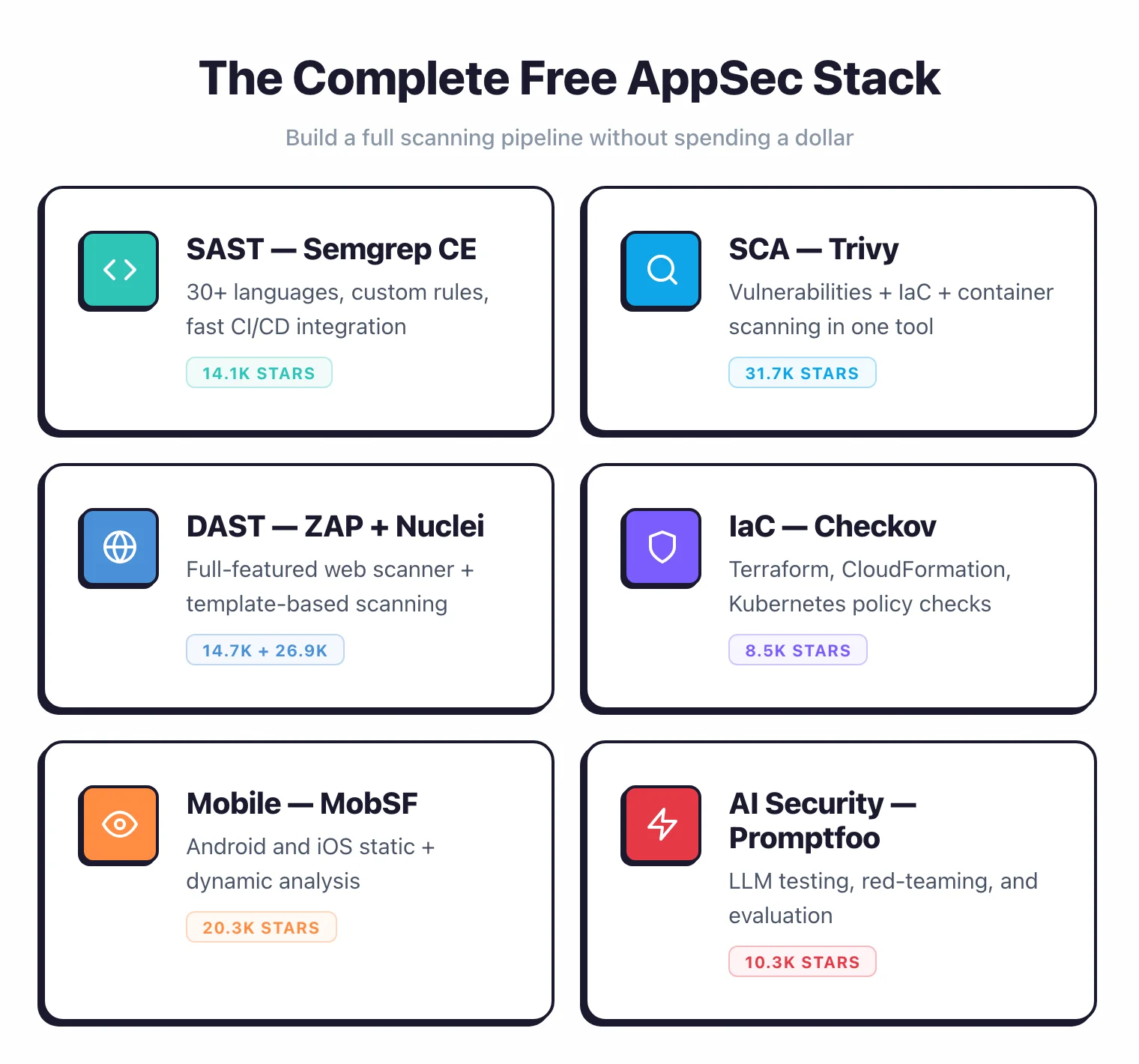
You can build a functional AppSec scanning pipeline without spending anything. Here is a free tool stack covering the core categories:
| Category | Free Tool | GitHub Stars | Notes |
|---|---|---|---|
| SAST | Semgrep | 14,100 | Supports 30+ languages, custom rules |
| SAST (Python) | Bandit | 7,800 | Python-specific, fast |
| SAST (Go) | Gosec | 8,700 | Go-specific |
| SAST (Ruby) | Brakeman | 7,200 | Rails-specific |
| SCA | Trivy | 31,700 | Also covers IaC and container scanning |
| SCA | Grype | 11,500 | Fast vulnerability matching |
| SCA | OWASP Dependency-Check | 7,400 | Mature, Java-focused |
| DAST | ZAP | 14,700 | Full-featured web scanner |
| DAST | Nuclei | 26,900 | Template-based, community-driven |
| IaC | Checkov | 8,500 | Terraform, CloudFormation, Kubernetes |
| IaC | Terrascan | 5,200 | Multi-cloud IaC scanning |
| Mobile | MobSF | 20,300 | Android and iOS analysis |
| ASPM | DefectDojo | 4,500 | Vulnerability management platform |
| AI Security | Promptfoo | 10,300 | LLM testing and red-teaming |
The gap is in IAST, RASP, and enterprise API security, where open-source options are limited or nonexistent.
What hidden costs do most buyers miss?#
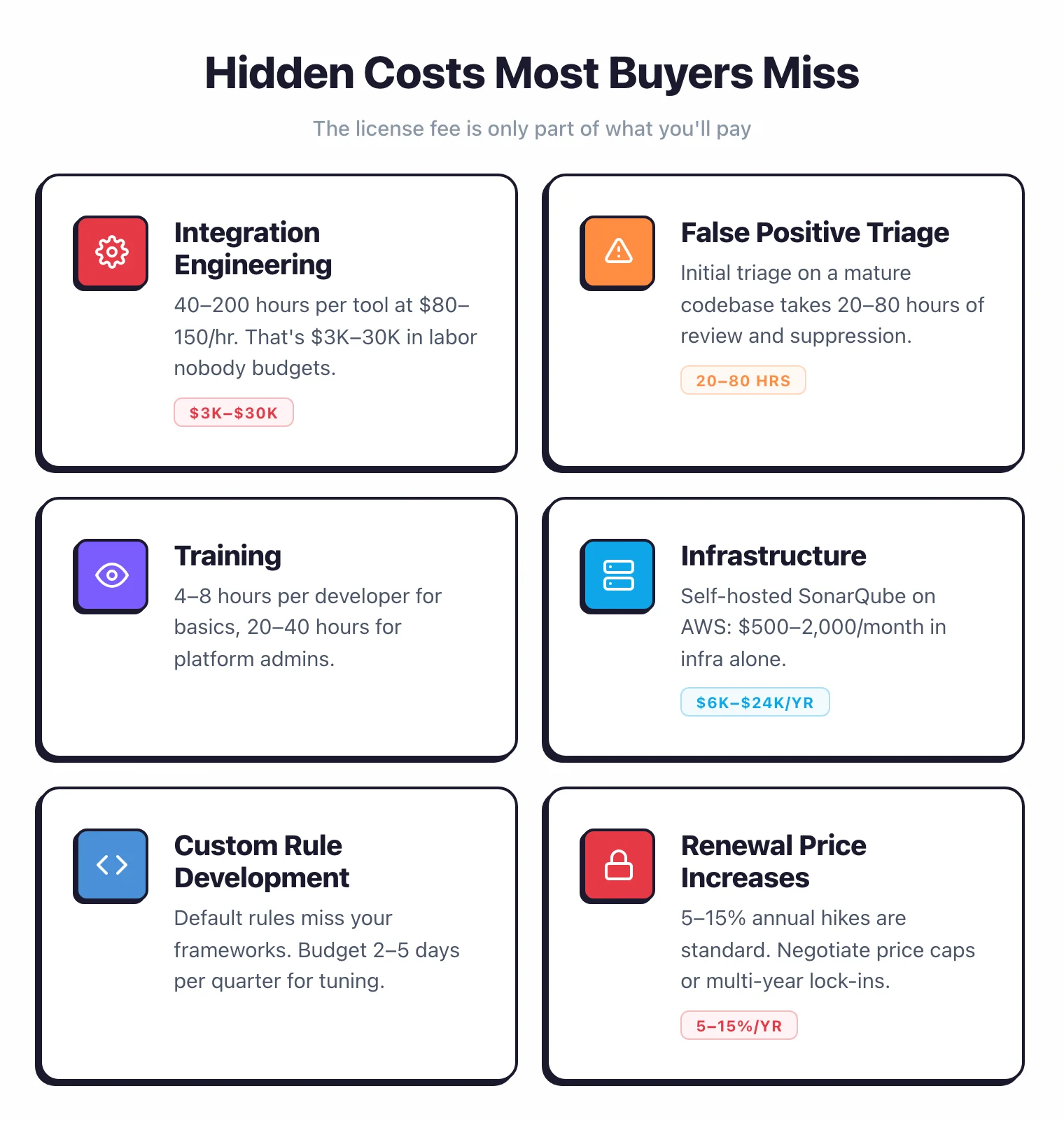
The license fee is only part of what you will pay. These costs catch first-time buyers off guard.
Implementation and integration#
Setting up a commercial tool takes 2 weeks to 3 months depending on your CI/CD complexity. Expect 40-200 hours of engineering time on integration.
At a loaded cost of $80-$150/hour, that is $3,200-$30,000 in labor per tool, and nobody ever budgets for it.
Training#
Developers and security teams need time to learn the tool. Budget 4-8 hours per person for basic proficiency and 20-40 hours for whoever will administer the platform.
Some vendors charge separately for training; others bundle it with onboarding.
False positive triage#
Every scanning tool produces false positives. Someone has to review, triage, and suppress them.
From our experience reviewing SAST tools and DAST tools , the initial triage on a mature codebase takes 20-80 hours.
Commercial tools have lower false positive rates than open-source alternatives, but “lower” still means hundreds of findings on a large application.
Infrastructure costs#
Self-hosted tools need servers, storage, and ongoing maintenance. A SonarQube Enterprise deployment on AWS typically runs $500-$2,000/month in infrastructure costs alone.
Cloud-hosted tools avoid this expense but may create data residency concerns.
Custom rule development#
Default rules catch common vulnerabilities, but your organization’s specific patterns, frameworks, and business logic need custom rules. Budget 2-5 days per quarter for rule tuning once the tool is running.
Renewal price increases#
Most vendors raise prices 5-15% at renewal. Multi-year contracts lock in pricing but reduce your flexibility to switch. Ask about price caps in the contract.
Budget recommendations by team size#
Startup (5-15 developers)#
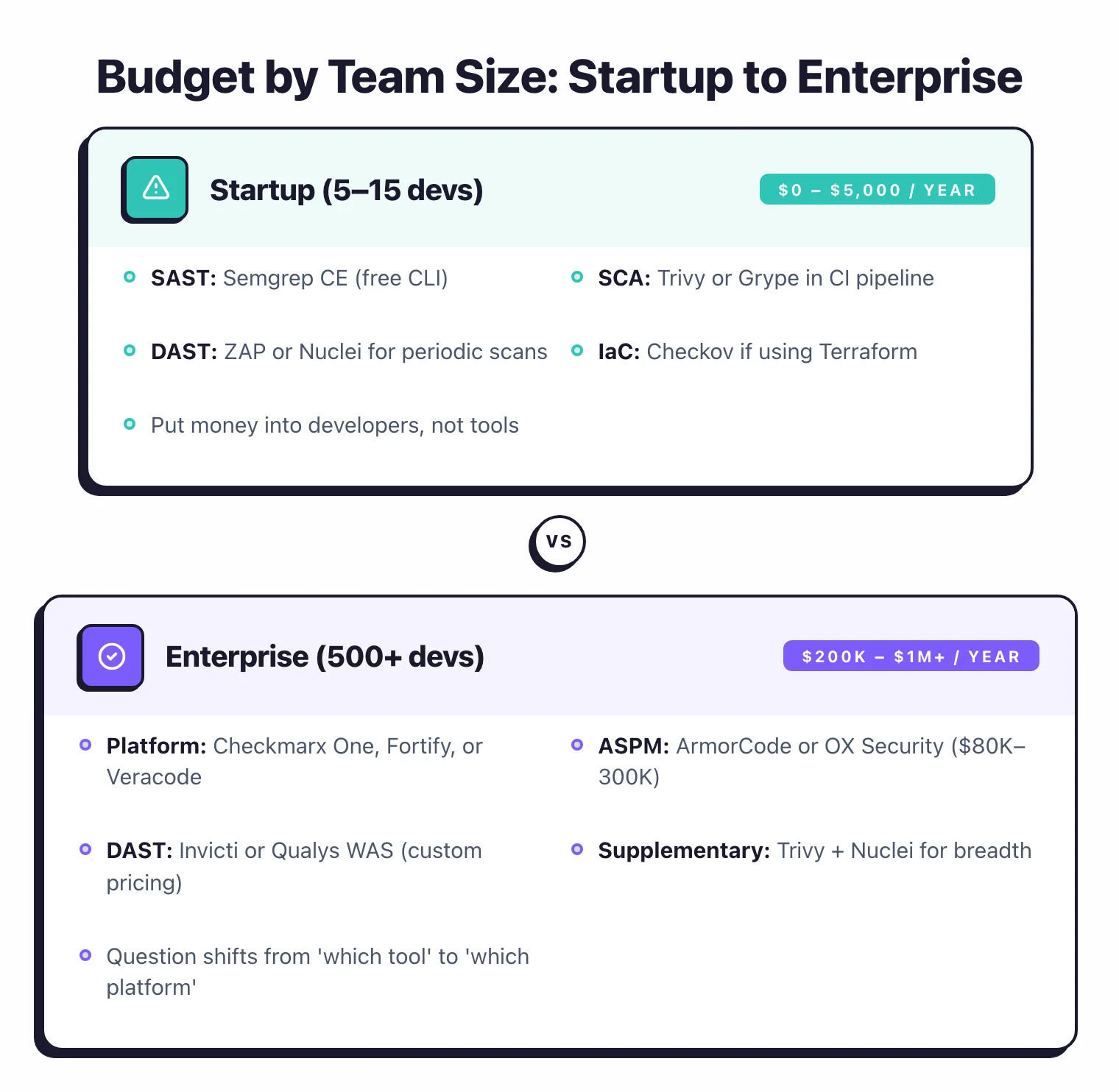
Recommended annual budget: $0 - $5,000
At this stage, put your money into developers, not tools. Use free and open-source options:
- SAST: Semgrep CE (free CLI)
- SCA: Trivy or Grype in your CI pipeline
- DAST: ZAP or Nuclei for periodic scans
- IaC: Checkov if you use Terraform or CloudFormation
The only commercial investment worth considering at this stage is Snyk Free tier (up to 5 users) or GitHub’s native security features (Dependabot , CodeQL).
Mid-market (50-200 developers)#
Recommended annual budget: $30,000 - $150,000
At this scale, you need centralized reporting, policy enforcement, and lower false-positive rates. A typical stack looks like this:
- SAST: Snyk Code or SonarQube Developer ($10,000-$40,000)
- SCA: Snyk Open Source or Mend SCA ($10,000-$30,000)
- DAST: StackHawk or Burp Suite Enterprise ($5,000-$30,000)
- IaC: Keep using Checkov or add Snyk IaC as part of a Snyk bundle
Bundle discounts matter here. Snyk, Checkmarx, and Veracode all offer platform bundles that are 20-40% cheaper than buying individual products.
Enterprise (500+ developers)#
Recommended annual budget: $200,000 - $1,000,000+
At this level, the buying decision shifts toward full-platform solutions:
- Platform: Checkmarx One , Fortify , or Veracode (custom enterprise pricing)
- ASPM: ArmorCode , Invicti ASPM , or OX Security ($80,000-$300,000)
- DAST: Invicti or Qualys WAS for web app coverage (custom enterprise pricing)
- Supplementary: Open-source tools like Trivy and Nuclei for breadth
At enterprise scale, the question changes from “which tool” to “which platform” and “how do we consolidate.” ASPM becomes a practical necessity for managing findings across multiple scanners.
ROI and TCO: when does an AppSec tool pay for itself?#
The question every CFO asks: at what spend level does this tool stop being a cost centre? The answer is a function of three numbers — the tool’s annual licence, the engineering hours it removes, and the cost of a breach it would have prevented.
The IBM 2024 Cost of a Data Breach report puts the global average cost of a single breach at $4.88 million, with US figures running materially higher. You do not need to assume a single tool prevents an entire breach to justify the spend. Use a simple expected-value framing:
ROI = (P_breach_avoided × cost_of_breach) + eng_hours_saved × loaded_rate − tool_licence
P_breach_avoided is small per tool — single-digit percentages — but the right-hand side is so large that even modest reductions clear the licence cost for most enterprises. The escape rate metric in the AppSec metrics guide is the cleanest input here: a tool that lowers your production-escape rate by two findings per quarter has saved real eng time even before you book any breach-prevention credit.
For TCO, do not stop at the licence number. Add the four hidden cost lines from the section above (FP triage, integration, training, scan-time) and a fifth: the operational cost of running the tool in CI — minutes of pipeline time, multiplied by your runner spend, multiplied by deploys per day. On a fast-moving monorepo, that line item alone can rival the licence cost. Teams that consolidate scanners through an ASPM platform often find the dedup and orchestration savings cover the ASPM licence and then some.
Negotiation tips#
Timing matters#
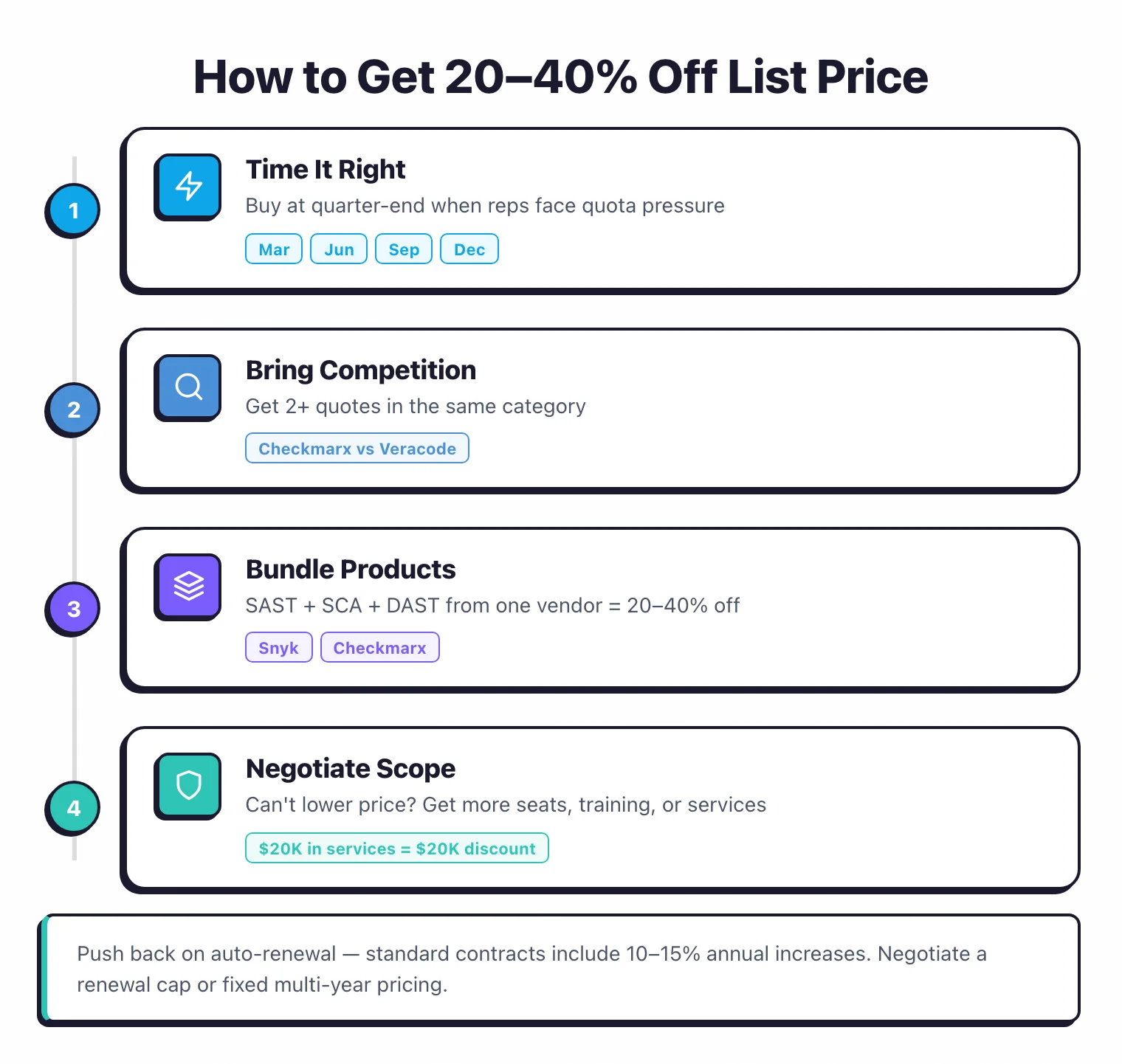
Software companies run on quarterly or annual sales cycles. Sales reps face quota pressure at the end of each quarter (March, June, September, December), and the pressure doubles at fiscal year-end.
Reach out in the last two weeks of a quarter and you will get better pricing than mid-quarter.
Bring competition to the table#
Get quotes from at least two vendors in the same category. Mention the competing offer.
A Checkmarx sales team will sharpen their pencil when they know you are also evaluating Veracode, and vice versa.
Bundle for discounts#
Vendors want platform deals. If you are buying SAST and also need SCA, negotiate both together.
Bundle discounts typically range from 20-40% off list price. Snyk, Checkmarx, and Veracode all offer multi-product bundles.
Ask about startup programs#
Many vendors have discounted programs for companies under a certain revenue threshold or headcount. Snyk, Semgrep, and several ASPM vendors offer startup-friendly tiers that are not listed on their pricing pages. You have to ask the sales rep directly.
Push back on auto-renewal#
Standard contracts often include automatic renewal at the new list price, which may be 10-15% higher than what you originally signed. Negotiate a renewal cap (e.g., maximum 5% annual increase) or go for a multi-year deal with fixed pricing.
Negotiate scope, not just price#
If the vendor will not lower the number, negotiate for more value instead: additional seats, extended support hours, professional services for onboarding, or access to premium features. Getting $20,000 in professional services included is the same as a $20,000 discount.
* Pricing data from Vendr — anonymized contract values from real buyer transactions.