
Dependabot Alternatives
Top GitHub Dependabot Alternatives

Renovate-powered SCA + Agentic SAST in one platform
CycloneDX SBOM generator for 20+ languages

Fast Container Vulnerability Scanner
SBOM generation tool
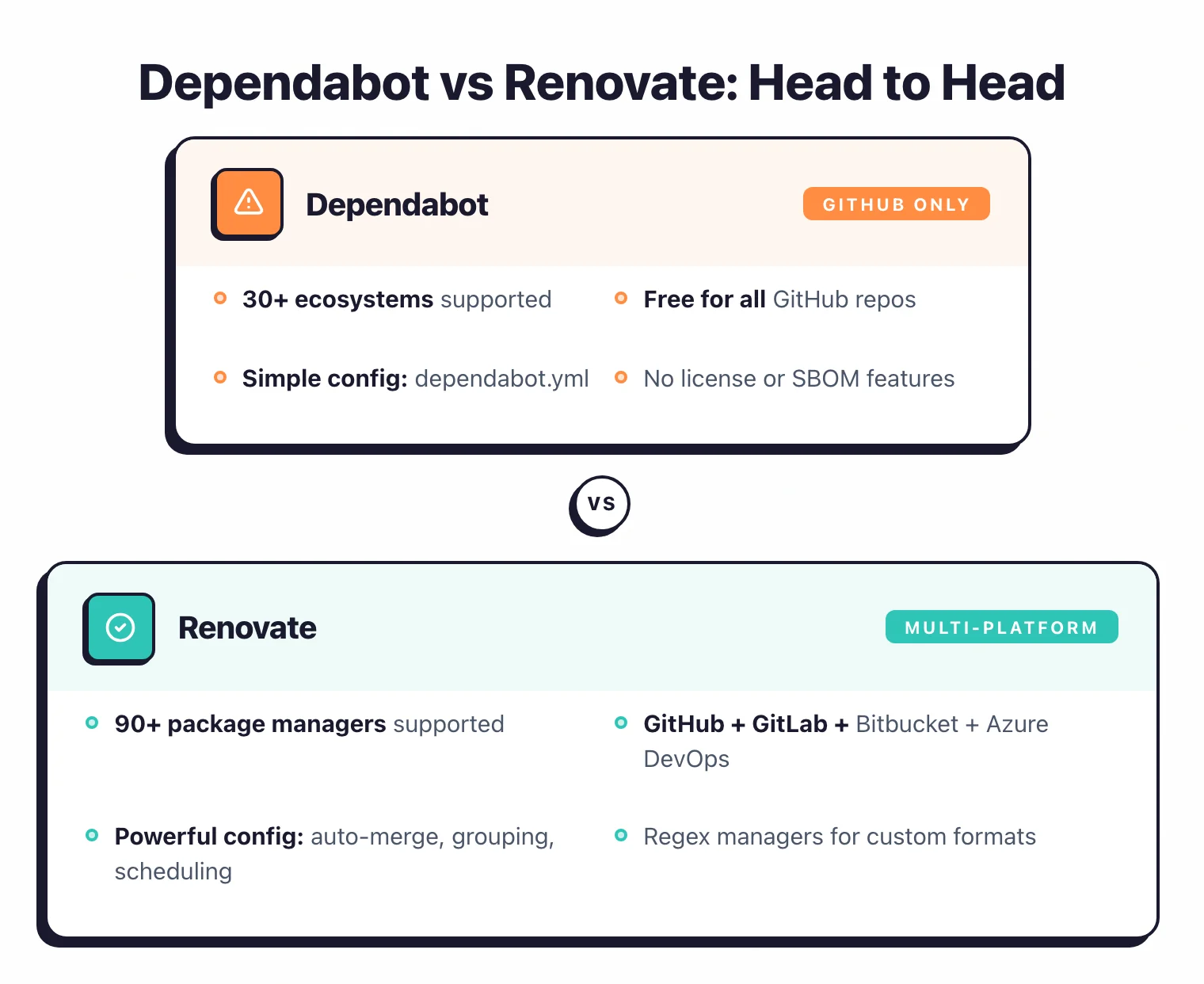
- Dependabot is free on GitHub with 30+ ecosystems and over 23,000 reviewed advisories, but only works on GitHub — no GitLab, Bitbucket, or Azure DevOps support.
- Renovate supports 90+ package managers across GitHub, GitLab, Bitbucket, Azure DevOps, and Gitea with advanced grouping, automerge, and shared config presets.
- According to Snyk, its proprietary database catches CVEs an average of 47 days before NVD and offers reachability analysis for Java, JavaScript, and Python; free tier caps at 200 tests/month.
- Socket detects malicious packages through behavioral analysis of install scripts and network access — threats that CVE-based tools like Dependabot miss entirely.
- Endor Labs reports up to 97% noise reduction (92% average) through function-level reachability analysis across 40+ languages; Dependabot has no reachability or risk scoring beyond CVSS.
The best Dependabot alternatives in 2026 are Renovate, Snyk, Socket, and Endor Labs — each adding capabilities like reachability analysis, malicious package detection, or multi-platform support that Dependabot lacks.
Why Look for Dependabot Alternatives?#
GitHub Dependabot is one of the most widely used SCA tools in the world, configured on over 846,000 repositories. It is free for every GitHub repository with no usage limits.
It covers 30+ package ecosystems, opens automated pull requests for both security and version updates, and uses the GitHub Advisory Database with its over 23,000 reviewed advisories.
For a built-in, zero-cost tool, the value is hard to argue with.
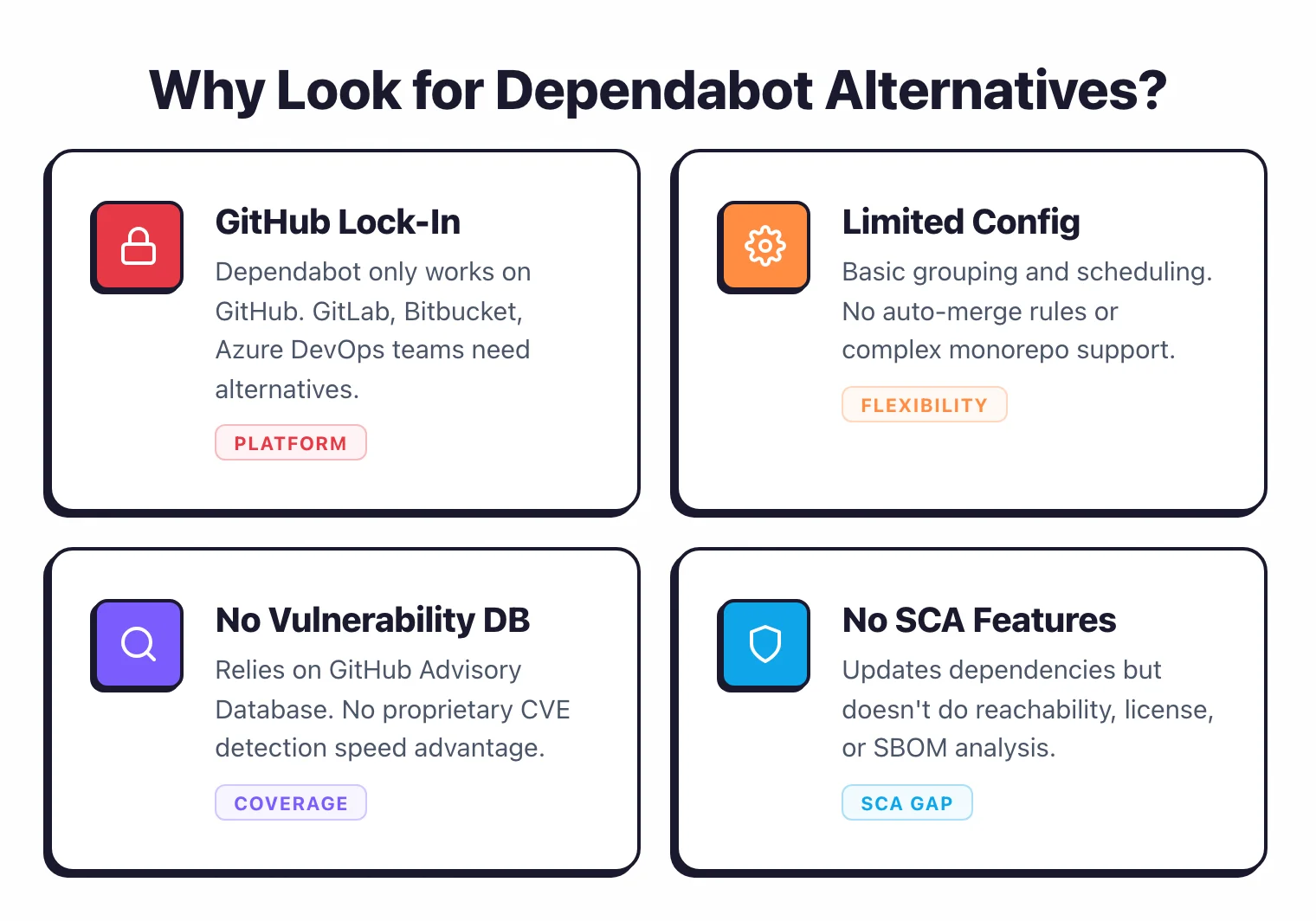
The problem is that Dependabot only works on GitHub. If your organization uses GitLab, Bitbucket, or Azure DevOps for even a portion of its repositories, Dependabot cannot help with those.
There is no self-hosted option, no CLI you can run in a different environment, and no API you can integrate outside the GitHub ecosystem.
Teams with multi-platform setups end up running a different SCA tool alongside Dependabot anyway, which raises the question of whether consolidating on one tool would be simpler.
Beyond platform lock-in, Dependabot has some real functional gaps. It does not perform reachability analysis, so it cannot tell you whether a vulnerable function is actually called in your code.
There is no license compliance scanning. Malicious package detection is limited to what the GitHub Advisory Database covers, with no behavioral analysis of package contents.
Configuration options are noticeably thinner than what Renovate provides. Dependabot cannot group updates by package type with different scheduling rules, cannot use regex managers to scan custom file formats, and does not support shared configuration presets across an organization’s repositories.
And when it comes to prioritization, Dependabot gives you severity labels from the advisory database. That is it.
No risk scoring, no exploitability context, no business impact weighting. For small teams with a handful of GitHub repositories, none of this matters much.
For organizations managing hundreds of repositories across platforms, these gaps compound quickly.
Pick your next step
Read the closest drop-in replacement
Renovate review — 90+ package managers across GitHub, GitLab, Bitbucket, Azure DevOps, with deeper grouping and automerge.
→Compare alternatives by vendor lens
Looking past Snyk too? See 6 commercial SCA platforms with reachability scoring and license compliance built in.
→Add a self-hosted scanner
12 free SCA tools — Trivy, Grype, OSV-Scanner — that pair with Dependabot or Renovate for deeper vuln coverage.
→Top Dependabot Alternatives#
1. Renovate#
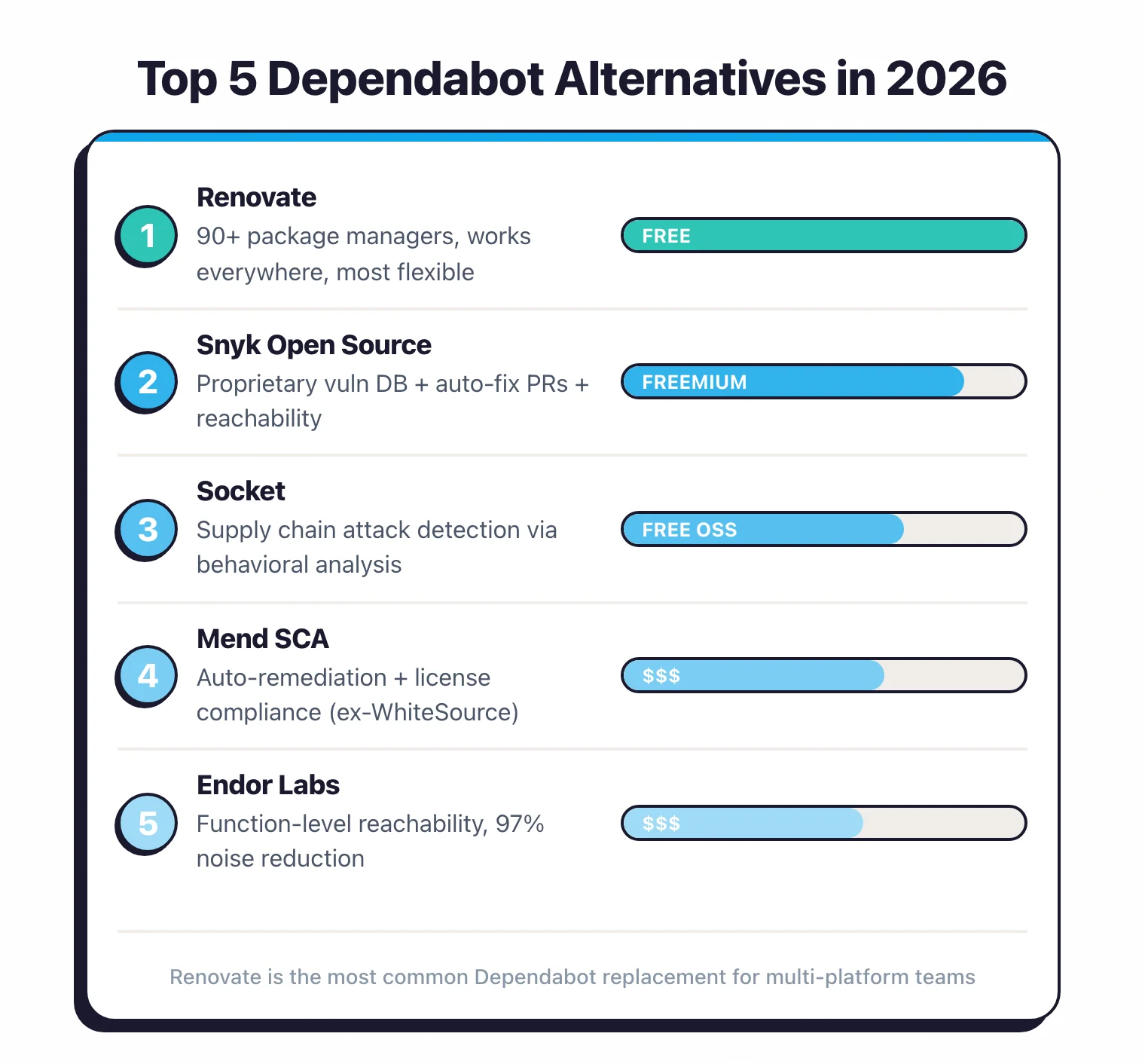
Renovate is the most direct alternative to Dependabot for automated dependency updates. It is open-source under AGPL-3.0 and runs on GitHub, GitLab, Bitbucket, Azure DevOps, Gitea, and Forgejo.
Mend (formerly WhiteSource) maintains the project and offers a free hosted app for GitHub and GitLab, though you can also self-host it.
Where Renovate pulls ahead is configuration depth. You can define update rules per package, per manager, per repository, or across your entire organization through shared presets.
Regex managers let you scan custom file formats like Dockerfiles with non-standard version pinning or Terraform modules with embedded version strings. Grouping is more flexible too.
You can batch minor and patch updates together while keeping major updates separate, set different schedules for different dependency types, and configure automerge for trusted packages with passing tests.
Dependabot added grouped updates in 2023, but the implementation is still less granular than what Renovate has offered for years.
The tradeoff is complexity. Renovate’s configuration file can grow large for organizations with detailed rules.
The learning curve is steeper than dropping a dependabot.yml into .github/. But for teams that have outgrown Dependabot’s configuration model or need to standardize dependency management across multiple Git platforms, Renovate is the tool most teams land on.
Best for: Teams on any Git platform that want advanced control over dependency update automation. License: Open-source (AGPL-3.0) Key difference: Multi-platform support (GitHub, GitLab, Bitbucket, Azure DevOps). Far more granular scheduling, grouping, and automerge controls.
Renovate review · Visit Renovate’s official site →
2. Snyk Open Source#
Snyk Open Source goes further than dependency updates. It scans your projects for known vulnerabilities, opens automated fix pull requests, and continuously monitors your dependencies for newly disclosed issues.
It works with GitHub, GitLab, Bitbucket, Azure DevOps, and essentially any CI/CD system through its CLI.
The main differentiator is Snyk’s proprietary vulnerability database. According to Snyk, its research team identifies and documents CVEs an average of 47 days before they show up in public databases like NVD or the GitHub Advisory Database.
For organizations where early patching is critical, that lead time matters. Snyk also offers reachability analysis for Java, JavaScript, and Python, which filters out vulnerabilities in functions your application never calls.
This reduces alert noise, though coverage is still limited to three languages.
The free tier caps at 200 tests per month, which is enough for individual developers or small teams but not for organizations scanning dozens of repositories. Paid plans scale with project count and contributors.
Compared to Dependabot’s unlimited free usage on GitHub, the cost can be a sticking point.
But Snyk covers more ground: richer vulnerability data, multi-platform support, reachability analysis, container scanning, and license compliance on paid plans. It is a different class of tool.
Best for: Teams that want a richer vulnerability database with automated fix PRs across multiple platforms. License: Freemium Key difference: Proprietary database catches CVEs an average of 47 days earlier than public sources, according to Snyk. Reachability analysis for Java, JavaScript, and Python. Multi-platform support.
Snyk Open Source review · Visit Snyk Open Source →
3. Grype#
Grype is a fast, lightweight vulnerability scanner from Anchore. It scans container images, filesystems, directories, and SBOMs against multiple vulnerability databases including NVD, GitHub Advisories, and Alpine SecDB.
Scans complete in seconds even for large container images. The tool outputs in JSON, table, CycloneDX, and SARIF formats, making it easy to integrate into CI/CD pipelines.
Grype pairs with Syft, Anchore’s SBOM generator, for a complete open-source scanning pipeline. You generate an SBOM with Syft, scan it with Grype, and feed the results into your CI/CD system.
The combination covers container images, language-specific packages, and operating system packages in a single workflow.
What Grype does not do is open pull requests, monitor dependencies continuously, or provide a web dashboard. It is a scanner, not a dependency management platform.
If you are using Dependabot today because you want automated update PRs, Grype alone will not replace that workflow.
But for teams whose primary need is scanning container images and build artifacts for vulnerabilities, Grype does it faster and with broader database coverage than Dependabot’s GitHub Advisory Database.
Some teams run Grype for scanning and Dependabot or Renovate for update automation.
Best for: Container-heavy teams that need fast CLI-based vulnerability scanning. License: Open-source (Apache 2.0) Key difference: Built for container image and filesystem scanning. Pairs with Syft for SBOM generation. No update PRs or continuous monitoring.
Grype review · Visit Grype’s project page →
4. Socket#
Socket approaches SCA from a different angle entirely. Rather than matching dependency versions against CVE databases the way Dependabot and most other tools do, Socket analyzes what packages actually do.
It inspects install scripts, network access patterns, filesystem operations, environment variable reads, and other behaviors to detect malicious packages, typosquatting, and compromised maintainer accounts.
This behavioral approach catches threats that CVE-based scanners miss entirely. A newly published malicious package has no CVE.
A compromised maintainer pushing a backdoored update will not trigger a vulnerability alert until someone discovers and reports it. Socket catches these scenarios by flagging suspicious behavior regardless of whether an advisory exists.
The platform also performs traditional CVE matching, but behavioral analysis is its defining capability.
Socket is commercial, though free for open-source projects. It integrates with GitHub and GitLab pull requests, flagging risky dependency changes before they merge.
For teams that already have Dependabot handling routine updates and vulnerability alerts, Socket adds a layer of supply chain security that Dependabot cannot provide. The two tools complement each other well.
Best for: Teams concerned about supply chain attacks and malicious packages. License: Commercial (free for open-source) Key difference: Behavioral analysis detects malicious packages, typosquatting, and compromised maintainer accounts. Not just CVE matching.
Socket review · Visit Socket →
5. Endor Labs#
Endor Labs goes after the biggest problem with SCA alerts: noise. Most SCA tools report every known vulnerability in your dependency tree, regardless of whether the vulnerable code is reachable from your application.
Endor Labs performs function-level reachability analysis across a broad set of languages, reporting up to 97% noise reduction (92% average).
If the vulnerable function in a transitive dependency is never called from your code, the alert gets deprioritized.
The platform also scores dependency health by tracking maintenance activity, release cadence, contributor patterns, and community engagement.
A package that has not had a release in two years, whose sole maintainer has gone quiet, gets flagged as a risk even if no CVE exists yet. This catches risks that CVE-only scanners miss.
Endor Labs is a commercial product aimed at mid-to-large engineering organizations. The value proposition is clearest for teams that currently spend significant engineering time triaging SCA alerts and deciding which ones actually matter.
If your Dependabot alerts feel like a firehose and you are ignoring most of them, Endor Labs is designed to solve that specific problem.
Best for: Teams drowning in vulnerability alerts who need intelligent noise reduction. License: Commercial Key difference: Function-level reachability analysis reports up to 97% noise reduction (92% average). Dependency health scoring flags risky packages before CVEs are published.
Endor Labs review · Visit Endor Labs →
6. OWASP Dependency-Check#
OWASP Dependency-Check is the veteran of open-source SCA. It has been around since 2012 and identifies known vulnerabilities by matching project dependencies against the NVD and other public databases.
It runs as a CLI tool, Maven plugin, Gradle plugin, Ant task, or Jenkins plugin, covering Java, .NET, Ruby, Python, and Node.js ecosystems.
The notable feature is air-gapped operation. After downloading the vulnerability database once, Dependency-Check can run entirely offline.
For organizations in regulated industries or government environments where tools cannot reach external networks during scans, this is not a nice-to-have. It is a requirement.
Dependabot has no self-hosted option and requires connectivity to GitHub’s infrastructure.
Reports come in HTML, XML, JSON, and CSV formats. The tool does what it does reliably and without surprises.
What it does not do is open fix PRs, perform continuous monitoring, or provide a web dashboard.
The vulnerability database relies entirely on public sources, so it will not catch issues faster than Dependabot’s GitHub Advisory Database. But it runs anywhere, costs nothing, and has no vendor dependency.
For some teams, that independence matters more than feature count.
Best for: Teams that want a proven, self-hosted SCA scanner that works in air-gapped environments. License: Open-source (Apache 2.0) Key difference: Fully self-contained. Can run air-gapped after downloading the vulnerability database. No cloud dependency.
OWASP Dependency-Check review · Visit OWASP Dependency-Check →
7. Mend SCA#
Mend SCA (formerly WhiteSource) is built on Renovate’s technology for automated dependency updates. On top of that, Mend adds merge confidence scoring, reachability analysis, license compliance, and container scanning.
The platform integrates with GitHub, GitLab, Bitbucket, Azure DevOps, and all major CI/CD systems.
Merge confidence is a useful feature that Dependabot lacks. When Mend opens a fix PR, it shows you how likely the update is to break your build based on data from millions of other repositories that have already applied the same update.
This helps teams decide whether to merge immediately or wait. Reachability analysis filters out alerts for vulnerabilities in code paths your application does not exercise, similar to what Snyk and Endor Labs offer.
License compliance scanning rounds out the feature set. Mend tracks license obligations across your dependency tree, flags conflicts, and enforces organizational policies.
For teams that need both vulnerability scanning and license management in one tool, Mend covers both without requiring separate products.
The pricing is enterprise-oriented, so this is not a tool for individual developers or tiny teams.
But for organizations that want Renovate’s update automation with enterprise security features layered on top, Mend is a natural fit.
Best for: Enterprise teams that want Renovate-powered automated remediation with reachability analysis. License: Commercial Key difference: Built on Renovate technology with added merge confidence scoring, reachability analysis, and license compliance.
Mend SCA review · Visit Mend SCA →
8. JFrog Xray#
JFrog Xray scans compiled artifacts stored in JFrog Artifactory rather than source-level manifest files. This matters because what you deploy is not always what your manifest declares.
Build tools resolve dependencies, apply overrides, and pull in transitive packages that may not match what your lock file specifies.
Xray scans the actual binary artifact, catching issues that source-level scanners miss.
The platform performs deep recursive analysis of container images, binaries, and packages.
It maintains a vulnerability intelligence database covering over 4 million open-source packages and integrates impact analysis that traces how a vulnerable component propagates through your artifact repository.
Policy gates can block vulnerable artifacts from being promoted to production registries.
JFrog Xray is most valuable for teams already running Artifactory as their artifact repository. The tight integration means scanning happens automatically as artifacts are uploaded, with no separate CI/CD step required.
For teams not using Artifactory, adopting Xray means adopting the entire JFrog platform, which is a significant commitment.
But for organizations that already manage their build artifacts through Artifactory, Xray adds security scanning at the layer that matters most: the artifacts you actually ship.
Best for: Teams using JFrog Artifactory that want binary-level scanning of deployment artifacts. License: Commercial Key difference: Scans compiled artifacts in Artifactory rather than source manifests. Impact analysis across your entire artifact repository.
JFrog Xray review · Visit JFrog Xray →
Other Dependabot alternatives worth knowing#
These cover narrower or adjacent use cases that come up in Dependabot evaluations.
Trivy (for container + IaC + dependency scanning in one)#
Trivy is the unified scanner from Aqua Security. While Dependabot focuses on dependency updates and vulnerability detection at the package-manifest level, Trivy adds container image scanning, IaC misconfiguration scanning, and SBOM generation in one CLI. For teams that want vulnerability scanning across containers and code in a single tool — beyond Dependabot’s repo-only scope — Trivy is the broader fit.
The trade-off versus Dependabot is no automated update PRs. Trivy reports vulnerabilities; remediation is manual or handled by another tool (Renovate, Dependabot itself, or a developer-driven update workflow). Most teams that adopt Trivy keep Dependabot or Renovate alongside for the auto-update workflow.
Feature Comparison#
| Feature | Dependabot | Renovate | Snyk | Grype | Socket | Endor Labs | OWASP DC | Mend SCA |
|---|---|---|---|---|---|---|---|---|
| License | Free | Open-source | Freemium | Open-source | Commercial | Commercial | Open-source | Commercial |
| Auto fix PRs | Yes | Yes | Yes | No | Yes | Yes | No | Yes |
| Platforms | GitHub only | GitHub, GitLab, Bitbucket, Azure DevOps | Multi-platform | CLI | GitHub, GitLab | Multi-platform | CLI/CI | Multi-platform |
| Reachability | No | No | Java, JS, Python | No | No | Yes (broad) | No | Yes |
| Malicious package detection | Limited | No | Limited | No | Core feature | No | No | No |
| License compliance | No | No | Paid plans | No | Basic | Yes | Basic | Yes |
| Container scanning | Docker ecosystem | Docker ecosystem | Yes | Core feature | No | Yes | Limited | Yes |
| SBOM generation | Dependency graph | No | Yes | Via Syft | No | Yes | No | Yes |
| Self-hosted | No | Yes | Enterprise | Yes | No | Yes | Yes | SaaS-first |
| Vuln database | GitHub Advisory DB | Uses host platform | Proprietary | Multiple | Behavioral | Multiple + health | NVD | Multiple |
When to Stay with Dependabot#
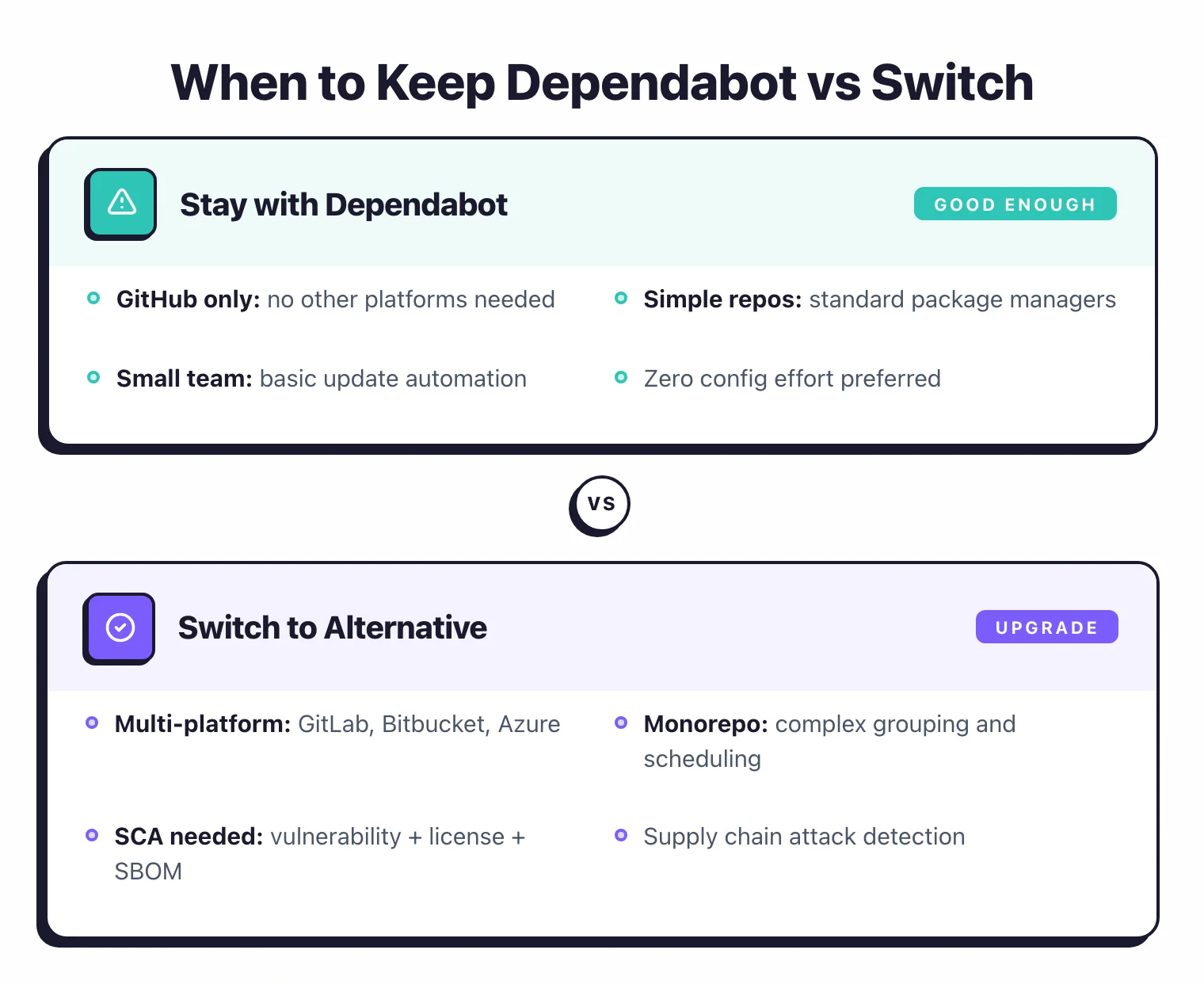
Dependabot still makes sense in several scenarios:
- Your repositories are all on GitHub. Dependabot is free, requires no external services, and works out of the box. For GitHub-only teams, it eliminates the need for a separate SCA tool for basic dependency management.
- Simplicity matters most. Turn on security alerts in settings and you are done. Version updates need a single YAML file. No API tokens, no external dashboards, no additional vendor relationships.
- Budget is zero. Dependabot has no usage limits and no paid tiers. For teams that cannot justify SCA spend, it provides genuine value at no cost.
- You pair it with another SCA tool. Many teams use Dependabot for automated updates while running Snyk, Socket, or Grype for deeper vulnerability analysis. Dependabot handles the update PRs; the other tool handles scanning and prioritization.
- 30+ ecosystem support covers your stack. Dependabot supports virtually every major package manager including newer options like pnpm, Bun, uv, and Helm.
For more AppSec Santa SCA comparisons, see the SCA tools category.
Frequently Asked Questions
What is the best alternative to Dependabot for GitLab or Bitbucket?
Is Renovate better than Dependabot?
Does Dependabot detect malicious packages?
Which SCA tool has the best vulnerability database?
Can I use Dependabot and another SCA tool together?

Written & maintained by
Suphi CankurtEight years on the vendor side of application-security sales — thousands of evaluations and demos. I started AppSec Santa in 2022 to put that insider view to work for buyers. Independent of any vendor, paid by none, and honest about what fits whom.