


DeepSource is a code quality and security platform with 20+ analyzers covering SAST , SCA, secrets detection, and code coverage. It integrates natively with GitHub, GitLab, Bitbucket, and Azure DevOps to analyze every commit and pull request without CI configuration.
Founded in 2018 in San Francisco, DeepSource reports 6,000+ customers including NASA, Ancestry, and Babbel. The platform is SOC 2 Type II certified, backed by Y Combinator and 645 Ventures.
Worth noting on the NASA reference: it is a JPL team using DeepSource on a single open-source Python utility, not an agency-wide deployment.
What is DeepSource?
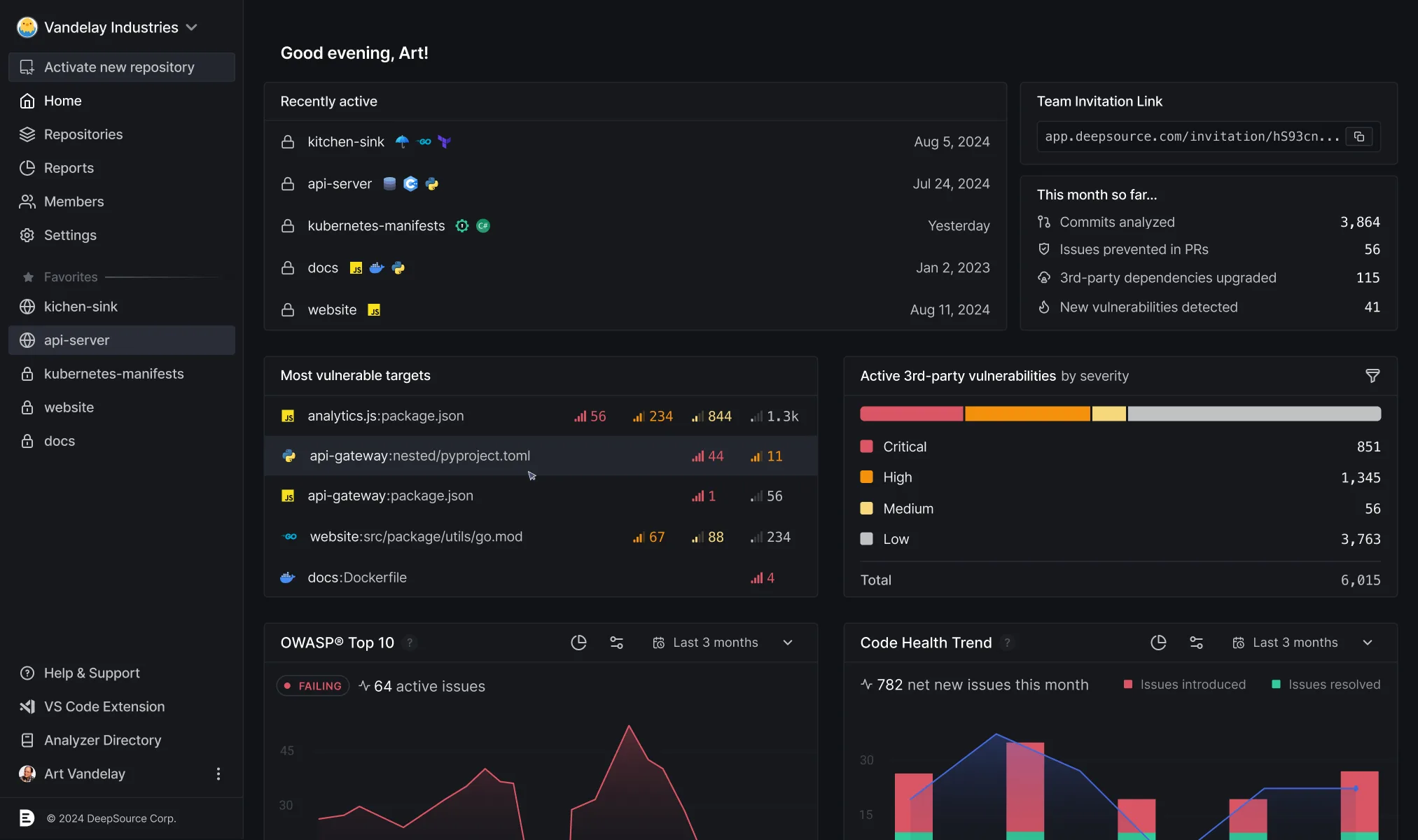
DeepSource runs static analysis on every commit and pull request. According to NIST’s guidelines on secure software development, automated analysis on every code change catches vulnerabilities before they accumulate.
DeepSource scans for security vulnerabilities, code quality issues, duplicated code, and hardcoded secrets. The platform also provides SCA for dependency vulnerabilities and code coverage tracking.
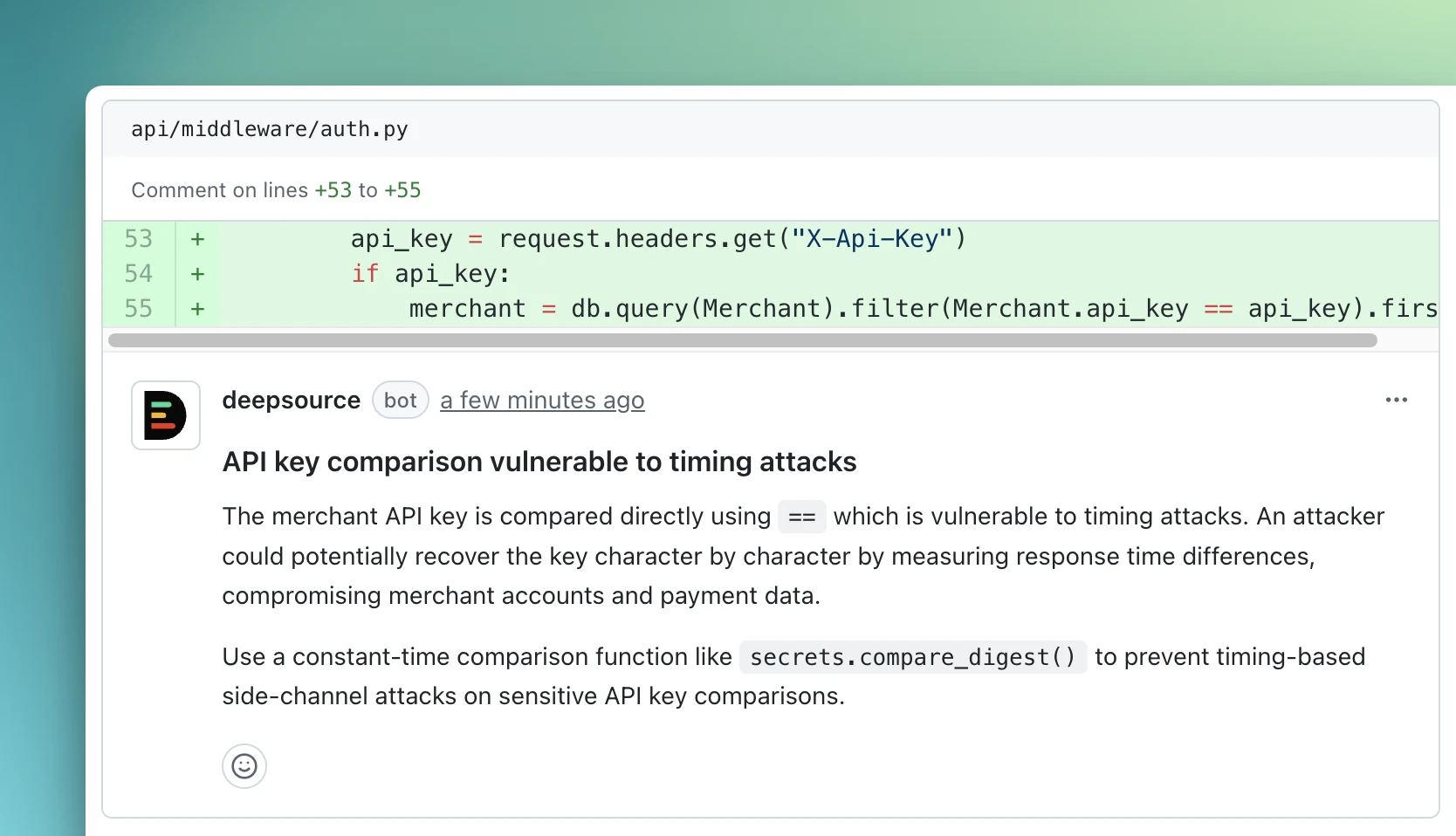
The standout feature is Autofix AI, which generates fixes for detected issues using LLMs. DeepSource says its legacy deterministic Autofix handled about 30% of issues, and that Autofix AI expands that to nearly all issues by analyzing surrounding context, imports, and project patterns.
| Capability | Details |
|---|---|
| 20+ Analyzers | GA support for Python, JavaScript, Java, Go, C#, Rust, Ruby, PHP, Scala, Docker, Shell, SQL, Terraform, Ansible, Dart, and Secrets. Beta support for C/C++, Swift, and Kotlin. |
| Autofix AI | Generates fixes for nearly all detected issues using LLMs. Analyzes surrounding context, imports, related functions, and project coding patterns. Proposed fixes appear as diffs in pull requests. |
| Vendor-Reported 97% Precision | Two-stage secrets detection: fast pattern matching followed by AI classification using the open-source Narada model. DeepSource reports a 93% reduction in false positives versus regex-only approaches — its own benchmark, not an independent test. |
What are DeepSource’s key features?
Security analysis
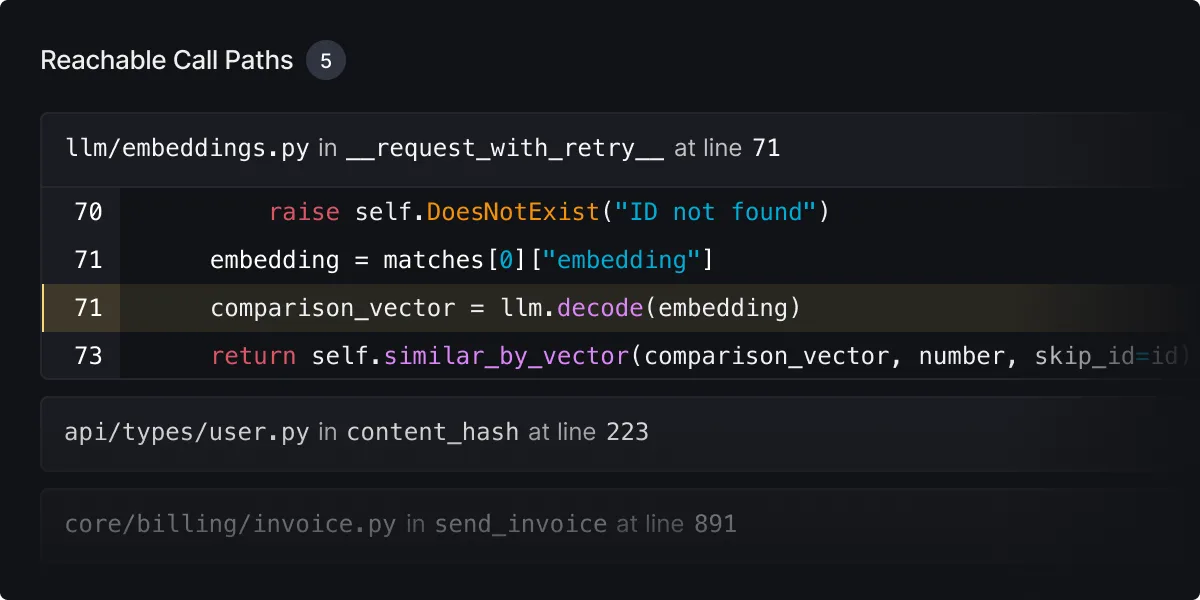
DeepSource detects security vulnerabilities across its supported languages. The SCA module scans dependencies for known vulnerabilities using reachability analysis to determine whether your code actually calls the vulnerable function.
For JavaScript and Python, SCA includes full reachability analysis and automated remediation. For Go, Rust, Java, C#, PHP, Ruby, and Kotlin, it provides vulnerability scanning.
Secrets detection
The secrets analyzer uses a two-stage approach: fast pattern matching identifies potential secrets, then AI-powered classification distinguishes real credentials from false positives.
DeepSource reports 97% precision, 96.3% recall, and a 93% reduction in false positives compared to pattern-only detection. These are DeepSource’s own benchmark figures, not an independent test. The classification is powered by Narada, an open-source secrets classification model.
Code quality and coverage
The platform tracks code complexity, duplication, and style violations. Code coverage integration supports Go, Rust, Java, Scala, C#, JavaScript, PHP, Python, Ruby, C/C++, Swift, and Kotlin. 17+ code formatters (Black, Prettier, Rustfmt, RuboCop, etc.) can auto-format code.
Configuration
DeepSource uses a .deepsource.toml configuration file in the repository root:
version = 1

[[analyzers]]
name = "python"
enabled = true

  [analyzers.meta]
  runtime_version = "3.x.x"

[[analyzers]]
name = "secrets"
enabled = true
What does DeepSource integrate with?
 GitHub
 GitLab
 Bitbucket Cloud
Bitbucket Data Center
Bitbucket Cloud
Bitbucket Data Center Azure DevOps
 Slack
Slack Jira Cloud
 Vanta
VantaHow do I get started with DeepSource?
- Sign up — Connect your GitHub, GitLab, Bitbucket, or Azure DevOps account at deepsource.com. No CI configuration needed.
- Activate repositories — Select repos to analyze. DeepSource creates a
.deepsource.tomlconfiguration file via pull request. - Review and fix — DeepSource analyzes every commit and PR. Use Autofix AI to generate fixes for detected issues with one click.
- Add coverage — Upload test coverage data using the DeepSource CLI or GitHub Actions to track coverage alongside security findings.
How much does DeepSource cost?
| Plan | Price | Key limits |
|---|---|---|
| Open Source | Free | Unlimited public repos and analysis runs |
| Team | $24/user/month | Unlimited Autofix, monorepo support, secrets detection, audit logs, 2-year retention; 3 SCA targets included |
| Enterprise | Custom | Self-hosted, SSO, dedicated account manager |
SCA targets beyond the included three on the Team plan are billed separately. Annual billing saves 20%.
When to use DeepSource
DeepSource works well for teams that want quick setup with no CI configuration overhead. The native Git platform integration means analysis starts within minutes.
Autofix AI is the main differentiator — instead of just flagging issues, it generates fixes that developers can review and merge.
Teams with strict compliance requirements may need to supplement DeepSource with additional tools, since its focus is developer experience over comprehensive vulnerability catalogs.
Self-hosted deployment is available on the Enterprise plan for organizations that need on-premises control. For more options, see the open-source SAST tools guide.
What are alternatives to DeepSource?
The closest substitutes for DeepSource depend on which slice of its scope matters most — security, code quality, or developer-experience speed.
- SonarQube and SonarCloud — the canonical code-quality-plus-security platform. Deeper rule depth and more languages than DeepSource, with a heavier CI footprint. Pick this when you already standardise on Sonar Quality Gates.
- Codacy — a direct DeepSource competitor on the developer-experience side, also Git-native, with broad linter aggregation. Closer to DeepSource on autofix UX, weaker on dataflow-aware security checks.
- Snyk Code — heavier on security depth, lighter on style and quality. A fit when SAST findings need to live alongside SCA , container, and IaC scanning in the same dashboard.
- Semgrep — rule-driven SAST with a free open-source engine and writable custom rules. Picked when teams want to author org-specific patterns instead of running a fixed rule pack.
- GitHub Advanced Security — CodeQL-powered SAST bundled with GitHub. A fit when the codebase already lives on GitHub and a single vendor is preferred.
For a fuller side-by-side, see the SAST tools hub .
Reed Wilson, Engineering Manager at Ancestry, states: “With DeepSource’s pull request analysis workflow, everything is integrated — right at the point of merge, and this has been a game changer for us.”