
- AppTrana is a fully managed WAAP platform bundling DAST, WAF, DDoS protection, and bot mitigation; Acunetix is a standalone DAST scanner focused purely on vulnerability detection with 7,000+ checks.
- AppTrana includes a 24/7 SOC with zero-false-positive guarantee and virtual patching; Acunetix relies on proof-based scanning for accuracy but leaves remediation to your team.
- Acunetix offers AcuSensor IAST for server-side code visibility during scans (.NET, Java, PHP, Node.js); AppTrana has no IAST agent but pairs scanning with managed WAF protection.
- AppTrana publicly starts at $99/app/month with a 14-day free trial and free Basic plan; Acunetix requires a 5-target minimum on a 2-year subscription with no free tier.
- Choose AppTrana when you need scanning plus runtime protection in one subscription without building a security operations team. Choose Acunetix when you need a dedicated vulnerability scanner with deep crawling and proof-of-exploit for each finding.
Which Is Better: Indusface AppTrana or Acunetix?#
AppTrana is better when you need scanning plus runtime protection in one managed subscription, while Acunetix is better when you need a dedicated high-accuracy vulnerability scanner with 7,000+ checks and proof-of-exploit.
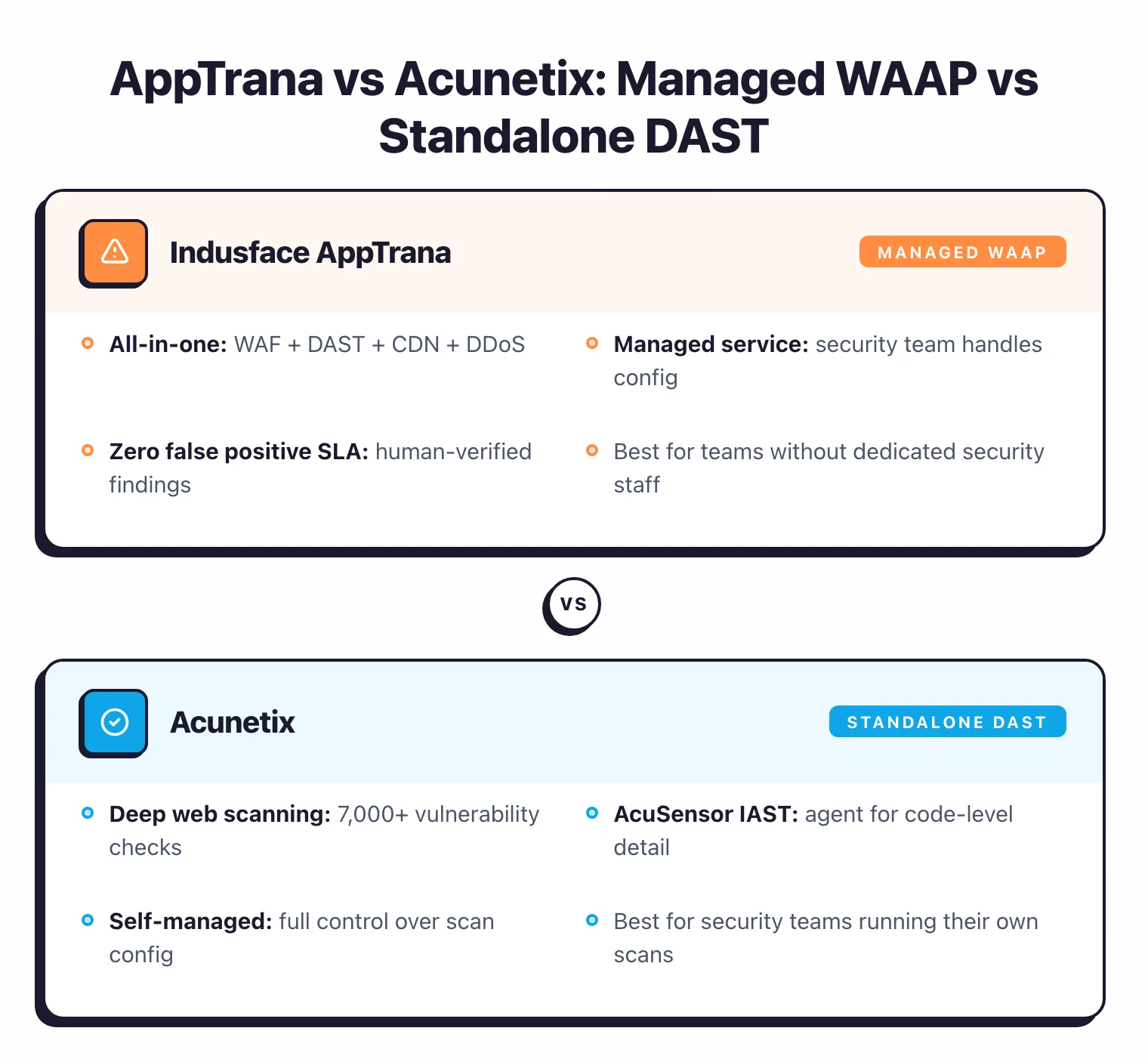
AppTrana is a fully managed WAAP platform bundling DAST, WAF, DDoS, and bot protection. Acunetix is a standalone DAST scanner focused purely on vulnerability detection depth.
AppTrana by Indusface is a fully managed WAAP (Web Application and API Protection) platform. It combines a built-in DAST scanner with a managed WAF, unmetered DDoS protection, bot mitigation, and API security, all backed by a 24/7 Security Operations Center.
When the scanner finds a vulnerability, the managed WAF can apply a virtual patch within hours. AppTrana starts at $99/app/month with a 14-day free trial.
Acunetix is a standalone DAST scanner from the Invicti family. It checks for over 7,000 vulnerability types with 99.98% accuracy using proof-based scanning — compared to AppTrana’s OWASP Top 10 and SANS 25 coverage.
Each finding comes with proof-of-exploit that confirms the vulnerability is real. Unlike AppTrana, Acunetix includes AcuSensor IAST integration for server-side code visibility in .NET, Java, PHP, and Node.js applications.
These tools solve different problems. AppTrana is the right choice when you need a single subscription that covers both vulnerability detection and runtime protection, especially if you lack an in-house security operations team.
Acunetix is the right choice when you need a dedicated, high-accuracy vulnerability scanner and already have separate WAF and DDoS protection in place.
What Are the Key Differences?#
| Feature | AppTrana | Acunetix |
|---|---|---|
| Developer | Indusface | Invicti Security |
| Product Type | Managed WAAP (DAST + WAF + DDoS + Bot) | Standalone DAST Scanner |
| License | Commercial (starts at $99/app/month) | Commercial (per-FQDN, contact sales) |
| Free Tier | 14-day trial + free Basic plan | No free tier |
| Vulnerability Checks | OWASP Top 10, SANS 25, zero-day | 7,000+ types with proof-based scanning |
| Accuracy Approach | Managed SOC with zero-false-positive guarantee | 99.98% via proof-of-exploit |
| IAST Support | No | AcuSensor for .NET, Java, PHP, Node.js |
| WAF Included | Yes (fully managed) | No |
| DDoS Protection | Yes (unmetered Layer 3-7) | No |
| Bot Mitigation | Yes (AI-powered behavioral) | No |
| API Security | Discovery + scanning + runtime protection | Scanning only (REST, SOAP, GraphQL) |
| Virtual Patching | Yes (SwyftComply: 72-hour SLA) | No |
| Managed Services | 24/7 SOC, false positive monitoring, custom rules | Self-service |
| Manual Pen Testing | Yes (Premium/Enterprise plans) | No |
| Deployment | Cloud-hosted (CDN-based) | On-premises (Windows, Linux, macOS) or cloud |
| CI/CD Integration | API-based scan triggers | REST API, Jenkins, GitLab CI, Azure DevOps |
| Compliance Reports | PCI DSS, SOC 2, ISO 27001 audit reports | CWE, HIPAA, ISO 27001, NIST, PCI DSS, OWASP, WASC |
Indusface AppTrana vs Acunetix: How Do They Compare?#
Product Philosophy#
AppTrana and Acunetix start from fundamentally different assumptions about what a security product should do. Acunetix focuses on detection depth, while AppTrana focuses on closing the gap between detection and protection.
Acunetix is a pure vulnerability scanner. Its job is to find security issues in your web applications and APIs as accurately as possible, give you proof that each finding is real, and hand the results to your development team.
What happens after detection (patching, WAF rules, monitoring) is handled by other tools in your stack. This focused approach lets Acunetix invest its engineering effort into scanning depth, crawling intelligence, and false positive reduction.
AppTrana takes the platform approach. Indusface built it on the premise that most organizations, particularly mid-market companies, struggle with the gap between finding vulnerabilities and fixing them. A scanner might flag 200 issues, but if your team takes three months to patch the critical ones, attackers have a long window.
AppTrana closes that gap by pairing its DAST scanner with a managed WAF that can apply virtual patches within hours of discovery. The 24/7 SOC handles the operational burden that would otherwise require a dedicated security team.
Neither approach is universally better. The right choice depends on whether your organization already has WAF, DDoS, and bot protection in place, or whether you need those capabilities bundled with your scanner.
Vulnerability Detection#
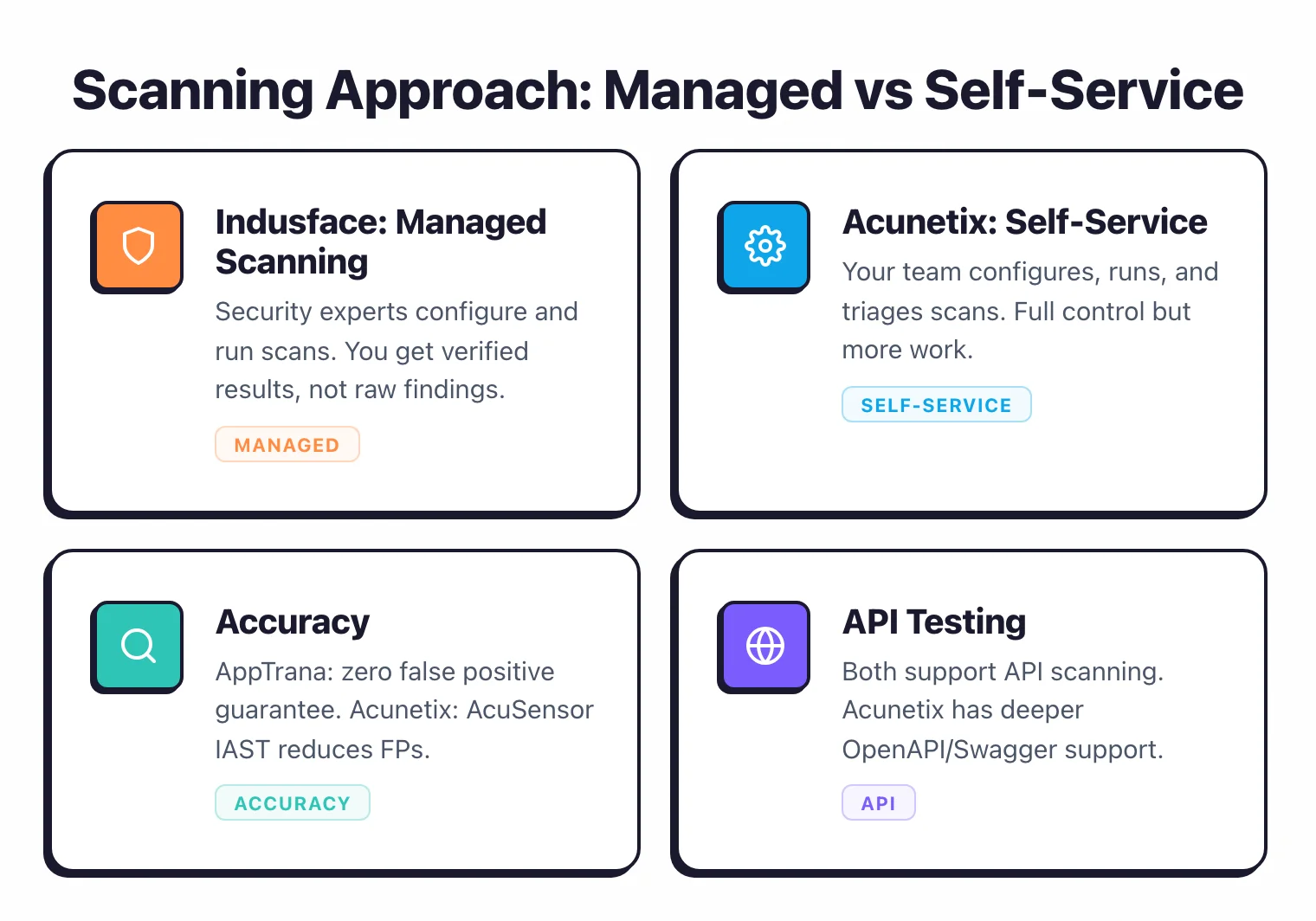
Acunetix has a clear edge in pure scanning depth compared to AppTrana. Its engine checks for over 7,000 vulnerability types, including OWASP Top 10, out-of-band vulnerabilities, and edge cases that simpler scanners miss.
The C++-based scanning engine is fast, with average scan times running 2-4 hours. Acunetix’s SmartScan technology prioritizes dissimilar elements to find 80% of vulnerabilities in the first 20% of scan time.
The proof-based scanning approach is Acunetix’s defining feature. Rather than just flagging potential issues, the scanner safely exploits each vulnerability and captures proof-of-exploit.
This means fewer false positives reaching your developers and less time spent triaging findings. Acunetix claims 99.98% accuracy.
AppTrana’s built-in DAST scanner covers OWASP Top 10, SANS 25, and zero-day vulnerabilities. Indusface states their scanner identifies over 90% of the vulnerabilities found in manual penetration testing. While AppTrana’s scanner is not as deep as Acunetix in total vulnerability checks, it comes with something Acunetix does not offer: the AcuRisQ risk prioritization engine, which reduces vulnerability fatigue by up to 80% by scoring findings based on business risk rather than raw severity alone.
AppTrana also includes manual penetration testing by certified security experts on Premium and Enterprise plans. This catches business logic flaws and complex attack chains that no automated scanner reliably detects, a capability Acunetix does not provide.
IAST and Code-Level Visibility#
Acunetix has a clear advantage over AppTrana here with AcuSensor, its IAST (Interactive Application Security Testing) agent. When deployed inside your application server, AcuSensor gives the scanner visibility into server-side code execution during scans.
It can pinpoint the exact line of code causing a vulnerability, detect issues invisible to external-only scanning, and reduce false positives further. AcuSensor supports .NET, Java, PHP, and Node.js applications.
AppTrana does not offer an IAST agent. Its scanning is purely external (black-box DAST), supplemented by the managed WAF and manual pen testing. For teams that need code-level vulnerability attribution, knowing exactly which file and line number is vulnerable, Acunetix with AcuSensor provides that visibility while AppTrana does not.
WAF and Runtime Protection#
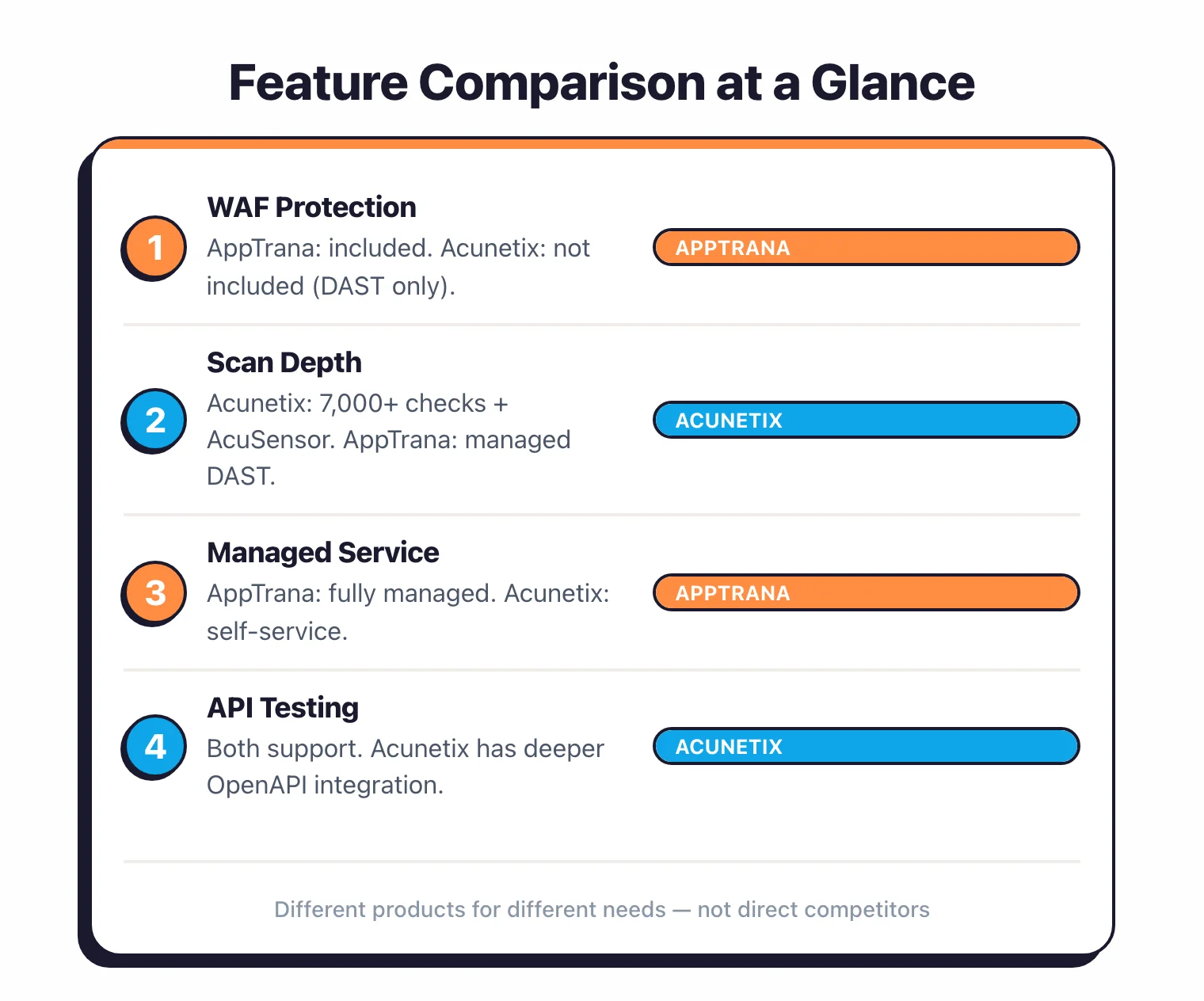
This is where AppTrana pulls decisively ahead of Acunetix. Acunetix is a scanner only — it finds vulnerabilities but provides no runtime protection. Once Acunetix delivers its findings, you need a separate WAF, DDoS protection, and bot mitigation solution.
AppTrana includes all of these in a single subscription:
- Managed WAF with a zero-false-positive guarantee. The SOC team tunes rules, monitors for false positives, and creates custom policies. AppTrana deploys in block mode from day one, not just detection mode.
- Unmetered DDoS protection across Layers 3-7. You pay for clean traffic only. Attack traffic is absorbed at no extra cost, regardless of volume.
- Bot mitigation using behavioral analysis across IPs, user agents, URIs, bounce rates, and device fingerprints. Protects against credential stuffing, account takeover, web scraping, and inventory hoarding.
- SwyftComply virtual patching that generates a clean, zero-vulnerability audit report within 72 hours by automatically patching critical, high, and medium CVSS vulnerabilities.
For organizations evaluating AppTrana against Acunetix, the question is whether you already have WAF and DDoS protection. If you do, Acunetix adds scanning depth to your existing stack. If you do not, AppTrana bundles everything together and eliminates the integration work.
API Security#
Both tools scan APIs, but the depth of API protection differs significantly. Acunetix provides scanning only, while AppTrana provides discovery, scanning, and runtime protection.
Acunetix scans REST, SOAP, and GraphQL APIs for vulnerabilities. It imports API definitions (OpenAPI/Swagger, WSDL, GraphQL introspection) and tests endpoints for injection flaws, authentication issues, and misconfigurations. This is solid API vulnerability scanning, but it stops at detection.
AppTrana goes further with runtime API protection. It automatically discovers shadow and zombie APIs that your team may not know exist, enforces schema validation using a positive security model (validating methods, paths, parameters, and data types), and blocks API-specific attacks including OWASP API Top 10 vulnerabilities. The managed WAF applies API-specific rules, and the bot mitigation layer protects APIs against automated abuse.
For API-first applications, AppTrana provides a more complete picture: discovery, scanning, and runtime protection. Acunetix provides deeper vulnerability scanning of known API endpoints but no discovery or runtime defense.
Deployment and Operations#
Acunetix can be installed on-premises on Windows, Linux, or macOS, or used as a cloud-hosted version. The multi-engine setup supports scanning more than 10 targets simultaneously from a central console. Acunetix is self-service: your team manages scan configurations, schedules, and results.
AppTrana is cloud-hosted and operates as a managed service. You point your DNS through AppTrana’s CDN, and the platform handles scanning, WAF rules, DDoS absorption, and bot detection.
The 24/7 SOC monitors your applications and responds to threats. This model works well for teams without dedicated security operations staff, but it means less control over scanning granularity compared to Acunetix’s self-service approach.
For CI/CD integration, Acunetix offers direct integrations with Jenkins, GitLab CI, and Azure DevOps, plus a REST API for custom workflows. AppTrana provides API-based scan triggers and can integrate with CI pipelines, but its primary value is continuous protection rather than per-build scanning.
Reporting and Compliance#
Acunetix ships with a broader set of compliance report templates: CWE, HIPAA, ISO 27001, NIST SP 800-53, OWASP Top 10, PCI DSS, Sarbanes-Oxley, STIG DISA, and WASC. Reports include proof-of-exploit for each finding, remediation guidance, and severity ratings. Exports are available in CSV, JSON, and XML.
AppTrana focuses on audit-ready reports for PCI DSS, SOC 2, and ISO 27001. The SwyftComply feature generates a zero-vulnerability audit report within 72 hours by applying virtual patches to all critical, high, and medium findings. For organizations on tight audit timelines, this is something Acunetix cannot match because Acunetix reports vulnerabilities but does not remediate them.
Cost Structure#
AppTrana publicly displays its pricing, unlike Acunetix. The Advanced plan starts at $99 per application per month, and a 14-day free trial is available.
After the trial, accounts move to a free Basic plan with limited features. Premium and Enterprise plans carry custom pricing and add manual pen testing, full bot protection, SwyftComply, and a named account manager.
Acunetix uses target-based pricing per FQDN with a minimum purchase of 5 targets on a 2-year subscription. There is no free tier or trial. Contact Acunetix sales for specific pricing.
The pricing models reflect different approaches. AppTrana’s per-application pricing includes scanning, WAF, DDoS, and managed services, so you pay for a complete protection package.
Acunetix’s per-target pricing covers the scanner only. WAF, DDoS, and bot protection are separate purchases from other vendors.
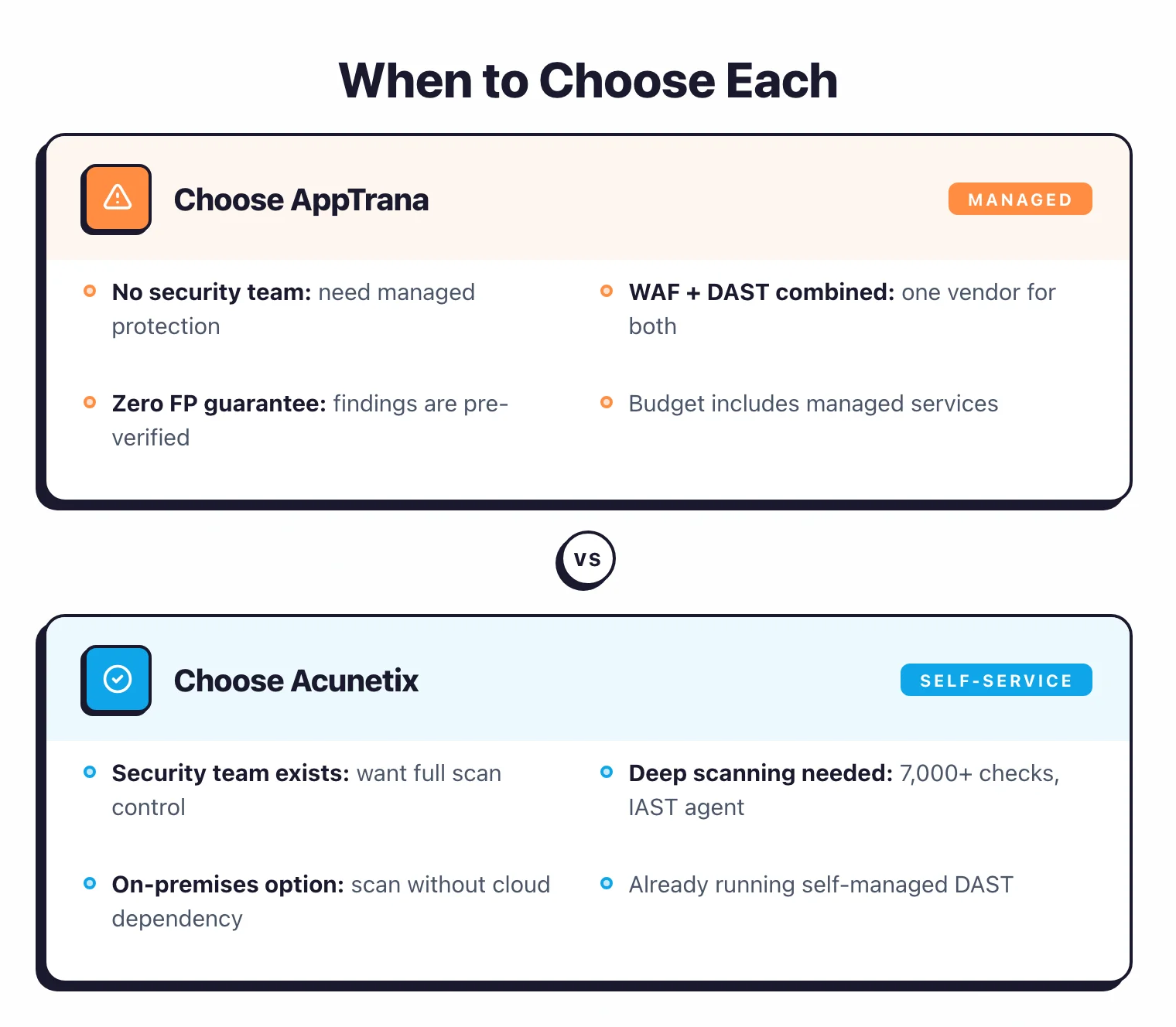
When Should You Choose Indusface AppTrana?#
Choose AppTrana if:
- You need vulnerability scanning and runtime protection (WAF, DDoS, bot mitigation) in a single subscription
- Your team lacks dedicated security operations staff and needs a fully managed service with 24/7 SOC
- Compliance audit timelines are tight and SwyftComply’s 72-hour clean report SLA solves a real problem
- API security is a priority and you need discovery, scanning, and runtime protection, not just vulnerability detection
- You want virtual patching to close the gap between finding a vulnerability and deploying a code fix
- Budget predictability matters and you prefer per-application pricing that includes protection
When Should You Choose Acunetix?#
Choose Acunetix if:
- You need the deepest possible vulnerability scanning with 7,000+ checks and proof-of-exploit for each finding
- IAST integration matters. AcuSensor provides server-side code visibility that AppTrana does not offer
- You already have WAF, DDoS, and bot protection from another vendor and need a dedicated scanner
- On-premises deployment is required for compliance or data sovereignty reasons
- Your security team is experienced and prefers self-service scanning with granular control over scan configurations
- CI/CD-driven scanning with direct Jenkins, GitLab, or Azure DevOps integration is central to your workflow
For teams evaluating other options in this space, Invicti is Acunetix’s enterprise sibling with ASPM capabilities, Burp Suite is the go-to for manual penetration testers, and open-source alternatives like ZAP and Nuclei provide free DAST scanning. See the full DAST tools comparison on AppSec Santa.
Frequently Asked Questions
What is the main difference between Indusface AppTrana and Acunetix?
Which tool has better accuracy — AppTrana or Acunetix?
Does AppTrana replace the need for a DAST scanner like Acunetix?
Can I use AppTrana and Acunetix together?
Is there a free version of either tool?
Which tool is better for API security?

Written & maintained by
Suphi CankurtEight years on the vendor side of application-security sales — thousands of evaluations and demos. I started AppSec Santa in 2022 to put that insider view to work for buyers. Independent of any vendor, paid by none, and honest about what fits whom.