
Burp Suite Alternatives
Top Burp Suite Alternatives

Free Open-Source DAST Scanner

Modern Proxy, Rust Engine, Free Tier

Template-Based OSS Scanner

Multi-Platform Easy-to-Use DAST
- Burp Suite Pro costs $499/year per user; the free Community Edition has throttled scanning and no automated scanner, pushing teams toward ZAP (fully free) or StackHawk (freemium).
- Caido is the fastest-rising manual-testing alternative — a modern intercepting proxy with a cleaner UI than Burp, a free Community tier, and project-based workflows aimed at pentesters and bug bounty hunters.
- ZAP provides an intercepting proxy, automated scanner, and YAML automation framework for CI/CD at zero cost with 15,500+ GitHub stars.
- Invicti’s proof-based scanning verifies vulnerabilities at 99.98% accuracy, virtually eliminating false positive triage that Burp Suite users handle manually.
- Dastardly from PortSwigger uses the Burp Scanner engine for free in CI/CD Docker containers with a 10-minute scan cap and zero configuration.
The best Burp Suite alternatives in 2026 are ZAP, Caido, Nuclei, Acunetix, Invicti, StackHawk, Bright Security, Dastardly, and Nikto.
I ranked these 9 tools on scan accuracy, manual-testing workflow, CI/CD fit, and pricing transparency. No vendor pays for placement or ranking on this page.
Why Look for Burp Suite Alternatives?#
Burp Suite is the standard toolkit for web application security testing. Pre-installed in Kali Linux, taught in every web security course, and widely used by professional pentesters.
Its intercepting proxy, manual testing tools, and extensible scanner make it hard to match for hands-on security work.
But not every team needs a hands-on pentesting toolkit. The most common reason organizations look for alternatives is that they need automated DAST scanning in CI/CD pipelines, not manual testing.
Burp Suite Professional is a desktop application designed for individual pentesters. While Burp Suite DAST (the enterprise edition) supports CI/CD, it carries enterprise pricing that may not fit smaller teams or those just starting with automated security testing.
Cost is a real factor. Burp Suite Professional costs $499/year per user.
The Community Edition is free but severely limited — throttled scanning, no project saves, and no automated scanner. Teams that need automated scanning for multiple developers face either the Professional per-seat cost or the enterprise DAST pricing.
Some teams also find that Burp Suite’s strength in manual testing is irrelevant to their workflow.
If you need a DAST scanner that runs in a Docker container, integrates with GitHub Actions, and returns results in JUnit format, you do not need an intercepting proxy.
A developer-focused DAST tool can deliver automated scanning at a fraction of the complexity.
Burp Suite Alternatives at a Glance#
Before the deep ranking, here is the tri-axis snapshot. Linked tools route to the brand pages on AppSec Santa.
| Track | Pick | One-line positioning |
|---|---|---|
| Manual testing | Caido | Modern intercepting proxy; cleaner UI than Burp, free tier, bug-bounty favorite. |
| Open-source / free | ZAP | Most capable free DAST, GUI plus YAML automation; Burp’s closest free peer. |
| Open-source / free | Nuclei | Template-based; 11,000+ community templates; fast pipeline checks. |
| Open-source / free | Dastardly | PortSwigger’s free CI/CD scanner using the Burp Scanner engine. |
| Commercial DAST | Invicti | Proof-based engine, multi-team RBAC, ASPM via Kondukto. |
| Commercial DAST | Acunetix | SMB sibling of Invicti; same engine, smaller scale. |
| Commercial DAST | StackHawk | CI/CD-native ZAP wrapper; 20-minute first-scan time. |
For broader context, see the broader DAST tools landscape . The ranked sections below explain when each one fits.
Top Burp Suite Alternatives#
1. ZAP (Zed Attack Proxy)#
ZAP is the open-source counterpart to Burp Suite. Maintained by Checkmarx (previously an OWASP project) with 15,500+ GitHub stars , it provides an intercepting proxy, automated scanner, spider, fuzzer, and WebSocket support. ZAP’s automation framework supports YAML-based configuration for CI/CD integration.
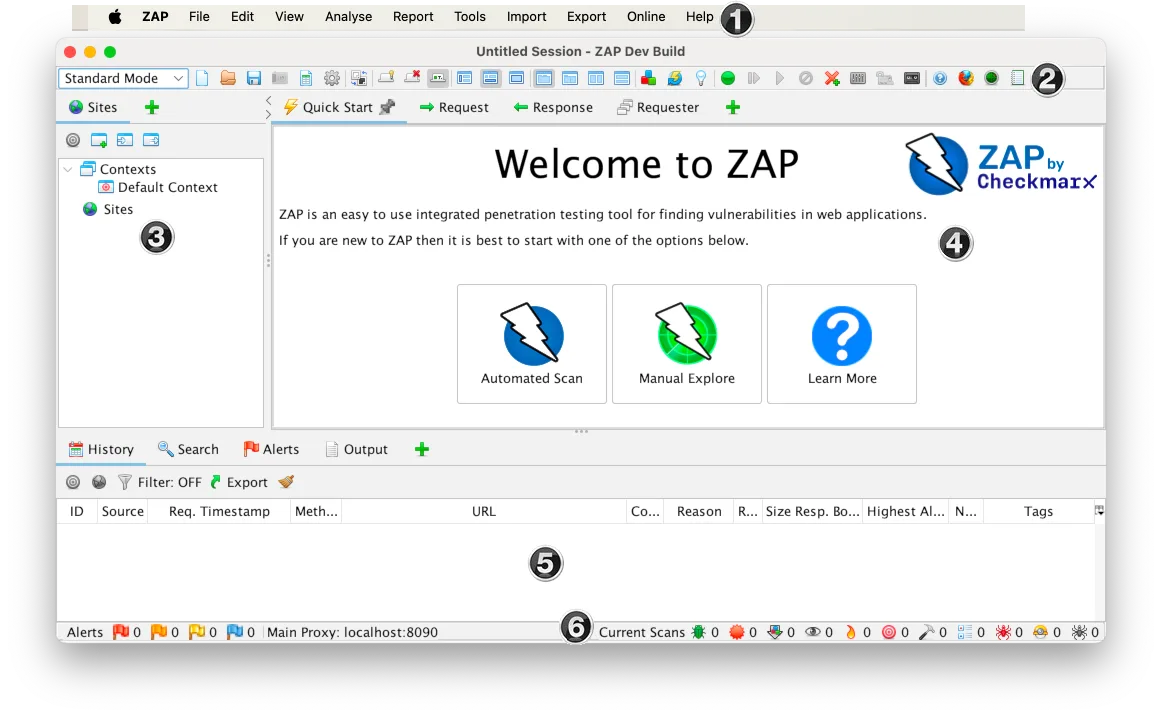
The feature overlap with Burp Suite Professional is significant. ZAP offers both manual and automated testing, a marketplace of add-ons, and API scanning for REST, GraphQL, and SOAP.
Where Burp wins on polish and scanner depth, ZAP wins on cost (free) and transparency (fully open-source).
Best for: Teams that want Burp Suite capabilities without the license cost, or those who need full source code visibility into their scanning engine.
License: Open-source (Apache 2.0) Key difference: Completely free and open-source. YAML automation framework for CI/CD. Active community with regular updates.
2. Caido#
Caido is the modern manual-testing alternative to Burp Suite, and the tool the 2026 conversation keeps returning to. It is a lightweight intercepting proxy with a clean web-based UI, built for speed.

Where most tools on this list replace Burp’s automated scanning, Caido replaces its manual workflow — proxy, replay, and request tampering — for pentesters and bug bounty hunters who find Burp heavy.
It offers a free Community tier, paid plans, a plugin system, and project-based organization. It does not match Burp’s extension ecosystem or scanner depth yet, but its workflow and performance are why testers are switching.
Best for: Pentesters and bug bounty hunters who want Burp’s manual proxy workflow in a faster, cleaner, modern interface.
License: Freemium (free Community tier) Key difference: A manual-testing alternative, not an automated scanner. Modern UI and performance, with a smaller extension ecosystem than Burp.
3. Nuclei#
Nuclei is a template-based vulnerability scanner with 11,000+ community-contributed detection templates . Instead of crawling an application and probing dynamically, Nuclei runs specific checks defined in YAML templates. This makes it fast, deterministic, and easy to extend.
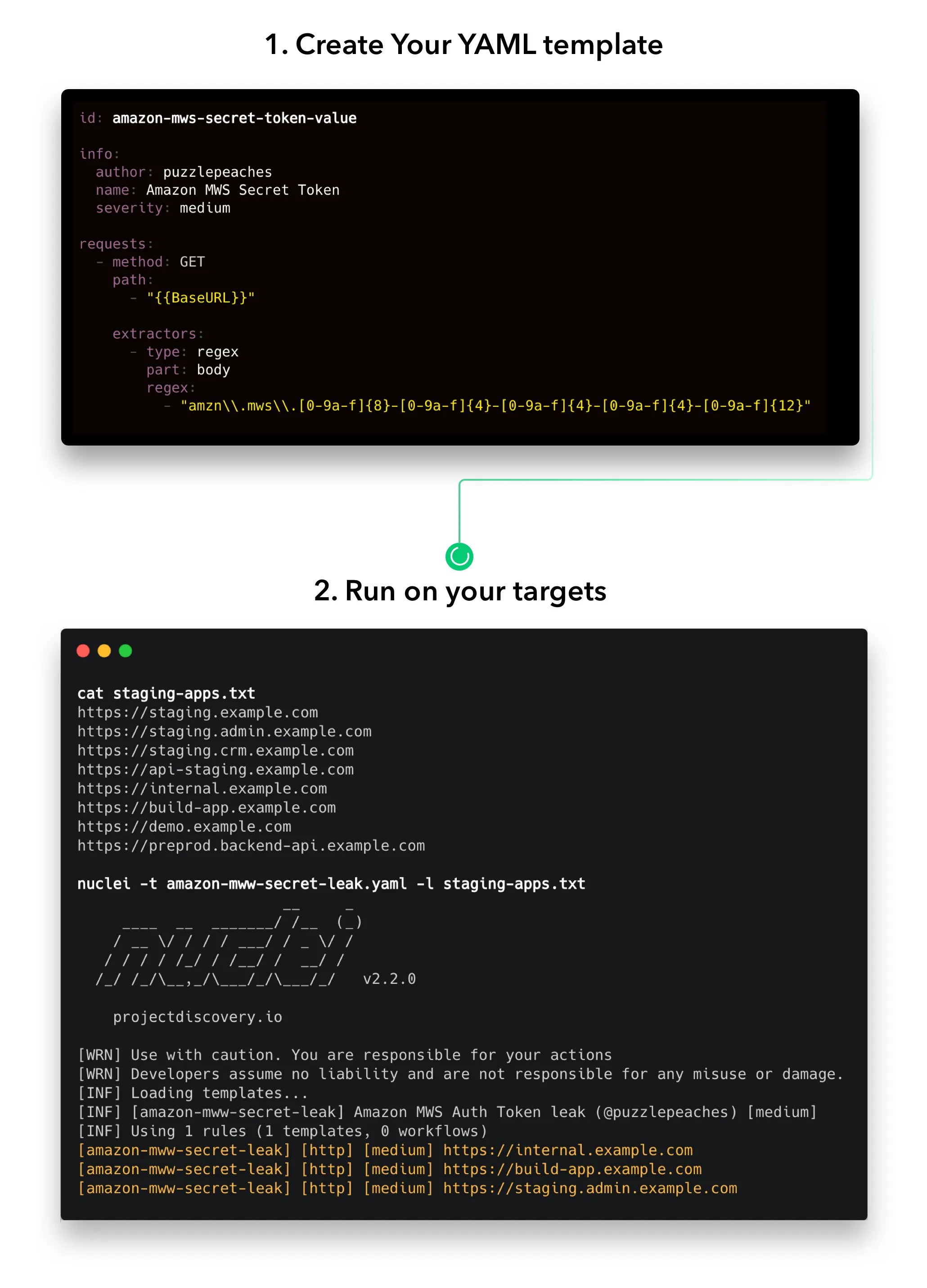
The scanner supports HTTP, DNS, TCP, SSL, WebSocket, and headless browser protocols. AI-powered template generation helps create custom templates from CVE descriptions.
Nuclei is widely used for reconnaissance, vulnerability validation, and known-CVE detection.
Best for: Security teams that want fast, template-driven scanning for known vulnerabilities and misconfigurations.
License: Open-source (MIT) Key difference: Template-based approach with 11,000+ community templates. Faster than traditional DAST crawlers. Does not replace manual testing tools.
4. Acunetix#
Acunetix is a commercial DAST scanner known for its 99.98% accuracy claim and 7,000+ vulnerability checks. The Business Logic Recorder captures multi-step workflows for testing complex application flows. AI-powered Predictive Risk Scoring prioritizes findings by exploitability.
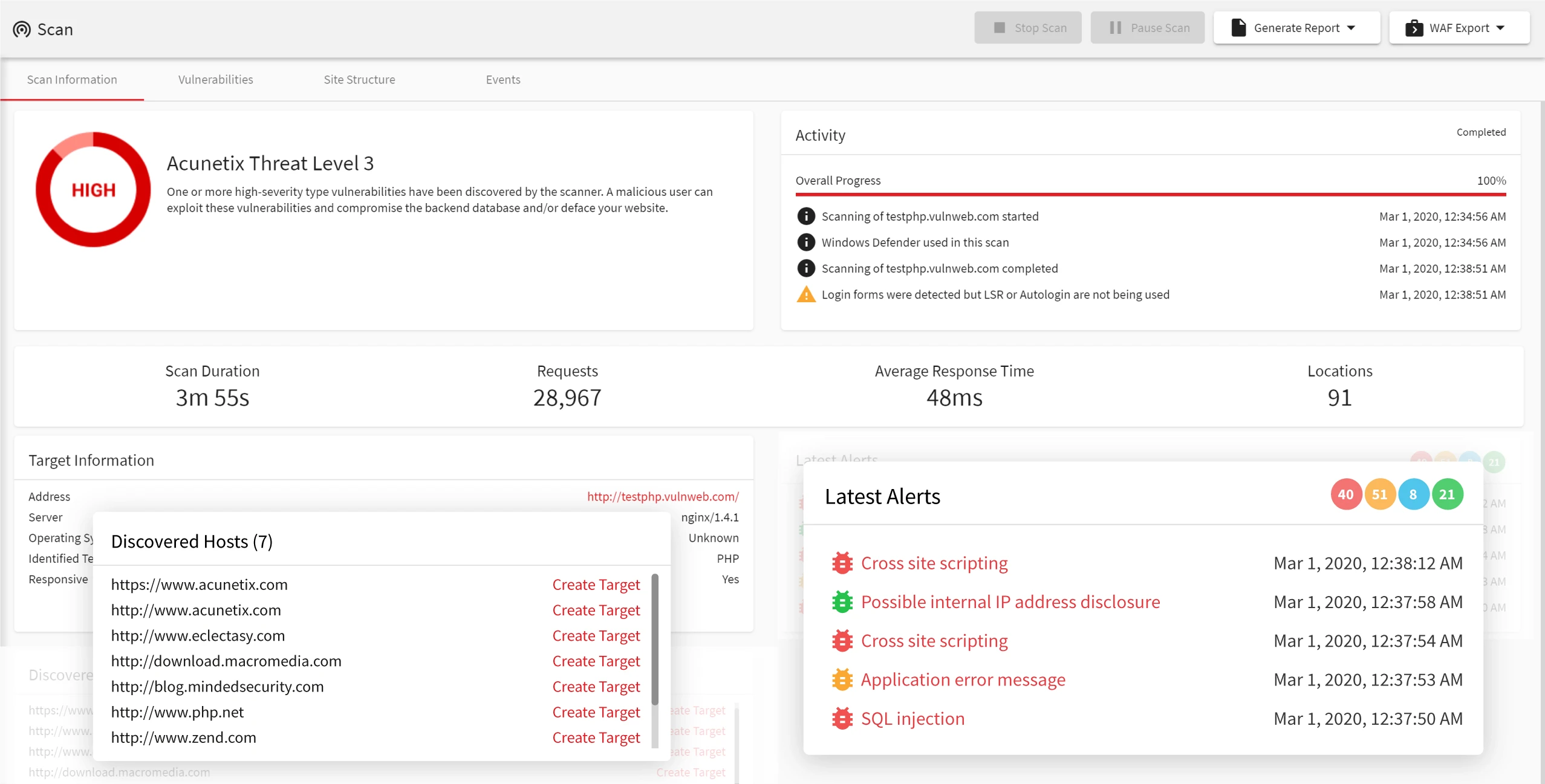
The AcuSensor IAST agent can be installed alongside DAST scanning for combined coverage. Acunetix supports both web application and API scanning, with reporting formatted for PCI DSS, HIPAA, and other compliance frameworks.
Best for: Organizations that need highly accurate automated scanning with compliance-ready reporting.
License: Commercial Key difference: 99.98% accuracy with Business Logic Recorder for complex workflows. Built-in compliance reporting. No manual testing tools.
5. Invicti#
Invicti (formerly Netsparker) uses proof-based scanning to verify vulnerabilities with minimal false positives. When it finds a potential issue, it attempts to confirm exploitation and provides proof that the vulnerability is real. This dramatically reduces triage time.
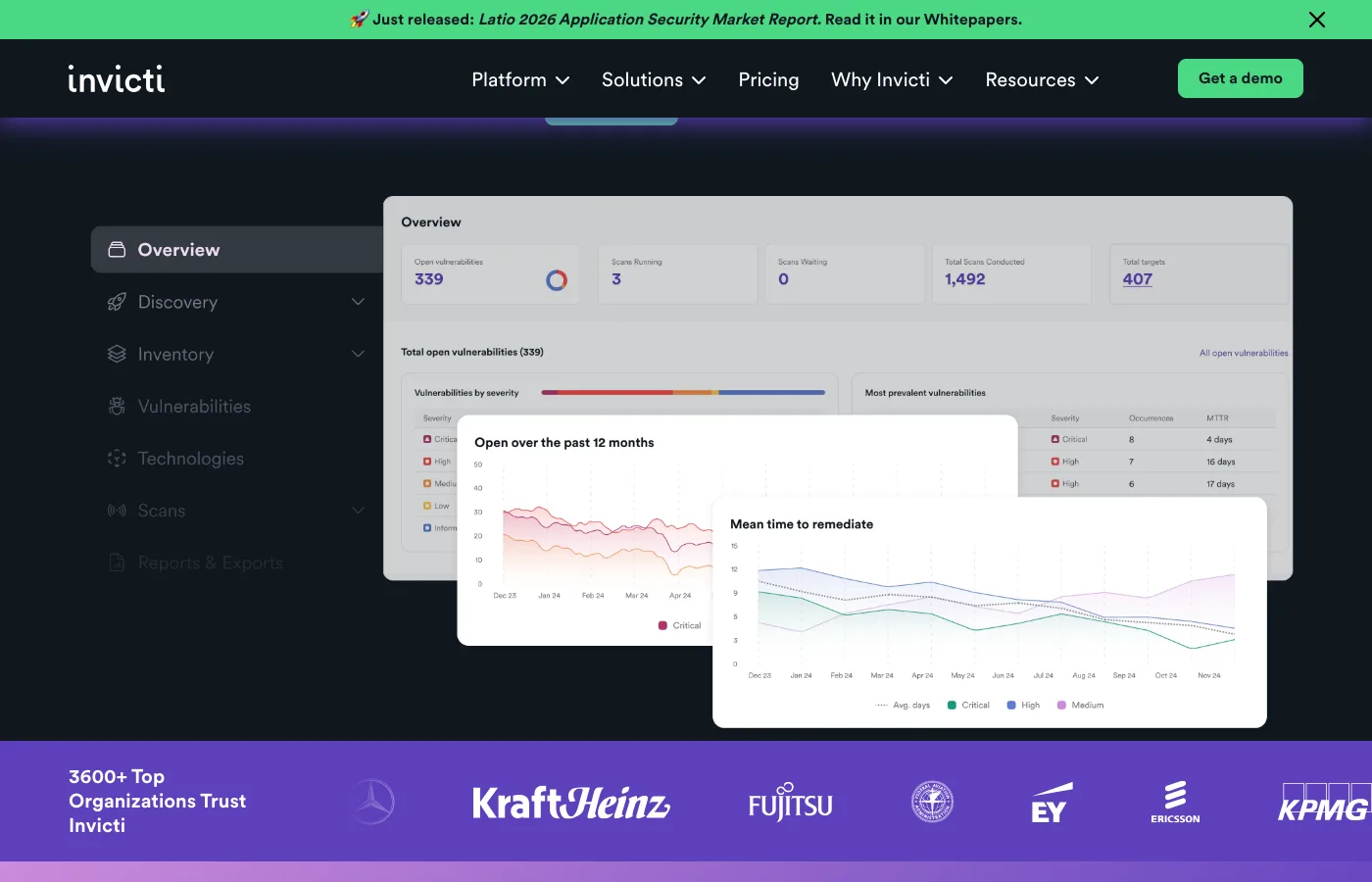
The platform combines DAST, IAST, and SCA in one tool and scales to scan thousands of applications. Invicti claims 8x faster scanning than competitors and provides AI-powered remediation guidance.
Best for: Large organizations scanning many applications that need verified findings with minimal false positives. License: Commercial Key difference: Proof-based scanning confirms vulnerabilities are real, not theoretical. Scales to thousands of applications.
6. StackHawk#
StackHawk is built for developers and CI/CD. Powered by the ZAP engine underneath, it wraps that scanning capability in a developer-friendly interface with YAML configuration, fast setup (20 minutes from signup to first CI/CD scan), and scan times of 3-10 minutes.
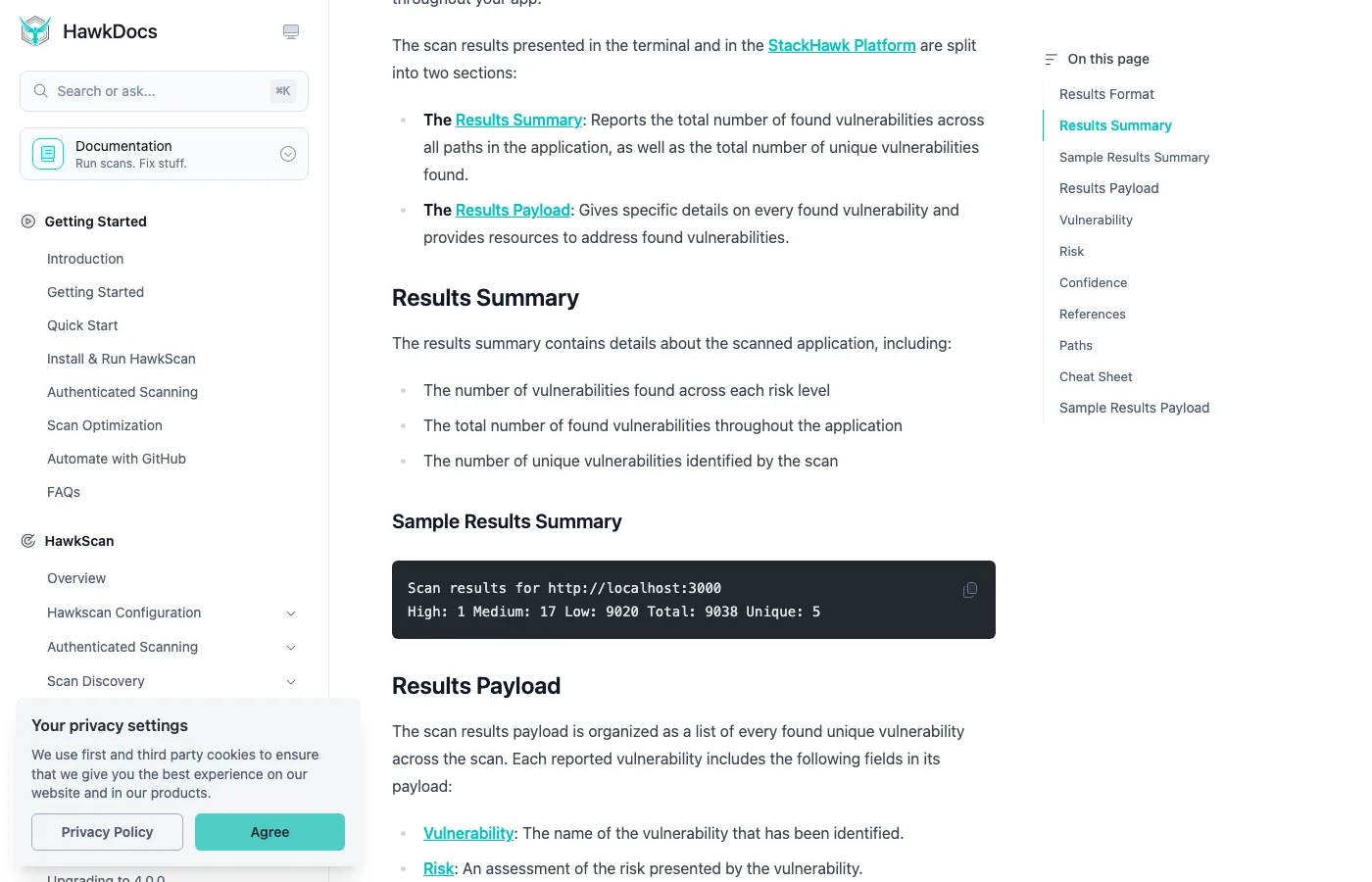
StackHawk supports REST, GraphQL, gRPC, and SOAP API testing through OpenAPI configuration . HawkAI provides API discovery, and the platform includes LLM security testing for AI-powered applications.
It integrates with GitHub Actions, GitLab CI, Jenkins, CircleCI, and Azure DevOps.
Best for: Developer teams that want fast, automated DAST in CI/CD without the complexity of traditional security tools.
License: Freemium Key difference: Developer-first UX with 20-minute setup. YAML-based configuration. Built on ZAP engine with a polished interface.
7. Bright Security#
Bright Security (formerly NeuraLegion) is a developer-focused DAST tool designed for CI/CD integration. It runs from a Docker container or CLI, supports HAR file import and OpenAPI/Swagger specs for API discovery, and uses AI-powered vulnerability validation to keep false positives under 3%.
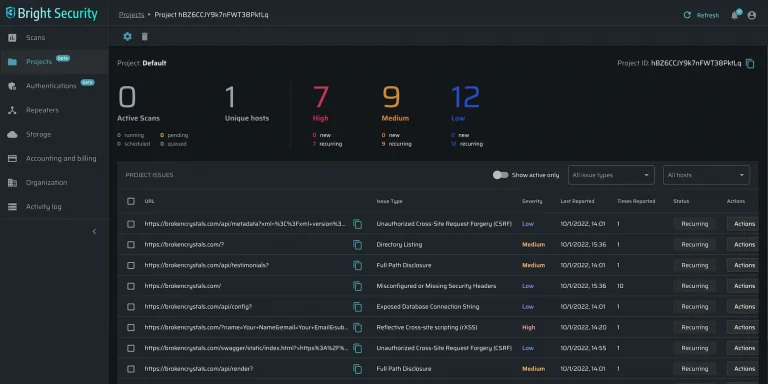
The platform supports REST, GraphQL, SOAP, and WebSocket APIs. Scan results map directly to developer workflows with remediation guidance and code snippets.
Best for: API-heavy teams that want automated DAST with very low false positive rates. License: Freemium Key difference: AI-powered validation keeps false positives under 3%. Strong API scanning with OpenAPI/Swagger support.
8. Dastardly#
Dastardly is PortSwigger’s free CI/CD scanner. It uses the Burp Scanner engine in a Docker container, runs scans capped at 10 minutes, and outputs JUnit XML.
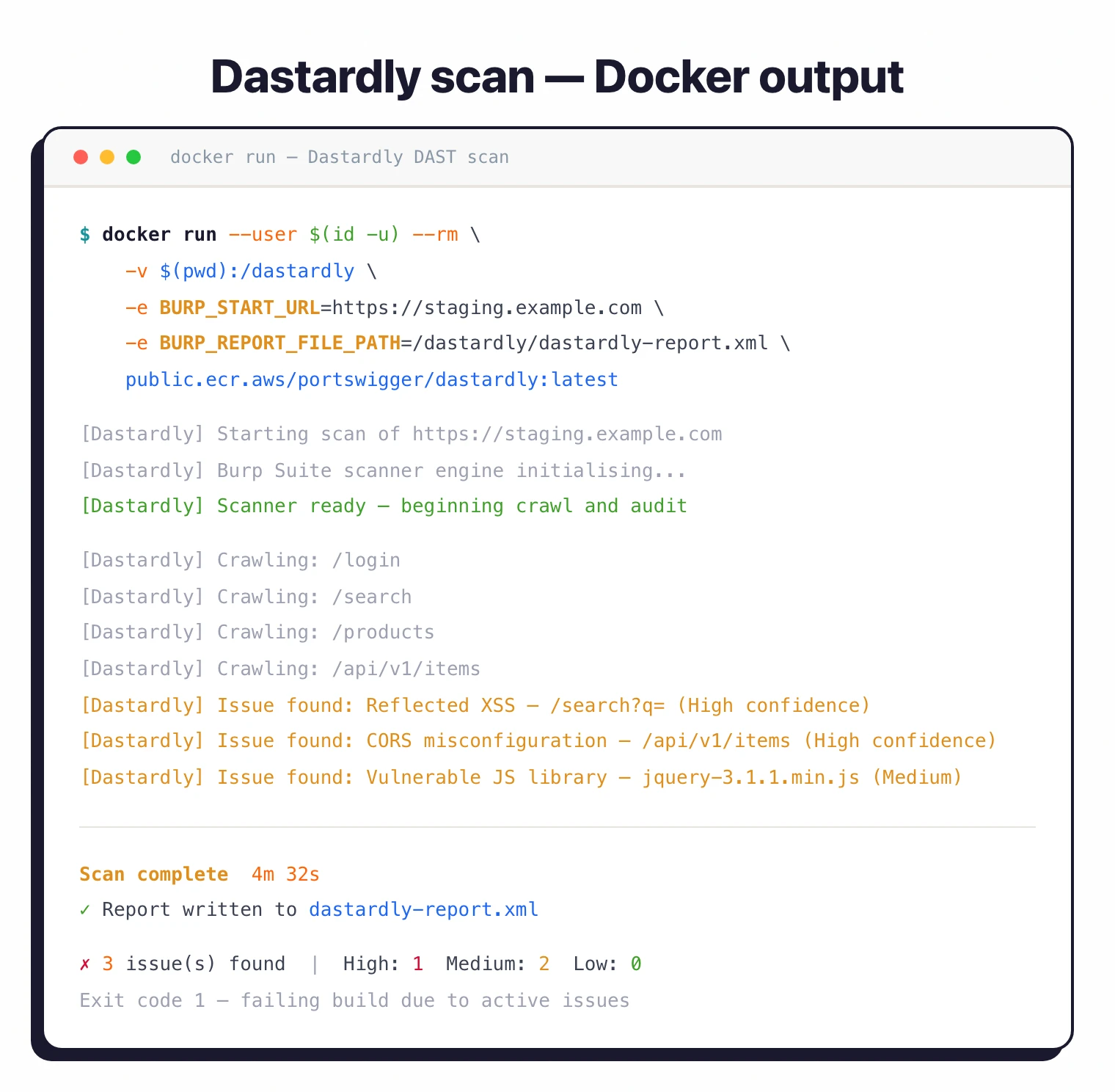
Zero configuration required — point it at a URL and it scans.
The tool is deliberately limited in scope. It covers a subset of Burp Suite’s vulnerability checks and has no manual testing capabilities.
But for teams that want a free, fast sanity check in CI/CD using a trusted scanning engine, Dastardly fills that gap.
Best for: Teams that want a free CI/CD DAST gate using the Burp Scanner engine, with zero configuration.
License: Free Key difference: Same Burp Scanner engine, free, Docker-based, 10-minute cap. No manual testing. Limited vulnerability coverage compared to full Burp Suite.
9. Nikto#
Nikto is a fast, no-frills web server scanner that checks for 7,000+ potentially dangerous files, scripts, and server misconfigurations. It has been around since the early 2000s and is pre-installed in Kali Linux alongside Burp Suite.
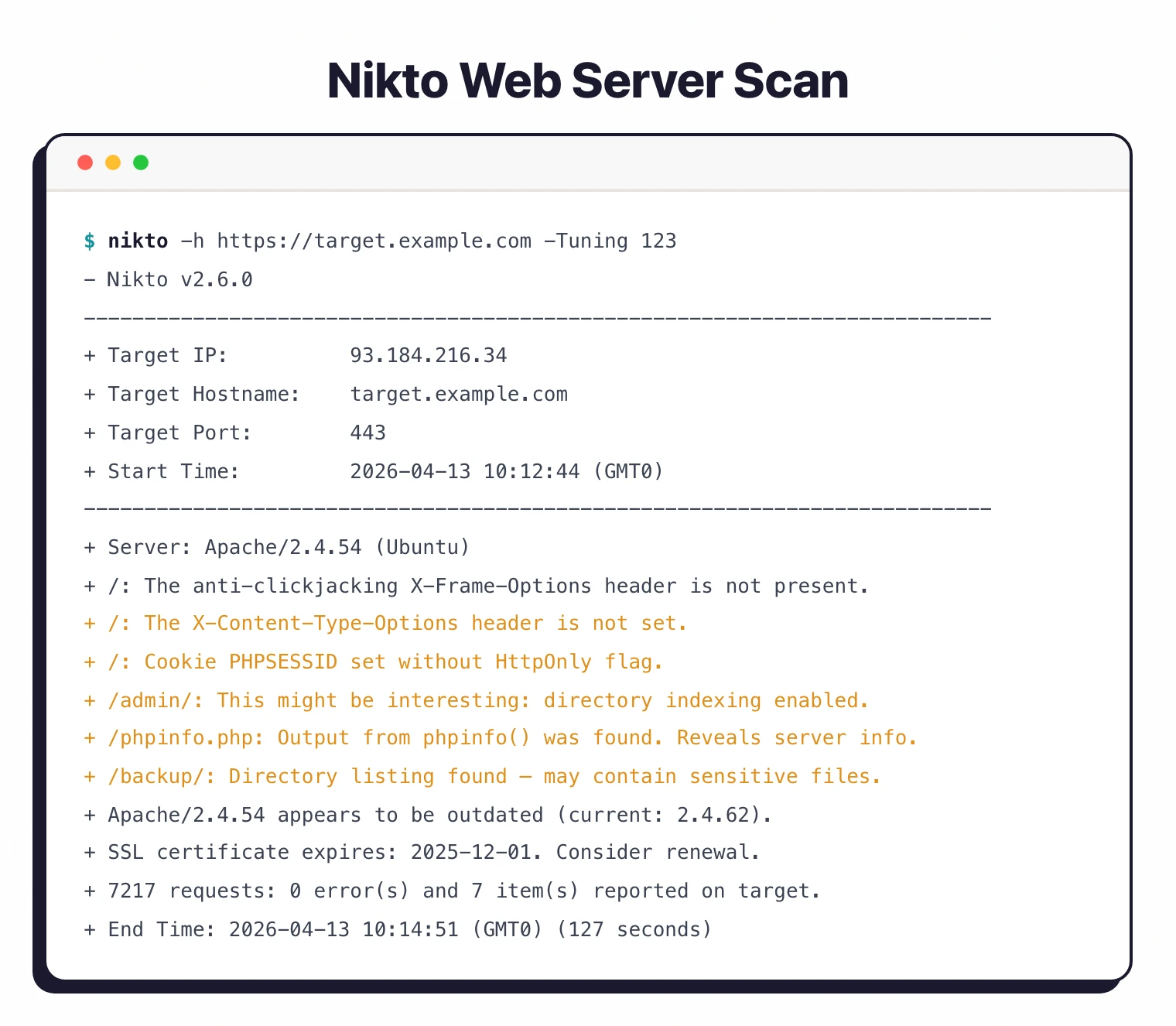
Nikto focuses on server-level issues rather than application-level vulnerabilities. It checks for outdated server versions, dangerous default files, and common misconfigurations.
The tool runs from the command line and outputs HTML, XML, JSON, CSV, and plain text.
Best for: Quick server-level reconnaissance and misconfiguration checks during penetration tests. License: Open-source (GPL-2.0) Key difference: Server-focused rather than application-focused. Fast reconnaissance tool, not a comprehensive DAST scanner.
Feature Comparison#
| Feature | Burp Suite Pro | ZAP | Caido | Nuclei | Acunetix | Invicti | StackHawk | Dastardly |
|---|---|---|---|---|---|---|---|---|
| License | $499/yr | Open-source | Freemium | Open-source | Commercial | Commercial | Freemium | Free |
| Manual testing | Full toolkit | Yes | Yes | No | No | Limited | No | No |
| Intercepting proxy | Yes | Yes | Yes | No | No | No | No | No |
| Automated scanner | Yes | Yes | Limited | Template-based | Yes | Yes | Yes | Yes (limited) |
| API scanning | Yes | REST, GraphQL, SOAP | Limited | HTTP, DNS, TCP | Yes | Yes | REST, GraphQL, gRPC, SOAP | Limited |
| CI/CD native | DAST edition | YAML automation | No | CLI-native | Yes | Yes | Core feature | Core feature |
| Extensions | 500+ BApps | Add-ons marketplace | Plugin system | 11,000+ templates | Limited | Limited | Limited | None |
| False positive handling | Manual triage | Manual triage | Manual triage | Template precision | 99.98% accuracy | Proof-based | ZAP engine | Low rate |
| AI features | Burp AI | No | No | AI template generation | Predictive Risk Scoring | AI remediation | HawkAI | No |
When to Stay with Burp Suite#
Burp Suite remains the right choice in several scenarios:
- You do manual penetration testing. Nothing matches Burp Suite’s combination of intercepting proxy, Repeater , Intruder , and Comparer for hands-on web security work. ZAP is the closest, but Burp Suite Professional is more polished and catches more edge cases.
- You need Burp Collaborator for out-of-band testing. Collaborator detects blind SSRF, blind XSS, and other out-of-band vulnerabilities that most automated scanners miss entirely. This capability has no direct equivalent in most alternatives.
- The BApp ecosystem matters to your workflow. With 500+ extensions covering JWT manipulation, authorization testing, content discovery, and more, the BApp Store extends Burp Suite in ways that are hard to replicate.
- Your team already knows Burp Suite. It is the most documented and taught web security tool in the world. Training materials, tutorials, and PortSwigger’s Web Security Academy provide a learning ecosystem that no alternative matches.
- You need both manual and automated testing. Burp Suite Professional combines manual tools with an automated scanner. If your workflow involves manual exploration followed by targeted scanning, this integrated approach saves time compared to switching between tools.
A few more reasons to stay put. If your team holds Burp Suite Certified Practitioner certifications, the value of internal expertise compounds — switching tools resets that knowledge. Compliance contexts that require evidence of manual penetration testing (PCI DSS 11.4 in particular) line up well with Burp’s audit-friendly reporting.
Larger organizations that already standardize on PortSwigger Enterprise (Burp Suite DAST) get unified RBAC across both Pro seats and the enterprise scanner without migrating tooling.
And if your AppSec program leans heavily on AD/SSO with deep group-based scoping, Burp’s Enterprise edition handles those access models without me writing custom session scripts in another scanner.
For detailed reviews of each alternative, browse the AppSec Santa DAST tools category.
Frequently Asked Questions
What is the best free alternative to Burp Suite?
Is Caido a good Burp Suite alternative?
Is ZAP as good as Burp Suite Professional?
Which Burp Suite alternative is best for CI/CD pipelines?
Can Nuclei replace Burp Suite for automated scanning?
What is the best Burp Suite alternative for API security testing?

Written & maintained by
Suphi CankurtEight years on the vendor side of application-security sales — thousands of evaluations and demos. I started AppSec Santa in 2022 to put that insider view to work for buyers. Independent of any vendor, paid by none, and honest about what fits whom.