


CrowdStrike Falcon ASPM is the ASPM module of the CrowdStrike Falcon platform — a runtime-driven approach to application security posture, with built-in shadow AI detection and sensitive data flow mapping.
What is Falcon ASPM?
I read CrowdStrike’s ASPM bet as the opposite of most of the field: Falcon ASPM builds its picture from how applications actually run.
The product page tagline — “Secure the applications that drive your business” — undersells the architectural choice. Falcon ASPM analyzes application code in runtime and uses that behaviour as the primary prioritization signal, with static package lists as secondary input.
The engine is agentless. It came from CrowdStrike’s 2023 acquisition of Bionic, and it maps microservices, APIs, data flows, and dependencies as a live graph.
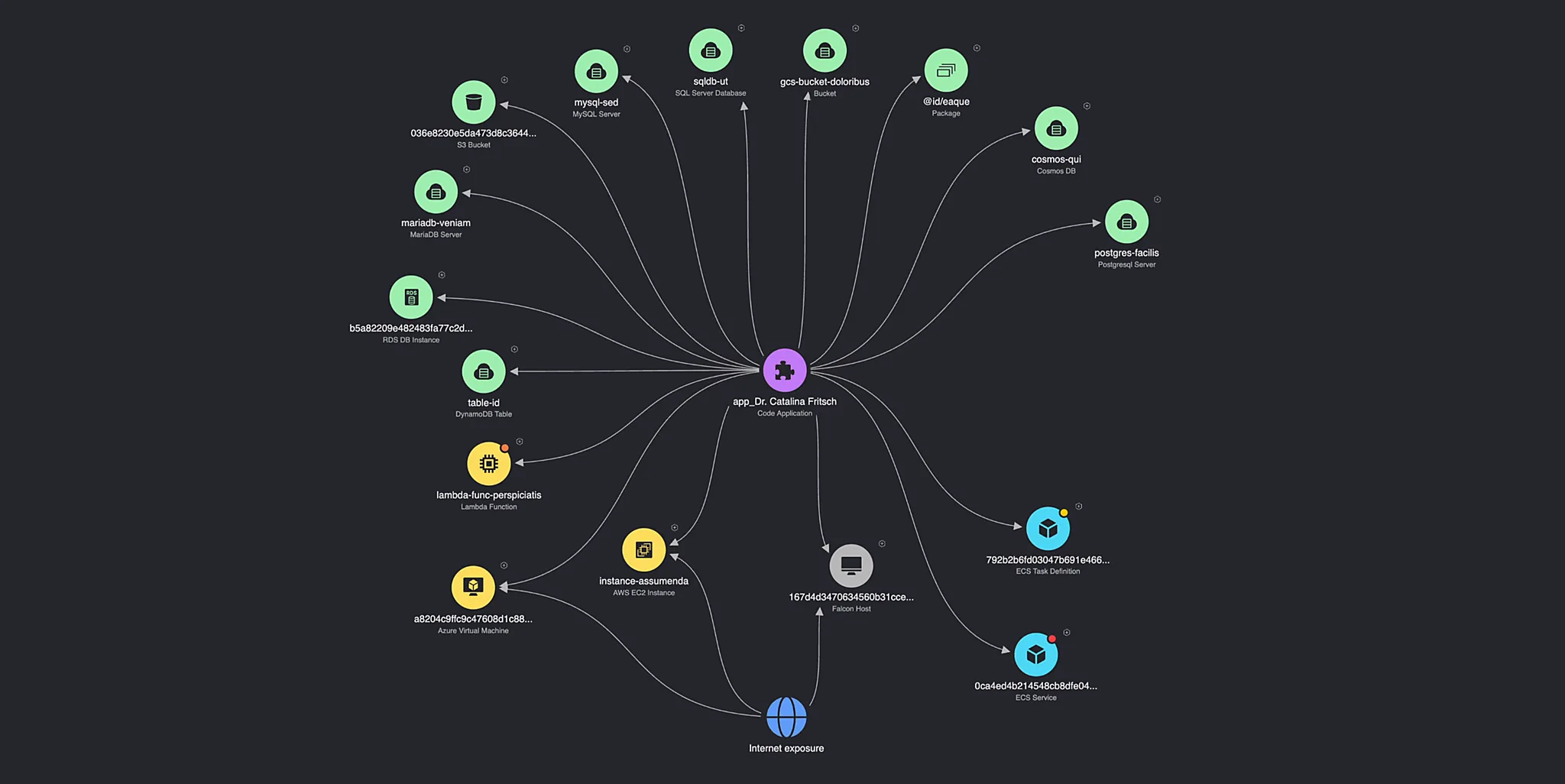 Falcon ASPM renders each application as a graph of its cloud services, data stores, and internet-facing exposure.
Key features
| Capability | What it does |
|---|---|
| Runtime application analysis | Surfaces exploitable vulnerabilities from how code executes, not which packages are present |
| Agentless graph mapping | Builds a real-time map of microservices, APIs, data flows, and dependencies |
| Shadow AI detection | Finds unsanctioned AI services and assesses what AI-enabled apps can access |
| Sensitive data flow | Identifies PII, PCI, and PHI moving through deployed applications |
| Breach-path detection | Combines application weaknesses with AI misconfigurations into likely attack paths |
Runtime-led prioritization
The traditional ASPM model ingests scanner findings, layers in intelligence (CISA KEV, EPSS, reachability heuristics), and produces a ranked queue. The runtime-led model differs in kind: vulnerabilities that never execute in production never reach the high-priority queue, regardless of CVSS.
| Static-led ASPM | Runtime-led ASPM (Falcon) |
|---|---|
| Findings start from scanner output | Findings start from runtime behaviour |
| Reachability is inferred statically | Reachability is observed |
| Strong on dev-time prevention | Strong on production-risk reduction |
| Works without runtime data | Uses agentless runtime analysis |
Both models have legitimate use cases. Choose static-led ASPM for pre-release prevention; choose runtime-led ASPM when production findings lack evidence of actual execution.
Shadow AI and sensitive data
Falcon ASPM detects unsanctioned AI services an application calls, monitors external AI integrations, and assesses what data those AI-enabled applications can reach. It also identifies combinations of application weaknesses and AI misconfigurations that together form breach paths.
On the data side, it automatically maps sensitive data flows — PII, PCI, and PHI — through deployed applications. That lets security and compliance teams scope exposure without instrumenting each service by hand.
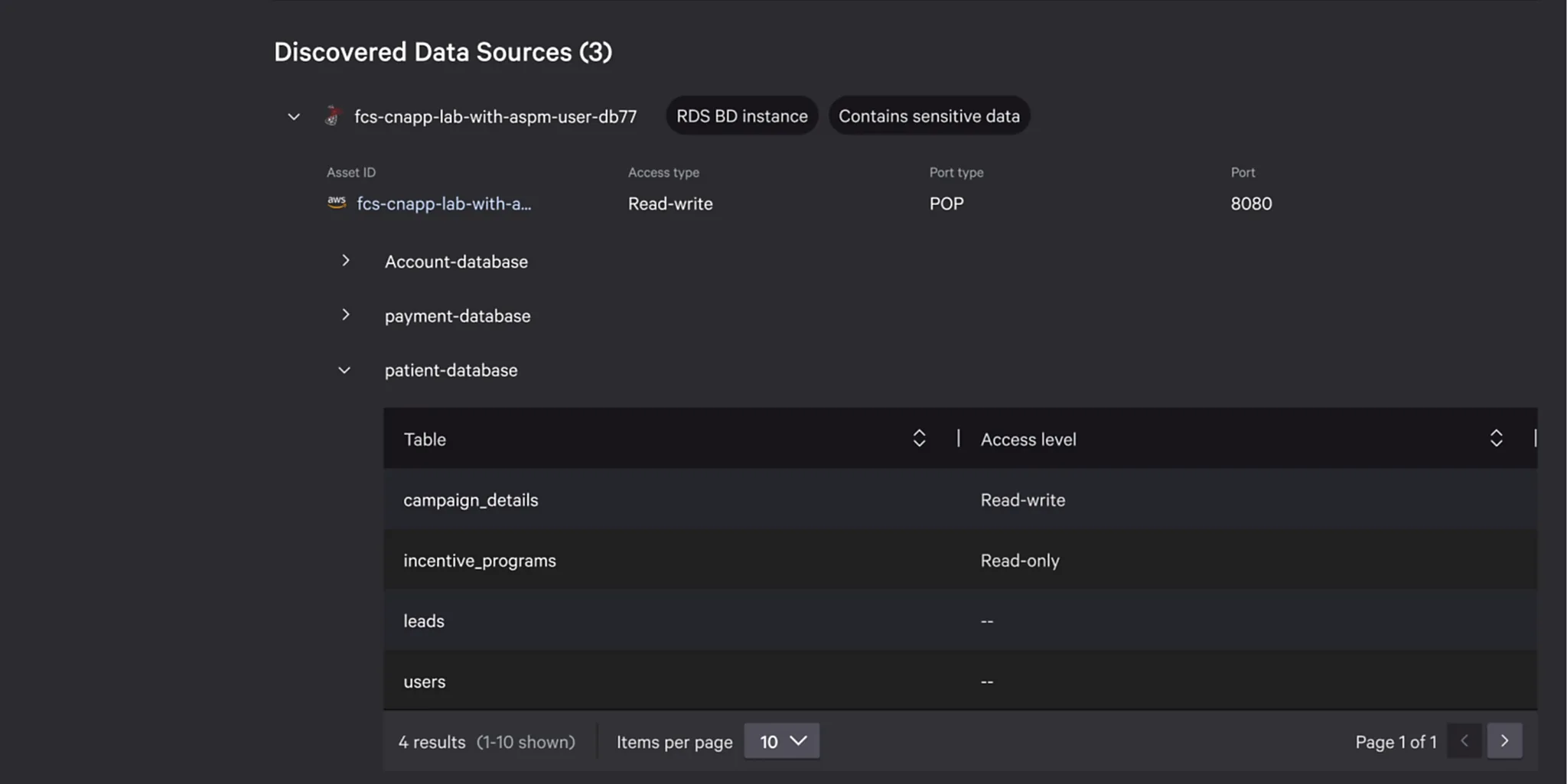 Discovered data sources are flagged when they hold sensitive data, down to table-level read/write access.
When to use CrowdStrike Falcon ASPM
Falcon ASPM fits organisations that already run CrowdStrike Falcon for endpoint or cloud workload protection and want to add ASPM without a third vendor. It also fits cloud-native shops where the runtime signal materially changes the prioritization picture.
Teams with shadow AI and sensitive-data exposure as active concerns get native coverage for both — categories most pure ASPM tools do not yet handle.
Teams without an existing Falcon footprint, or who prefer static-led ASPM with deep developer-tool integration, typically evaluate ArmorCode , Cycode , Apiiro , Invicti ASPM , or Wiz instead.
Pricing requires a sales conversation. Falcon ASPM is licensed as part of the broader Falcon platform.
How does Falcon ASPM fit into the Falcon workflow?
Falcon ASPM connects application runtime behavior with cloud services and AI usage. CrowdStrike’s product page presents that shared context as the basis for prioritizing application risk.
The operational flow starts with discovering applications and their dependencies. Teams then review runtime reachability, cloud exposure, sensitive-data paths, and asset importance before routing remediation.
I would pilot it on one cloud application whose services and owners are already understood. That gives the team a known map for checking whether Falcon’s application graph reflects reality.
The ASPM datasheet focuses on risks present in production now. Development teams still need source, dependency, and pipeline controls before deployment.
How is Falcon ASPM delivered and updated?
Falcon ASPM is part of Falcon Cloud Security rather than a separate downloadable scanner. CrowdStrike provides a Falcon Cloud Security trial and a vendor-led demo path.
CrowdStrike publishes quarterly Falcon platform highlights instead of numbered ASPM releases. The Spring 2026 update includes unified application and cloud risk plus shadow-AI discovery in cloud-native applications.
Product-specific list pricing is not shown on the ASPM page. Existing Falcon customers should confirm whether the module fits their current subscription or requires additional Falcon Flex capacity.
What are CrowdStrike Falcon ASPM’s limitations?
Falcon ASPM prioritizes what runs in production . It cannot replace design review, SAST, SCA, or testing for code that has not executed there.
The value also depends on a usable cloud and application map. Short-lived workloads, incomplete permissions, or services outside the connected cloud estate can leave gaps in that picture.
Falcon ASPM is closely tied to the Falcon platform. Teams without an existing CrowdStrike operating model should include platform onboarding, identity, data access, and commercial packaging in the evaluation.
I would test the prioritization result, not just graph completeness. The useful question is whether runtime context consistently changes remediation order without hiding issues the team still considers material.
Sensitive-data discovery also requires careful access design. The platform needs enough cloud visibility to map flows, while security teams must keep those permissions within their own least-privilege standards.
I would review that access before connecting production accounts and repeat the review when new cloud services enter the application graph.