
CRACI is a software supply chain security service built into CI runners. It runs GitHub Actions jobs and records the packages a build downloads in an SBOM (Software Bill of Materials).
The company was founded in Helsinki in 2025 and operates as CRACI Corporation Oy. In 2026 it raised a €1.4M pre-seed led by Lifeline Ventures, with First Fellow Partners and Wave Ventures.
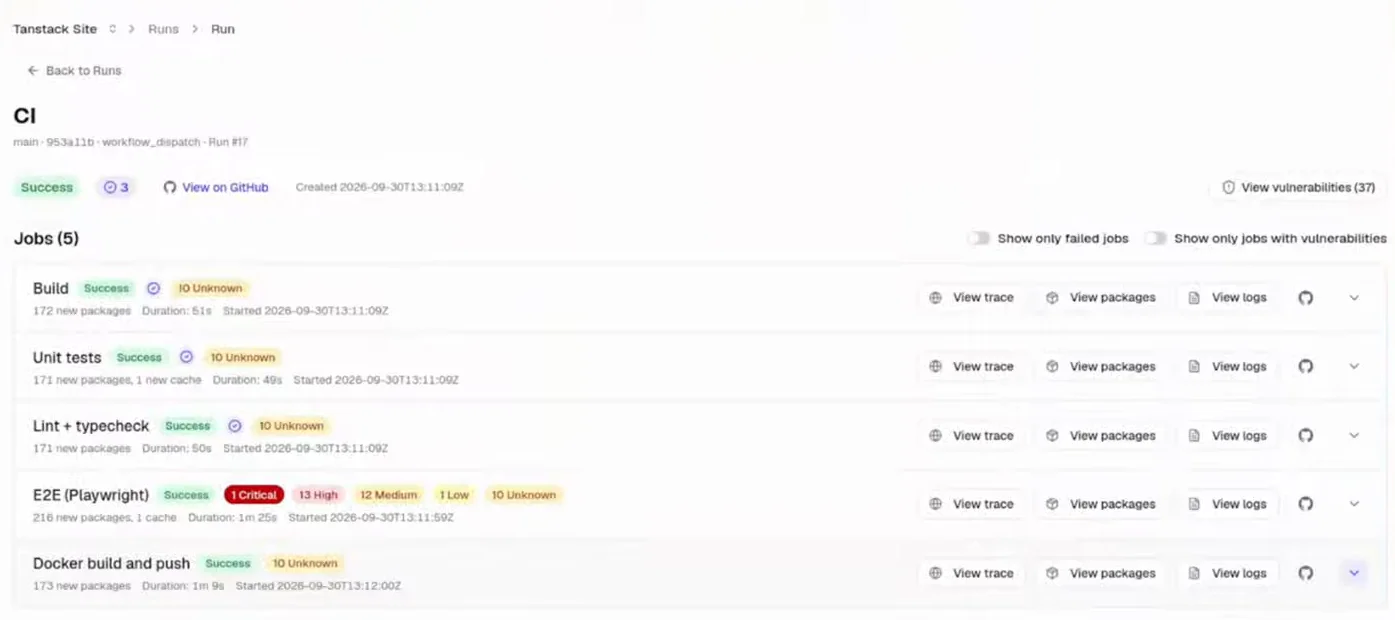 A CI run in CRACI: each job shows package counts, vulnerability badges and links to its trace, packages and logs. From CRACI’s sign-up demo video.
What is CRACI?
Most SCA tools read a lockfile or scan a finished image. CRACI watches the build itself.
A package-aware proxy sits between the job and its package sources. Downloads from supported sources are recorded, including fetches that a lockfile never lists.
CRACI names three kinds it is built to catch: downloads from install hooks, fetches inside build scripts, and container base image layers.
Switching is a one-line change in the workflow. Jobs run in isolated virtual machines on European infrastructure, and runs still show up in GitHub as usual.
The four co-founders are Juho Niemi (CEO), Dennis Marttinen (CTO), Jaakko Sirén (CPO) and Petteri Pulkkinen (CISO). The team page lists 14 people.
CRACI’s information security management system holds ISO/IEC 27001 certification, issued by Into Certification. Its homepage names Fluencify, Homie, Bahn Express, Hamina Wireless, ConfidentialMind and Propia as teams building on it.
I based this review on CRACI’s website, pricing, about and team pages, its documentation and its sign-up demo video, checked on November 18, 2026.
What are CRACI’s key features?
| Capability | Details |
|---|---|
| Runners | GitHub Actions-compatible, selected with runs-on: craci; one isolated VM per job |
| Sizes | 1 to 32 units per job, each 1 vCPU and 3 GiB of memory; default 2 units |
| Architectures | x86-64 and ARM64 at the same price |
| Images | Default image matches GitHub’s Ubuntu 24.04 runner image |
| SBOM | CycloneDX or SPDX per build, including transitive dependencies |
| Network | Network trace of every build, plus a per-job egress policy |
| Vulnerabilities | Recorded packages matched against known vulnerabilities and re-evaluated after release |
| Fixes | Fixbox pull requests for vulnerable dependencies, verified with a new build |
| CI support | GitHub Actions only, Linux jobs only |
| Hosting | European infrastructure; ISO/IEC 27001-certified ISMS |
Which package sources does CRACI record?
CRACI lists ten source types, plus download presets for Yocto and OpenEmbedded builds.
| Source type | Examples |
|---|---|
| Language registries | npm, PyPI, RubyGems, Cargo, Go |
| System packages | apt, apk, Nix |
| Containers | OCI registries |
| Code | Git sources over HTTPS or SSH |
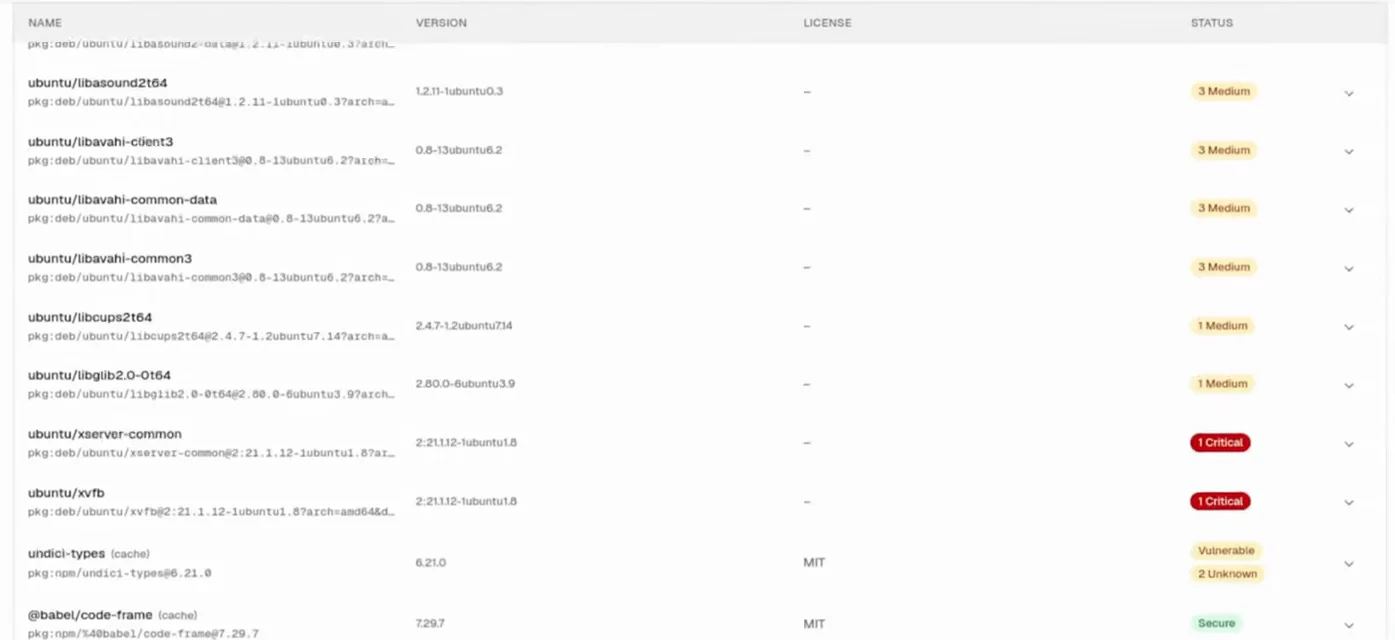 The package view: OS and npm packages together, with package URLs, versions, vulnerability statuses and license values where available.
Caches need care. The docs list restoring a cache, pulling OCI artifacts and allowing unmonitored traffic as reasons a job SBOM is marked degraded.
SBOM completeness
Each job gets a completeness status: Complete, Complete with connections, Incomplete, Unavailable, or Unknown or absent. It flags gaps CRACI knows about, not every package it missed.
CRACI’s docs are direct about the limit. Support for package sources is still expanding, and some packages may not yet be detected.
A build SBOM also lists build tools, test dependencies and downloads the build never used. It shows what the build fetched, not what shipped in the artifact.
Egress policy
A network policy limits which hosts a job can reach. Without one, unmatched traffic is allowed, so the policy is opt-in.
Once a job has a network section, its default setting is deny. The presets, sources and connections you allow get through, and policies are validated before the job starts.
sources:
  - oci:
      urls: [https://registry.example.com]
      repositoryPatterns: ["platform/**", "third-party/*"]
      operations: [pull]
The reference docs list sharp edges. Git fallback requests ignore repositoryPatterns, the SSH user field is not enforced, and overlapping passthrough rules can bypass package detection.
What happens after the build?
Stored SBOMs are re-checked as new vulnerabilities are published. Organization views show which vulnerable dependencies are shared across builds and repositories.
Security teams can triage findings and assign them to the owning team. You can also add vendor SBOMs from third parties for the same monitoring.
Fixboxes
A Fixbox opens one pull request per vulnerable dependency, including transitive ones. Its CI runs on CRACI, and the fix counts only when a new build, tests included, no longer has the vulnerability.
Nothing merges automatically, and GitHub signs the commits. You can scope Fixboxes to all vulnerabilities or only critical and high ones.
Fixboxes come with the Secure and Enterprise plans. They cover vulnerable dependencies only, not routine version bumps.
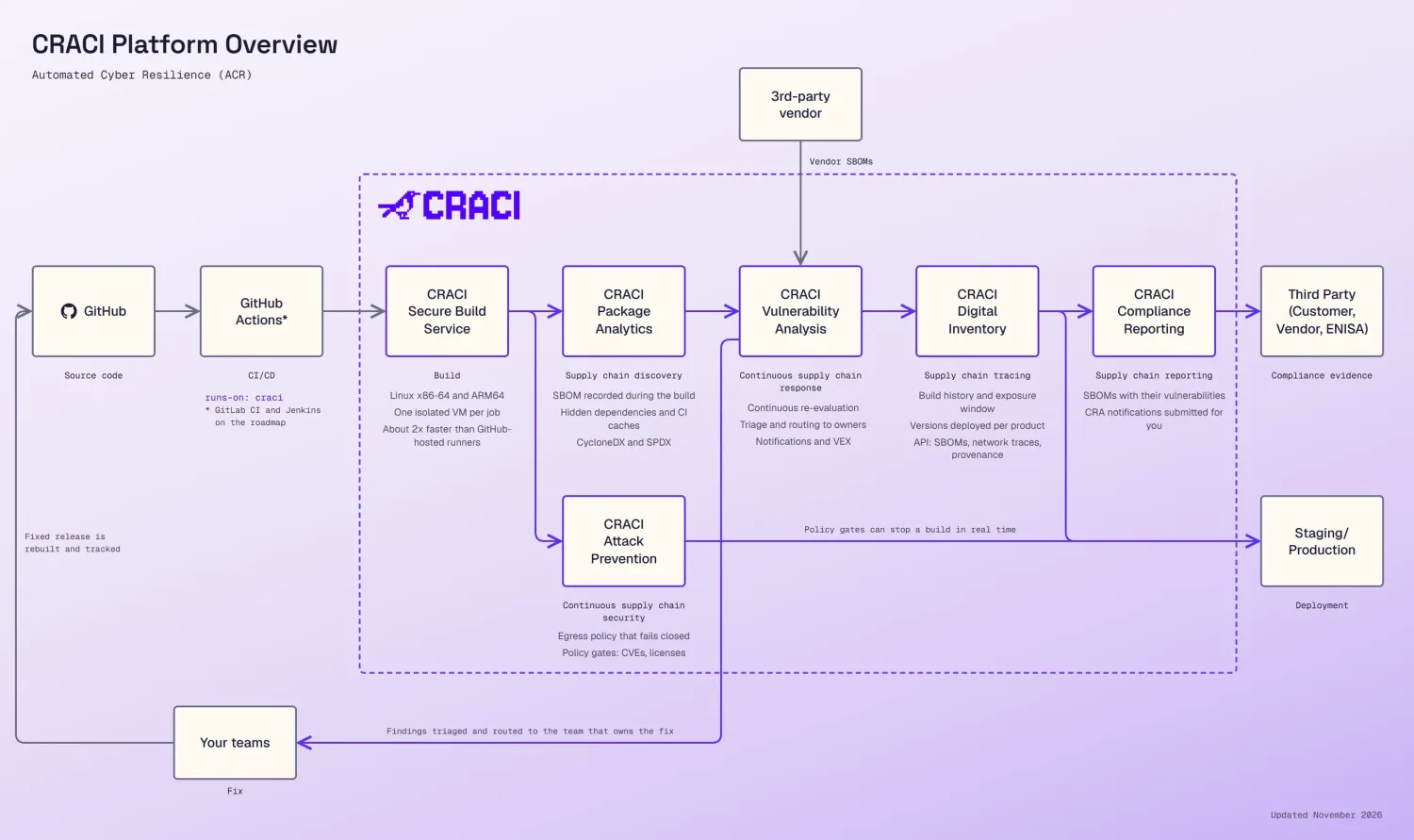 CRACI’s own map of the platform, from build to compliance reporting.
For the EU Cyber Resilience Act, CRACI prepares vulnerability notifications for you to submit yourself. The EU CRA guide explains what that reporting duty covers.
The API returns SBOMs, network traces and provenance, and build history is kept for 180 days by default.
CRACI vs Syft
Syft is Anchore’s Apache-2.0 SBOM generator. It catalogs container images, directories and archives, runs fully offline, and costs nothing.
Syft reads what is present after the build. CRACI records what the build downloaded while it ran, so it also sees install-hook fetches that never leave a manifest behind.
The trade is cost and lock-in. Syft runs locally and in most CI systems, while CRACI is a paid service that only covers GitHub Actions Linux jobs today.
Pick Syft for a free, portable SBOM of a finished artifact. Pick CRACI if you need a record of what entered the build and control over its network access.
CRACI vs Socket
Socket analyzes what a package does, such as network access, install scripts and obfuscation, and flags suspicious packages on the pull request before they merge.
CRACI does not judge package behavior. It records which packages a build fetched and can stop a job from reaching hosts you have not allowed.
The two cover different moments. Socket reviews a dependency change before merge; CRACI watches the build that runs afterwards.
Pick Socket to catch malicious packages at review time. Pick CRACI to see and limit what your builds actually pull in, and run both if you need both.
CRACI vs Dependabot
Dependabot is free on every GitHub repository. It raises alerts for vulnerable dependencies, opens security update pull requests and keeps versions current across 30+ ecosystems.
Dependabot works from your manifests and lockfiles. CRACI’s Fixboxes work from what the build actually downloaded, and each proposed fix runs through a fresh build and tests before your team merges it.
Dependabot also handles routine version updates, which Fixboxes skip. For that comparison, see Dependabot vs Renovate .
Pick Dependabot for free, manifest-based alerts and updates. Pick CRACI Fixboxes if you already build on CRACI and want fixes checked against the real build.
How much does CRACI cost?
CRACI publishes its prices and calls them early adopter pricing. Compute is €0.002 per vCPU-minute, billed by the second, with no concurrency limit.
| Plan | Price | Notable inclusions |
|---|---|---|
| Starter | €0/month + €0.002 per vCPU-minute | €10 free credit, SBOM per build, network trace, egress policy, vulnerability matching |
| Secure | €2,000/month + compute at 10% off | Continuous SBOM monitoring, alerts to Slack, incident.io or webhooks, policy gates, API, Fixbox pull requests |
| Enterprise | On request | SAML SSO, custom retention, run in your own cloud, uptime SLA |
Early adopters on Starter get unlimited seats, repositories and runner templates instead of 5, 10 and 2. On free credits alone, jobs can use 8 vCPUs in total at a time.
CRACI says Secure and Enterprise are still rolling out with early adopters. It also claims runners about twice as fast as GitHub’s standard ones, a vendor figure I have not reproduced.
How do you get started with CRACI?
The quickstart has three steps.
- Connect GitHub: enter your organization name, install the CRACI GitHub App, and give it access to all repositories or one.
- Move the build job: change
runs-ontocraci, leave the steps alone, and push to the default branch. - Review the result: download the SBOM and open Vulnerabilities for that run.
jobs:
  build:
    runs-on: craci
    steps:
| Requirement | Details |
|---|---|
| GitHub access | Owner access to the organization, or help from an owner |
| Repository | Private or internal; public repositories need a runner settings change first |
| Jobs | Linux only; macOS and Windows jobs stay on their current runners |
| Runner size | Optional cracicorp/setup@v1 step with a size from 1 to 32 |
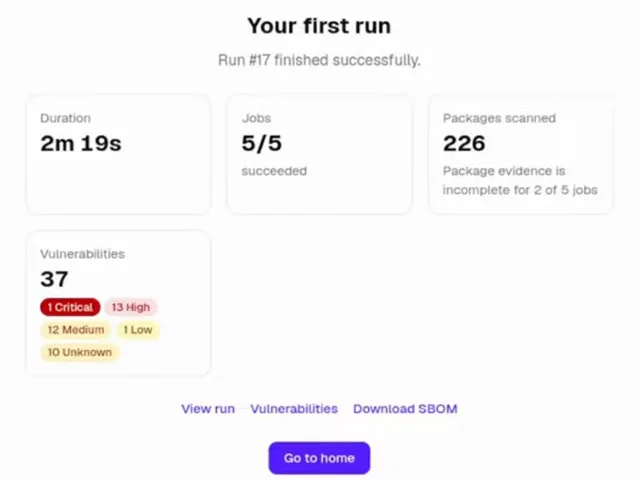 The onboarding summary after a first run. Note the completeness warning: package evidence was incomplete for 2 of 5 jobs.
When should you use CRACI?
It fits teams on GitHub Actions who need an SBOM of what their builds really fetched. Yocto and OpenEmbedded builds are covered through download presets.
It also fits teams preparing for EU CRA reporting who want build evidence and vulnerability tracking in one place.
It fits poorly if you run GitLab CI, Jenkins, or macOS and Windows builds. It is also the wrong tool if you only need a free SBOM of a finished container image.
What are alternatives to CRACI?
- Syft : free Apache-2.0 SBOM generator for images and directories.
- cdxgen : OWASP CycloneDX generator for source, images and VMs.
- Socket : behavior-based malicious package detection on pull requests.
- Dependency-Track : open-source platform that monitors CycloneDX SBOMs after build time.
For the wider picture, see software supply chain security tools and the SBOM tools comparison .
What are CRACI’s limitations?
- It covers GitHub Actions and Linux jobs only; GitLab CI and Jenkins are on the roadmap.
- CRACI says some packages may not yet be detected, and the completeness status only flags the gaps it knows about.
- The SBOM includes build and test tools and does not prove what shipped.
- Egress control is opt-in. Without a network policy, unmatched traffic is allowed.
- The company was founded in 2025, and its higher plans are still rolling out.
- The public pages do not name the vulnerability databases used for matching.