
Contrast Security Alternatives
Considering switching from Contrast Security? Compare top competitors including Checkmarx, Fortify, Seeker, HCL AppScan, and Datadog for runtime security.
Top Contrast Security Alternatives
View all 8 alternatives →
Line-of-Code Details

Unified AppSec Platform Integration
Runtime IAST with Low False Positives

APM-Integrated Vulnerability Detection

Runtime Code-Level Reporting

Patented False Positive Reduction
- Contrast Security's IAST agents support 8 languages (Java, .NET, Node.js, Python, Go, Ruby, PHP); Semgrep covers 30+ and Checkmarx covers 35+ without requiring runtime agents.
- Contrast's IAST produces fewer false positives than SAST by observing actual data flow during execution, but only detects vulnerabilities in code paths exercised during testing.
- Contrast Protect is one of the few tools offering RASP (runtime attack blocking) in production — most alternatives provide only development-time detection.
- Invicti's proof-based scanning verifies 94%+ of direct-impact vulnerabilities at 99.98% accuracy from both DAST and IAST perspectives.
- Datadog IAST integrates runtime security with APM, logging, and infrastructure monitoring — ideal for teams already on the Datadog observability platform.
The best Contrast Security alternatives in 2026 are Checkmarx, Semgrep, Snyk Code, and Fortify — offering broader language coverage and different deployment models for application security testing.
Why Look for Contrast Security Alternatives?
Contrast Security pioneered the commercial IAST and RASP market. Contrast Assess instruments running applications with a lightweight agent that traces data flow through the code, identifying vulnerabilities as they are exercised during testing.
Contrast Protect extends that instrumentation to production, detecting and blocking attacks in real time.
The approach produces far fewer false positives than traditional SAST because it observes actual execution rather than estimating code paths from static analysis.
The biggest barrier is language coverage. Contrast’s agents support Java, .NET, .NET Core, Node.js, Python, Go, Ruby, and PHP.
Teams working with Rust, Swift, Kotlin (outside JVM), or other languages cannot use Contrast at all. Agent deployment adds operational complexity, requiring instrumentation of every application instance and careful management of agent versions.
Some teams report measurable performance overhead from the agent, particularly under high-throughput scenarios.
Pricing is another friction point. Contrast uses a subscription model that scales with the number of applications and workloads.
For organizations running hundreds of microservices, costs accumulate quickly. The platform requires runtime access to applications, which raises concerns for teams with strict security policies about third-party agents running inside their production workloads.
And as SAST tools have improved their taint analysis capabilities, some teams question whether the additional accuracy IAST provides justifies the operational overhead of maintaining runtime agents.
Top Contrast Security Alternatives
1. Checkmarx One
Checkmarx One is a unified application security platform that bundles SAST, SCA, DAST, IAST, API security, IaC scanning, and container security.
Its SAST engine supports 35+ languages and 80+ frameworks, far exceeding the language coverage of Contrast’s agent-based approach. The platform is a consistent Gartner Magic Quadrant Leader, used by over 1,800 organizations worldwide.
Checkmarx’s IAST capabilities complement its SAST engine by correlating static findings with runtime behavior.
The ASPM layer aggregates findings from all scanning engines and prioritizes them based on application context, exploitability, and business criticality.
This cross-correlation between SAST and IAST findings cuts triage time compared to running separate tools.
Compared to Contrast, Checkmarx offers broader testing coverage but requires more setup and configuration.
The IAST component is part of a larger platform rather than a standalone product, which means teams get more capabilities but also more complexity.
Enterprise pricing with Checkmarx tends to be substantial, but organizations needing a unified AST platform often find the consolidation saves money compared to running multiple separate tools.

Best for: Enterprise teams needing a unified AST platform with SAST, IAST, SCA, and DAST under one roof. License: Commercial Key difference: 35+ language SAST plus IAST correlation. Full AST platform with ASPM for finding prioritization across all scan types.
2. Semgrep
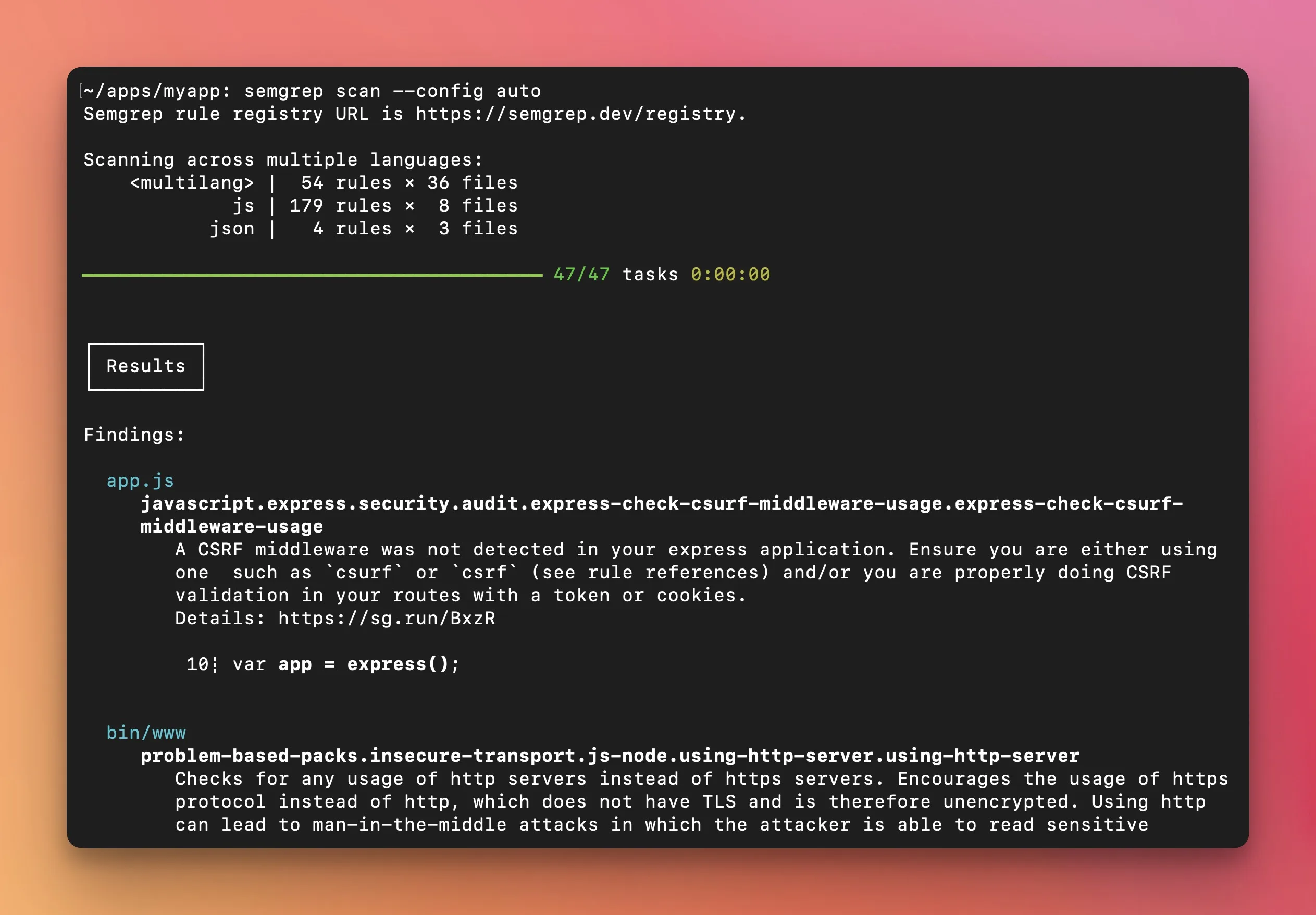
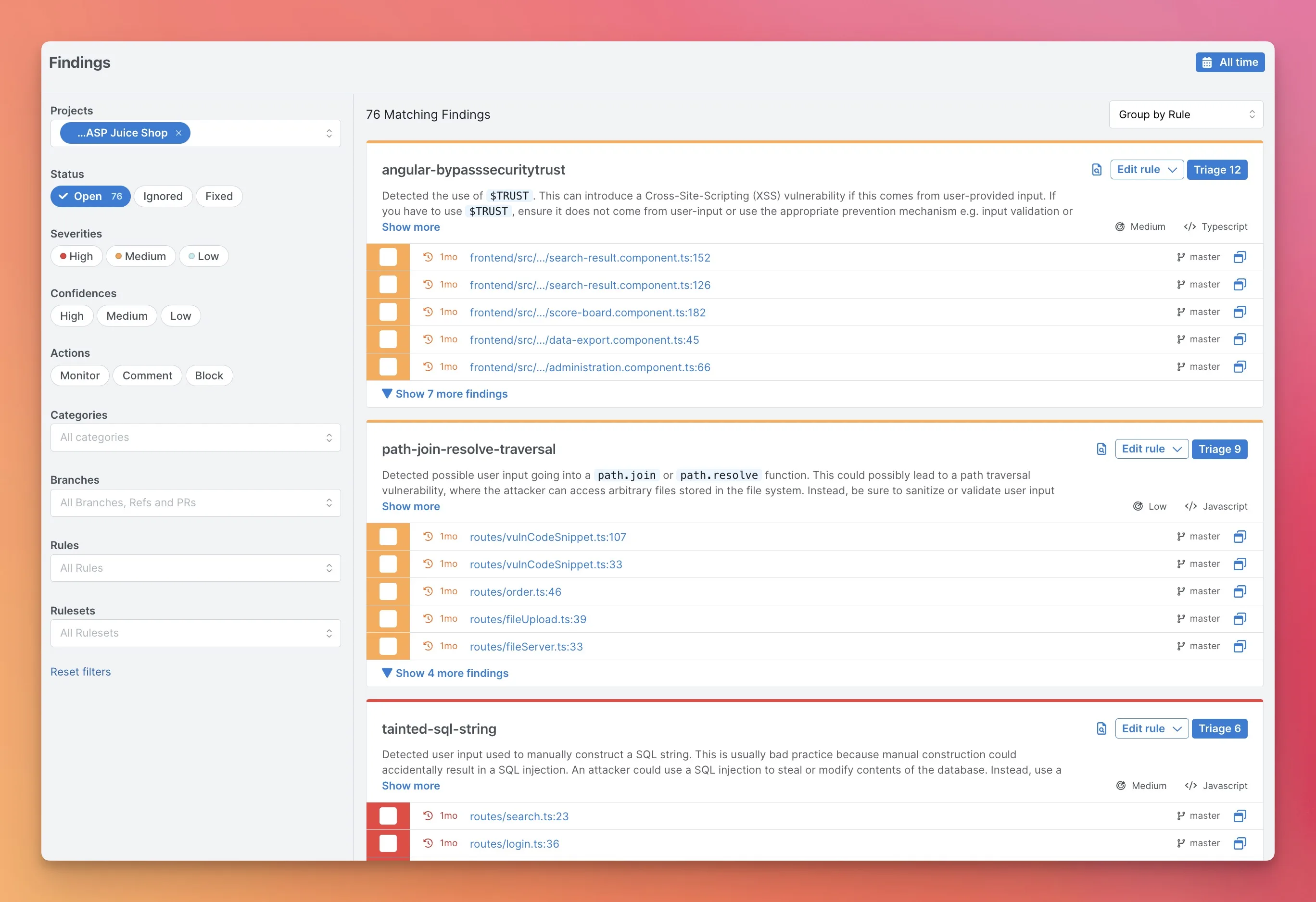
Semgrep takes a SAST-first approach that covers some of the same ground as Contrast Assess without requiring runtime instrumentation.
Semgrep Code performs cross-file taint analysis that traces data from user-controlled inputs through multiple files and functions to dangerous sinks.
This catches many of the injection vulnerabilities that IAST tools find, but from source code analysis rather than runtime observation.
The advantage over Contrast is deployment simplicity. Semgrep runs as a CLI or CI/CD step with no agents, no application changes, and no runtime overhead.
It supports 30+ languages compared to Contrast’s 8. Custom rules use a pattern syntax that reads like the code it matches, making rule authoring accessible to developers who are not security specialists.
Semgrep CE handles single-file analysis, while Semgrep Code on the AppSec Platform adds cross-file taint tracking and 20,000+ proprietary rules.
Semgrep cannot replicate Contrast Protect’s RASP capabilities. It analyzes code at rest, not applications at runtime.
False positive rates will be higher than IAST for some vulnerability classes because static analysis estimates data flow paths rather than observing them.
But for many teams, the combination of broader language coverage, simpler deployment, and competitive detection rates makes Semgrep a practical replacement for the IAST detection side of Contrast.
Best for: Teams that want vulnerability detection across 30+ languages without runtime agent overhead. License: Open Source / Commercial Key difference: No runtime agents needed. Cross-file taint analysis via static code analysis. 30+ language support vs. Contrast’s 8.
3. Snyk Code
Snyk Code provides real-time SAST inside IDEs, scanning code as developers write it.
The DeepCode AI engine performs semantic analysis that goes deeper than pattern matching, identifying vulnerabilities in context and proposing concrete fix suggestions trained on millions of real-world code changes.
Snyk Code supports 20+ languages and integrates with the broader Snyk platform for SCA, container scanning, and IaC.
Where Snyk Code differs from Contrast is the shift-left philosophy. Instead of finding vulnerabilities during QA testing (IAST) or blocking them in production (RASP), Snyk Code catches them before the code leaves the developer’s editor.
The AI fix suggestion feature is particularly useful: when a vulnerability is identified, Snyk proposes a specific code change rather than just describing the issue. This cuts mean time to remediation.
Snyk Code does not offer RASP or runtime protection. It is purely a development-time tool.
But its real-time feedback loop means many vulnerabilities are caught and fixed before they would ever reach the testing environment where Contrast Assess would find them.
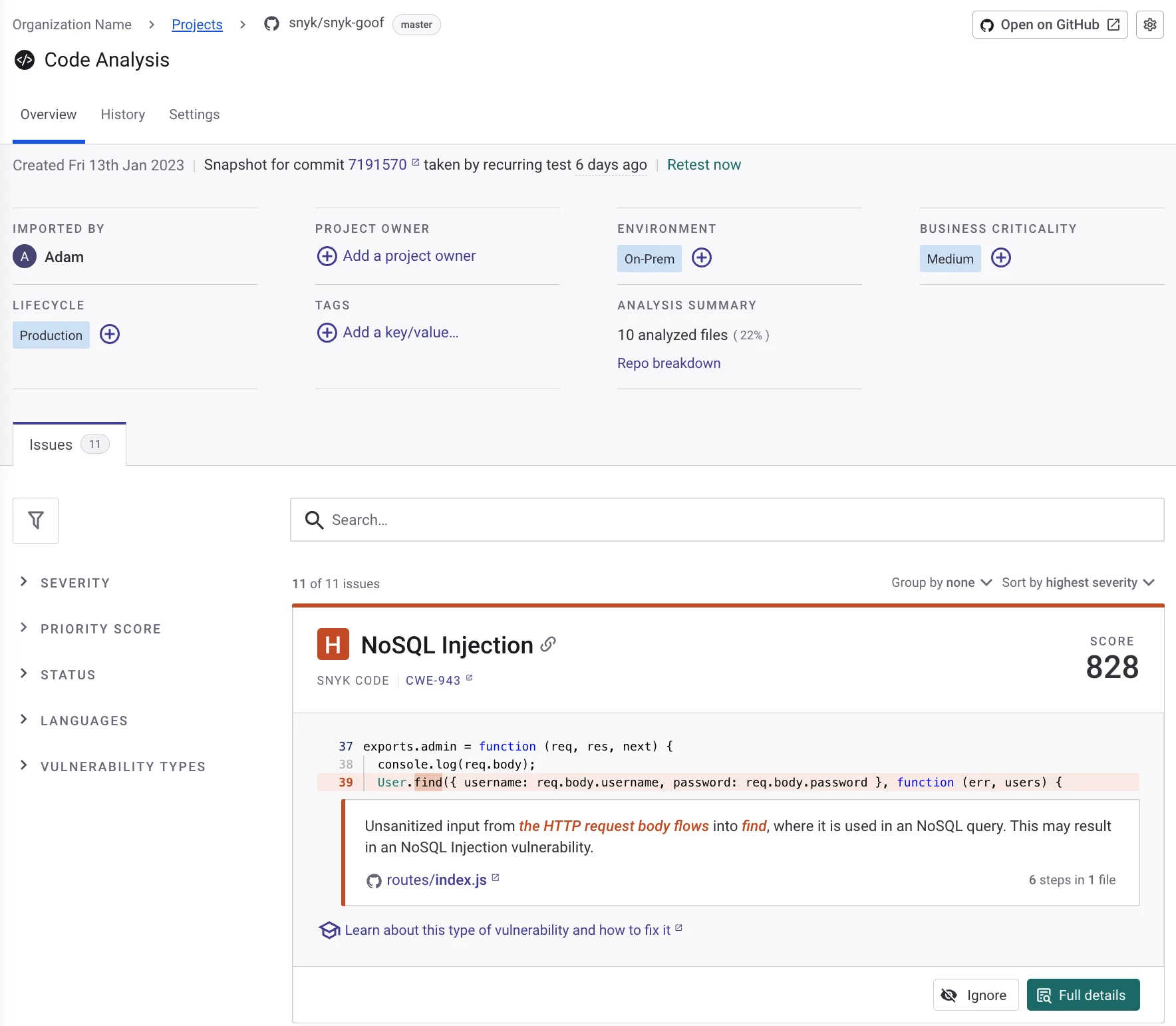
Best for: Developer teams wanting real-time vulnerability detection in IDEs with AI-powered fix suggestions. License: Commercial (free tier available) Key difference: Real-time IDE scanning catches vulnerabilities as code is written. AI fix suggestions propose specific code changes.
4. Fortify Static Code Analyzer
Fortify SCA, now under OpenText, has been a Gartner Leader for SAST for over a decade. It supports 33+ languages including legacy platforms like COBOL, ABAP, and PL/SQL that no other tool covers well.
Deep interprocedural analysis traces data flow across function boundaries and module imports, catching complex vulnerability patterns that lighter SAST tools miss.
Fortify offers deployment flexibility that Contrast does not: on-premises, SaaS (Fortify on Demand), and hybrid models. The on-premises option matters for regulated industries that cannot send source code to third-party clouds.
Audit Workbench provides desktop-based triage with detailed trace information. The rule set covers 1,700+ vulnerability categories.
The trade-off is speed and developer experience. Fortify scans take minutes to hours for large codebases, compared to Contrast’s real-time detection during testing.
The tool is built for security teams, not developers. But for organizations in regulated industries with legacy codebases, Fortify handles languages Contrast does not support.
Best for: Enterprises with legacy language requirements and on-premises deployment needs. License: Commercial Key difference: 33+ languages including COBOL and ABAP. On-premises, SaaS, and hybrid deployment options.
5. HCL AppScan
HCL AppScan provides SAST, DAST, IAST, and SCA in a single platform. Its IAST capability competes directly with Contrast Assess by instrumenting running Java and .NET applications.
The platform’s strength is breadth: rather than specializing in IAST alone, it provides a unified view across all testing methodologies.
AI and machine learning capabilities help reduce false positives and prioritize findings.
HCL AppScan has been trusted by regulated industries for decades (originally IBM AppScan). Its compliance coverage includes PCI DSS, HIPAA, OWASP Top 10, and SANS Top 25 out of the box.
The enterprise governance features support large organizations with hundreds of applications and multiple development teams.
The platform carries enterprise pricing and complexity. Setup is more involved than Contrast.
Scan times for SAST are slower than modern tools. But for organizations that want SAST, DAST, and IAST from a single vendor with proven compliance support, HCL AppScan provides that consolidation.
Best for: Large enterprises in regulated industries needing SAST, DAST, and IAST with compliance reporting. License: Commercial Key difference: Combined SAST, DAST, IAST, and SCA in one platform. Decades of enterprise compliance coverage.
6. Invicti
Invicti combines DAST with IAST capabilities in its proof-based scanning approach. The IAST component, known as Invicti Shark, provides a lightweight agent that confirms DAST findings from inside the application.
According to Invicti’s analysis of six years of scan data, this proof-based approach verifies over 94% of direct-impact vulnerabilities with 99.98% accuracy, virtually eliminating false positives.
Best for: Teams wanting combined DAST and IAST with proof-based vulnerability verification. License: Commercial Key difference: Proof-based scanning verifies vulnerabilities from both outside (DAST) and inside (IAST) the application simultaneously.
7. Datadog IAST
Datadog Application Security provides IAST capabilities integrated into the Datadog observability platform.
For teams already using Datadog for APM, logs, and infrastructure monitoring, adding IAST is a straightforward add-on that reuses existing agents and dashboards. The tool correlates security findings with performance data and runtime context.
Best for: Organizations already using Datadog for observability that want IAST integrated into their existing monitoring stack. License: Commercial Key difference: IAST integrated with APM, logging, and infrastructure monitoring. Leverages existing Datadog agents.
8. Imperva RASP
Imperva RASP provides runtime application self-protection focused on production defense. Unlike Contrast, which provides both IAST and RASP, Imperva focuses specifically on the runtime protection side.
The tool instruments applications to detect and block attacks like SQL injection, XSS, and command injection from inside the application, complementing WAF protection at the network layer.
Best for: Teams that need production runtime protection without the IAST component. License: Commercial Key difference: Focused RASP for production defense. Complements WAF with application-layer attack blocking.
9. Dynatrace Application Security
Dynatrace provides runtime vulnerability detection as part of its full-stack observability platform. The OneAgent instrument automatically detects vulnerabilities in running applications and maps them to specific code locations.
The approach is similar to IAST but integrated into an observability tool rather than a standalone security product.
Best for: Dynatrace customers who want runtime vulnerability detection as part of their observability platform. License: Commercial Key difference: Runtime security integrated with full-stack observability. OneAgent provides automatic instrumentation without separate security agents.
10. PT Application Inspector
PT Application Inspector by Positive Technologies combines SAST, DAST, and IAST in a single tool. The combination of testing methodologies provides cross-validation: SAST findings can be confirmed by DAST and IAST, reducing false positives.
The tool generates exploit samples to verify vulnerabilities, giving development teams concrete evidence of issues.
Best for: Teams wanting combined SAST, DAST, and IAST with automated exploit verification. License: Commercial Key difference: Generates exploit samples to prove vulnerabilities are real. Three testing methodologies in one tool.
PT Application Inspector review
Note: Positive Technologies has been under U.S. sanctions since April 2021. U.S.-based organizations should verify compliance requirements before evaluating this tool.
Feature Comparison
| Feature | Contrast | Checkmarx One | Semgrep | Snyk Code | Fortify | HCL AppScan | Invicti |
|---|---|---|---|---|---|---|---|
| Testing type | IAST + RASP | SAST + IAST + DAST + SCA | SAST | SAST | SAST | SAST + DAST + IAST + SCA | DAST + IAST |
| Languages | 8 | 35+ (SAST) | 30+ | 20+ | 33+ | 30+ | N/A (web apps) |
| Agent required | Yes | IAST only | No | No | No | IAST only | IAST only |
| Runtime protection | RASP | No | No | No | No | No | No |
| False positive rate | Very low | Low (SAST) | Medium | Low | Medium | Medium | Very low (proof-based) |
| CI/CD integration | Yes | Yes | Yes | Yes | Yes | Yes | Yes |
| IDE integration | No | Yes | Yes | Yes (real-time) | Yes | Yes | No |
| Custom rules | Limited | Yes | Core feature | No | Yes | Yes | No |
| Free tier | No (CE discontinued June 2025) | No | CE engine | Yes | No | No | No |
| On-premises | Yes | Yes | Yes | Enterprise only | Yes | Yes | Yes |
When to Stay with Contrast Security
Contrast Security remains the right choice when runtime accuracy matters most. IAST produces the lowest false positive rates of any application security testing methodology because it observes actual data flow during execution rather than estimating it from source code.
If your team spends significant time triaging false positives from SAST tools, Contrast Assess will reduce that burden substantially.
Contrast Protect provides runtime defense that no SAST tool can replicate. If your security program requires defense-in-depth with application-layer attack blocking in production, Contrast is one of the few tools that instruments the application itself rather than sitting at the network perimeter.
For organizations running Java, .NET, Node.js, Python, Go, Ruby, or PHP applications where the supported languages align with the stack, Contrast’s combination of IAST and RASP remains the most comprehensive runtime security solution available.
For more AppSec Santa comparisons, see our IAST tools category.
Frequently Asked Questions
What is the best free alternative to Contrast Security?
How does Contrast compare to traditional SAST tools?
Can Semgrep replace Contrast Security?
Is IAST still relevant with modern SAST tools?
What is the difference between Contrast Assess and Contrast Protect?

+7 Years in AppSec
10+ years in application security. Reviews and compares 208 AppSec tools across 11 categories to help teams pick the right solution. More about me →