


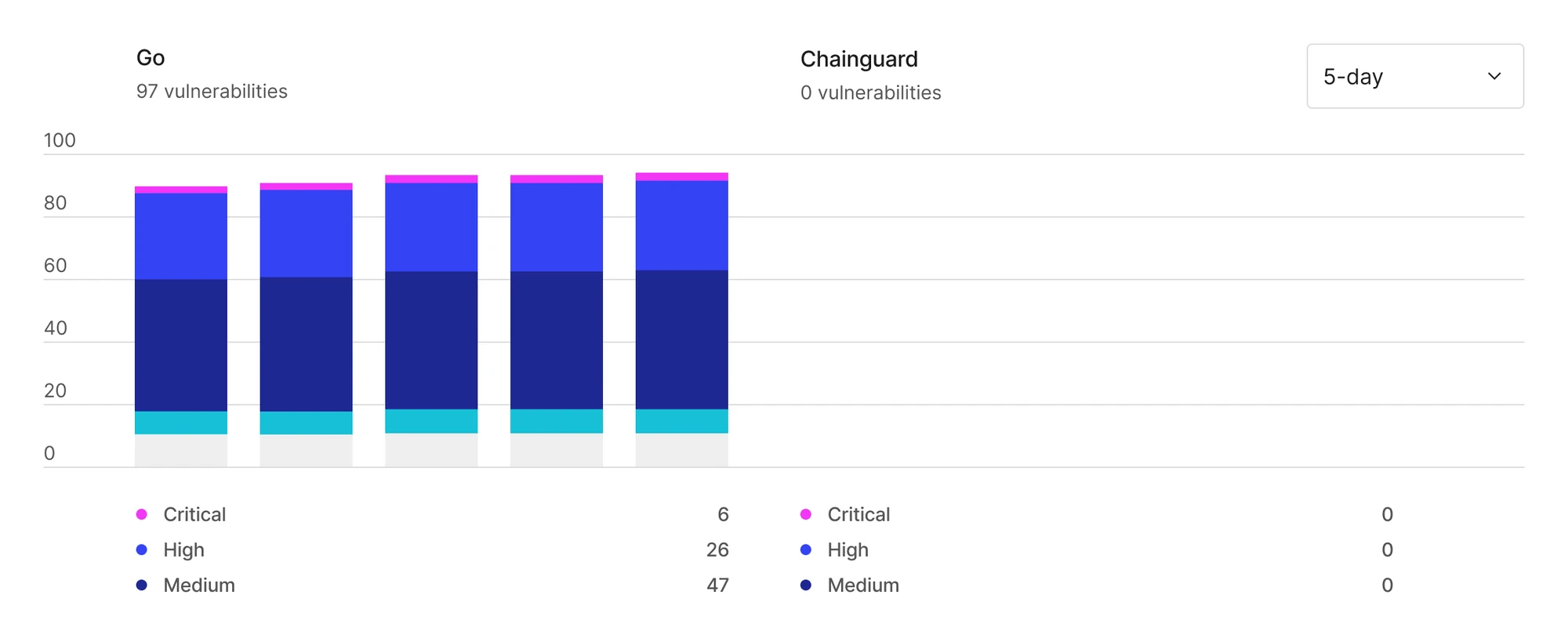
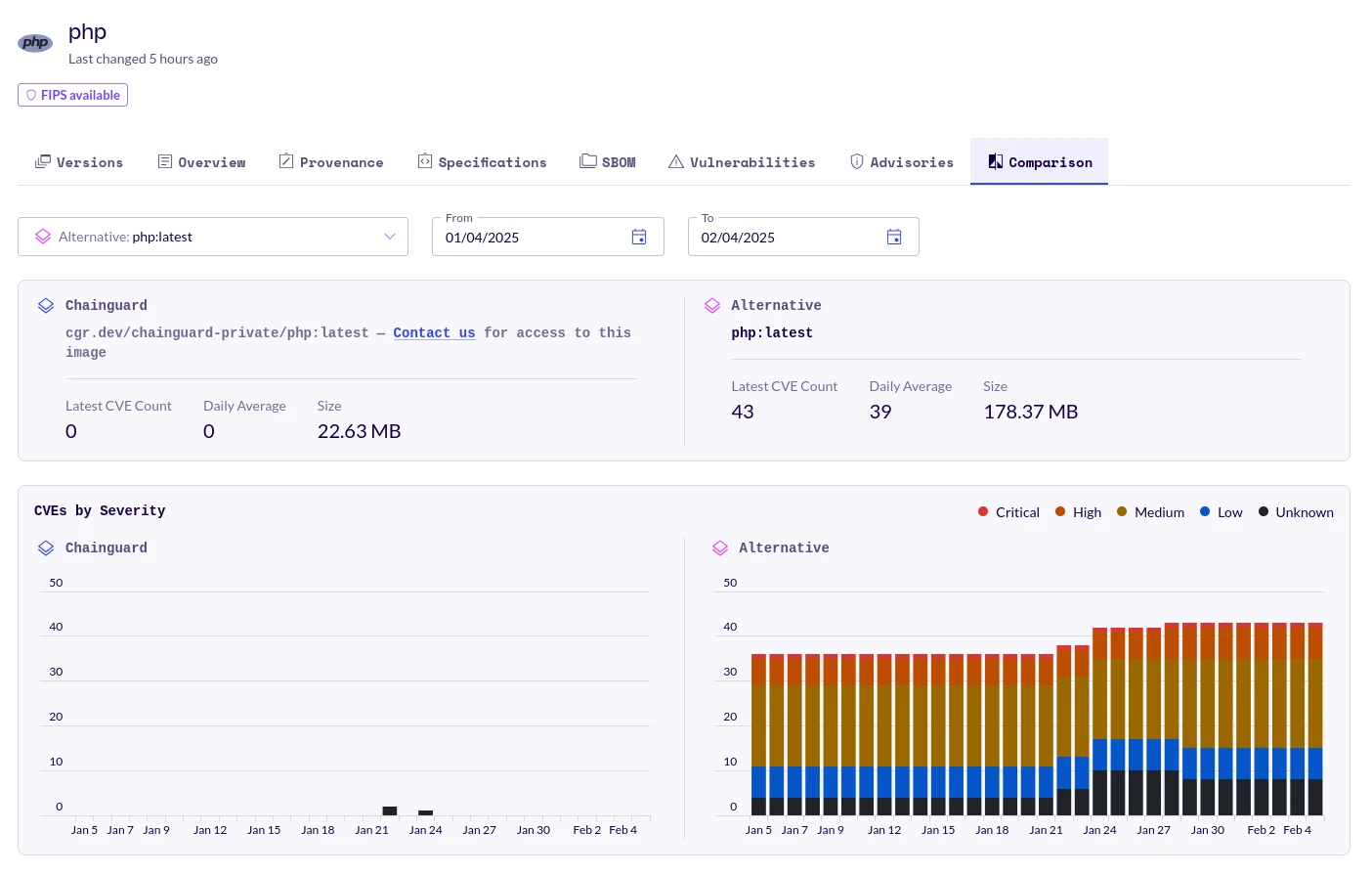
Chainguard provides hardened container images that it reports carry zero or near-zero known CVEs. Where standard Docker Hub images regularly carry dozens of unpatched vulnerabilities, Chainguard Images are rebuilt nightly from source with only the packages needed to run the application.
The “zero-CVE” label is Chainguard’s own framing: it means zero known CVEs at scan time against public vulnerability databases, not an independent guarantee that an image is flaw-free.
As of February 2026, Chainguard reports surpassing 500 million unique container build manifests and a catalog of more than 2,000 projects. The company was founded by former Google engineers who created Sigstore, the open-source signing standard for software artifacts, and reported $40M ARR in FY2025.
What is Chainguard?
Chainguard is a supply chain security company that takes a different approach to vulnerability management. Instead of scanning images after they are built and filing tickets for remediation, Chainguard produces images that start clean.
Every image is built on Wolfi, a minimal Linux undistro purpose-built for containers, and goes through an automated pipeline that rebuilds, patches, signs, and generates SBOMs without manual intervention.
The result is a drop-in replacement for popular base images (Node.js, Python, Go, Nginx, PostgreSQL, and hundreds more) that carries significantly fewer vulnerabilities from day one.
| Capability | Details |
|---|---|
| Zero-CVE Images | Images are built from source with only essential runtime dependencies. No shells, no package managers, no unnecessary utilities. Automated nightly rebuilds ensure the latest patches are always applied. |
| Built-in SBOMs | Every Chainguard Image includes a high-quality SBOM generated at build time, attesting exactly what software is inside. Available in standard formats without additional tooling. |
| Sigstore Signing | All images are cryptographically signed using Sigstore and include SLSA Build Level 2 provenance attestations, verifying the integrity of the build process from source to artifact. |
What are Chainguard’s key features?
Distroless, minimal images
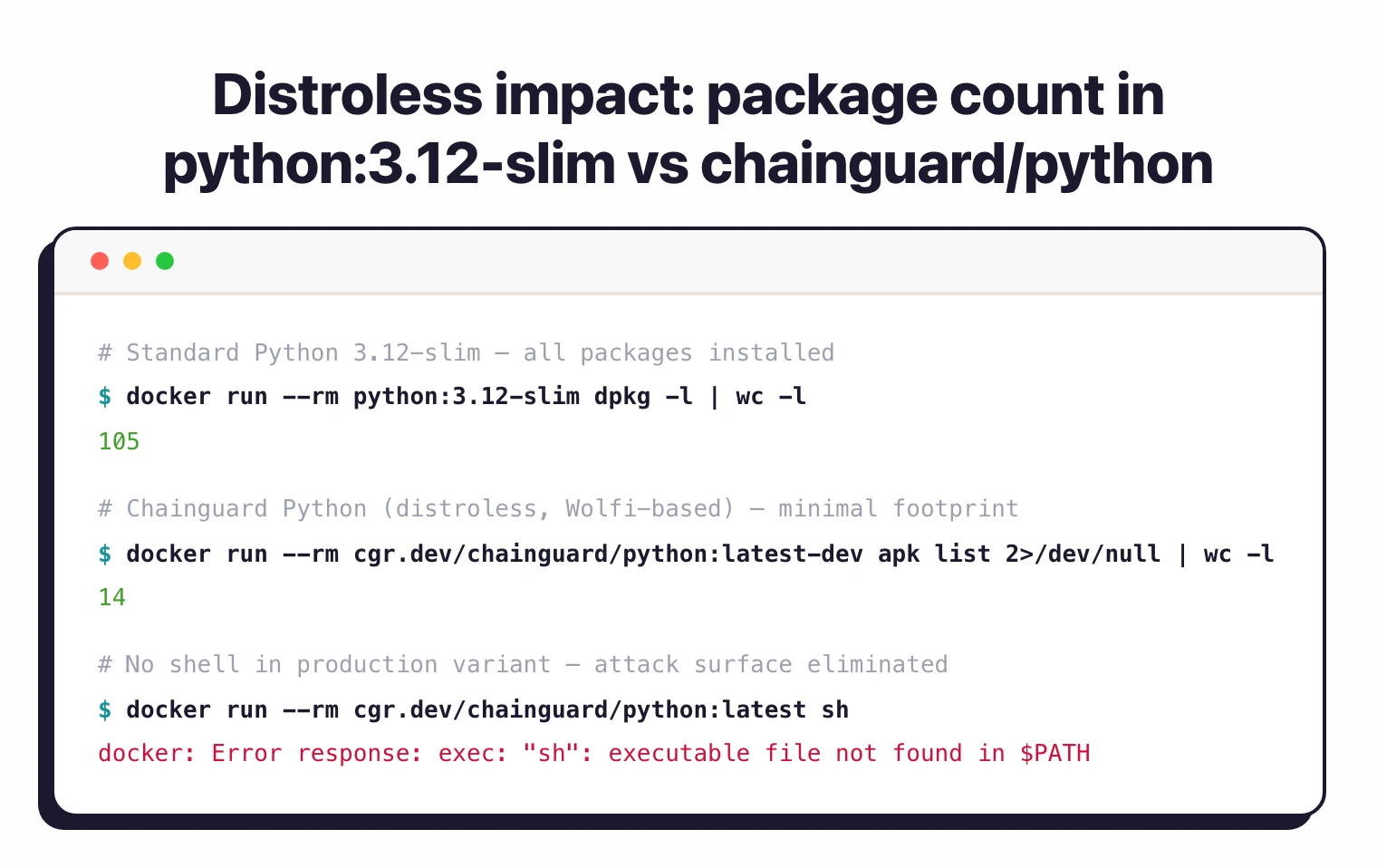
Chainguard Images follow a distroless philosophy. They contain only the application and its essential runtime dependencies.
Shells, package managers, debugging utilities, and other common tools that expand the attack surface are excluded by default. Development variants (tagged :latest-dev) include a shell for debugging but are not intended for production.
This minimal approach dramatically reduces the number of packages in each image, which directly reduces the number of potential vulnerabilities.
Automated nightly rebuilds
The Chainguard factory platform, powered by DriftlessAF, rebuilds every image nightly from source. This is not just a base layer update.
The entire image is reconstructed, pulling in the latest security patches from upstream sources. AI-driven reconciliation bots trigger dependency updates and vulnerability-based rebuilds automatically, so images stay current without manual intervention.
Wolfi: the container-native Linux undistro
Wolfi is Chainguard’s purpose-built Linux distribution for containers. Unlike traditional distributions that ship hundreds of packages to support general-purpose computing, Wolfi packages are granular and independently versioned. Key characteristics include:
- No kernel – Wolfi relies on the host kernel, reducing the package footprint
- apk-based – Uses the Alpine Package Keeper format for fast, minimal package management
- Security hardening – Packages compiled with hardening flags (PIE, RELRO, stack protectors)
- Detailed provenance – Every package includes SBOM data and build attestations
SBOM and attestation
Every Chainguard Image ships with an SBOM generated during the build process. These are not afterthought scans.
The SBOM reflects exactly what went into the image at build time, making it far more accurate than post-build scanning tools that may miss statically linked binaries or embedded libraries.
Images also include Sigstore cosign signatures and SLSA Build Level 2 provenance attestations. You can verify the entire chain from source commit to container registry.
Catalog breadth
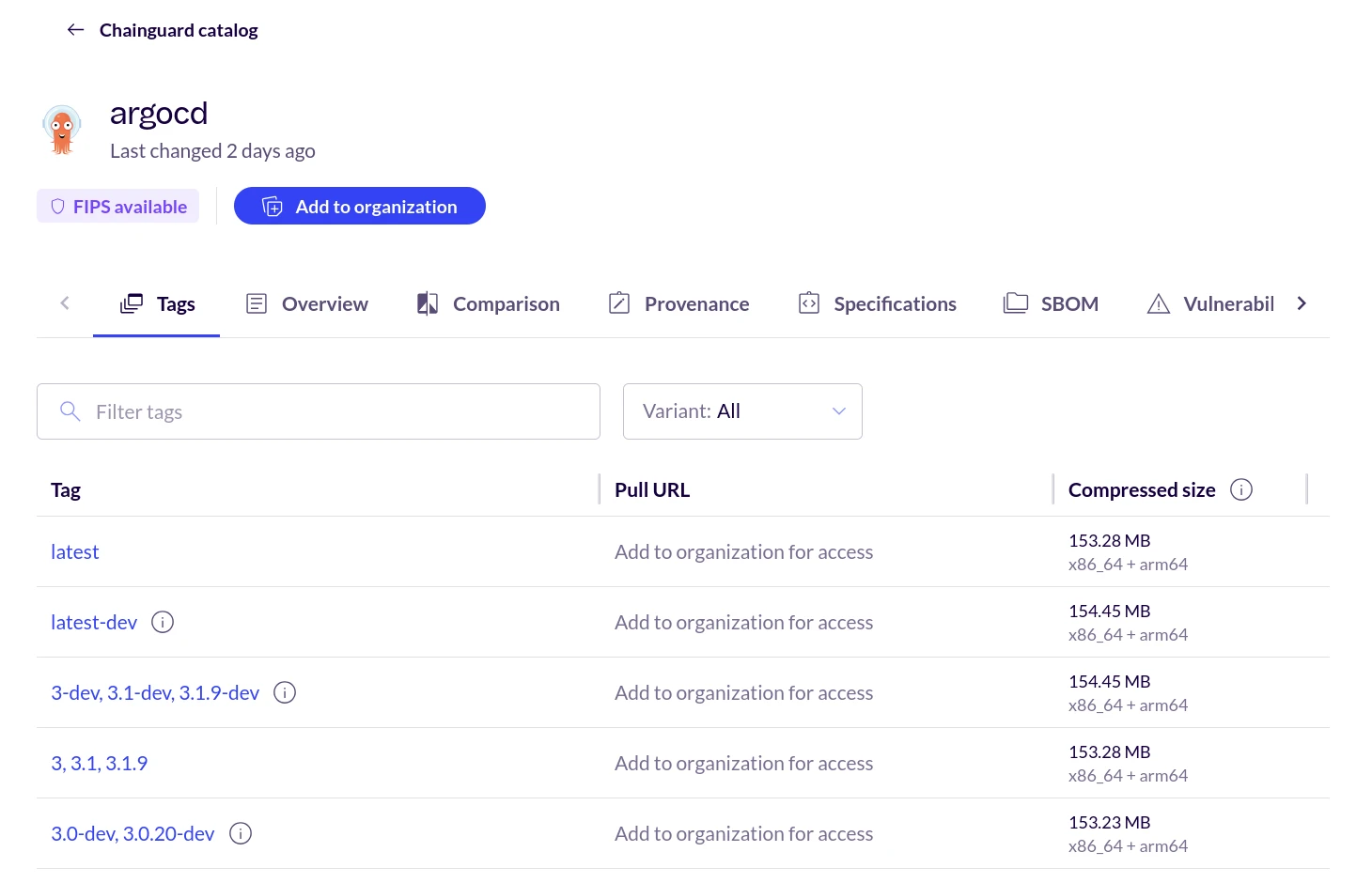
The Chainguard catalog covers 2,000+ projects including popular runtimes, databases, web servers, and development tools. Chainguard says it has added more than 600 new projects since introducing its catalog option in June 2025 — a roughly 50% expansion.
| Category | Example Images |
|---|---|
| Runtimes | Node.js, Python, Go, Ruby, Java (JRE/JDK), .NET, PHP, Rust |
| Databases | PostgreSQL, MySQL, MariaDB, Redis, MongoDB |
| Web Servers | Nginx, Caddy, Traefik, HAProxy |
| Infrastructure | Kubernetes, Helm, Terraform, Vault, Consul |
| CI/CD | Git, GitHub Actions Runner, GitLab Runner |
| Monitoring | Prometheus, Grafana, OpenTelemetry |
How do I get started with Chainguard?
- Pull a free image – Free tier images are available without login:
docker pull cgr.dev/chainguard/python:latest - Verify the signature – Use cosign to verify:
cosign verify --certificate-oidc-issuer=https://token.actions.githubusercontent.com --certificate-identity=https://github.com/chainguard-images/images/.github/workflows/release.yaml@refs/heads/main cgr.dev/chainguard/python:latest - Check the SBOM – Download the attestation:
cosign download attestation cgr.dev/chainguard/python:latest - Replace your base image – Update your Dockerfile FROM line to use Chainguard’s image as a drop-in replacement.
# Before: standard Python image with 100+ known CVEs
FROM python:3.12-slim

# After: Chainguard Python image with zero known CVEs
# Use the -dev variant which includes pip and other package managers for building
FROM cgr.dev/chainguard/python:latest-dev

WORKDIR /app
COPY requirements.txt .
RUN pip install --no-cache-dir -r requirements.txt
COPY . .
CMD ["python", "app.py"]
How much does Chainguard cost?
| Tier | Access | SLA | Price |
|---|---|---|---|
| Free | ~50 images, :latest tag only | No CVE SLA | Free |
| Catalog | 2,000+ images, version pinning | CVE remediation SLA | Contact sales |
| Per-Image | Selected images | CVE remediation SLA | Contact sales |
Free tier images receive automatic updates including major and minor version bumps. Paid tiers add version pinning, extended support for older versions, and a guaranteed SLA for CVE remediation turnaround.
When to use Chainguard
Chainguard is the right choice when you want to eliminate container vulnerabilities at the source rather than triaging scan results after the fact.
Strengths:
- Zero or near-zero CVEs out of the box (Chainguard’s own framing), reducing scan-and-patch cycles
- Build-time SBOMs and Sigstore signatures for supply chain compliance
- 2,000+ images covering most popular software stacks
- Automated nightly rebuilds keep images current without manual effort
- Free tier available for evaluation and small projects
Limitations:
- Not a vulnerability scanner; it is a secure image provider (pair with Grype or Trivy for runtime scanning)
- Distroless images lack shells, making debugging more difficult
- Paid tiers required for version pinning and CVE remediation SLAs
- Switching base images requires Dockerfile changes and testing across your stack
How it compares:
| vs. | Key difference |
|---|---|
| Docker Hub Official Images | Docker Hub images prioritize compatibility over security and often carry dozens of CVEs. Chainguard reports its minimal images carry zero known CVEs. |
| Grype | Grype scans existing images for vulnerabilities. Chainguard provides images it reports carry no known vulnerabilities to begin with. Complementary tools. |
| Distroless (Google) | Google’s distroless images pioneered the minimal approach. Chainguard extends it with nightly rebuilds, SBOMs, Sigstore signing, and a much broader catalog. |
| Alpine | Alpine is small but still carries CVEs and requires manual patching. Chainguard images are rebuilt nightly and include supply chain attestations. |
Further reading: Container Image Security | What is SBOM? | Software Supply Chain Security