


Bumblebee is an open-source scanner that inventories the packages, extensions, and developer tools installed on a machine, then flags exposure to known software supply-chain compromises.
It comes from Perplexity AI and sits next to SCA tooling, but it works from a different angle. Rather than scanning a project’s dependency tree in CI, it reads what is actually installed on a developer endpoint.
GitHub: perplexityai/bumblebee | Stars: 4.8k | Latest release: v0.1.2 (June 2026) | License: Apache-2.0
The project is young — the repository was created in May 2026 and reached 4.8k stars within its first months. It is written in Go with zero non-standard-library dependencies.
What is Bumblebee?
Bumblebee answers one incident-response question: which of my machines has this compromised package on it?
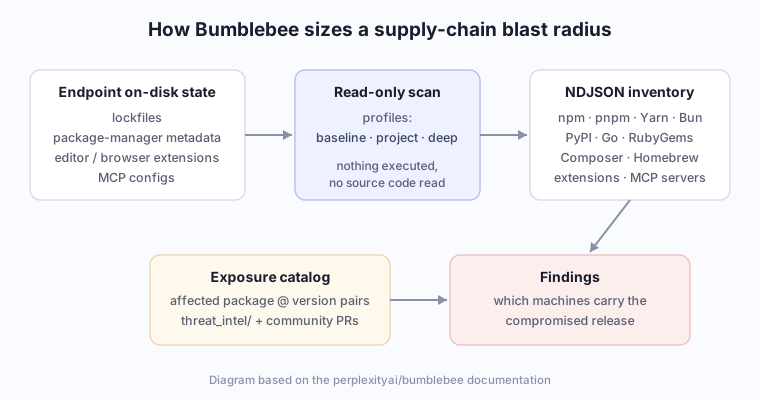
When a package is found to be malicious, responders need to know their exposure fast. Bumblebee reads on-disk state — lockfiles, package-manager metadata, extension manifests, MCP configs — and turns it into a structured inventory.
It is read-only by design. It does not run package managers, install anything, or read application source code, which keeps it safe to run on a potentially affected endpoint.
The inventory only becomes useful once you pair it with an exposure catalog. That catalog lists the affected package-and-version pairs, and Bumblebee reports any match as a finding.
Key Features
| Feature | Details |
|---|---|
| Mode | Read-only; no package-manager execution, no source reading |
| Platforms | macOS and Linux developer endpoints |
| Inventory | Packages, editor/browser extensions, MCP servers, agent skills |
| Exposure matching | Against a JSON exposure catalog of affected package/version pairs |
| Output | NDJSON — package records, finding records, and a scan summary |
| Profiles | baseline, project, deep |
| Runtime | Go 1.25+, zero non-stdlib dependencies |
| License | Apache-2.0, open-source |
Ecosystems it reads
Bumblebee spans several package ecosystems in one pass, which matters during a broad incident.
| Category | Coverage |
|---|---|
| JavaScript | npm, pnpm, Yarn, Bun |
| Python | PyPI |
| Go | Go modules |
| Ruby | RubyGems |
| PHP | Composer |
| System | Homebrew formulas and casks |
| AI / dev tools | MCP servers, agent skills |
| Extensions | VS Code, Cursor, Windsurf, VSCodium, Chromium, Firefox |
Scan profiles
The profile controls how much of the filesystem Bumblebee walks. Wider scans find more but take longer.
| Profile | Scope |
|---|---|
baseline | Common global and user package roots, toolchains, and extensions |
project | Configured development directories passed with --root |
deep | Explicit and broad roots; requires --exposure-catalog for exposure checks |
Exposure catalogs
Inventory alone tells you what is installed. Exposure matching tells you what is dangerous.
Catalogs are JSON files with a schema_version and an entries array. Each entry names an ecosystem, a package, and affected versions, where "versions": ["*"] matches every version of that package.
The repository ships threat-intelligence catalogs under threat_intel/, and the community keeps them current through pull requests. You can also point Bumblebee at your own catalog for internal advisories.
Output
Every scan produces NDJSON, one record per line. Package records carry the ecosystem, version, source file, and a confidence level; finding records carry exposure-catalog matches with severity and evidence.
Each run closes with a scan_summary record. The line-delimited format is built to pipe straight into log pipelines or triage scripts.
When to use Bumblebee
I’d reach for Bumblebee during a supply-chain incident. When a compromised npm or PyPI package hits the news, it answers “are we exposed, and where” across developer machines faster than manual checks.
It also works as a periodic hygiene sweep — inventory endpoints on a schedule, keep the catalog current, and match on each run. Because it is read-only and dependency-free, it is easy to drop onto a machine you are unsure about.
It is not a replacement for build-time SCA . For dependency-tree vulnerability scanning in CI, tools like Trivy fit that job, and for behavioral analysis of package intent, Socket inspects what a package actually does. Bumblebee complements both by covering the installed-endpoint layer they do not.
Limitations
Bumblebee is not a CVE scanner. It matches against exposure catalogs of known compromises, so it will not flag a package simply because it has a disclosed vulnerability — that is the job of traditional SCA.
Exposure detection depends entirely on catalog quality. Without a current catalog, a scan produces an inventory but no findings, so keeping threat_intel/ up to date matters.
Coverage is macOS and Linux only, and the project is new — v0.1.2, first released in 2026. For the wider supply-chain picture, see the supply chain attacks guide and the rest of the SCA tools category.