


Astra Security combines automated DAST scanning with a managed penetration testing service on the same platform. The scanner runs 9,300+ security tests against web applications and 10,000+ authenticated attack cases against APIs.
What sets Astra apart from pure DAST tools is the human layer. On the Pentest Plan, certified pentesters manually review findings, verify vulnerabilities, and ship a publicly verifiable security certificate.
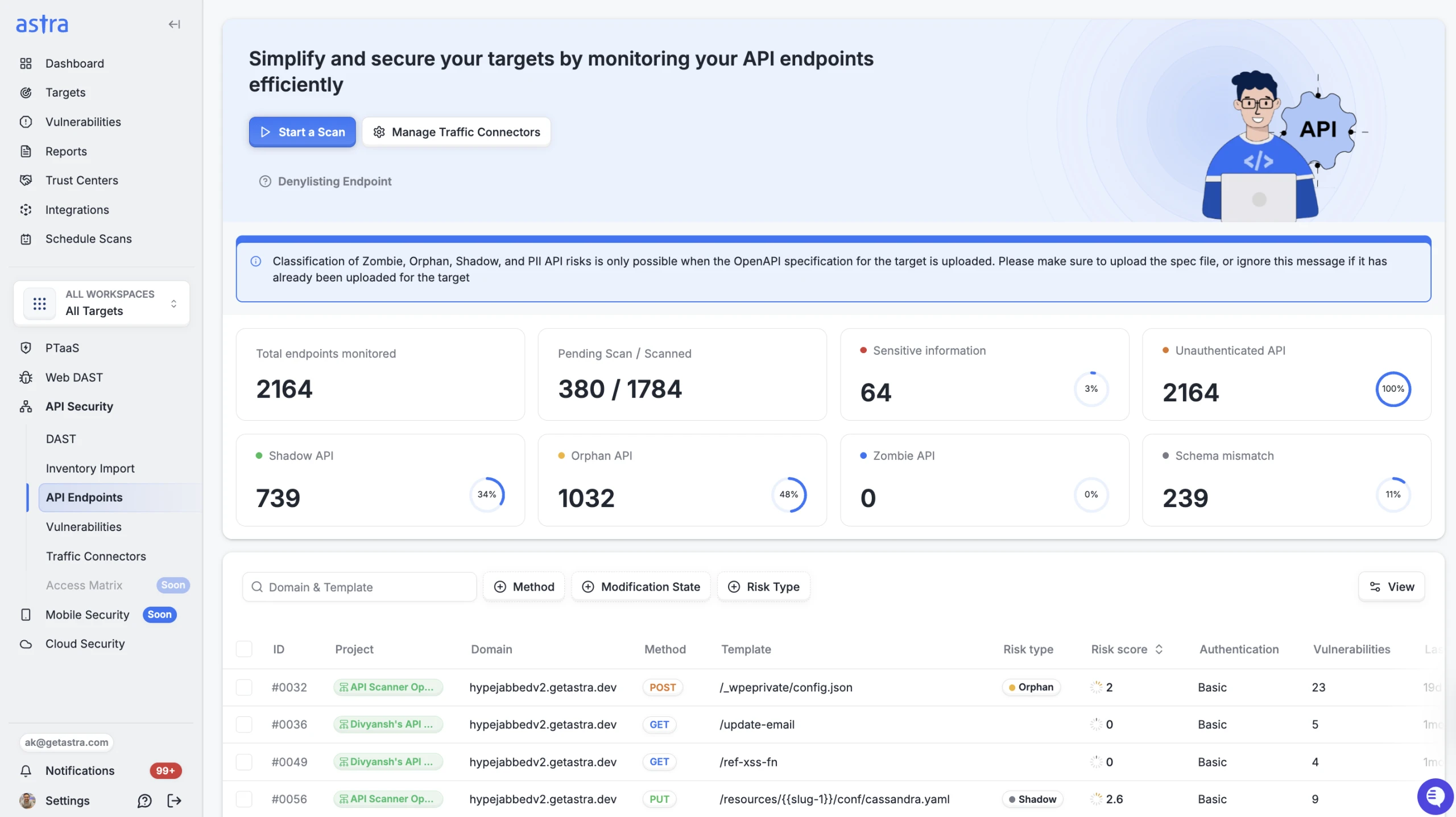
What are Astra Security’s key features?
| Feature | Details |
|---|---|
| Automated tests | 9,300+ security checks |
| API attack cases | 10,000+ authenticated scenarios |
| Manual review | Included on the Pentest Plan |
| Compliance | ISO 27001, HIPAA, SOC 2, GDPR, PCI DSS mapping |
| Certification | Publicly verifiable security certificate on Pentest Plan |
| Resolution Center | Track and manage remediation in-platform |
| Risk scoring | Per-vulnerability and aggregate risk scores |
| CI/CD | Pipeline integration for automated scans on deploy |
The automated DAST scanner runs 9,300+ security tests covering OWASP Top 10, SANS 25, injection flaws, authentication issues, and misconfigurations. Setup is three steps: add target URL, configure authentication, pick your tech stack.
Managed pentest services put certified pentesters on your application on the Pentest Plan. They chase business logic flaws, chained attacks, and authorization issues that automation misses.
The engagement ends with remediation re-tests and a verifiable certificate.
API security testing runs 10,000+ authenticated attack cases covering REST API vulnerabilities, broken authentication, parameter tampering, and broken access control.
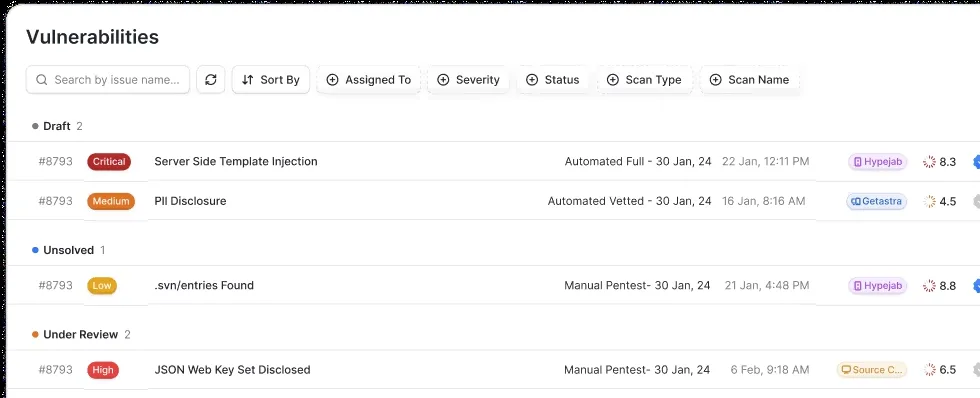
The Resolution Center provides built-in remediation tracking. Each finding gets severity, reproduction steps, and fix guidance, and you can assign issues to developers and track progress without leaving the platform.
Scan Configuration
Setting up a scan takes three steps:
- Add your target URL and verify domain ownership
- Configure authentication so the scanner can reach protected areas of your application
- Select your technology stack (framework, language, CMS) for more targeted test selection
Most DAST tools are either fully automated or fully manual. Astra sits in between.
The automated scanner handles volume and coverage. Human pentesters handle business logic, complex attack chains, and edge cases that automation misses.
Compliance and Certification
As recommended by NIST SP 800-53 controls for system and information integrity, regular dynamic testing helps maintain a strong security posture. Astra maps scan findings to compliance frameworks:
- ISO 27001
- HIPAA
- SOC 2
- GDPR
- PCI DSS
The Pentest Plan includes a publicly verifiable security certificate. Each certificate carries a unique URL that auditors, clients, or partners can check independently.
This matters for teams selling into regulated industries or responding to procurement questionnaires.
What does Astra Security integrate with?
 GitHub
 GitLab
 Jira
Jira Slack
SlackAstra Security’s managed SaaS model
Astra is a managed SaaS that pairs a scheduled scanner with certified pentesters. Findings from each scan land in the Resolution Center for triage.
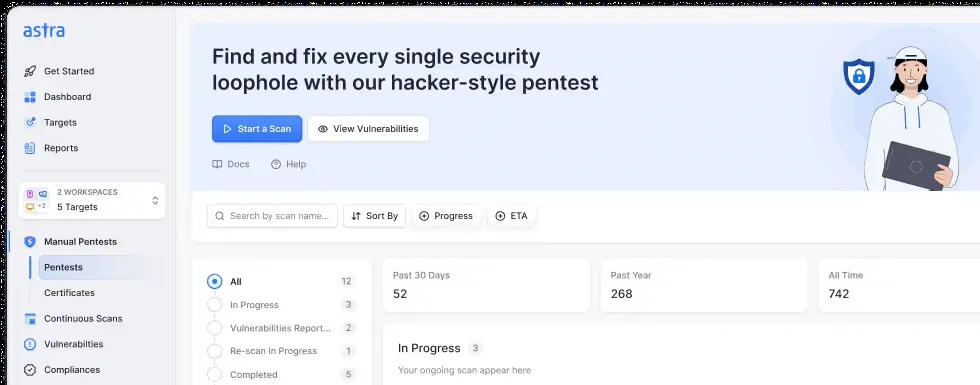 The Manual Pentests view tracks every engagement by status, from active scans to completed pentests.
On the Pentest Plan, Astra’s own testers take on the manual work. There is no proxy to configure and no separate consultant to hire.
This suits teams that want scanning, human review, and a verifiable certificate without building a security team.
Astra Security’s application-layer focus
Astra focuses on the application layer, covering web applications and APIs. The scanner understands authenticated web sessions and REST API endpoints.
On the Pentest Plan, manual testing catches business logic flaws that automated scanning alone would miss.
How much does Astra Security cost?
Astra does not publish full pricing on its website, so teams need to contact sales for a quote.
The vendor lists two main product lines: a Scanner Plan for continuous automated DAST and a Pentest Plan that adds manual pentesting and the verifiable certificate.
An Enterprise tier is available for multi-target and multi-environment rollouts.
Per the AppSec Santa policy of not publishing pricing that isn’t openly displayed, I’m not quoting specific numbers here.
Expect the Scanner Plan to sit at the low end and the Pentest Plan to step up significantly because a certified pentester is included in every subscription.
For current figures, request a quote at getastra.com/pricing .
How do I get started with Astra Security?
- Create an account — Sign up at getastra.com and pick a plan based on whether you need automated-only scanning or the full managed pentest.
- Add your target — Enter the URL of the web application or API you want scanned. Verify domain ownership.
- Configure and scan — Set authentication, select your tech stack, and launch. The automated scanner runs 9,300+ tests.
- Review findings — Use the Resolution Center to triage vulnerabilities, assign fixes, and track remediation. Generate compliance reports as needed.
Teams without dedicated security staff who want both automated scanning and expert human review.
The managed pentest fills the gap for organizations that cannot hire full-time pentesters, and the verifiable certificate is useful for compliance-driven industries.
What are Astra Security’s limitations?
Astra’s value depends on the managed pentest layer. If you only need automated scanning, a pure DAST tool like Acunetix or Burp Suite can give you more control for less money.
The platform does not publish full pricing, so you need to contact sales. There is no free tier or community edition.
The automated scanner covers web apps and APIs. It does not replace SAST for source code analysis or infrastructure scanning for network-level vulnerabilities.
For a breakdown of how DAST and IAST differ, see the IAST vs DAST guide . Teams looking for developer-first CI/CD scanning might also consider Bright Security or StackHawk .