
Aikido Alternatives
Top Aikido Security Alternatives

Proof-Based DAST at 99.98% Accuracy

Deep Code Analysis ASPM with Risk Graph

AI-Powered Risk Correlation

Native Scanning Plus 100+ Third-Party Integrations
The bottom line. The top Aikido alternatives are Snyk , Apiiro , ArmorCode , and Checkmarx . Aikido bundles 16 scanners (code, cloud, attack-surface, runtime) at $350-$1,050/month for 10 users; pick the others when you need depth in a single category or pure ASPM orchestration.
- Snyk — SCA depth, narrower stack. Snyk’s proprietary vulnerability database catches CVEs 47 days faster on average than the next-largest vulnerability database, but lacks Aikido’s DAST, CSPM, and runtime modules.
- Apiiro — graph-based ASPM with native scanners. Apiiro’s Risk Graph maps code-to-runtime context and detects GenAI framework usage; it orchestrates third-party scanner findings and also provides native SAST/SCA/secrets detection.
- ArmorCode — pure aggregation, no scanners. Aggregates findings from 350+ third-party tools, filling the ASPM orchestration role Aikido doesn’t cover.
Why Look for Aikido Alternatives?#
The best Aikido alternatives in 2026 are Snyk, Apiiro, Legit Security, Checkmarx One, Cycode, ArmorCode, OX Security, Mend.io, Jit, and Veracode.
Aikido Security has positioned itself as an all-in-one AppSec platform for development teams that want broad security coverage without stitching together separate tools.
The platform covers SAST, DAST, SCA, IaC scanning, secrets detection, container scanning, cloud posture management (CSPM), and runtime protection in a single product.
Aikido claims up to 95% noise reduction compared to competing solutions, uses AI-driven prioritization to surface what matters, and offers AI Autofix that generates pull requests to resolve vulnerabilities automatically.
Pricing starts with a free Developer plan and scales to $350-700/month for teams of 10.
So why look elsewhere? The most common concern is depth.
An all-in-one platform that covers eight scanning types inevitably makes trade-offs in each area.
Aikido’s SAST engine may not catch the same range of vulnerabilities as a dedicated enterprise SAST tool like Checkmarx or Veracode.
Its SCA may not match Snyk’s proprietary vulnerability database or Endor Labs’ reachability analysis. Its DAST may not reach the depth of Invicti or Burp Suite.
Teams with advanced needs in a specific domain often find they outgrow Aikido’s capabilities in that area.
Ecosystem maturity is another factor. Aikido is a newer company compared to established vendors, which means its integration ecosystem, vulnerability database, and rule coverage are still expanding.
Enterprise teams with complex compliance requirements, custom workflow needs, or strict deployment constraints may find Aikido’s platform less configurable than mature enterprise tools.
And organizations with existing investments in specific security tools may prefer to add ASPM orchestration on top rather than replacing their scanning engines entirely.
Top Aikido Alternatives#
1. Snyk#
Snyk is the closest competitor to Aikido in terms of covering multiple AppSec domains from a single platform, but with deeper capabilities in each area.
Snyk Open Source provides SCA with a proprietary vulnerability database that catches CVEs 47 days earlier than NVD. Snyk Code offers SAST with real-time IDE scanning and AI fix suggestions powered by the DeepCode engine.
Snyk Container and Snyk IaC round out the platform for container image scanning and infrastructure-as-code security.
Snyk has a polished developer experience that sets it apart. IDE plugins for VS Code, JetBrains, and Eclipse provide real-time feedback.
The CLI integrates with any CI/CD pipeline. Automated fix pull requests are one of the most useful features in any security tool.
Snyk is used by over 2.5 million developers and is one of the most widely deployed developer-first security platforms.
The trade-off compared to Aikido is cost and coverage gaps. Each Snyk product is priced separately, so a team needing SCA plus SAST plus containers plus IaC may pay significantly more than Aikido’s bundled pricing.
Snyk added DAST through its 2024 Probely acquisition (Snyk DAST API & Web), but cloud posture management and runtime protection still require separate tooling.
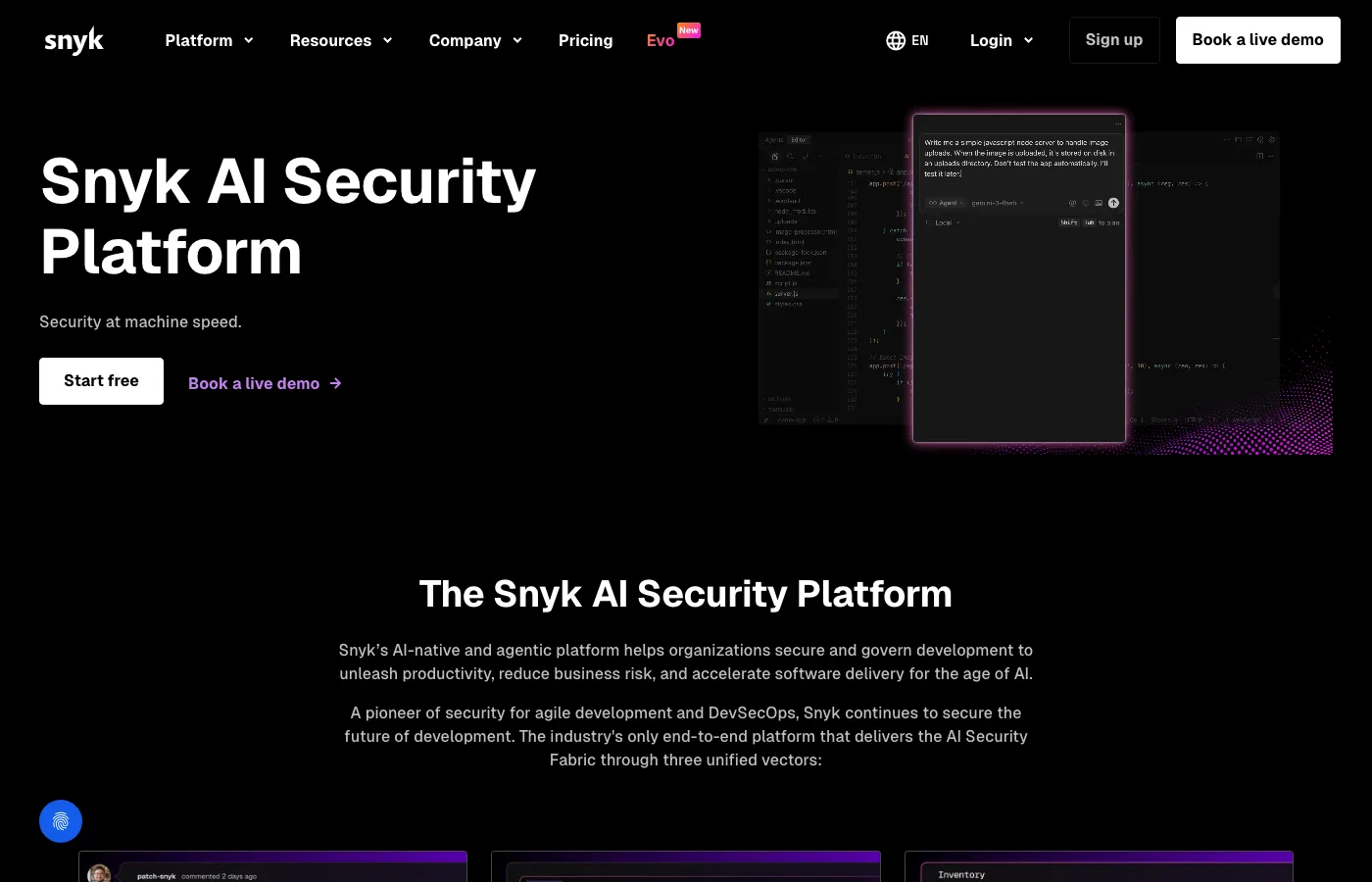
Best for: Development teams wanting best-in-class developer experience with deep SCA, SAST, container, and IaC scanning. License: Commercial (free tier available) Key difference: Proprietary vulnerability database with earlier CVE detection. Real-time IDE scanning with AI fix suggestions. 2.5M+ developers.
2. Apiiro#
Apiiro is a Gartner ASPM Magic Quadrant Leader that takes a fundamentally different shape from Aikido.
Instead of bundling its own scanners, Apiiro plugs into the scanners you already run and adds a Risk Graph on top — mapping every finding to code ownership, repository identity, deployment target, and business context.
The Deep Code Analysis engine traces data flows across function and service boundaries, identifying material changes that shift application risk before code merges.
Apiiro tells you not just that a SQL injection exists, but that it sits in a repository handling PII data, has a reachable path from an internet-exposed service, and is owned by a team without an active security champion.
The 2025 Guardian Agent extends the model to AI-assisted coding: Apiiro inspects prompts, generated code, and AI-suggested dependencies for risky patterns before they enter the repo.
Where Aikido is built for SMB and growth-stage teams that want everything-in-one, Apiiro is built for enterprises with existing scanner stacks (often Checkmarx, Snyk, or Veracode) and a need for risk context that ties findings to people, services, and business impact.
Best for: Enterprises that already own SAST, SCA, and DAST scanners and need an ASPM layer with deep code-to-cloud risk context plus AI-prompt guardrails.
License: Commercial Key difference: Risk Graph maps findings to code ownership and business impact. Guardian Agent inspects AI-generated code. Gartner ASPM Magic Quadrant Leader.
3. Legit Security#
Legit Security is an ASPM platform that maps the full SDLC — code, pipelines, artifacts, and the people who touch them — and applies governance on top.
Where Aikido scans code and cloud, Legit’s mental model is “the entire path from developer keyboard to production deployment is the attack surface, and every step needs an inventory plus a policy. "
The platform discovers SCM repositories, CI/CD pipelines, build systems, secret stores, and artifact registries automatically, then layers SAST, SCA, secrets, and IaC scanning across them.
The 2025 VibeGuard module is purpose-built for AI-developed code: it inspects PRs created by Cursor, Copilot, Claude Code, and other agents for risky patterns and missing guardrails before merge.
Aikido is the better fit for SMBs and growth-stage teams that want one product to scan everything. Legit fits enterprises with several development orgs, multiple SCMs, and a real need for full-SDLC inventory and AI-developer guardrails — coverage Aikido does not natively provide.
Best for: Mid-market and enterprise teams that need full-SDLC visibility, AI-developer code guardrails, and supply-chain governance on top of scanning.
License: Commercial Key difference: Full-SDLC inventory across SCM + CI/CD + build + artifact layers. VibeGuard targets AI-generated code specifically. Strong on supply chain and pipeline integrity.
4. Checkmarx One#
Checkmarx One is the enterprise alternative to Aikido, offering SAST, SCA, DAST, IAST, API security, IaC scanning, container security, and secrets detection in a unified platform.
Its SAST engine covers 35+ languages , far exceeding both Aikido and most competitors.
The ASPM layer aggregates findings across all scan types and prioritizes them based on application context, exploitability, and business criticality.
Checkmarx is used by large enterprises including Apple, Salesforce, and Walmart. The platform provides custom query authoring, compliance reporting, and role-based access control for enterprise governance.
Cloud, on-premises, and hybrid deployment options accommodate organizations with strict data residency requirements.
Compared to Aikido, Checkmarx One offers significantly deeper capabilities in each scanning domain, particularly SAST. The platform is designed for large enterprise security programs with dedicated AppSec teams.
The trade-off is cost and complexity: Checkmarx pricing is substantially higher than Aikido, and the platform requires more configuration and expertise to operate effectively.
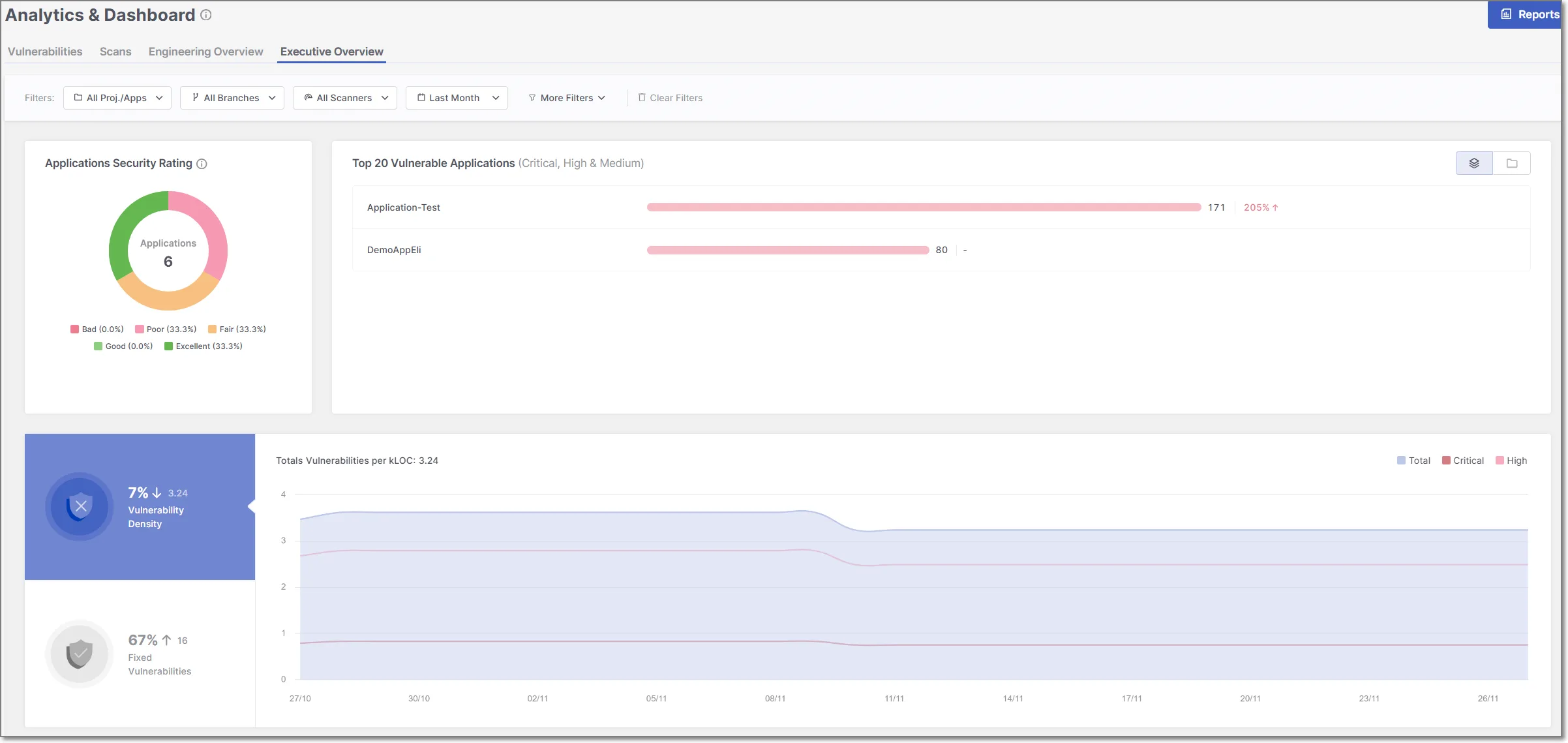
Best for: Large enterprises needing the deepest scanning capabilities across SAST, SCA, DAST, and more with enterprise governance.
License: Commercial Key difference: 35+ language SAST. Full enterprise ASPM with cross-scan correlation. Used by Apple, Salesforce, and Walmart.
5. Cycode#
Cycode provides application security posture management (ASPM) with built-in scanning capabilities spanning SAST, SCA, secrets detection, IaC security, and CI/CD pipeline security.
The platform maps the entire software development pipeline from code to cloud, providing visibility into where security risks exist at every stage.
Cycode’s pipeline integrity features detect tampering and unauthorized changes to build configurations.
What distinguishes Cycode from Aikido is the pipeline security focus. While Aikido concentrates on code and cloud scanning, Cycode extends coverage to the CI/CD infrastructure itself, detecting risks like poisoned pipelines, unauthorized access to build systems, and drift in security configurations.
The ASPM layer correlates findings from built-in and third-party scanners, providing a unified view even for organizations that want to keep their existing scanning tools.
Best for: Teams that want ASPM with built-in scanning that extends to CI/CD pipeline security and code integrity. License: Commercial Key difference: Pipeline security and code integrity monitoring beyond code scanning. ASPM that orchestrates both built-in and third-party scanners.
6. ArmorCode#
ArmorCode is an ASPM platform that aggregates and correlates findings from 350+ third-party security tools.
Unlike Aikido, which provides its own scanning engines, ArmorCode sits on top of existing scanners (Semgrep, Snyk, Checkmarx, Burp Suite, etc.) and provides unified dashboards, deduplication, prioritization, and remediation workflows.
The platform uses AI-driven risk scoring to rank findings by business impact.
Best for: Organizations with existing security tools that need a correlation and prioritization layer without replacing scanners. License: Commercial Key difference: Aggregates 350+ third-party tools rather than providing its own scanners. AI-driven risk scoring and unified remediation workflows.
7. OX Security#
OX Security provides ASPM with pipeline bill of materials (PBOM) technology that maps every artifact, dependency, and configuration across the software supply chain.
The platform ingests findings from both built-in scanners and 320+ third-party integrations, deduplicating and correlating results to reduce noise. Active PBOM provides continuous visibility into what is running in production.
Best for: Teams needing supply chain visibility with ASPM that maps artifacts across the full software pipeline. License: Commercial Key difference: Pipeline Bill of Materials (PBOM) for full supply chain mapping. Active PBOM tracks what runs in production.
8. Mend.io Platform#
The Mend AppSec Platform bundles SCA, SAST, container security, dependency updates (Renovate), and AI security under a single per-developer license. Mend’s SCA engine supports 200+ ecosystems with reachability analysis, malicious package protection, and license compliance. Mend SAST offers agentic scanning via MCP protocol that integrates with AI-powered IDEs.
Best for: Teams wanting bundled SCA, SAST, and container security with a unified per-developer pricing model. License: Commercial Key difference: One price for SCA, SAST, containers, and AI security. Agentic SAST via MCP for AI-powered IDE integration.
9. Jit#
Jit provides a DevSecOps orchestration platform that stitches together open-source security tools (Semgrep, Trivy, Gitleaks, ZAP, and others) into a unified pipeline.
Rather than building its own scanning engines, Jit curates and manages the best open-source tools for each scanning type, providing a single dashboard and policy engine on top.
This gives teams the depth of specialized open-source tools with the convenience of a managed platform.
Best for: Teams that prefer open-source scanning engines with a managed orchestration and dashboard layer. License: Commercial (free tier available) Key difference: Orchestrates open-source tools (Semgrep, Trivy, Gitleaks, ZAP) rather than building proprietary scanners.
10. Veracode#
Veracode offers a mature application security platform with SAST, SCA, DAST, and container scanning. The platform has been in the market for over two decades and carries strong compliance certifications including FedRAMP authorization .
Veracode’s Fix feature uses AI to generate code fixes for detected vulnerabilities. The platform is cloud-only with no self-hosted option.
Best for: Enterprises in regulated industries needing FedRAMP-authorized application security with compliance reporting.
License: Commercial Key difference: FedRAMP-authorized cloud platform. Two decades of enterprise compliance track record. AI-powered fix generation.
Other Aikido alternatives worth knowing#
These platforms come up alongside the ten above. Each link goes to the relevant tool review or comparison page.
Endor Labs#
Endor Labs is the SCA-focused alternative with reachability analysis as the differentiator. Where Aikido covers the broad AppSec stack, Endor Labs goes deep on SCA.
The reachability engine analyses whether a vulnerable function is actually called from your code. Pick Endor Labs when SCA depth is the primary need; pick Aikido when broad scanner coverage matters more.
Semgrep AppSec Platform#
Semgrep is the rules-engine SAST alternative. Aikido bundles Semgrep CE rules under the hood for its SAST.
Semgrep AppSec Platform is the full hosted product — managed rules, secret scanning, and supply chain coverage on top of the open-source engine. For SAST depth and custom-rule control rather than a bundle, Semgrep is the closer fit.
Feature Comparison#
| Feature | Aikido | Snyk | Apiiro | Legit Security | Checkmarx One | Cycode | ArmorCode |
|---|---|---|---|---|---|---|---|
| SAST | Yes | Yes (Snyk Code) | Third-party | Yes (+ partners) | Yes (35+ langs) | Yes | Third-party |
| SCA | Yes | Yes (Snyk OSS) | Third-party | Yes | Yes | Yes | Third-party |
| DAST | Yes | Yes (Probely) | Third-party | Third-party | Yes | No | Third-party |
| Secrets detection | Yes | Yes (Snyk Code) | Yes | Yes | Yes | Yes | Third-party |
| IaC scanning | Yes | Yes (Snyk IaC) | Third-party | Yes | Yes | Yes | Third-party |
| Container scanning | Yes | Yes | Third-party | Third-party | Yes | No | Third-party |
| Cloud posture (CSPM) | Yes | No | Third-party | Third-party | No | No | No |
| Runtime protection | Yes | No | No | No | No | No | No |
| ASPM | No | No | Core feature | Core feature | Yes | Yes | Core feature |
| AI autofix | Yes | Yes | AutoFix Agent | VibeGuard | Assist | Cycode AI | Anya AI |
| Free tier | Yes (2 users) | Yes (200 tests/mo) | No | No | No | No | No |
| Pricing (10 users) | $350-700/mo | Per-product | Enterprise | Enterprise | Enterprise | Enterprise | Enterprise |
Which Aikido alternative fits you best?#
The right pick depends on what you are optimizing for. Here is the cheat sheet I use when AppSec teams ask which alternative to shortlist:
- SMB or growth-stage team that wants breadth. Stay with Aikido or evaluate Snyk’s free-then-team plan. Aikido covers eight scanning types in one product; Snyk gives deeper SCA and SAST in exchange for paying per module.
- Enterprise with 35+ language coverage and a dedicated AppSec team. Pick Checkmarx One or Veracode. Both run substantially deeper per-scanner than Aikido and ship the governance, compliance reports, and role-based access control large programs need.
- You already have scanners and want correlation on top. Pick ArmorCode for pure ASPM aggregation across 350+ tools, or Cycode if you also want built-in scanners plus pipeline-integrity coverage.
- Code ownership, business context, and AI-prompt risk matter most. Pick Apiiro. Its Risk Graph maps every finding to the developer, service, and deployment behind it; the Guardian Agent inspects AI-generated code before merge.
- Full-SDLC inventory plus AI-developer guardrails. Pick Legit Security. The platform discovers SCM + CI/CD + build + artifact layers automatically and adds VibeGuard for AI-generated PRs.
- Software supply chain visibility is the priority. Pick OX Security for Pipeline Bill of Materials.
Whichever shortlist you land on, run a 30-day trial first. Pick three representative repos, free-tier where possible, and measure two things: noise reduction versus your current setup, and time-to-fix on a real critical finding. Anything that does not move both numbers is not worth the migration cost.
When to Stay with Aikido#
Aikido remains the right choice for teams that value breadth of coverage over individual scanner depth.
If your organization is an SMB or growth-stage company that needs SAST, DAST, SCA, secrets detection, IaC scanning, container security, and cloud posture management without assembling and maintaining six different tools, Aikido provides genuine value at a price point that undercuts most alternatives.
The up to 95% noise reduction, according to Aikido, driven by AI-powered analysis and context-aware prioritization, means security teams spend more time fixing real issues and less time triaging noise.
The AI Autofix feature generates remediation PRs that reduce mean time to fix.
And the simple onboarding experience, often under 10 minutes to first scan, means teams get security coverage immediately rather than spending weeks on configuration.
For development teams that want to ship secure code without becoming security tool experts, Aikido’s all-in-one approach removes friction that multi-tool setups introduce.
For more AppSec Santa comparisons, browse the ASPM tools category.
Frequently Asked Questions
What is the best free alternative to Aikido?
How does Aikido compare to Snyk?
Can Apiiro replace Aikido?
Is Aikido suitable for enterprise teams?
Which Aikido alternative has the best pricing for startups?

Written & maintained by
Suphi CankurtEight years on the vendor side of application-security sales — thousands of evaluations and demos. I started AppSec Santa in 2022 to put that insider view to work for buyers. Independent of any vendor, paid by none, and honest about what fits whom.