


Arize AI is an AI observability and LLM evaluation platform built on OpenTelemetry standards, offering vendor-agnostic tracing from development through production.
The company provides Phoenix (open-source, 10.2k+ GitHub stars) for LLM tracing and evaluation, and AX for enterprise-scale AI monitoring.
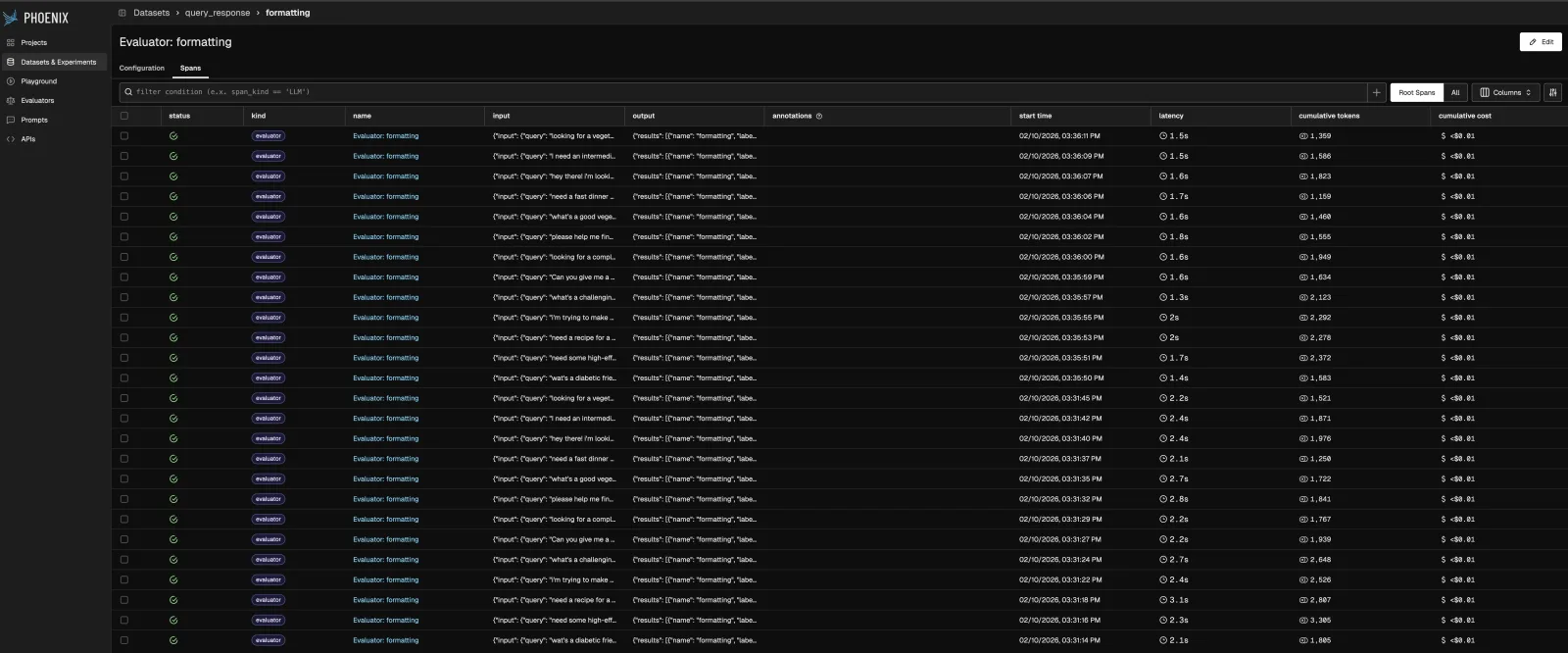 Phoenix’s evaluator view lists each evaluation run with status, latency, and cumulative token cost.
Arize reports processing 1 trillion spans and 1 billion evaluations per month across its customer base — figures the vendor publishes on its own site, not an independent benchmark. It is listed in the AI security category.
Arize’s published customer list includes DoorDash, Instacart, Reddit, Uber, Booking.com, Roblox, PagerDuty, Air Canada, Cohere, Conde Nast, Flipkart, TripAdvisor, Siemens, Microsoft, and Priceline. These are logos the vendor displays on its own site, not references I independently verified.
Arize’s approach centers on open standards — OpenTelemetry for instrumentation, open-source evaluation models rather than proprietary black-box evaluators, and standard data formats that prevent vendor lock-in.
What is Arize AI?
Arize operates across two layers of the AI stack: development-time experimentation (Phoenix) and production-scale monitoring (AX).
This split lets teams start with the free, open-source Phoenix for prototyping and evaluation, then move to AX when they need enterprise-grade scale and collaboration.
OpenTelemetry is central to Arize’s architecture. LLM application traces use the same standard as traditional application performance monitoring (APM), so AI observability plugs into existing DevOps infrastructure instead of requiring a separate monitoring stack.
Phoenix is the open-source option: fully self-hostable AI observability with zero feature gates, covering LLM tracing, evaluation, experiment tracking, prompt management, and dataset versioning. It has 10.2k+ GitHub stars, runs locally, in Jupyter, Docker, or cloud, under Elastic License 2.0.
Arize AX is the enterprise option: production-scale AI monitoring with two editions — AX-Generative for LLM and generative AI, and AX-ML & CV for traditional machine learning and computer vision. It is built on adb, a purpose-built datastore for real-time ingestion and sub-second queries.
Both are OpenTelemetry-native: vendor-agnostic instrumentation where traces export to any compatible backend, preventing lock-in. It uses the same format as traditional APM, so AI observability integrates with existing DevOps tooling.
What are Arize AI’s key features?
| Feature | Details |
|---|---|
| LLM Tracing | Full-flow logging of agent interactions, tool calls, retrieval steps, and configurations |
| Evaluation | Arize reports 1B+ evaluations/month (vendor figure); open-source evaluation models, not proprietary black-box |
| Agent Monitoring | Track agent behavior, tool usage, decision chains, and performance in production |
| Experiment Tracking | Compare prompt variations, model changes, and parameter adjustments side-by-side |
| Prompt Management | Version control for prompts with systematic testing and rollback |
| Datasets | Versioned datasets for evaluation, experimentation, and fine-tuning |
| RAG Evaluation | Measure retrieval quality, relevance, and response grounding |
| Scale | Arize reports 1 trillion spans and 5 million downloads per month (vendor figures) |
| Datastore | adb — purpose-built for generative AI with real-time ingestion and sub-second queries |
| Framework Support | OpenAI Agents SDK, Claude Agent SDK, LangGraph, Vercel AI SDK, CrewAI, LlamaIndex, DSPy, Haystack, Guardrails, Instructor, Pydantic AI, AutoGen AgentChat, Portkey, Google ADK, and 15+ more |
| License | Elastic License 2.0 (Phoenix); commercial (AX) |
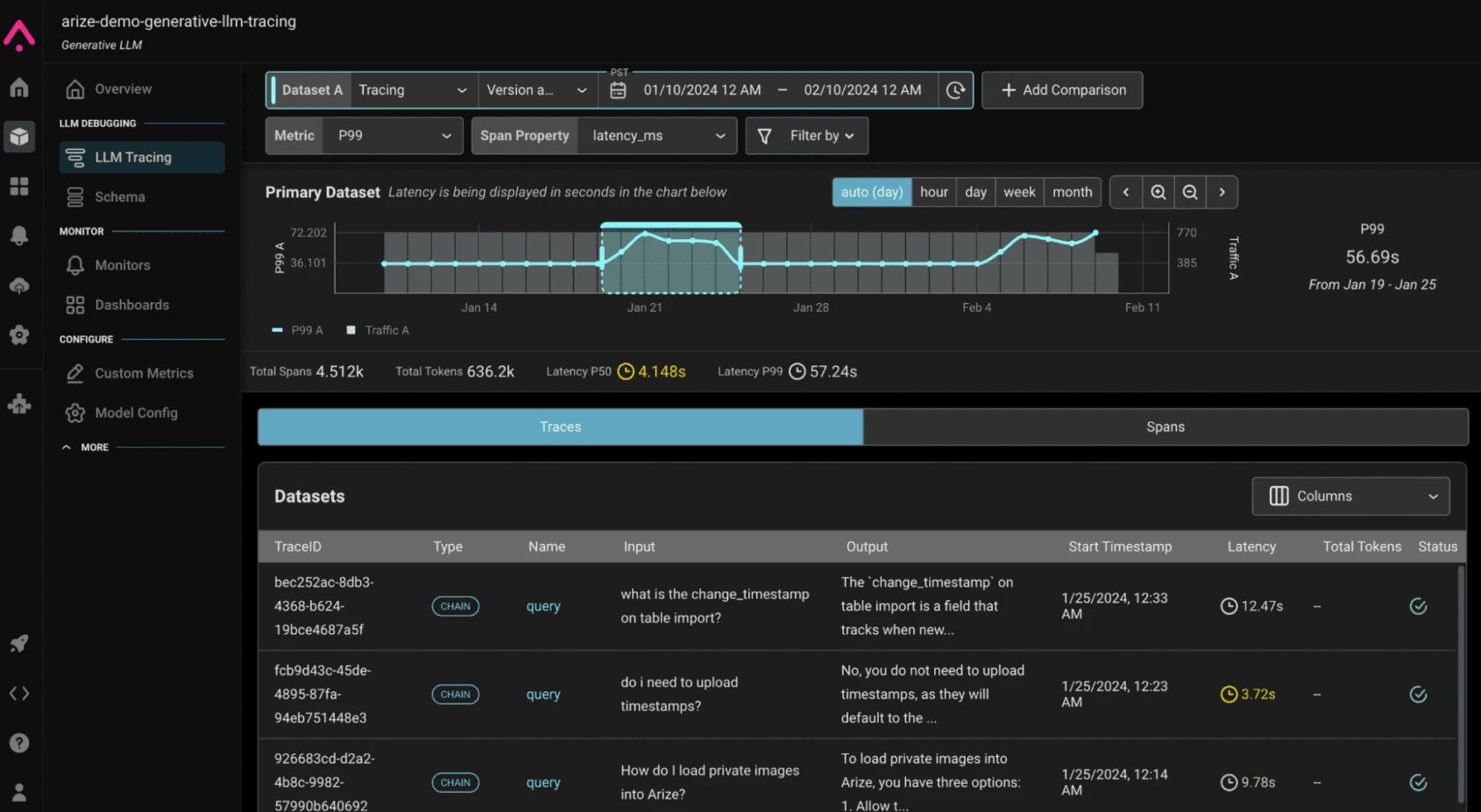
Phoenix: Open-Source AI Observability
Phoenix is the open-source core of Arize’s platform. It has the same tracing, evaluation, and experimentation capabilities as the enterprise platform, with no feature gates or restrictions on the self-hosted version.
Key capabilities include:
- LLM Tracing — Captures the full execution flow of LLM applications: each prompt, response, tool call, retrieval step, and agent decision. Traces follow the OpenTelemetry standard, making them compatible with existing observability infrastructure.
- Evaluation — Run evaluations using open-source models to measure response quality, relevance, hallucination rates, toxicity, and other metrics. Evaluations can run in batch (for dataset-level assessment) or continuously (for production monitoring).
- Experiment Tracking — Compare different prompt templates, model versions, temperature settings, and other parameters side-by-side to make data-driven decisions about which configuration to deploy.
- Prompt Management — Version control for prompts with the ability to test changes systematically before deployment.
- Dataset Management — Create and maintain versioned datasets for evaluation benchmarks, fine-tuning, and reproducible experiments.
Phoenix runs on local machines, in Jupyter notebooks, as Docker containers, or in cloud environments. Installation is straightforward: pip install arize-phoenix or pull the Docker image from Docker Hub.
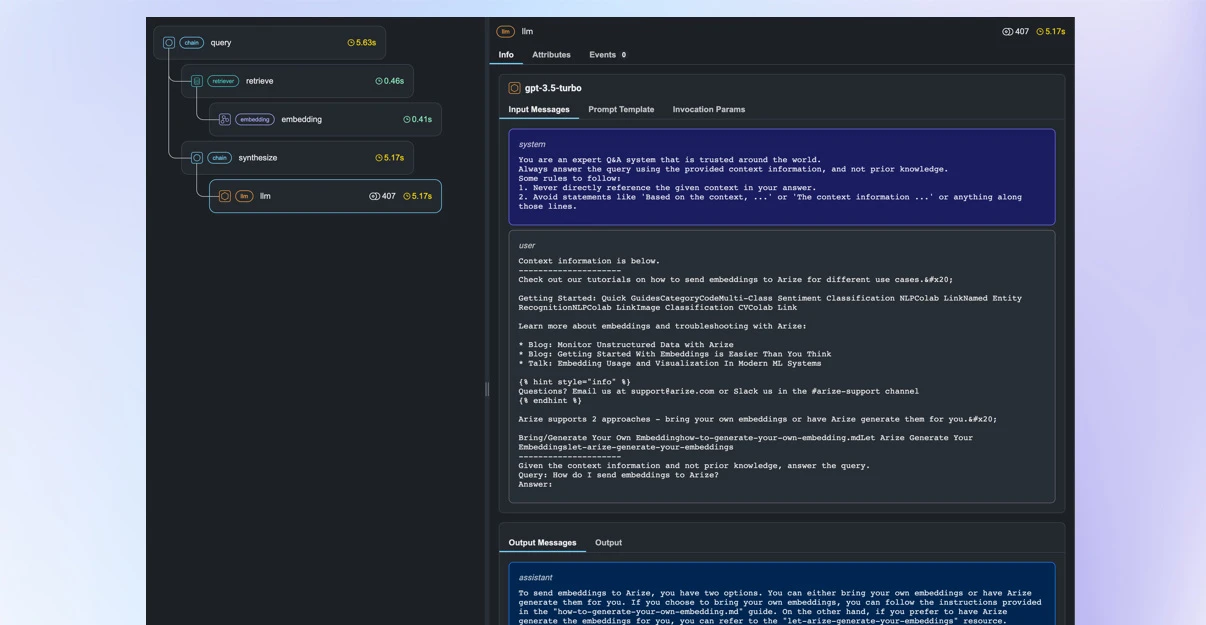
Arize AX: Enterprise Platform
AX extends Phoenix’s capabilities to production scale with two editions:
- AX-Generative — For LLM and generative AI applications. Monitors production traffic, detects quality degradation, tracks agent behavior, and provides team collaboration features for debugging and investigation.
- AX-ML & CV — For traditional machine learning and computer vision workloads. Extends observability beyond LLMs to cover the full spectrum of AI models.
Both editions are built on adb, Arize’s purpose-built datastore optimized for generative AI workloads. It handles real-time ingestion of trace data and provides sub-second query performance for debugging and analysis at scale.
Alyx: AI Debugging Assistant
Alyx is Arize’s AI assistant for LLM application development. It helps debug traces, spot failure patterns, and integrate domain knowledge into the development workflow.
Alyx works alongside Phoenix and AX to speed up investigation and root cause analysis.
Framework Integrations
Arize provides instrumentation for major AI frameworks and SDKs:
- Agent frameworks — OpenAI Agents SDK, Claude Agent SDK, LangGraph, CrewAI, AutoGen AgentChat, Pydantic AI, Google ADK
- LLM frameworks — LlamaIndex, DSPy, Vercel AI SDK, Haystack, Guardrails, Instructor, Portkey
- LLM providers — OpenAI, Anthropic, Google GenAI, AWS Bedrock, Mistral AI, Groq, OpenRouter, LiteLLM, VertexAI, and more
- Deployment — Kubernetes, Docker, Jupyter notebooks, local machines, cloud-native environments
The OpenInference project (also open-source from Arize) provides the OpenTelemetry instrumentation packages that connect these frameworks to Phoenix or AX.
How do I get started with Arize AI?
Phoenix installs via pip or Docker and runs fully self-hosted for local development, tracing, and evaluation, with no license key or account required.
When you need production-scale monitoring and team collaboration, Arize AX uses the same OpenTelemetry trace format, so the move up from Phoenix is seamless.
When to Use Arize AI
Arize AI is built for teams that need observability across the full AI application lifecycle — from prototyping and evaluation through production monitoring. The open-source Phoenix makes it accessible to individual developers and small teams, while AX scales to enterprise deployments.
It is particularly useful when you are building agent-based applications that need full-flow tracing of decision chains, running evaluations at scale to compare models and prompts, or working in environments where vendor lock-in is a concern and OpenTelemetry compatibility matters.
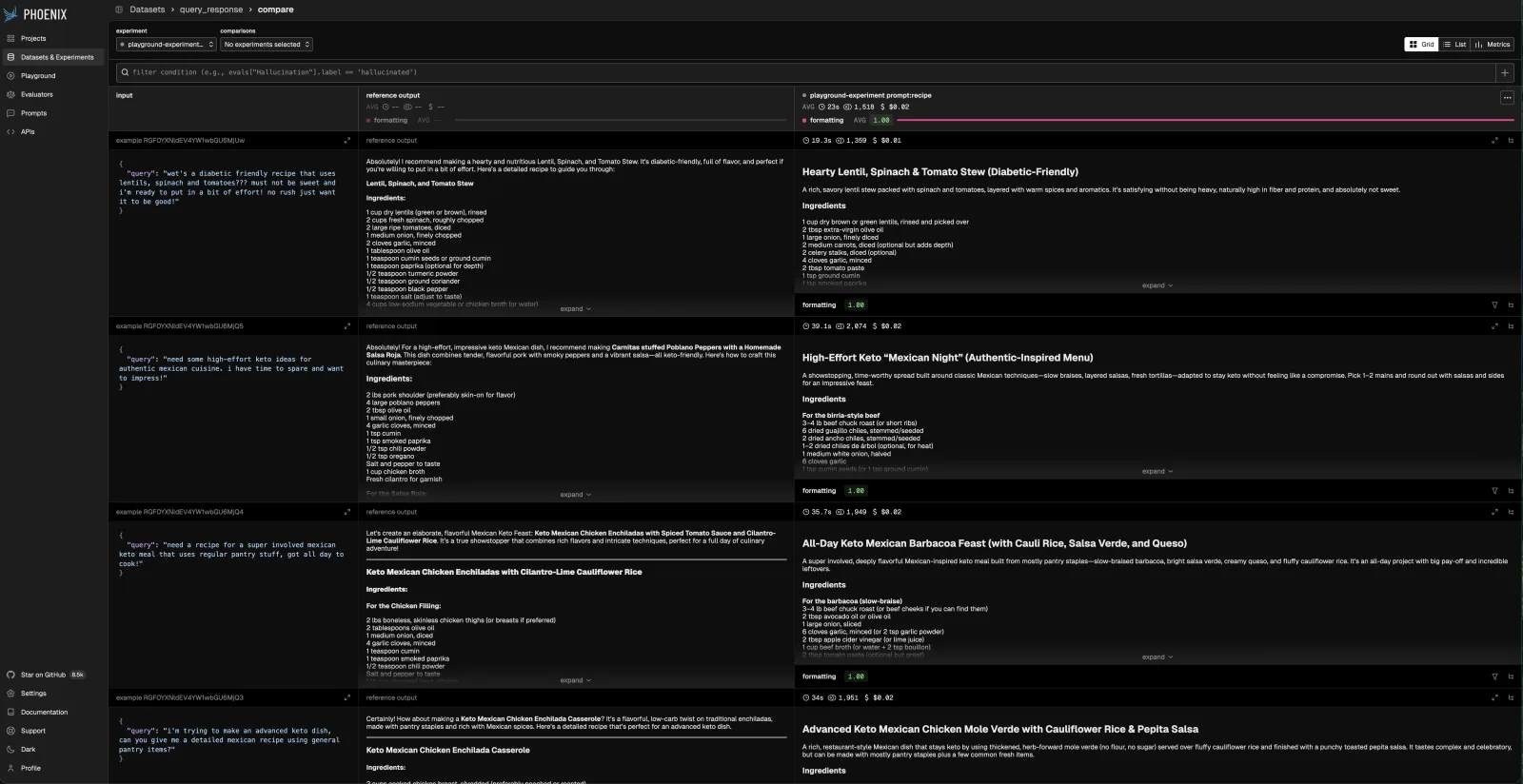 Phoenix’s experiment compare grid puts prompt and model variations side by side with latency and cost.
How Arize AI Compares
Arize AI occupies the observability and evaluation layer of the AI security landscape. The closest direct alternatives split by what they prioritize at the observability layer:
- Arthur AI — Multi-model monitoring with bias detection and explainability across LLMs and traditional ML. A fit when responsible-AI metrics (fairness, drift, explainability) carry as much weight as tracing.
- WhyLabs — Privacy-preserving statistical profiling for ML and LLM monitoring. WhyLabs was acquired by Apple in January 2025 and its commercial platform has been discontinued, but the open-source tools (whylogs, langkit) remain available. A fit when self-hosted statistical drift detection on data without raw-content logging is the constraint.
- Helicone — Open-source LLM observability built around routing, debugging, and analytics for AI applications. Helicone announced it is joining Mintlify.
- Langfuse — Open-source LLM engineering platform covering tracing, prompt management, and evaluation, now part of ClickHouse. Self-hosting is documented for Docker Compose, Kubernetes, AWS, GCP, and Azure.
For LLM security rather than observability — prompt injection detection, guardrails, and runtime protection — consider Lakera Guard , Prompt Security , LLM Guard , or NeMo Guardrails .
For pre-deployment vulnerability scanning, see Garak , Augustus , or Promptfoo .
For a broader overview of AI security tools, see the AI security tools category page.