

RASP vs WAF is a comparison of two complementary runtime defenses within the broader application security discipline: WAF filters malicious HTTP traffic at the network perimeter, while RASP blocks attacks from inside the application runtime.
Quick comparison#
WAF and RASP both protect web applications from attacks, but they operate at different layers and use fundamentally different approaches:
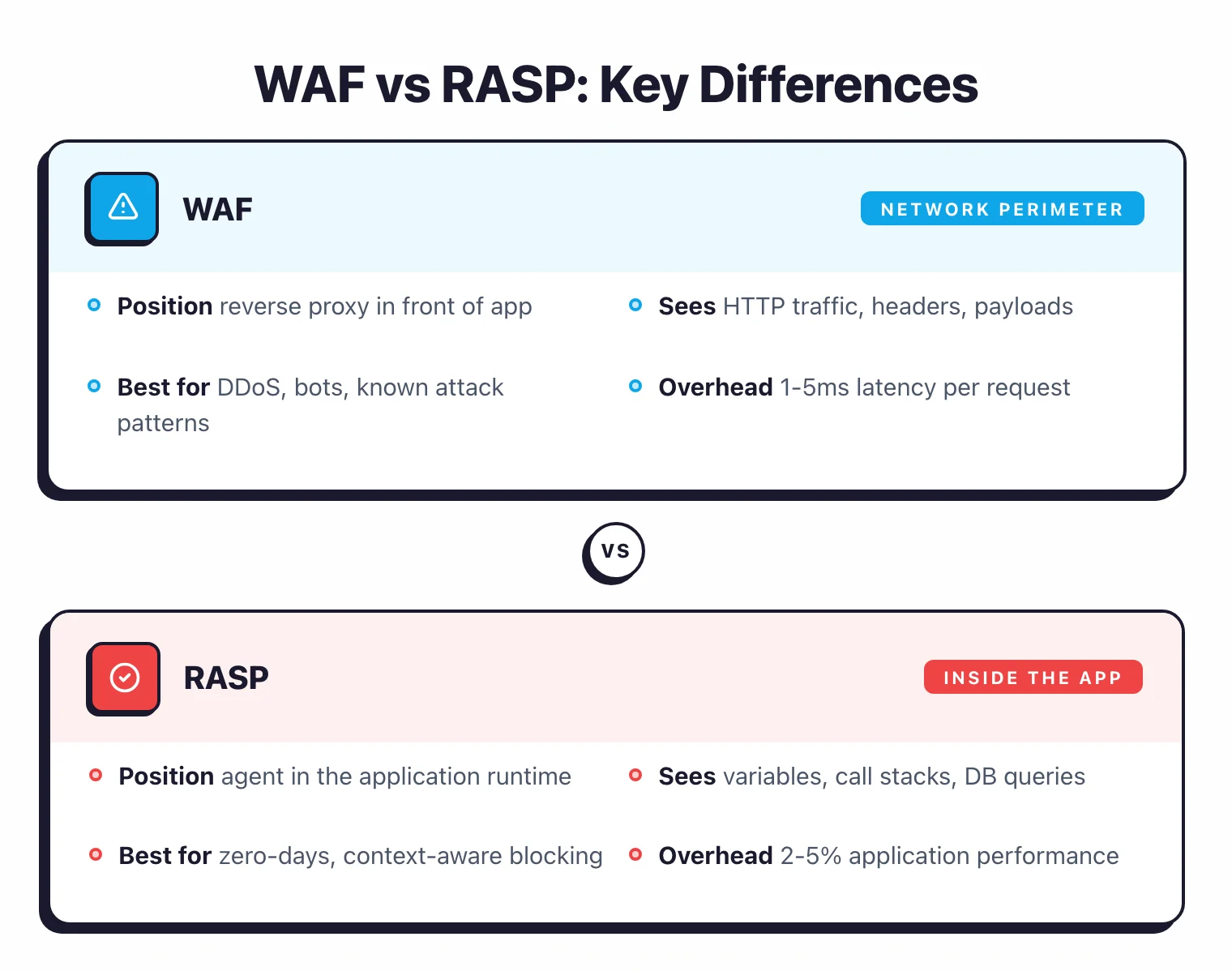
| WAF | RASP | |
|---|---|---|
| Full name | Web Application Firewall | Runtime Application Self-Protection |
| Position | Network perimeter (in front of the application) | Inside the application runtime |
| Deployment | Reverse proxy, cloud service, or appliance | Agent or library embedded in the application |
| Detection method | Inspects HTTP/HTTPS traffic against rule sets and signatures | Monitors application behavior, function calls, and data flows at runtime |
| Context | Sees network traffic only (headers, payloads, IP addresses) | Sees application internals (variables, call stacks, database queries) |
| Code changes required | None | Requires agent installation in the app runtime |
| Scope | Protects all applications behind it | Protects only the instrumented application |
| Best at | Blocking known attack patterns, DDoS, bots, rate limiting | Blocking context-aware attacks, zero-days, business logic exploits |
The short version: WAF is a perimeter guard that checks everyone entering the building. RASP is a security system inside each room that understands what is supposed to happen there and reacts when something goes wrong.
What WAF does#
A Web Application Firewall sits between the internet and your web application, inspecting every HTTP/HTTPS request before it reaches your server. It filters out malicious traffic based on rule sets, signatures, and increasingly, machine learning models.
WAFs protect against the most common web attacks:
- SQL injection — Requests containing SQL syntax in parameters, headers, or body
- Cross-site scripting (XSS) — Payloads containing script tags or JavaScript event handlers
- OWASP Top 10 — Broad coverage of the most prevalent web vulnerabilities
- DDoS mitigation — Rate limiting and traffic filtering to prevent denial-of-service
- Bot management — Identifying and blocking automated scraping, credential stuffing, and abuse
- Virtual patching — Blocking exploitation of known vulnerabilities before the application code is fixed
WAF deployment options fall into three categories:
| Type | Examples | Pros | Cons |
|---|---|---|---|
| Cloud WAF | Cloudflare, AWS WAF, Azure WAF | Easy to deploy, scales automatically, managed rule sets | Less customization, vendor lock-in |
| Appliance WAF | F5 BIG-IP, Fortinet FortiWeb | Full control, on-premise option | Hardware cost, maintenance burden |
| Host-based WAF | ModSecurity, open-source options | Free, flexible | Requires manual rule management, performance overhead |
The biggest limitation of WAF is context. A WAF sees HTTP traffic.
It does not know what the application does with that traffic. A request containing ' OR 1=1 -- looks like SQL injection to a WAF, and it will block it.
But a WAF cannot distinguish between a malicious SQL injection attempt and a legitimate blog post that discusses SQL injection syntax.
This lack of application context leads to false positives and forces teams to loosen rules, which creates gaps.
What does RASP do?#
Runtime Application Self-Protection works from inside the application. A RASP agent integrates into the application runtime (JVM for Java, CLR for .NET, interpreter for Python/Node.js) and monitors function calls, data flows, and database queries in real time.
The key difference from WAF is context. When RASP sees a string reach a SQL query function, it does not just pattern-match the string.
It knows the string came from user input, it knows it was not sanitized, and it knows the function it is about to reach will execute it as SQL.
That is contextual detection, and it is why RASP has lower false positive rates than WAF for application-layer attacks.
RASP protects against:
- Injection attacks with context — Detects actual exploitation, not just suspicious patterns in HTTP traffic
- Zero-day vulnerabilities — Blocks exploit attempts even before a patch exists, because it monitors behavior rather than signatures
- Business logic attacks — Can detect abnormal application behavior like unauthorized data access or privilege escalation
- Insecure deserialization — Monitors deserialization functions and blocks malicious payloads
- Server-side request forgery (SSRF) — Detects when the application makes unexpected outbound requests
RASP tools in the application security space include Contrast Security , which pioneered the RASP category for server-side applications, and mobile-focused tools like Appdome and Guardsquare that provide runtime protection for mobile applications.
The trade-off is operational complexity. RASP requires a per-application agent deployment.
Each supported language needs its own agent implementation. Updating the RASP agent means updating every application that uses it.
For organizations running hundreds of services, this operational overhead is real.
Key differences#
Here is a detailed comparison across the dimensions that matter for architecture and purchasing decisions:
| Dimension | WAF | RASP |
|---|---|---|
| Deployment position | Network perimeter (reverse proxy, CDN, cloud edge) | Inside the application process |
| Visibility | HTTP request/response only | Full application context (variables, call stacks, queries) |
| Detection accuracy | Rule-based with limited context; higher false positives | Context-aware with application internals; lower false positives |
| Zero-day protection | Limited (needs rule updates or ML models) | Strong (behavioral detection, not signature-dependent) |
| DDoS protection | Yes (core capability) | No (operates at application layer, not network layer) |
| Bot management | Yes (fingerprinting, challenges, rate limiting) | No |
| Virtual patching | Yes (block exploit patterns without code changes) | Not applicable (protects from within, does not filter traffic) |
| Performance impact | 1-5ms per request | 2-5% application overhead |
| Deployment effort | Low (DNS change or proxy configuration) | High (agent per application, per language) |
| Scale of protection | All applications behind the WAF | One application per agent deployment |
| Maintenance | Managed rule updates (cloud WAF) or manual (on-prem) | Agent updates across all instrumented applications |
| Cost model | Per request or per bandwidth (cloud); per appliance (on-prem) | Per application or per server |
The critical distinction: WAF protects broadly with limited context. RASP protects deeply with full context. Neither covers everything the other does.
When should you use each?#
Use WAF when:
- You need protection for all internet-facing applications with a single deployment
- DDoS mitigation and bot management are requirements
- You need virtual patching to buy time before code fixes
- Compliance frameworks require a WAF (PCI DSS Requirement 6.6, for example, requires a WAF or equivalent protective measure such as application-layer code review)
- You want fast time-to-protection without application code changes
Use RASP when:
- You have high-value applications that handle sensitive data (financial transactions, healthcare records, PII)
- False positives from WAF rules are causing operational pain
- You need protection against zero-day exploits before patches are available
- Your application has complex business logic that WAF rules cannot model
- You want runtime visibility into how attacks interact with application internals
Practical priority:
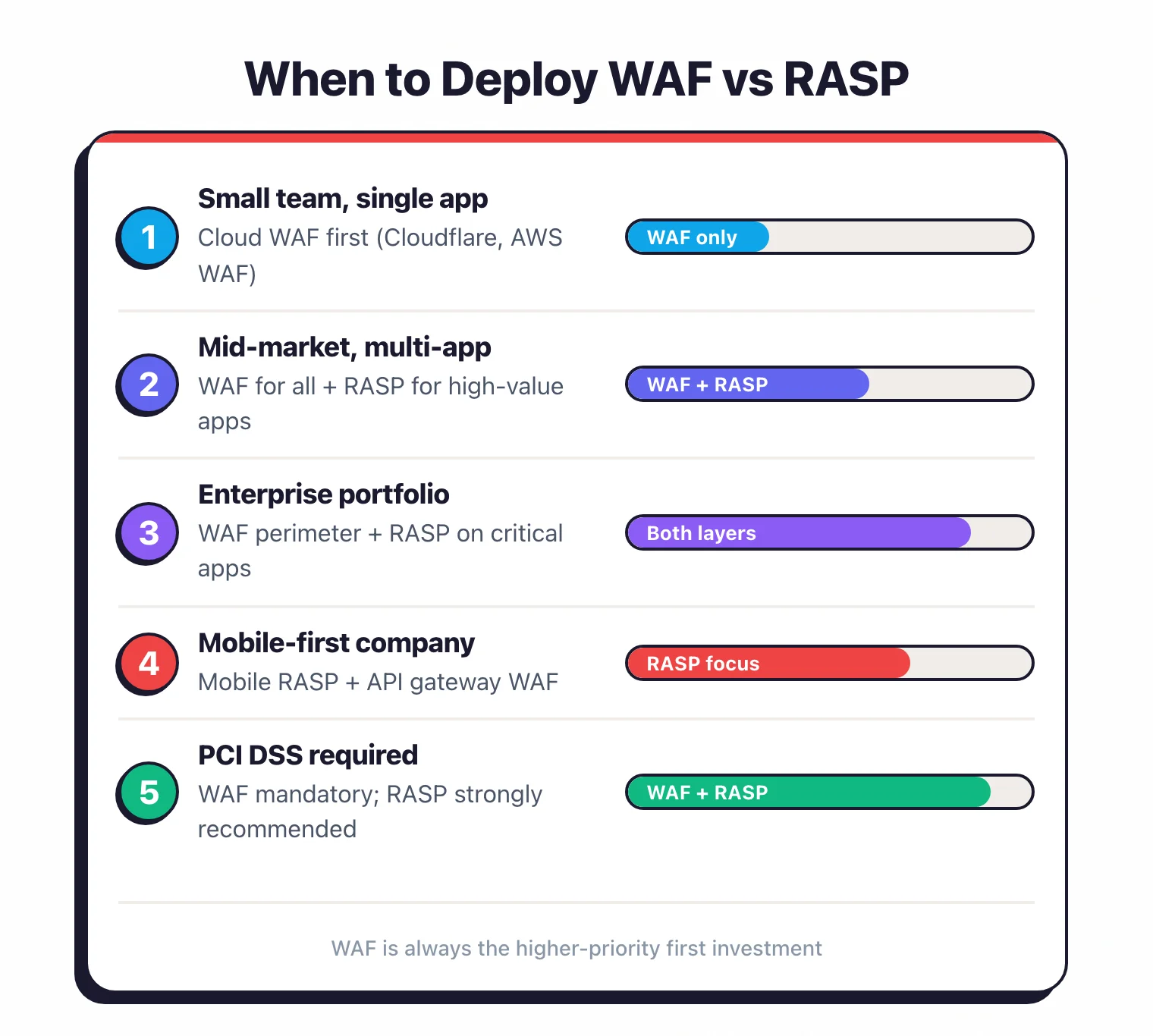
| Organization Type | Recommended Approach |
|---|---|
| Small team, single web app | Cloud WAF first (Cloudflare, AWS WAF) |
| Mid-market, multiple apps | Cloud WAF for all apps, RASP for highest-value apps |
| Enterprise, large portfolio | WAF for perimeter defense + RASP for critical applications |
| Mobile-first company | Mobile RASP (Appdome , Guardsquare ) + API WAF |
| PCI DSS compliance required | WAF is mandatory; RASP is strongly recommended for cardholder data apps |
Complementary use#
WAF and RASP are not competing alternatives. They protect different layers, and the strongest security posture uses both.
WAF as the outer perimeter. The WAF blocks the bulk of automated attacks, commodity scanners, DDoS traffic, and known exploit patterns.
It handles volume and reduces the load on your applications.
Think of it as filtering out the noise so that only potentially legitimate traffic reaches your application.
RASP as the inner defense. For traffic that passes the WAF (either because it looks legitimate or because the attack is novel), RASP provides the second layer.
Inside the application, RASP can detect whether a request actually triggers a vulnerability, not just whether it looks like it might.
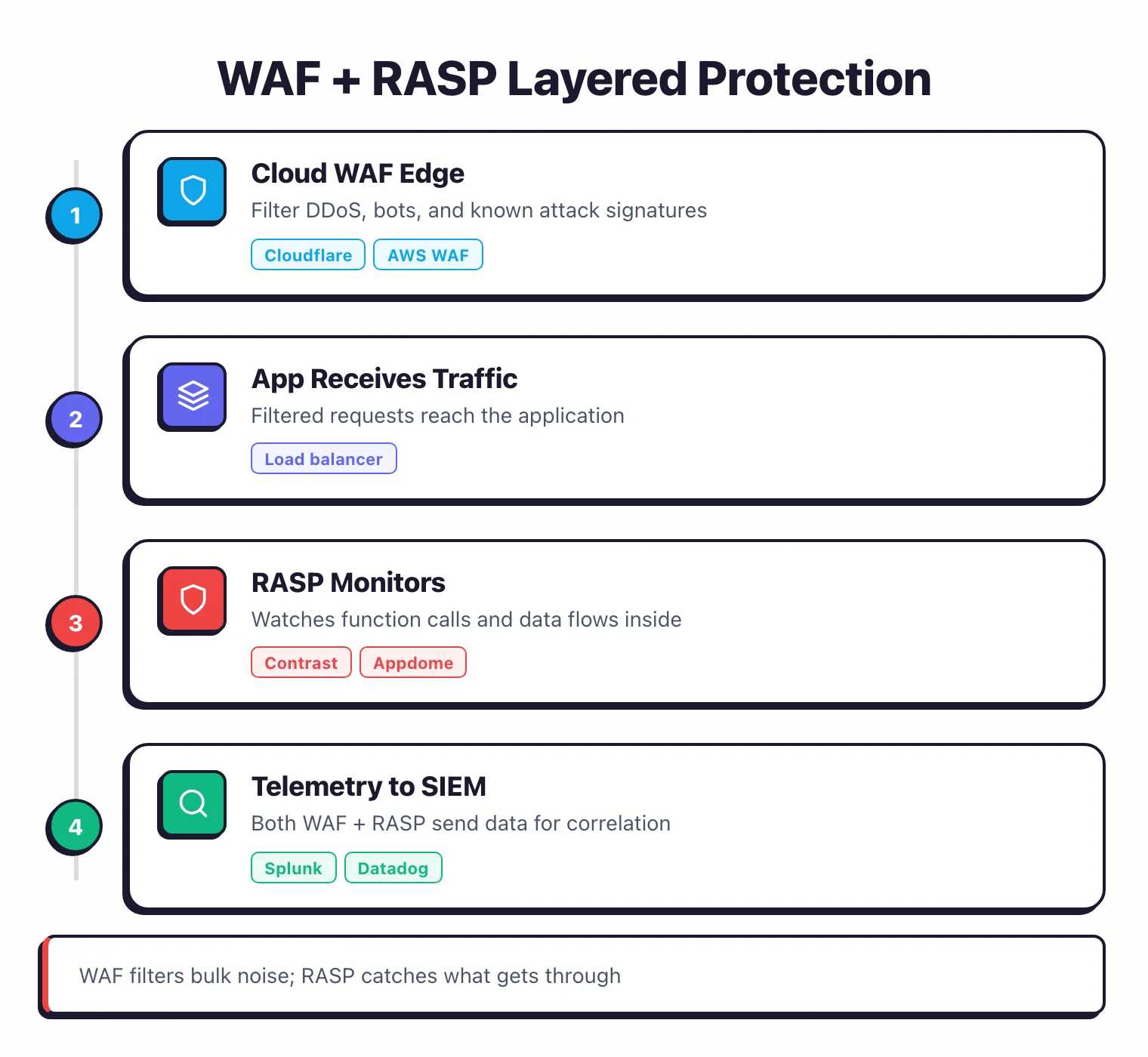
Practical integration pattern:
- Cloud WAF at the edge filters DDoS, bots, and known attack signatures
- Application receives filtered traffic
- RASP agent inside the application monitors function calls and data flows
- RASP blocks context-confirmed exploitation attempts that the WAF missed
- Both WAF and RASP send telemetry to your SIEM for correlated analysis
This layered approach is particularly important for organizations facing sophisticated attackers. A WAF alone can be bypassed by encoding tricks, parameter pollution, or attacks that do not match known signatures.
RASP catches what gets through because it understands the application context.
The cost of running both is higher than either alone. WAF pricing is typically based on traffic volume; RASP pricing is based on the number of instrumented applications.
For organizations with tight budgets, a WAF is the higher-priority investment because it provides broader coverage. RASP should be added to the applications where a breach would cause the most damage.
For detailed reviews, check the AppSec Santa RASP tools and DAST tools categories. Tools to evaluate for a layered approach:
- WAF: Cloudflare WAF, AWS WAF, Azure WAF, Fastly WAF
- RASP (server-side): Contrast Security for Java, .NET, Node.js, Python, Ruby, and Go applications
- RASP (mobile): Appdome for no-code mobile app protection, Guardsquare for mobile app hardening and runtime protection