


Appknox is an enterprise mobile application security testing platform used by 100+ global enterprises, including Samsung, Singapore Airlines, and Paytm. It scans compiled APK, AAB, and IPA binaries rather than source code, combining automated scanning with manual penetration testing across Android and iOS apps.
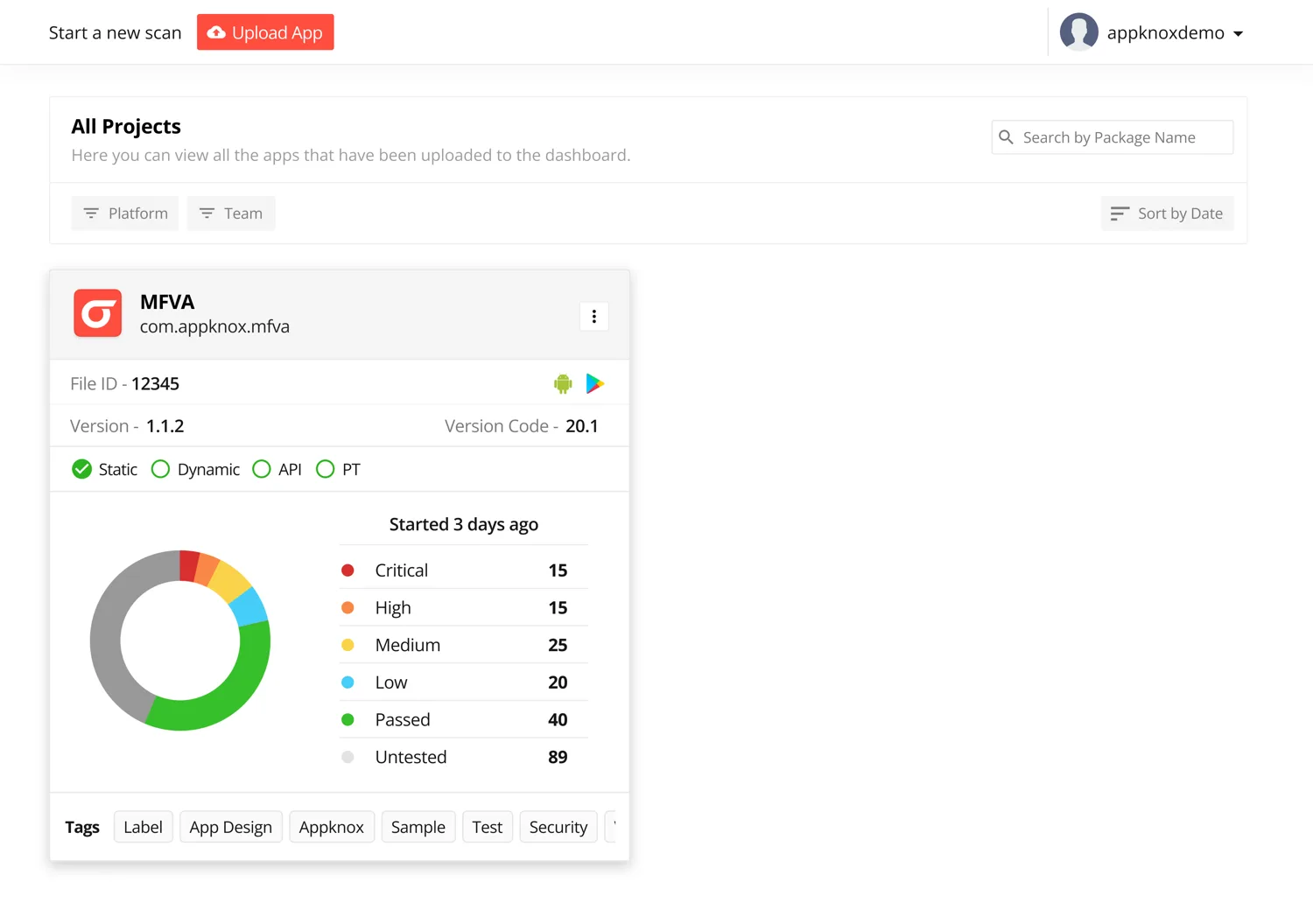
Founded in 2014 in Bangalore by Subho Halder and Harshit Agarwal, the platform packages binary SAST, real-device DAST, and API testing into one product.
What is Appknox?
Appknox is a mobile application security testing (MAST) platform built around binary analysis. It scans the compiled app you ship — the APK, AAB, or IPA — instead of your source code, so it reaches third-party SDKs and library issues that source scanners miss.
Three engines run against each upload: binary-based SAST, AI-led automated DAST executed on real physical devices, and API security testing. Certified security researchers add manual penetration testing on top of the automated pass.
Because it works from the binary, Appknox does not need access to your source repositories. That fits enterprises that outsource app development or want security to run independently of the engineering pipeline.
The platform targets regulated industries — banking, insurance, and companies with customer-facing mobile apps where compliance is mandatory. Findings map to OWASP MASVS, PCI-DSS, HIPAA, NIST, and regional frameworks that auditors accept directly.
What are Appknox’s key features?
| Feature | Details |
|---|---|
| Scanning approach | Binary-based — analyzes compiled APK, AAB, and IPA files, not source code |
| Testing engines | Binary SAST, AI-led DAST on real physical devices, API security testing |
| Manual testing | Penetration testing by certified security researchers, sub-24-hour turnaround |
| Prioritization | KnoxIQ ranks findings by real, exploitable risk |
| Platforms | Android (APK, AAB), iOS (IPA) |
| App store monitoring | Storeknox detects fake, orphaned, and unauthorized app versions |
| Compliance mapping | OWASP MASVS, GDPR, PCI-DSS, HIPAA, OWASP Top 10, NIST |
| Deployment | Cloud SaaS; on-premises option |
| Automation | Python CLI (appknox on PyPI) for CI/CD pipelines |
Binary SAST and Real-Device DAST
Appknox’s static analysis works on the compiled binary, flagging issues that source-level scanners skip because they never see the shipped artifact. This covers embedded SDKs, third-party libraries, and hardening gaps in the packaged app.
The dynamic side runs on real physical devices rather than emulators. Testing against real device behavior surfaces runtime issues — insecure storage, weak transport, certificate validation gaps — that simulated environments can miss.
KnoxIQ Prioritization
KnoxIQ ranks findings by exploitable risk instead of raw severity counts. The goal is to cut the noise that leaves security teams triaging long, undifferentiated vulnerability lists.
Manual Penetration Testing
Certified security researchers investigate logic flaws, authentication bypasses, and business-logic bugs that automated scanners cannot reason about. Appknox delivers this manual testing with remediation consultation and a sub-24-hour turnaround, wired into the same vulnerability pipeline as the automated scans.
Storeknox App Store Monitoring
Storeknox watches Google Play and the App Store for fake apps impersonating your brand, orphaned apps that still expose data, and unauthorized versions of your app. It is a separate add-on aimed at brand and supply-chain risk beyond the binary itself.
Privacy Shield and Binary SBOM
Privacy Shield analyzes data-collection behavior in mobile apps and flags potential GDPR, CCPA, and other privacy-regulation gaps. The binary-based SBOM enumerates the third-party libraries and SDKs baked into the app, which supports dependency and supply-chain reviews.
OWASP MASVS / MASTG Coverage
Appknox maps its checks to the OWASP Mobile Application Security Verification Standard (MASVS): MASVS-AUTH for authentication and session handling, MASVS-CRYPTO for weak cryptography, MASVS-NETWORK for transport issues, MASVS-PLATFORM for IPC and component misuse, MASVS-RESILIENCE for anti-tamper defenses, and MASVS-PRIVACY for data handling.
Because the MASTG tests are the same checks assessors use during regulated audits, Appknox reports line up with those frameworks without manual translation.
Automating Appknox in CI/CD
Appknox ships a Python CLI (appknox on PyPI) so scans run inside any build pipeline. Authenticate with appknox login, or set APPKNOX_ACCESS_TOKEN and APPKNOX_ORGANIZATION_ID for non-interactive CI use:
# Install the CLI
pip install appknox

# Non-interactive auth for CI/CD
export APPKNOX_ACCESS_TOKEN=your_token_here
export APPKNOX_ORGANIZATION_ID=your_org_id

# Upload an app for scanning
appknox upload app-release.apk

# Check analyses for the uploaded file
appknox analyses <file_id>

# Create and download a report
appknox reports create <file_id>
appknox reports download summary-csv <report_id>
Generate the access token from your Appknox dashboard under Settings → Developer Settings. Because the CLI runs anywhere, Appknox slots into GitHub Actions, Jenkins, GitLab CI, and Azure Pipelines without a platform-specific plugin.
 GitHub Actions
 Jenkins
 GitLab CI
 Azure Pipelines
Compliance Support
Appknox maps scan and pen-test results to major regulatory frameworks, producing reports auditors can use directly:
- OWASP MASVS — Mobile Application Security Verification Standard
- GDPR — Data protection and privacy
- PCI-DSS — Payment card industry security
- HIPAA — Healthcare data protection
- NIST — National Institute of Standards guidelines
How much does Appknox cost?
Appknox does not publish pricing on its website — every plan is quoted by sales. The model is per-app or per-organization commercial licensing, scaled by the number of mobile apps (iOS and Android binaries count separately) and the depth of testing you need.
A free trial and demo scan let prospective buyers see the dashboard before committing. Manual penetration testing is a separate line item, billed per engagement, with a sub-24-hour turnaround.
For regulated buyers, an on-premises deployment option adds an installation and support component to the contract. Contact Appknox with app counts and compliance scope for a quote.
When to Use Appknox
Appknox fits organizations that want managed mobile security testing combining automated scanning with human expertise, without access to app source code.
Consider Appknox when:
- You ship compiled apps and cannot (or prefer not to) grant source-code access
- You need both automated scanning and manual penetration testing in one platform
- Compliance reporting (OWASP MASVS, PCI-DSS, HIPAA) is a hard requirement
- You want app-store monitoring for fake and unauthorized clones via Storeknox
- You operate in banking, insurance, or other regulated sectors
Teams looking for free or open-source options can start with MobSF for initial assessments. For the wider category, see my mobile security tools hub.
What are alternatives to Appknox?
Appknox sits in a competitive enterprise MAST market. The most-evaluated alternatives I see on regulated-industry shortlists:
- NowSecure . US-based MAST platform with strong CI/CD and automated mobile API testing. Comparable scope to Appknox, often the head-to-head choice for North American buyers.
- Data Theorem Mobile Secure. Continuous mobile, API, and cloud security with daily app-store scans. Broader cloud-native coverage; Appknox stays focused on binary scanning and managed pentesting.
- Zimperium zScan . Static binary scanning inside Zimperium’s MAPS bundle. Strong if you also need on-device runtime protection (zDefend) — Appknox does not ship a RASP layer.
- Quokka Q-mast. Binary-only MAST, formerly Kryptowire, with SAST, DAST, IAST, and forced-path execution. Stronger on NIAP mapping; it does not list a manual pentest service the way Appknox does.
- Ostorlab Enterprise. Mobile, API, and web scanner with an OSS edition (Asteroid). Closer feature parity on the SAST/DAST/API side, with a lower entry price for smaller teams.
- MobSF . Open-source MAST framework. The right comparison for teams with internal AppSec headcount who want to self-host and skip a commercial license — at the cost of no managed pentesting and no compliance reporting.
For a wider category view, see my mobile security tools hub.