


Appdome is a no-code mobile application security platform that protects Android and iOS apps without requiring developers to write code, integrate SDKs, or modify source. The platform uses patented Fusion technology to inject security, anti-fraud, anti-bot, and compliance protections directly into compiled app binaries through CI/CD pipelines.
The company offers over 400 individual defenses across categories including app security, fraud prevention, malware detection, bot defense, and geo-compliance. Appdome positions itself as an AI-native platform and has gained significant enterprise adoption in financial services, gaming, streaming, and retail verticals.
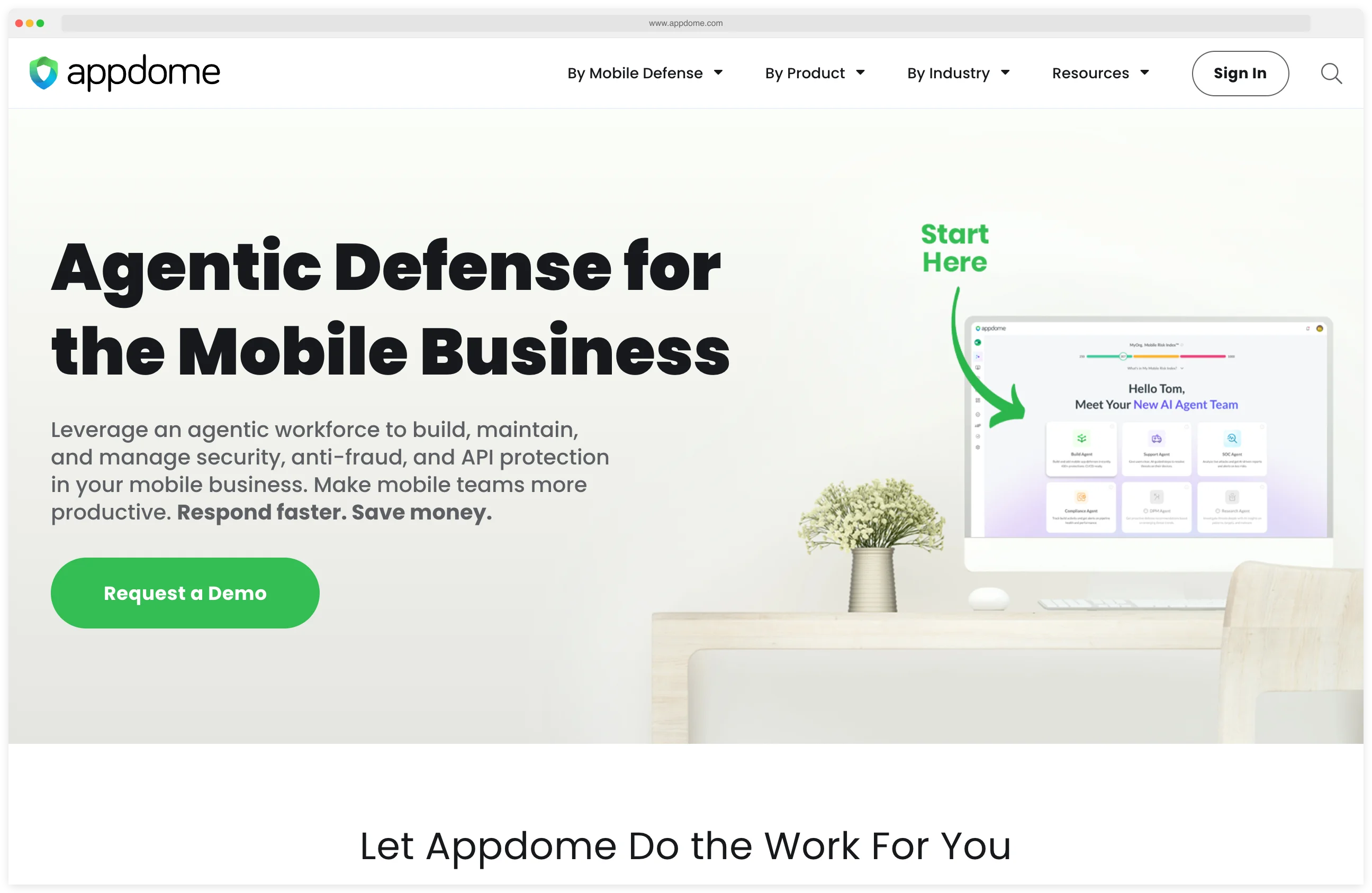
What is Appdome?
Traditional mobile security tools require developers to integrate SDKs, write protection logic, and manage ongoing maintenance. Appdome takes a different approach.
The platform works on the finished app binary, meaning protection can be added after development is complete and without touching source code.
Development teams upload their APK, AAB, or IPA file, select the defenses they want through a web-based interface, and receive a protected build back. This entire process fits into existing CI/CD pipelines, so protected builds can ship automatically alongside regular releases.
| Capability | Details |
|---|---|
| No-Code Fusion | Patented technology injects protections into compiled app binaries. No SDK integration, no code changes, no specialized mobile security expertise required. |
| 400+ Defenses | Covers app security, anti-fraud, anti-malware, anti-bot, anti-cheat, geo-compliance, and social engineering protection in a single platform. |
| AI-Native CI/CD | Plugs directly into build pipelines to automate protection, certification, and deployment. Supports automated Certified Secure verification. |
What are Appdome’s key features?
ONEShield Mobile RASP
ONEShield is Appdome’s runtime application self-protection layer. It detects and responds to threats while the app is running on a user’s device.
The protection includes anti-tampering checks, anti-debugging measures, emulator detection, and defenses against hooking frameworks such as Frida, Xposed, and Magisk.
Unlike RASP solutions that require SDK integration, ONEShield is applied through Appdome’s no-code Fusion process. Protected apps gain runtime awareness without developers writing a single line of defense code.
ThreatScope Threat Intelligence
ThreatScope provides real-time visibility into the threats targeting your mobile apps in production. The dashboard monitors the active attack surface across devices, OS versions, geographies, and app releases, giving security teams data on what attacks are occurring and how defenses are performing.
The platform includes a threat analytics engine for segmenting and analyzing fraud attempts, account takeover events, and cyberattacks by application, API, or attack type.
Anti-Fraud and Bot Defense
Beyond traditional app security, Appdome addresses fraud and bot traffic at the mobile layer. The platform detects account takeover attempts, credential stuffing, automated bot activity, and social engineering attacks.
These defenses work alongside the RASP protections so a single platform handles both security and fraud concerns.
Geo-Compliance
For apps that must enforce geographic restrictions (streaming services, gambling apps, region-locked content), Appdome provides fake GPS detection, VPN detection, and location verification. These protections prevent users from spoofing their location to bypass geographic access controls.
OWASP MASVS-RESILIENCE Mapping
Appdome’s ONEShield layer maps cleanly to the OWASP MASVS-RESILIENCE control family — the part of the Mobile Application Security Verification Standard that covers anti-tampering, anti-debugging, and anti-emulator defenses. ONEShield’s anti-tamper checks address MASVS-R-1 (impede dynamic analysis), the anti-debugging routines cover MASVS-R-2, and emulator detection lines up with MASVS-R-3.
If you are auditing against MASVS or referencing the MASTG resilience tests in a compliance program, Appdome lets you tick those boxes without writing or maintaining the controls yourself.
How do I get started with Appdome?
- Upload your app binary — Submit your Android APK/AAB or iOS IPA to the Appdome platform through the web interface or CI/CD integration.
- Select defenses — Choose from 400+ available protections across security, fraud, bot defense, and compliance categories. Defenses are organized by use case.
- Build with Fusion — Appdome’s patented Fusion engine injects the selected protections into your app binary without modifying source code.
- Certify and deploy — Use Certified Secure verification to confirm protections are active, then push the protected build to app stores through your CI/CD pipeline.
How much does Appdome cost?
Appdome does not publish pricing on its website — every plan goes through the sales team. The model is a per-app subscription scaled by the number of protected apps and the platforms you cover (each iOS/Android binary is counted separately).
Marketing tiers visible on appdome.com group features into Standard, Premium, and Enterprise bundles, with the higher tiers unlocking ThreatScope analytics, advanced anti-fraud, and priority response. Build2Test access lets prospective customers run protected builds before signing.
For an actual quote you need to contact Appdome directly with app counts, monthly active users, and the defense categories you care about — there is no self-serve checkout.
Platform Coverage
Appdome supports both Android and iOS platforms, including apps built with native frameworks and cross-platform tools like React Native, Flutter, Cordova, Ionic, Unity, and Xamarin. Protection extends to mobile SDKs as well as full applications.
When to Use Appdome
Appdome suits organizations that need broad mobile defense capabilities without the engineering overhead of integrating security SDKs. The no-code model appeals to teams where mobile security expertise is limited or where the goal is to protect many apps at scale without modifying each one individually.
The platform covers more ground than pure obfuscation tools like Guardsquare , extending into fraud, bots, and compliance. It sits alongside runtime protection tools like Talsec but takes a fundamentally different integration approach by working on compiled binaries rather than requiring SDK embedding.
Consider alternatives if you need deep code obfuscation at the compiler level (Guardsquare) or if your budget favors a free starting tier (Talsec’s freeRASP).
What are alternatives to Appdome?
Appdome sits in a crowded mobile RASP and app-shielding market. The closest alternatives — depending on which slice of Appdome’s coverage matters most — are:
- Guardsquare (DexGuard + iXGuard). Compiler-level obfuscation and hardening for Android and iOS. Stronger on deep code protection and bytecode obfuscation, but requires build-stage integration rather than no-code.
- Talsec RASP+. Mobile RASP and runtime threat detection with a free tier (freeRASP) and a paid AppiCrypt SDK. Simpler footprint than Appdome, focused on RASP rather than the full fraud/bot stack.
- Promon SHIELD. Norwegian app-shielding vendor used heavily in fintech and mobile banking. Comparable RASP scope to ONEShield, with strong banking-specific case studies.
- Verimatrix XTD. Extended threat-defense platform that pairs app shielding with telemetry and incident response — closest to Appdome’s broad “shield + analytics” positioning.
- Zimperium zShield. App-shielding component of Zimperium’s MAPS bundle, often paired with their on-device zDefend SDK for runtime protection.
For a wider view of the category, see my mobile security tools hub which covers RASP, MAST, and shielding side-by-side.