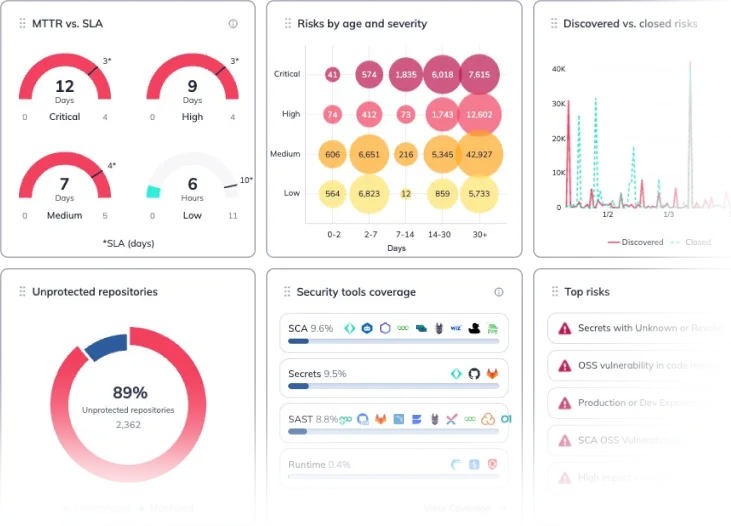

Apiiro is an ASPM platform that uses Deep Code Analysis (DCA) and a proprietary Risk Graph to understand code behavior and prioritize risk from code to runtime.
Unlike traditional SAST tools that scan for known vulnerability patterns in source code, Apiiro flags material changes that shift risk even when no scanner fires an alert — because it understands what the code does, not just what it looks like.
Apiiro reports $135M in total funding, including a $100M Series B in 2022 led by General Catalyst — figures from the company’s own announcements and press coverage, not an independent audit. It lists customers including USAA, BlackRock, Shell, SoFi, Cloudera, and Equinix.
What is Apiiro?
Apiiro is a risk-based ASPM platform that sits on top of existing security scanners and uses code intelligence to separate real risk from noise. It splits the development lifecycle into three phases:
| Capability | Details |
|---|---|
| Design | Threat modeling and risk detection before coding starts. Contextual questionnaires replace manual security reviews. |
| Develop | Secrets detection, open source security, API inventory, SAST, and sensitive data detection. All findings get Risk Graph context. |
| Deliver | SCM and CI/CD pipeline protection with release risk assessment. Software supply chain security across the build process. |
Apiiro is tool-agnostic — it aggregates findings from whatever SAST, DAST, and SCA tools you already run, then layers Risk Graph context on top to determine which findings actually matter based on reachability, business criticality, and internet exposure. It does not replace your existing scanners; it makes them more useful.
What are Apiiro’s key features?
Deep Code Analysis
Deep Code Analysis builds an abstract representation of how code actually behaves, not just what it looks like syntactically.
It traces data flows across function and service boundaries, spots business logic patterns (authentication, payment processing, PII handling), and flags behavioral changes even when the diff looks minor.
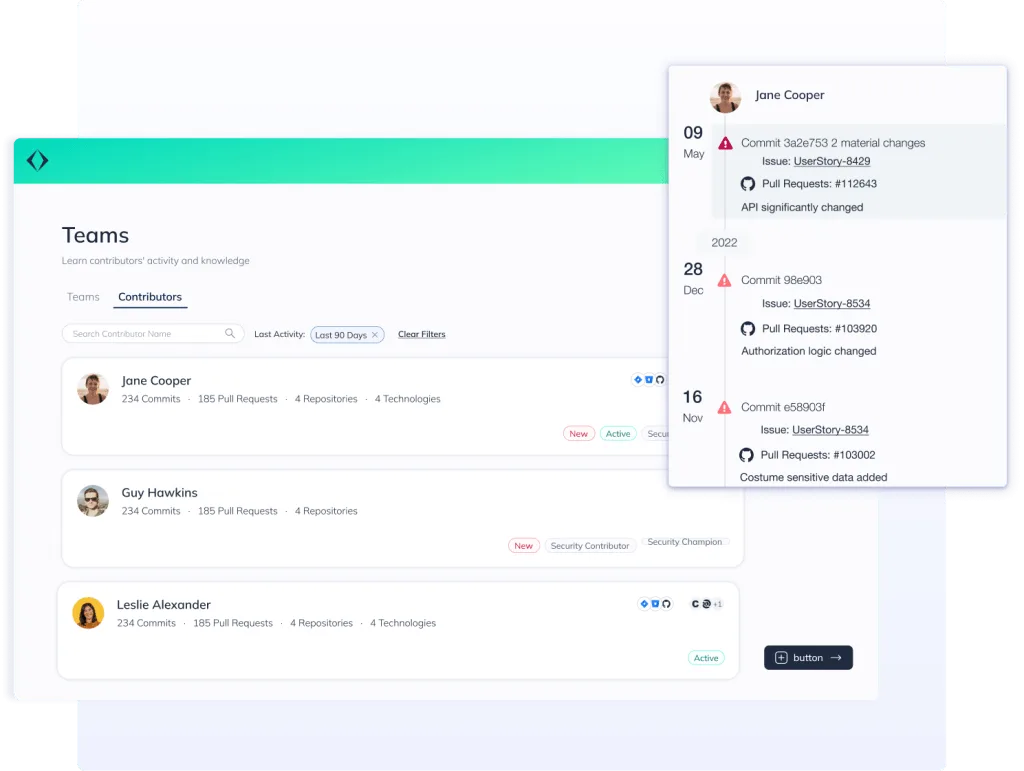
Material Change Detection separates high-risk changes from routine refactoring. A rename that touches 200 files won’t trigger the same response as a 3-line change to your authentication flow.
Traditional SAST scans for known vulnerability patterns in source code. Apiiro’s DCA understands code behavior and flags material changes that shift risk, even when no vulnerability pattern matches.
A new API endpoint that exposes PII gets flagged based on what it does, not because it matches a regex.
Risk Graph
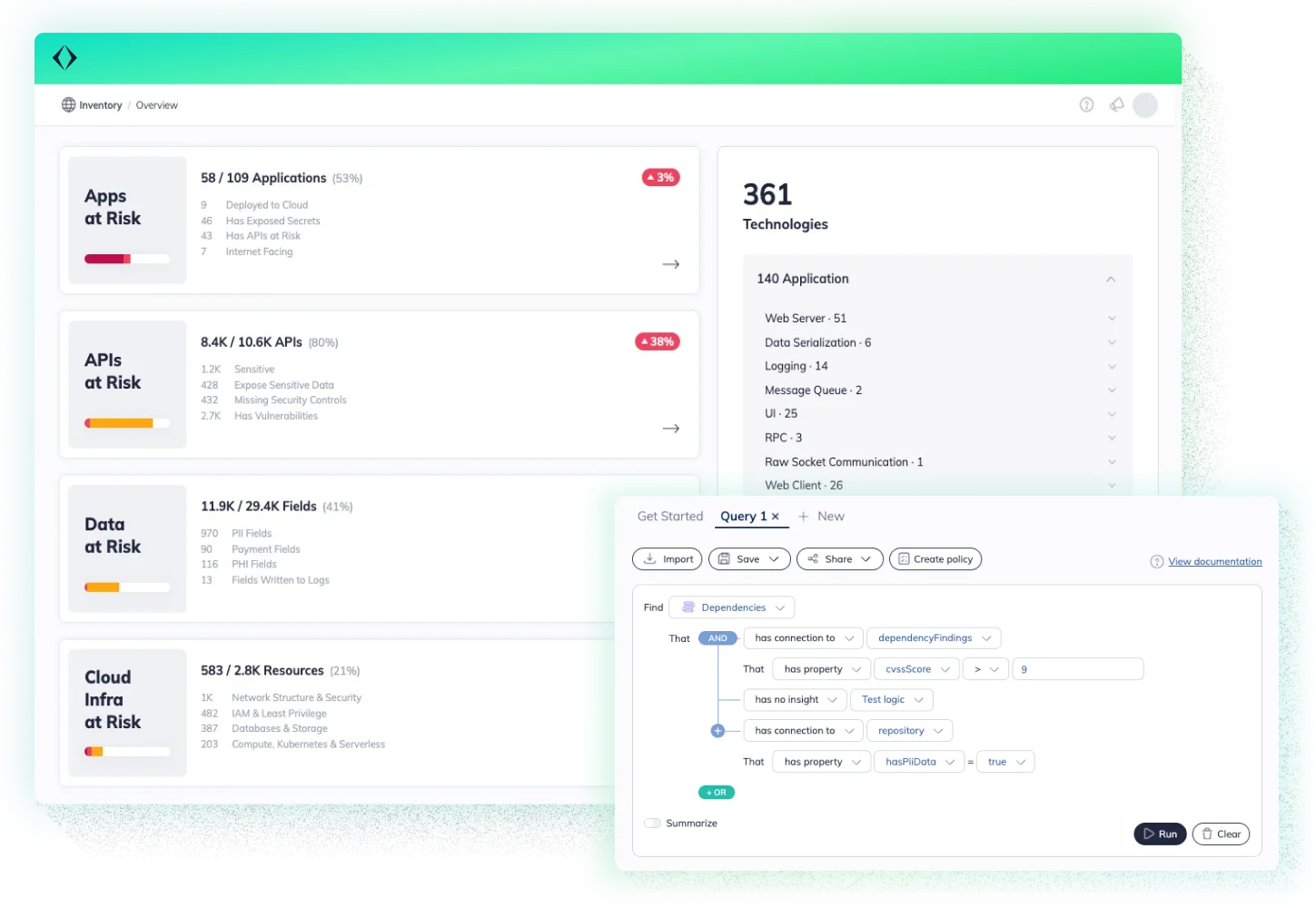
The Risk Graph is Apiiro’s queryable knowledge graph that connects code, infrastructure, and people with business context. It ties together code (repositories, branches, commits, functions, data flows), infrastructure (build pipelines, deployment targets, runtime environments), and people (developers, reviewers, approvers) with business context like data sensitivity and internet exposure.
You can query it in natural language:
| Query | What it returns |
|---|---|
| “Changes to PII handling code in the last 30 days” | All commits touching sensitive data flows, with authors and review status |
| “Path from this CVE to internet-exposed endpoints” | Dependency chain showing if the vulnerable code is reachable from production |
| “Unreviewed commits to authentication modules” | Commits to auth code that bypassed code review, ranked by risk |
Software supply chain security
Apiiro extends standard SBOM with its XBOM (eXtended Software Bill of Materials), which adds behavioral analysis on top of dependency inventory. Where a standard SBOM lists what packages are present, XBOM detects suspicious changes in dependency updates and flags dependency confusion risks. Specific capabilities include:
- Transitive dependency mapping across the full dependency tree
- Behavioral analysis of dependency updates (detecting suspicious changes)
- Dependency confusion risk detection
- License compliance tracking
- SBOM generation and maintenance
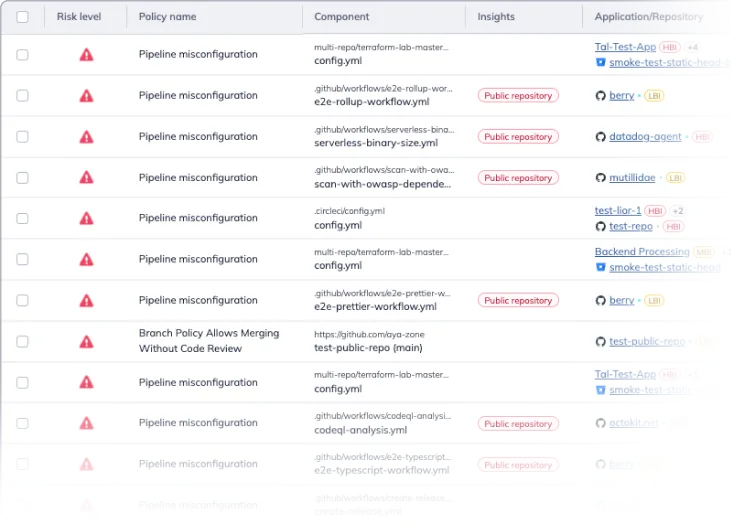
AI agents
Apiiro’s Guardian Agent addresses a gap that traditional AppSec tools miss entirely: insecure code generated by AI coding assistants. It intercepts developer prompts sent to tools like GitHub Copilot or Cursor and injects security context, threat models, and compliance policies before any code is generated. The result is that insecure patterns are blocked at the prompt layer rather than caught in a scan after the fact. AutoFix agents handle remediation across the design, code, and delivery phases.
In April 2026, Apiiro shipped the Apiiro CLI , which Apiiro bills as the first command-line interface designed for AI coding agents rather than humans. It exposes six agent skills — query risks, scan code, validate changes, apply policies, fetch threat models, and surface Secure Prompt context — directly inside CI pipelines and AI assistants. Coverage is reported by SiliconANGLE, SC Media, and Help Net Security.
ASPM correlation and prioritization
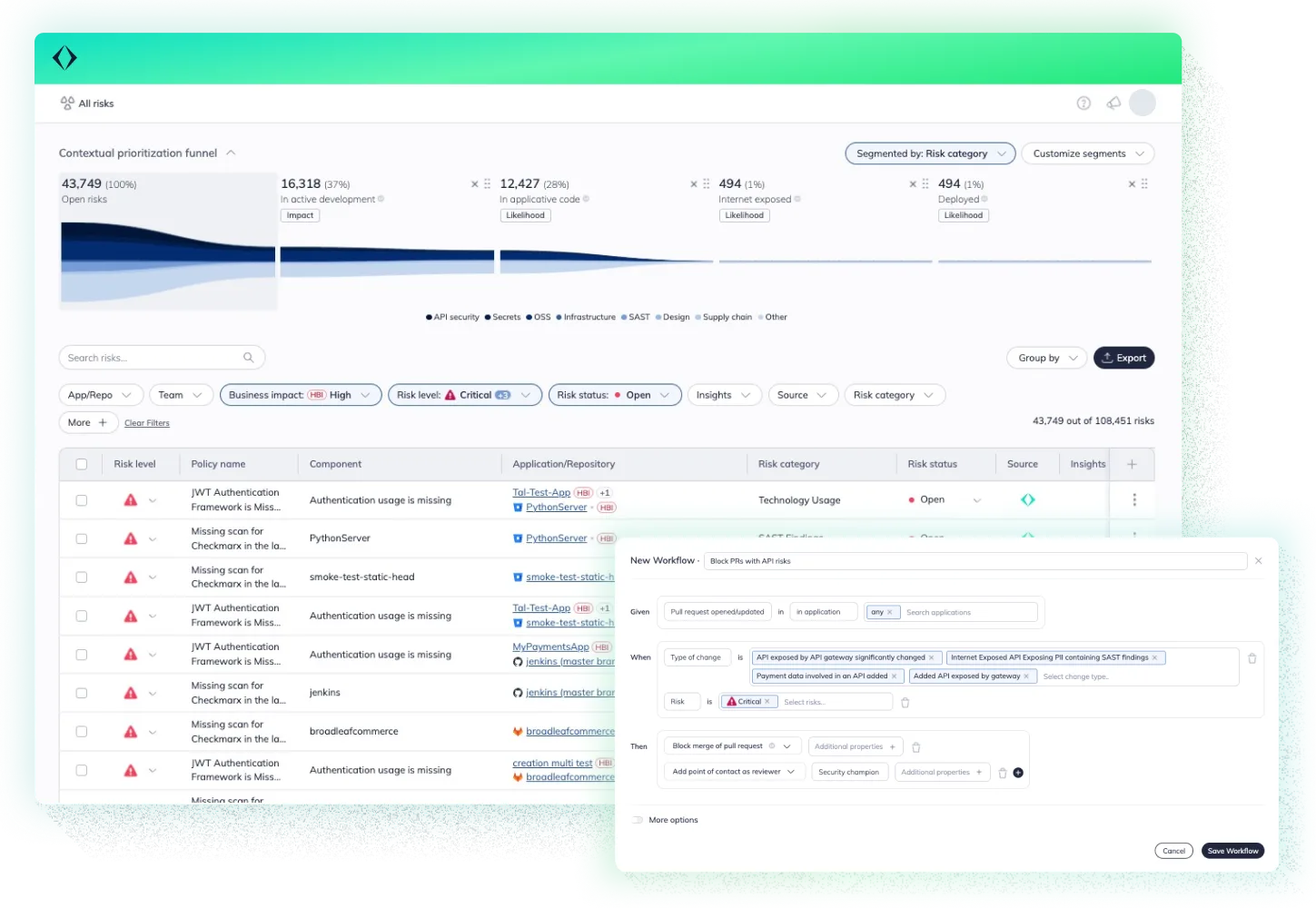
Risk Graph and Deep Code Analysis are how Apiiro implements vulnerability correlation across scanners. Findings from your existing SAST, DAST, SCA, container, IaC, secrets, and CSPM tools land in one queryable graph; duplicate findings are reconciled through code-behavior fingerprinting rather than only through CVE IDs.
Apiiro layers application context enrichment on top. Each finding is tagged with the repository, function, owning team, runtime exposure, data sensitivity, and recent material-change history. Risk-based prioritization uses those signals — reachability, exploitability, business criticality, and data sensitivity — to surface what is actually worth fixing this week.
The result is a unified dashboard across security tools that replaces console-hopping. Instead of triaging four scanner UIs, security and engineering teams work from one Risk Graph view with Jira and ServiceNow tickets routed by ownership.
What does Apiiro integrate with?

 GitHub
 GitLab
 Bitbucket
 Azure DevOps
GitHub Actions
GitLab CI
Azure DevOps
GitHub Actions
GitLab CI Jenkins
 CircleCI
Azure Pipelines
CircleCI
Azure Pipelines Buildkite
 AWS
AWS Azure
Azure GCP
GCP Kubernetes
 Jira
Jira ServiceNow
How much does Apiiro cost?
Apiiro does not publish prices on its website. The pricing page routes to a sales conversation, so the only honest description is tier shape: enterprise contracts custom-priced by repository count, scanner volume, modules in scope (Risk Graph, Guardian Agent, AutoFix, Apiiro CLI), and term length.
Apiiro is positioned as an enterprise ASPM platform — the customer logos (USAA, BlackRock, Shell, SoFi, Cloudera, Equinix) cluster in the Fortune 500 and large-financial bracket, not the SMB tier. For a buyer-side view of typical ASPM contract sizes, see the AppSec tools pricing guide .
Expect a discovery call, a proof of value across one or two repositories, and a custom quote. If you need self-serve scanning with a free tier, Apiiro is the wrong shape — see the alternatives section below.
What are alternatives to Apiiro?
Apiiro’s strength is code intelligence on top of existing scanners. If your shortlist needs a different shape, four alternatives come up frequently.
- Cycode — Better fit when SCM and CI/CD pipeline posture matter as much as code analysis. Cycode covers source-code-to-runtime governance with strong pipeline-tampering signals; Apiiro leans more on code-behavior analysis.
- ArmorCode — Better fit when you want a pure aggregator across many existing scanners with rich workflow automation. ArmorCode does not perform deep code analysis; Apiiro does.
- Legit Security — Better fit for teams focused on the SDLC governance angle (SBOM, secrets, pipeline integrity) rather than the code-behavior angle. Legit emphasizes process visibility; Apiiro emphasizes risk graph depth.
- Phoenix Security — Better fit when reachability-driven prioritization across SAST, SCA, container, and cloud is the priority and you want OSS-friendly pricing. Phoenix is more orchestration-focused than Apiiro’s behavioral analysis.
If you also need scanners (not just risk context), Aikido and Snyk ship scanning plus aggregation. The full landscape is on the ASPM tools hub .
How do I get started with Apiiro?
- Connect your SCM — Link GitHub, GitLab, Bitbucket, or Azure DevOps. Apiiro needs full commit history for Deep Code Analysis.
- Apiiro builds the Risk Graph — The platform maps your repositories, infrastructure, team ownership, and business context into a queryable graph.
- Connect existing scanners — Import findings from your SAST, DAST, and SCA tools. Apiiro applies Risk Graph context to prioritize them.
- Review prioritized risks — See findings ranked by actual business impact. Use natural language queries to explore the Risk Graph.
When to use Apiiro
Apiiro is built for enterprises already drowning in scanner findings who need risk-based prioritization, not more alerts. If you’re tracking code risk over time, managing complex supply chains, or need compliance evidence across the development lifecycle, that’s where Apiiro earns its keep.
The difference between Apiiro and a standalone ASPM tool is code intelligence depth. Most ASPM platforms aggregate findings and apply static metadata (severity, asset criticality) to prioritize. Apiiro uses Deep Code Analysis to understand behavioral changes in the code itself, so prioritization reflects actual risk rather than scanner severity scores.
Pricing requires a sales conversation; Apiiro does not publish a rate card.
Smaller teams with simple codebases where manual review still works, or organizations that need scanning capabilities rather than aggregation, should look at tools like Aikido or Jit instead.