


Anchore is a container security company built around the principle that SBOMs should be the foundation of software security.
The company maintains two widely-used open-source tools – Syft for SBOM generation and Grype for vulnerability scanning – with over 50 million combined downloads across the ecosystem.
Anchore Enterprise extends these with continuous monitoring, compliance automation, and policy enforcement. The push for SBOM adoption accelerated after Executive Order 14028 mandated software bills of materials for federal suppliers.
Where many SCA tools focus on developer workflows and fix PRs, Anchore targets organizations that need to prove compliance.
Its FedRAMP, NIST, DISA packs and air-gapped support are what make it a regulated-industry fit in my book.
What is Anchore?
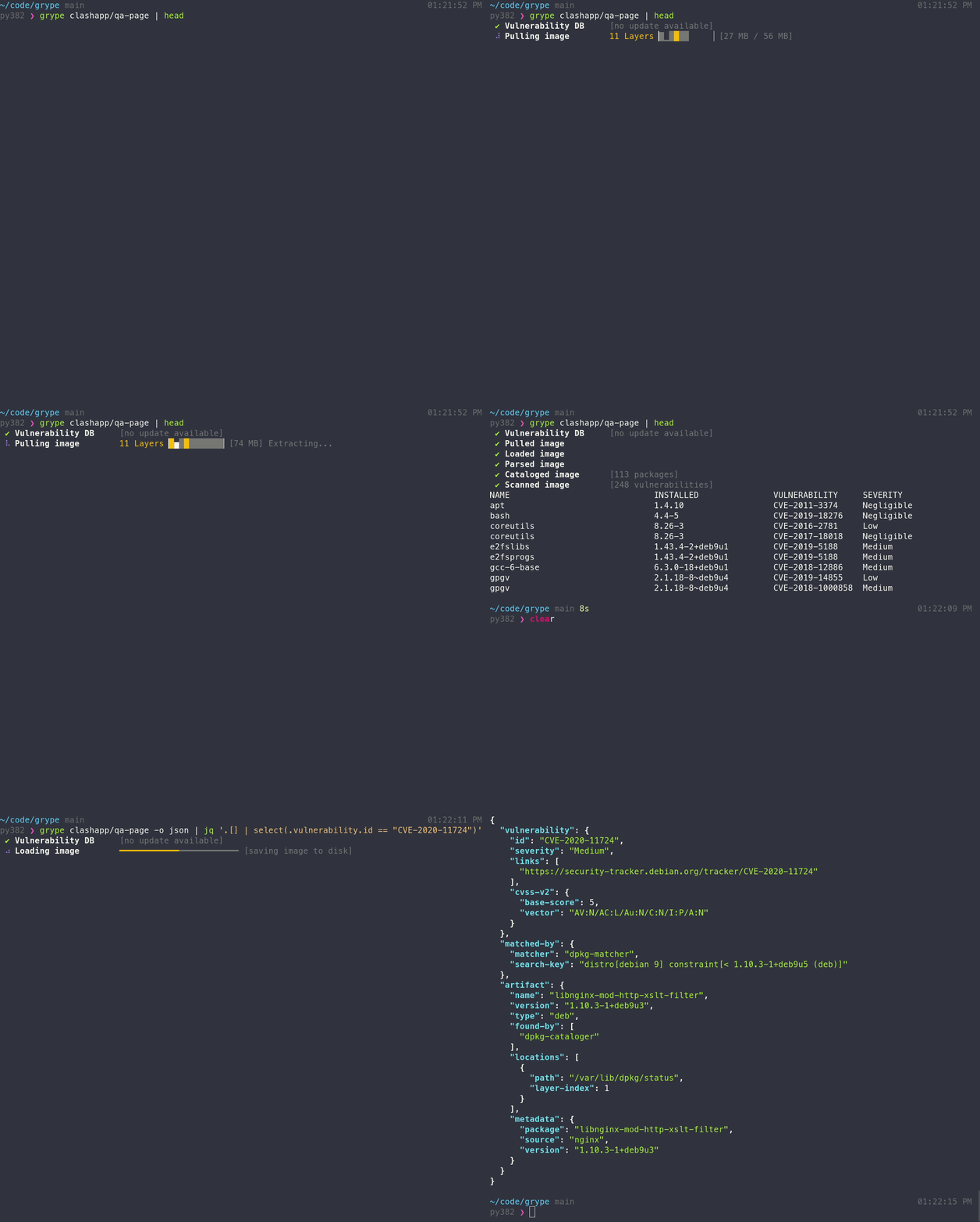
Anchore takes an SBOM-first approach to container security. Rather than scanning an image once and moving on, it generates a detailed SBOM, stores it centrally, and continuously matches it against updated vulnerability feeds.
When a new CVE drops, Anchore knows immediately which images in your inventory are affected, without rescanning a single container.
The platform spans two tiers: free open-source CLI tools for individual developers and CI pipelines, and a commercial enterprise platform for organizations that need dashboards, compliance, and governance.
| Capability | Details |
|---|---|
| SBOM Lifecycle Management | Generate SBOMs with Syft, store them centrally in Anchore Enterprise, and continuously monitor them against new vulnerability disclosures. No rescanning needed when new CVEs drop. |
| Compliance Automation | Pre-built policy packs automate checks against FedRAMP, NIST 800-53 Rev 5, NIST 800-190, and DISA standards. Federal Edition deploys in IL2 through IL6 air-gapped environments. |
| Open-Source Foundation | Syft (8,400+ GitHub stars) and Grype (12.4K GitHub stars) are free Apache 2.0 tools. Enterprise builds on them with governance, dashboards, and continuous monitoring. |
Open-source tools
Syft: SBOM generation
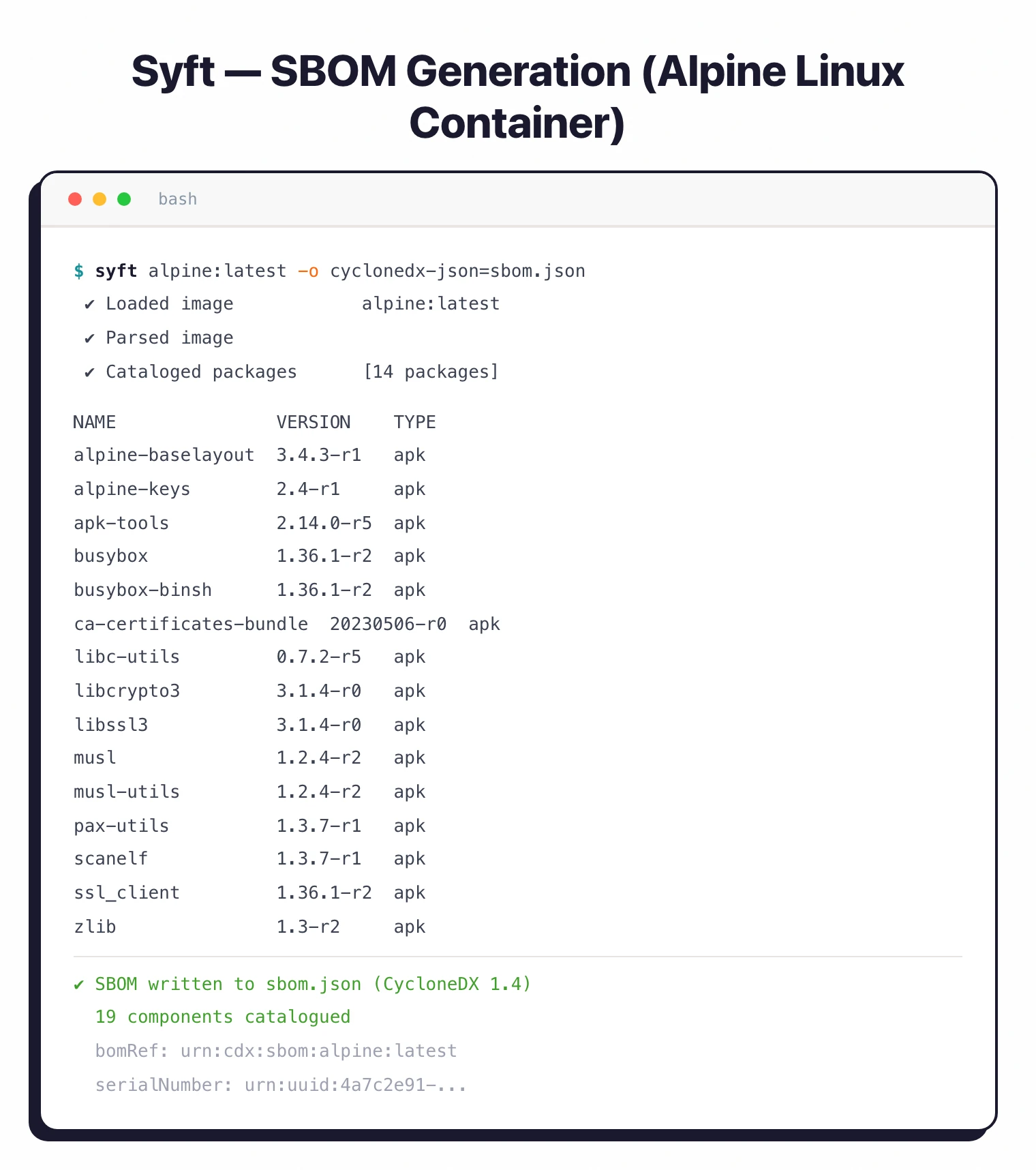
Syft is a CLI tool and Go library that generates Software Bills of Materials from container images, filesystems, and archives. It supports dozens of packaging ecosystems including Alpine, Debian, RPM, npm, pip, Maven, Go, Cargo, Composer, NuGet, and more.
Output formats include CycloneDX, SPDX, Syft JSON, and GitHub’s dependency snapshot format. Syft can also convert between SBOM formats, making it useful as a general-purpose SBOM utility.
# Generate SBOM from container image
syft alpine:latest -o cyclonedx-json > sbom.json

# Generate SBOM from directory
syft dir:/path/to/project -o spdx-json

# Generate SBOM from archive
syft docker-archive:image.tar

# Convert SBOM format
syft convert sbom.cdx.json -o spdx-json
Grype: vulnerability scanning
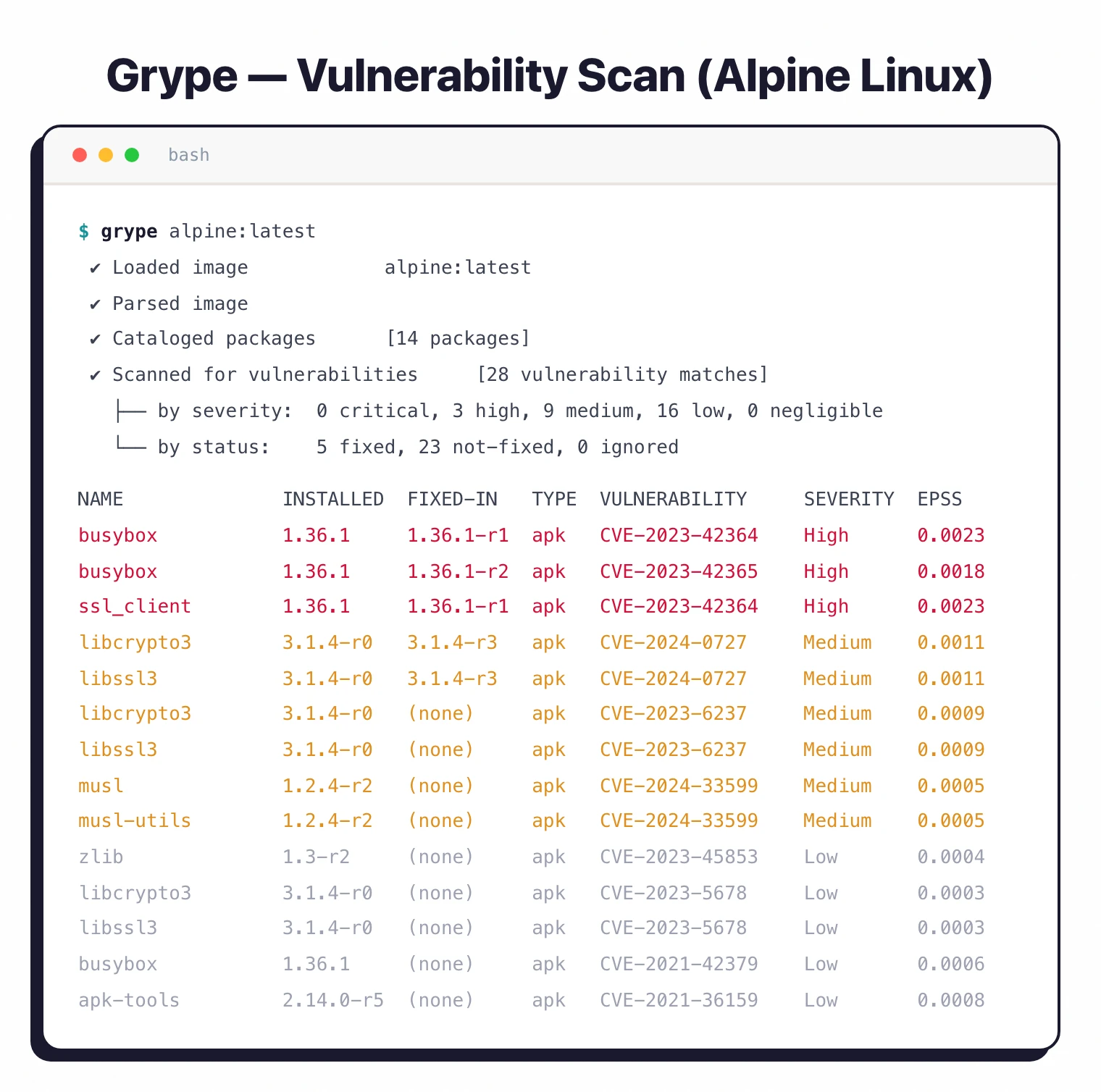
Grype scans container images, filesystems, and SBOM files against multiple vulnerability databases including NVD, GitHub Security Advisories, and distribution-specific feeds. It includes EPSS and KEV-based risk scoring with a composite score from 0 to 10.
# Scan container image
grype alpine:latest

# Scan an SBOM
grype sbom:./sbom.json

# Fail on high or critical
grype alpine:latest --fail-on high

# Output SARIF for GitHub Security
grype alpine:latest -o sarif > results.sarif
Grant: license compliance
Grant is a newer addition to the Anchore open-source suite that handles license checking. It reads SBOMs and evaluates package licenses against configurable policies, flagging non-compliant or risky licenses.
Enterprise platform
Anchore Enterprise extends the open-source tools with capabilities that organizations need at scale.
Continuous vulnerability monitoring
This is the feature that distinguishes Anchore Enterprise from running Grype in CI. The platform stores every SBOM generated from your pipeline and continuously matches stored SBOMs against updated vulnerability feeds.
When a new advisory is published, Anchore identifies affected images instantly and sends alerts, without requiring a rescan of the original artifact.
This solves the “scan gap” problem where vulnerabilities disclosed after your last pipeline run go undetected until the next build.
By storing SBOMs centrally, Anchore Enterprise can retroactively identify which images are affected by a newly disclosed CVE. A traditional scanner needs access to the original image or filesystem.
Anchore just needs the SBOM it already has on file.
Policy-based admission control
Define policies that determine which images are allowed to deploy. Policies can check for:
- Maximum vulnerability severity thresholds
- Required SBOM presence and completeness
- Approved or denied base images
- License compliance requirements
- Secret detection results
- Package blacklists or whitelists
Policies integrate with Kubernetes admission controllers and CI/CD gates to enforce compliance before deployment.
Compliance automation
Anchore Enterprise ships with pre-built policy packs for major regulatory frameworks:
| Framework | Coverage |
|---|---|
| FedRAMP | Vulnerability scanning requirements, NIST 800-53 Rev 5 controls |
| NIST 800-190 | Container security guidelines |
| DISA | DOD/DISA standards compliance |
| CIS Benchmarks | Container hardening checks |
| Executive Order 14028 | SBOM requirements for federal software |
The Federal Edition supports FIPS compliance and deploys in environments from IL2 through IL6 air-gapped classified networks.
Secret and malware detection
Beyond vulnerability scanning, Anchore Enterprise scans container image layers for embedded secrets (API keys, credentials, private keys) and known malware signatures, catching risks that dependency-level scanning misses.
CI/CD integration
GitHub Actions
name: Anchore Container Security
on: [push, pull_request]

jobs:
  anchore-scan:
    runs-on: ubuntu-latest
    steps:
      - uses: actions/checkout@v4

      - name: Build image
        run: docker build -t myapp:${{ github.sha }} .

      - name: Generate SBOM with Syft
        uses: anchore/sbom-action@v0
        with:
          image: myapp:${{ github.sha }}
          format: cyclonedx-json
          output-file: sbom.cdx.json

      - name: Scan with Grype
        uses: anchore/scan-action@v7
        id: scan
        with:
          image: myapp:${{ github.sha }}
          fail-build: true
          severity-cutoff: high

      - name: Upload SARIF
        uses: github/codeql-action/upload-sarif@v4
        with:
          sarif_file: ${{ steps.scan.outputs.sarif }}
When to use Anchore
Anchore is the right fit when compliance is a hard requirement, not a nice-to-have.
Strengths:
- SBOM-first approach enables continuous monitoring without rescanning
- Pre-built compliance policy packs for FedRAMP, NIST, DISA
- Air-gapped deployment for classified environments (IL2-IL6)
- Strong open-source tools (Syft, Grype) with 50M+ downloads
- Policy-based admission control integrates with Kubernetes
Limitations:
- Enterprise pricing requires sales engagement
- Open-source tools are CLI-only without dashboards
- Focused on containers; less coverage for non-containerized workloads
- Learning curve for policy authoring and enterprise configuration
How it compares:
| vs. | Key difference |
|---|---|
| Snyk Open Source | Snyk is developer-focused with fix PRs and IDE plugins. Anchore targets compliance-heavy environments with policy packs and air-gapped deployment. |
| Chainguard | Chainguard provides secure images. Anchore scans and monitors images you build. Complementary – Anchore and Chainguard announced a partnership in 2025. |
| JFrog Xray | Xray is tightly coupled with Artifactory. Anchore is registry-agnostic and stronger on government compliance. |
| FOSSA | FOSSA excels at license compliance for source code. Anchore focuses on container security with broader compliance framework coverage. |
Further reading: What is SBOM? | Container Image Security | Software Supply Chain Security