

AccuKnox is a runtime-aware ASPM platform that bundles SAST, DAST, SCA, IaC, container, and secret scanning with runtime visibility from its open-source KubeArmor project. The ASPM layer is one part of a wider Unified Zero Trust CNAPP that also covers cloud posture, workloads, and AI.
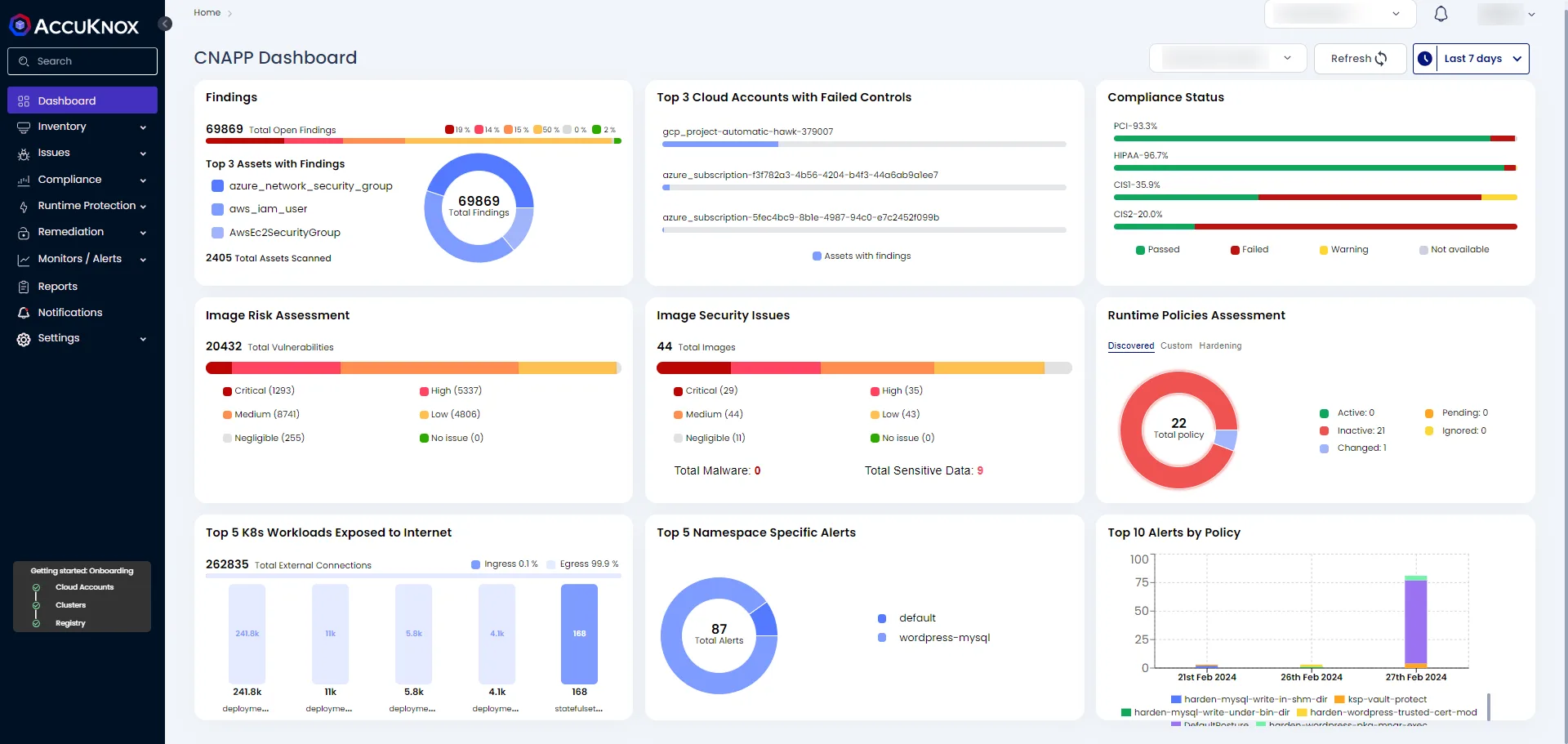 The AccuKnox console rolls findings, compliance scores, image risk, and runtime policy status into one dashboard.
What is AccuKnox?
Most ASPM tools ingest scanner output and deduce exploitability from static signals alone. AccuKnox instead runs its own runtime telemetry through KubeArmor, an eBPF and LSM-based engine that watches what workloads do in production.
That runtime view feeds the prioritization model. A vulnerable package can be marked as not reachable when the engine sees the affected code path is never invoked, which suppresses noise rather than re-sorting it.
Key features
AccuKnox positions itself as a 5-in-1 CNAPP. The AppSec slice that matters here, to me, is the ASPM layer plus the scanners that feed it.
| Layer | What it covers |
|---|---|
| ASPM (AppSec) | SAST, DAST, SCA, SBOM, container, secret, IaC, and CI/CD pipeline scanning |
| Runtime (CWPP) | KubeArmor eBPF/LSM enforcement, microsegmentation, admission control |
| Cloud (CSPM) | Misconfiguration and drift detection, cloud detection and response, compliance |
| AI (AI-SPM) | Prompt firewall, AI red teaming, agentic AI and MCP security |
| Reporting | xBOM (SBOM, QBOM, CBOM, AI-BOM), CERT-IN and RBI compliance packs |
The AppSec scanners are native to the platform, so a team can start without wiring in a third-party SAST or SCA engine first. The newer AI-Accelerated SAST and Model Context Protocol (MCP) security modules extend the same pipeline toward AI-generated and agentic code.
KubeArmor: the runtime engine
KubeArmor is the open-source project that gives AccuKnox its differentiating signal. It was the first Kubernetes security engine to use BPF-LSM, and it is a CNCF Sandbox project with 2M+ downloads and roughly 2,500 GitHub stars.
It runs as a non-privileged daemonset. It uses eBPF for in-kernel observability, plus Linux Security Modules — AppArmor, BPF-LSM, or SELinux — for inline enforcement.
| Capability | What it does |
|---|---|
| Runtime visibility | Maps process, network, and file activity per workload |
| Inline mitigation | Blocks disallowed syscalls, file access, or network egress at the kernel level |
| Threat correlation | Feeds runtime telemetry into the AccuKnox ASPM prioritization layer |
| Workload coverage | Hardens containers, VMs, and IoT/Edge and 5G workloads |
Because enforcement runs through existing LSMs, KubeArmor hardens pods and containers without changing the workload or making host-level adjustments.
AI security posture
The AI-SPM module is the newer half of the platform. It adds an AI guardrail and prompt firewall, AI red teaming, AI detect-and-respond, and dedicated coverage for agentic AI and Model Context Protocol servers.
For teams shipping LLM features, this puts AI posture management under the same console as the application scanners rather than in a separate tool.
Integrations
| Type | Examples |
|---|---|
| CI/CD | GitHub Actions, Jenkins, GitLab, Azure DevOps |
| Ticketing | Jira, ServiceNow |
| Comms | Slack |
| SIEM | Splunk |
The current connector catalogue is published at accuknox.com/integrations .
When to use AccuKnox
AccuKnox suits teams that run substantial Kubernetes workloads and want runtime context built into the ASPM correlation, not bolted on. It also fits teams already using KubeArmor as an open-source runtime control who want one vendor across static scanners and runtime enforcement.
AccuKnox ships as both SaaS and on-premises, and its CERT-IN and RBI compliance packs point at regulated and public-sector buyers. It was named the #1 AI Security Startup of 2025 at Security BSides Bangalore.
If runtime context is not a priority, DefectDojo (open source) and ArmorCode (enterprise commercial) cover ASPM aggregation without the runtime layer. For a CNAPP-led ASPM, Wiz extends from the cloud side.
Pricing requires a sales conversation.
How does AccuKnox fit into a pipeline?
AccuKnox can run native AppSec checks and ingest results from other products. Its ASPM page describes SAST, SCA, DAST, IaC, container, and pipeline security across development and production.
The integration catalog includes GitHub, GitLab, Jenkins, Azure DevOps, Jira, ServiceNow, Splunk, Snyk, SonarQube, Veracode, and Semgrep. It also connects registries and Kubernetes platforms.
I would stage adoption in four steps:
- Connect repositories and the CI system for pre-deployment findings.
- Add container registries and Kubernetes clusters for image and workload context.
- Validate code-to-runtime correlation on a small service set.
- Enable ticket routing or runtime enforcement only after ownership is correct.
This avoids mixing scanner setup, asset mapping, and runtime policy changes in one rollout. Each stage has a different failure mode and a different owner.
How is AccuKnox deployed?
AccuKnox offers cloud delivery and an on-premises platform . The on-premises option is aimed at organizations that need control over security data and infrastructure.
The platform separates application scanning from runtime controls. A team can evaluate scanner and cloud context before enabling KubeArmor enforcement on production workloads.
AccuKnox publishes product updates through its site and documentation rather than one numbered ASPM release train. Commercial packaging is quote-based on the pricing page .
What are AccuKnox’s limitations?
AccuKnox covers many AppSec, cloud, workload, and AI controls. That breadth increases setup work and makes a narrow secret-scanning or repository-only need a poor reason to adopt the full platform.
Runtime value depends on Kubernetes or host coverage. Services outside the connected estate cannot contribute the same eBPF and LSM context.
KubeArmor policy enforcement also needs careful testing. Kernel capabilities, Linux Security Module support, workload privileges, and existing controls vary across clusters and can affect rollout.
I would ask AccuKnox to demonstrate one finding from commit through deployment and runtime. The evaluation should prove correlation, ownership, and safe enforcement rather than count dashboard modules.
The same test should include a service without KubeArmor coverage. That contrast shows which prioritization decisions depend on runtime telemetry and which still come from static inputs.